
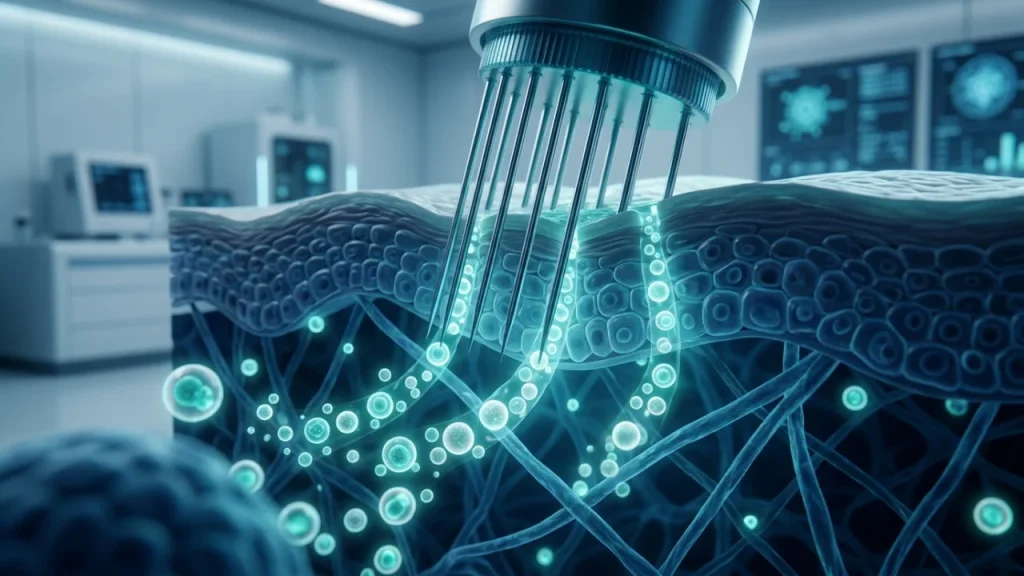
What Is Skin Pen with Exosomes and Why It Matters
Understanding the Basics of Microneedling with Exosomes
Microneedling works by creating controlled micro-injuries. A device with fine needles punctures the skin’s top layer. This is a precise and temporary process. These tiny channels are crucial. They bypass the skin’s main barrier, the stratum corneum. This barrier normally blocks large molecules.
The channels allow direct access to the dermis. The dermis is the deeper, living skin layer. This is where collagen and elastin are made. The micro-injuries also trigger a natural healing signal. Your body senses the need for repair. It sends growth factors and new cells to the area.
This is where exosomes add a powerful boost. Exosomes are natural signaling vesicles. They carry instructions between cells. Using a skin pen with exosomes combines two actions. The first is creating physical access channels. The second is delivering advanced biological messages.
The exosome formulation is applied topically after microneedling. It moves into the micro-channels. The exosomes reach the target cells in the dermis. They do not work as simple filler material. They communicate with your skin’s own repair systems.
Think of microneedling as opening a door to a construction site. The exosomes are the expert architects and foremen arriving with new blueprints. They guide your cells to repair skin more effectively. This guidance can improve the healing response’s quality and speed.
The process aims for smarter regeneration, not just trauma. Traditional collagen induction relies mostly on the injury itself. Adding exosomes provides specific instructions. These instructions can help reduce unwanted inflammation. They can also promote better tissue structure.
This combination matters for clear reasons. It uses the skin’s own biological language for healing. The method enhances results while potentially shortening recovery time. The next step is understanding what these exosome signals specifically tell your skin to do.
Why Exosomes Are a Game-Changer for Skin Repair
Exosomes carry precise instructions for skin regeneration. They are not random messengers. Each tiny vesicle contains a specific cargo. This cargo includes proteins, lipids, and nucleic acids like RNA. Think of them as a delivery truck with a custom load. The truck goes directly to a cell’s address. The cargo then tells that cell what to do.
This targeted signaling is the game-changer. Traditional treatments often rely on a general inflammatory response. The body gets a signal to heal, but the instructions are vague. Using a skin pen with exosomes changes this. It provides detailed, intelligent commands. These commands can direct many repair processes.
For example, exosomes can tell cells to: – Increase collagen and elastin production specifically. – Calm down overactive immune responses that cause redness. – Form new, healthy blood vessels for better skin nourishment. – Reduce the activity of enzymes that break down existing collagen.
This makes repair more efficient and directed. Your skin does not waste energy on unnecessary inflammation. It focuses on structured rebuilding. The result is not just more tissue, but better-quality tissue. The skin’s architecture improves.
The science shows exosomes work at a fundamental level. They influence gene expression in your skin cells. This means they can help “switch on” youth-promoting genes. They can also help “switch off” genes linked to degradation and aging. This level of control was not possible with older methods.
Why does this matter for you? It shifts the goal from simple wound healing to true cellular renewal. The combination matters because it pairs a proven physical technique with advanced biological communication. You get a smarter healing process. This can lead to more noticeable and longer-lasting results.
The next logical question is about safety and how these natural signals integrate with your body’s own systems without causing conflict.
How Skin Pen with Exosomes Differs from Traditional Treatments
Traditional microneedling creates controlled skin injuries. Your body reacts to these tiny wounds. It starts a general repair process. This process builds new collagen. However, it is a blunt tool. The instructions to your skin cells are simple: “Heal this damage.”
A skin pen with exosomes works differently. It is a precise biological tool. The microneedling channels are still created. But then they are used for delivery. They carry millions of exosomes into the skin’s deeper layers. These exosomes are not simple ingredients. They are complex messengers.
Think of the difference like this: – Traditional method: It is like knocking on a door to get someone’s attention. – New method: It is like delivering a detailed instruction manual after you knock.
The exosomes provide specific commands to your cells. These commands go beyond basic repair. They guide intelligent renewal. This leads to several key differences in results.
First, the recovery process is often smoother. Traditional treatments rely on inflammation to trigger healing. This can mean more redness and downtime. Exosome signals can calm inflammation while still promoting growth. Your skin may look better faster.
Second, the results can be more complete. Building collagen is one goal. But skin health needs more. Exosomes can also instruct cells to improve hydration, strengthen the skin barrier, and enhance elasticity. They address multiple aging factors at once.
Third, the effects may last longer. Traditional collagen induction has a limit. Once the wound heals, the signal fades. Exosomes can change cell behavior for a longer period. They influence how genes are read. This can lead to a sustained improvement in skin quality.
The core difference is in strategy. Old methods push the skin to react. The new combination gives the skin the information it needs to rebuild itself optimally. It uses the body’s own language for smarter outcomes.
This leads us to consider the practical experience and what someone can realistically expect from this advanced approach.
The Science Behind Exosomes and Cellular Communication
What Exosomes Are and Where They Come From
Exosomes are incredibly small messengers. Your body’s own cells create them. Almost every type of cell in your body can release these tiny packages.
Think of a cell as a busy factory. It makes products and also needs to communicate. The cell packages instructions into tiny bubbles. These bubbles are exosomes. They are released into the space around cells.
Their size is hard to grasp. One exosome is about 1000 times smaller than a single grain of salt. You need a powerful electron microscope to see one. Despite their size, they carry a powerful cargo.
This cargo is the key. Each exosome vesicle contains important molecules: – Signaling proteins that give cells commands. – Growth factors that tell cells to multiply or repair. – Different types of RNA, which are genetic instructions. – Lipids and other building blocks.
This mix is not random waste. It is a precise communication toolkit. A skin cell sends a different message than an immune cell. The contents change based on what the cell needs to say.
Where do therapeutic exosomes come from? For treatments like a skin pen with exosomes, they are harvested from other cells. These are often stem cells grown in labs. Stem cells are expert healers. Their exosomes carry potent regenerative signals.
Scientists collect these exosomes from the liquid surrounding cultured cells. They then purify them into a concentrated serum. This serum is what gets applied to the skin after microneedling.
The process uses the body’s natural language. It just delivers more of the right messages at the right time. This direct form of cell-to-cell signaling is why the combination is so effective. The skin pen with exosomes works because it delivers these intelligent packages directly into the areas that need them most.
Understanding this origin story explains their power. They are not a synthetic drug. They are natural biological couriers. Now we can explore exactly what these couriers tell your skin to do.
How Exosomes Deliver Messages Between Skin Cells
Think of a skin cell that needs help. It might be damaged by the sun. It could be inflamed from irritation. Nearby healthy cells sense this. They package instructions into exosomes and release them.
These tiny vesicles travel through the fluid between cells. They navigate to the target cell in need. The exosome does not enter the cell’s core. Instead, it docks on the surface. It fuses with the cell’s outer membrane.
This fusion delivers the cargo directly into the cell’s cytoplasm. It is like handing a sealed envelope to a manager inside an office. The cell opens the instructions and reads them. The proteins and RNA give clear commands.
The messages are direct and action-oriented. They tell the target cell what to do next. Common commands found in regenerative exosome cargo include:
- Initiate collagen production now.
- Form new elastin fibers here.
- Multiply to replace damaged neighbors.
- Reduce all inflammatory signals.
- Increase overall cellular energy.
This is why combining a skin pen with exosomes is so strategic. The microneedling device creates precise micro-channels. These are temporary pathways through the skin’s outer barrier. The exosome serum is applied topically right after.
The channels allow the exosome messengers to bypass surface layers. They go directly into the living dermis. There, they can find struggling fibroblasts and other cells. The exosomes deliver their repair commands on site.
Without this direct delivery, most exosomes cannot penetrate deeply. They would sit on the surface. The skin pen with exosomes ensures the messages reach the right address. The cells listen and act.
This process mirrors how your body heals a cut. It just amplifies and focuses the signal. The result is not forced or artificial. It is guided natural regeneration. Your skin cells get the help they need to fix themselves.
Next, we will look at the visible results this cellular conversation creates.
The Role of Exosomes in Natural Healing Processes
Your body has a built-in repair network. Exosomes are key messengers in this system. They are not foreign or synthetic. Your own cells make them every day.
Think about what happens when you get a small cut. The area becomes red and slightly swollen. This is inflammation. It is a necessary first step. Cells at the injury site release a flood of signals.
Exosomes are among these critical signals. Damaged skin cells and immune cells send them out. Their job is to coordinate the cleanup and repair crews. They carry instructions to neighboring healthy cells.
These instructions tell other cells what to do. The commands are very specific. One exosome might tell a blood vessel to rebuild itself. Another might direct a fibroblast to start making new collagen. A third could signal an inflammatory cell to stand down.
This process happens in clear phases. First comes the alert and inflammation phase. Next is the rebuilding phase. Finally, the remodeling phase fine-tunes the new tissue. Exosomes guide each step.
They ensure all cells work together toward healing. Without this communication, repair would be chaotic and slow. The body would waste resources. Exosomes provide efficiency and precision.
The natural healing process is powerful but limited. For a minor cut, it works perfectly. For deeper skin damage like wrinkles or scars, the signal may be too weak. Aged cells also send fewer, less effective exosomes.
This is where advanced treatments add support. A procedure using a skin pen with exosomes mimics and amplifies your body’s natural call for help. The microneedling creates a controlled, minor injury. This triggers your skin’s own repair response.
Adding concentrated exosomes supercharges this signal. It provides a stronger, clearer set of instructions. The treatment works with your biology, not against it. It gives your cells the extra guidance they need for major renewal.
The goal is to restore the communication quality of younger skin. This leads to more organized collagen and better healing outcomes. The science taps into a system that already exists within you.
Understanding this foundation is crucial. It shows why this approach is logical and safe. The next step is to see how this enhanced communication translates into visible skin changes over time.
How Microneedling Enhances Exosome Delivery
Creating Micro-Channels for Better Absorption
Your skin’s top layer is a powerful shield. This outer barrier, the stratum corneum, keeps germs out. It also keeps most skincare ingredients from going deep. Topical creams and serums mostly work on the surface. Their large molecules cannot pass through this tight wall. This is a key problem for advanced treatments.
Exosomes need to reach the living layers of skin. They must get to the dermis where collagen is made. A skin pen with exosomes solves this problem. The device uses fine, sterile needles. These needles create hundreds of microscopic channels in a controlled pattern. The channels are incredibly small. They are measured in microns. They are not open wounds.
These micro-channels are temporary pathways. They bypass the tough outer shield. The channels reach into the dermis where repair happens. This process is often called fractional delivery. It leaves most of the skin’s surface intact. Healing is very fast.
The created channels serve two main purposes. First, they trigger the body’s own repair cascade as discussed before. Second, they act as direct entry points. Applied exosome formulations can now flow down these tiny pathways. They reach a depth that is otherwise impossible with topical application alone.
Think of it like a garden. Watering hard-packed soil from the top leads to runoff. The water does not reach the roots. Aerating the soil first creates holes. Water can then seep deep into the ground where plants need it most. Microneedling aerates the skin.
The timing of application is critical. Exosomes are applied immediately after creating the micro-channels. This takes advantage of a brief window. The channels are still open. The skin’s repair signals are active. Absorption is at its peak.
This direct delivery offers clear advantages: – It places a high concentration of exosomes exactly where they are needed. – It avoids waste from product sitting on the surface. – It ensures cells in the dermis get a strong, immediate signal.
The result is efficient and targeted treatment. The exosomes are not fighting to get through a barrier. They are guided directly to their workspace. This synergy between physical channel creation and biological signaling is what makes the combination so effective. It transforms a simple delivery problem into a precise therapeutic strategy. Next, we will look at what happens after the exosomes arrive at this ideal depth.
Why Timing Matters in Exosome Application
The skin is not a passive surface. It is a living, reactive organ. When microneedling creates micro-channels, it starts a precise biological clock. This clock ticks fast. The treatment area enters a state of controlled wound healing. This state is temporary but powerful.
Applying exosomes immediately after microneedling is key. It works with this natural process. Think of the micro-channels as open doors. These doors do not stay open forever. The body quickly begins to close them to protect itself. This closure starts within minutes.
Two main processes create this short window. First, there is initial inflammation. This is a normal and helpful response. It increases blood flow to the area. Fluid and healing factors rush in. This fluid can start to seal the channels if exosomes are not already present.
Second, the skin starts to rebuild its barrier. Special cells move to repair the tiny openings. A protein called fibrin forms a temporary mesh. This mesh is the first step in closing each channel. It acts like a natural bandage.
Applying exosomes during this window has major benefits: – Exosomes enter before the fibrin mesh fully forms. – They mix with the body’s own fresh healing factors. – Cells are most receptive to signals at this active moment.
Delay reduces these advantages. Applying exosomes even thirty minutes later is less effective. Many channels will have started to close. The skin’s repair cascade will have moved to a different phase. The peak moment for communication is missed.
Using a skin pen with exosomes captures this perfect timing. The procedure combines two steps into one seamless event. The channels are fresh. The exosome formulation is applied directly into this ideal environment. It is a synchronized delivery.
This timing does more than just place exosomes deep in the skin. It allows them to join an active cellular conversation. The exosomes deliver their instructions exactly when skin cells are listening most closely. They guide the repair process from its very beginning.
The result is a stronger, more directed outcome. The body’s natural healing is amplified with precise external instructions. This turns a brief physical opening into a lasting biological opportunity. Next, we will explore what these exosome instructions tell your skin cells to do.
The Synergy Between Needling and Exosome Signals
Microneedling does more than make tiny openings. It sends a deliberate signal to your skin. The skin interprets these micro-channels as minor wounds. This triggers an immediate repair response. Think of it as a controlled alert system.
Your cells release a flood of natural chemicals. These are growth factors and cytokines. They are your body’s own instructions for healing. This process starts within minutes. It prepares the area for reconstruction.
This is where exosomes add a powerful new layer. They do not work alone. They join this existing cellular conversation. Exosomes carry their own sophisticated set of instructions. Their signals mix with your skin’s natural repair signals.
The combination creates a synergy. Your skin’s initial signal says, “Repair this area now.” The exosome signals add, “And do it this way, for better strength and texture.” One process amplifies the other.
Using a skin pen with exosomes leverages this biology perfectly. The device creates the optimal signal to start healing. The exosome formulation then delivers advanced guidance for that healing. It is a two-part communication strategy.
The synergy leads to several clear benefits: – The healing process becomes more efficient. Resources are directed with greater precision. – Collagen production may be more organized and robust. This improves skin density. – The overall inflammatory phase can be shorter and more productive. This supports better recovery.
Without exosomes, the skin follows its standard repair protocol. With exosomes, the protocol receives an upgrade. The instructions are enhanced. The outcome is not just faster healing, but smarter healing.
This partnership between needling and biological signals is key. The physical action of the pen sets the stage. The biological intelligence of the exosomes directs the performance. Together, they aim for a result that is greater than the sum of its parts.
The next logical question is about the nature of these exosome instructions. What specific messages do they carry to change the skin’s behavior so effectively?
Key Benefits of Using Skin Pen with Exosomes
Improving Skin Texture and Smoothness
One of the most noticeable results from a skin pen with exosomes treatment is a smoother skin surface. The skin feels softer to the touch. It looks more refined. This change happens because the treatment targets texture at a cellular level.
Microneedling alone creates micro-channels. This prompts skin renewal. But adding exosomes changes the quality of this renewal. Exosomes carry direct orders for skin cells. These orders tell older, tired cells to make way for new ones. They also instruct cells to produce better building materials.
Think of your skin’s top layer, the epidermis. Over time, it can become rough and uneven. Dead cells may build up. The treatment addresses this precisely. The exosome signals encourage faster turnover of epidermal cells. New, healthy cells rise to the surface more efficiently. This process reduces the look of roughness.
The deeper dermis layer is also crucial for smoothness. Here, exosomes guide fibroblasts, which are collagen-making cells. The signals promote the creation of organized, high-quality collagen networks. This is different from just making more collagen. It is about making better collagen.
Better collagen provides a firmer, more even foundation. Imagine a mattress. A lumpy, sagging mattress makes the sheet on top look wrinkled. A new, supportive mattress makes that sheet lie flat and smooth. Improved dermal structure similarly supports the surface skin.
Key actions driven by exosome messages include: – Accelerating the shedding of dull, dead skin cells. – Promoting the generation of fresh, plump skin cells. – Directing the synthesis of supportive elastin and organized collagen fibers. – Calming uneven pigment production that can contribute to a rough appearance.
The outcome is not a superficial polish. It is a fundamental improvement in skin architecture. The texture improves because the underlying processes have been optimized. The skin’s repair work is now guided by advanced biological intelligence.
This leads to a visible reduction in fine lines and small scars. These imperfections often contribute to an uneven texture. As new tissue forms in a more orderly way, these surface flaws become less distinct. The skin’s landscape becomes more uniform.
Ultimately, smoother texture is a sign of healthier skin function. The combination resets cellular behavior towards renewal and precision building. The next logical benefit explores how this renewed activity strengthens the skin’s defense and resilience over time.
Reducing Fine Lines and Wrinkles
Fine lines and wrinkles often form because the skin’s support system weakens. This system relies on collagen and elastin. Think of them as a mattress’s springs and padding. Over time, these proteins break down. They are not replaced quickly enough. The skin above loses its plump foundation. It begins to fold and crease.
Using a skin pen with exosomes addresses this core issue. The microneedling process creates precise micro-channels. These channels act as direct pathways into the dermis. They allow exosome formulations to bypass the skin’s tough outer barrier. The exosomes deliver their messages to living skin cells.
These messages are instructions for rebuilding. They tell fibroblast cells to become more active. Fibroblasts are the skin’s construction crews. The key directives they receive include: – Increase production of new Type I collagen. This is the main structural protein. – Synthesize fresh elastin fibers for snap-back resilience. – Reduce the activity of enzymes that break down existing collagen.
The result is a net gain in supportive tissue. New collagen and elastin accumulate in the dermal layer. This adds volume beneath the surface. Imagine a deflated balloon. Adding air plumps it out and smooths its wrinkles. Similarly, adding structural proteins plumps the skin from below.
This method smooths lines by filling them from the base up. It is different from topical creams that only hydrate the very top layer. It is also different from methods that cause general inflammation hoping for repair. The approach is targeted and intelligent. The exosomes guide a natural, productive healing response.
The effect on wrinkles is progressive and natural-looking. Deeper folds may become less severe. Fine lines can become less visible. The skin does not look stretched or fake. Instead, it appears fuller and more supported. This restoration of foundational volume is a primary reason for combining these technologies.
This internal reinforcement does more than smooth existing lines. It also helps prevent new ones from forming easily. Stronger skin resists creasing from repeated facial movements. The next benefit explores how this newfound strength translates to better protection against daily environmental damage.
Healing Scars and Pigmentation Issues
Scars and dark spots are signs of skin that healed poorly. A skin pen with exosomes tackles both issues directly. It does this by guiding cells to repair the area correctly. This is different from just wounding the skin and hoping for the best.
First, consider raised or pitted scars. These form when the body makes too much or too little collagen during healing. The process is disorganized. Microneedling creates controlled micro-channels. This signals the need for new repair. Adding exosomes changes everything. They deliver precise instructions to the local cells.
The exosomes tell fibroblast cells to produce new, healthy collagen. They also instruct them to arrange it in a neat, organized pattern. This helps flatten raised scars. For pitted scars, it helps fill the depression with new supportive tissue. The goal is to blend the scar texture with the surrounding skin.
Hyperpigmentation, or dark spots, is a different challenge. It happens when melanin-producing cells become overactive. Sun damage or inflammation can trigger this. The exosomes help normalize this activity. They carry messages that calm the overactive cells.
This reduces the overproduction of pigment. Existing dark spots can gradually fade. New ones are less likely to form from future irritation. The result is a more even and uniform skin tone.
The process for both benefits follows a clear path: – The microneedling device creates an entry point and a repair signal. – Exosomes enter through these micro-channels. – They deliver specific instructions to target cells. – For scars, the instruction is “rebuild with organized collagen.” – For pigmentation, the instruction is “normalize melanin production.”
This targeted approach leads to smarter healing. It does not just cause general inflammation. It provides the skin with a detailed blueprint for repair. The improvements happen gradually over weeks and months. This allows the changes to look natural, not sudden or artificial.
Correcting scars and pigmentation strengthens the skin’s barrier function. Healthier, more even skin is better protected. This leads us to the next key benefit: enhanced resilience against daily environmental stress.
Boosting Skin Firmness and Elasticity
Loose skin often lacks strong support underneath. This support comes from proteins called collagen and elastin. Think of them as the skin’s scaffolding and springs. Collagen provides firm structure. Elastin allows skin to snap back after stretching. Over time, our bodies make less of these proteins. Sun exposure and aging break them down faster. The skin’s framework weakens. This leads to sagging and wrinkles.
Using a skin pen with exosomes tackles this problem directly. The microneedling device does two key things. First, it creates controlled micro-injuries in the skin. This triggers the body’s natural wound healing process. That process calls for new collagen. Second, it opens temporary channels. These channels allow exosomes to reach deeper skin layers.
The exosomes carry precise instructions to the cells there, called fibroblasts. Fibroblasts are the skin’s builders. They make collagen and elastin. The exosomes tell these builder cells to become more active. They encourage them to produce new, high-quality structural proteins. This is not just more of the old, damaged material. It is fresh, organized support.
The process focuses on building a better network. The new collagen fibers are laid down in a healthy, crisscross pattern. This strengthens the skin’s foundation from within. Improved elastin production restores some bounce. The combined effect is a gradual tightening and lifting of the skin’s surface.
You can think of the treatment in three clear stages: – The device signals the need for repair and opens delivery pathways. – Exosomes enter and target the fibroblast cells. – These cells then ramp up production of new collagen and elastin.
Results are not instant like a pull-tight sheet mask. The skin needs time to build these new proteins. Improvements in firmness and elasticity develop over weeks. Most people see the best results after a month or two. The skin continues to improve as the new support structure matures.
This internal reinforcement has a visible effect. Skin may look tighter and more lifted. Fine lines caused by laxity often soften. The skin feels more resilient to the touch. This restored foundation is crucial for long-term skin health. It sets the stage for a radiant, healthy complexion that comes from within.
Who Is the Ideal Candidate for This Treatment
Skin Types and Conditions That Respond Best
The ideal candidate has skin that needs to rebuild its foundation. This treatment is not for every concern. It works best for issues rooted in a lack of collagen or poor cellular communication. The synergy of a skin pen with exosomes specifically targets these problems.
People with early to moderate signs of aging often see excellent results. This includes fine lines and wrinkles. It also includes mild skin laxity or loosening. The treatment encourages the skin to produce new structural proteins. This can restore firmness and smoothness.
The approach is also effective for certain types of scarring. Atrophic scars sit below the skin’s surface. These include acne scars or some surgical scars. The microneedling creates controlled channels in the scar tissue. Exosomes then guide the repair process toward more normal, healthy collagen formation. The goal is to fill and soften the scar’s appearance.
Dull, tired-looking skin with poor texture can also improve. This is often due to a slow cell turnover rate. The process signals cells to renew themselves more effectively. It promotes a healthier, more radiant complexion from within.
Some skin conditions are not a good match. This treatment is generally not for active inflammatory acne. It is also not for active skin infections or rashes. People with certain medical conditions should avoid it. This includes uncontrolled diabetes or a history of poor wound healing. A qualified provider must review your full health history.
The best outcomes come from realistic expectations. This is a regenerative treatment, not a quick fix. It improves skin quality and structure over time. Ideal candidates understand this gradual process. They seek long-term improvement, not instant dramatic change.
Consider your primary skin concern. Does it involve thinning skin, scars, or dullness? If so, this combined method could be a powerful solution. A consultation with a skilled professional is the final, essential step for confirmation. They can assess your unique skin and goals directly.
Factors That Might Make You a Poor Candidate
Certain medications can interfere with the skin’s healing process. Blood thinners are a primary example. These include common prescriptions like warfarin. They also include over-the-counter drugs like aspirin. These medications increase the risk of bruising and bleeding during the microneedling procedure. Your provider needs a complete list of all your medicines.
A history of allergic reactions is a critical factor. This is especially true for reactions to topical numbing creams. These creams are often used before the procedure. A severe allergy could trigger a dangerous response. Some people may also be allergic to components in the exosome serum itself. A patch test can sometimes help check for this.
Active skin inflammation is a clear barrier. This means more than just occasional pimples. Conditions like active rosacea, eczema, or psoriasis flares create an unstable skin environment. The micro-injuries from the device can worsen this inflammation. The treatment should only be on calm, non-inflamed skin.
Anyone with a history of keloid scarring should proceed with extreme caution. Keloids are raised, overgrown scars. The controlled injury from microneedling could potentially trigger a new keloid. This risk must be discussed in detail with a dermatologist. It may rule out the treatment entirely.
Recent cosmetic procedures create a timing issue. You should not have this done if you’ve had recent laser treatments or chemical peels. Your skin needs time to recover fully first. Similarly, recent sunburn or significant tanning damages the skin barrier. The treatment would be too stressful for compromised skin.
Certain autoimmune diseases require careful evaluation. Conditions like lupus or rheumatoid arthritis affect how the body heals. The immune system’s altered state may not respond predictably to the signals from exosomes. A doctor must approve the treatment in these cases.
Pregnancy and breastfeeding are typical exclusion periods. The effects of concentrated growth factors and exosomes on fetal development are not fully studied. Most ethical providers will postpone treatment until after this stage is complete. Safety for both mother and child is the priority.
The goal is to ensure your safety and the treatment’s success. Disclosing your full health history is not optional. It is the most responsible step you can take. An honest consultation protects you and allows your provider to make the best call for your skin health. This careful screening makes the procedure safer for everyone involved.
Setting Realistic Expectations for Results
A single treatment session is a powerful start, but it is rarely a complete solution. Think of combining a Skin Pen with exosomes as a process, not a one-time event. Your skin needs time to respond and rebuild. Most people require a series of sessions for optimal results. A common plan includes three to six treatments. These are spaced about four to six weeks apart. This schedule aligns with your skin’s natural renewal cycle.
Why does it take multiple sessions? The microneedling creates precise micro-channels. This allows the exosome formulation to reach deeper layers. The exosomes then deliver their regenerative signals to your skin cells. These signals instruct cells to boost collagen and elastin production. However, building new, strong structural proteins takes weeks. Each session builds upon the progress of the last. It is a cumulative effect.
Your individual results will vary. Several key factors influence your outcome. Your age plays a role. Younger skin may respond more quickly. The specific concerns you want to address matter too. Fine lines often show improvement faster than deep wrinkles. Your skin’s baseline condition is important. Sun-damaged skin has more repair work to do. Your overall health and lifestyle habits also affect healing. Good nutrition and sun protection support the process.
You should notice some changes after your first session. Early results often include better hydration and a brighter complexion. Texture typically improves first. You might see smoother skin surface. The more significant lifting and firming comes later. This is from the new collagen. It usually becomes noticeable around three months after your series is complete. The results are not permanent, but they are long-lasting. Maintenance treatments are often recommended. A session every six to twelve months can help sustain the benefits.
Setting realistic expectations is crucial for satisfaction. This advanced approach requires an investment of time. It is not an instant fix. The synergy of the Skin Pen with exosomes works with your biology, not against it. True cellular renewal follows a natural timeline. Patience leads to more natural and enduring outcomes. Your provider will design a personalized plan based on your unique goals and skin’s response.
Step-by-Step Treatment Protocol Overview
Pre-Treatment Preparation and Skin Assessment
Proper preparation begins days before your appointment. Clean, calm skin is the ideal starting point. Your provider will give you specific instructions. Follow them closely for the best outcome.
Stop using certain skincare products one week prior. This step is non-negotiable for safety. Avoid any retinoids or strong acids. These include retinol, glycolic acid, and salicylic acid. They can make your skin too sensitive. Discontinue any topical prescription medications as directed. Do not use abrasive scrubs or brushes. Your goal is to reduce irritation risk.
Discuss your full medical history with your provider. Be honest about all conditions and medications. This is a key part of your skin assessment. Tell them if you have a history of cold sores. Preventive medication may be needed. List all supplements you take. Some, like high-dose vitamin E or ginseng, can increase bleeding. Your provider needs a complete picture.
Avoid sun exposure and tanning for two weeks before treatment. Sunburned skin cannot be treated. A recent tan can increase side effect risks. Use a broad-spectrum sunscreen daily. This protects your skin’s baseline.
On the day of your treatment, arrive with a clean face. Do not apply makeup, moisturizer, or sunscreen. Wash your face with a gentle cleanser at home. Men should shave the treatment area the day before. This prevents fresh micro-cuts.
The clinical skin assessment happens right before the procedure. Your provider will examine your skin closely. They check for active breakouts, rashes, or irritation. They confirm the treatment plan areas. They will clean your skin again with a medical-grade antiseptic. This removes any final surface oils and bacteria.
This careful protocol minimizes complications. It sets the stage for optimal healing. It allows the skin pen with exosomes to work effectively on a receptive canvas. Well-prepared skin recovers faster and responds better. This preparation is your first active role in the process. Next, we will walk through the treatment experience itself.
The Microneedling Procedure Explained
The procedure begins with a topical numbing cream. Your provider applies it to your clean skin. You wait for about 20 to 30 minutes. This allows the cream to work fully. Your skin will feel very numb. This ensures your comfort during the treatment.
Next, the provider removes the numbing cream. They cleanse the skin once more. The sterile skin pen device is prepared. It is a handheld pen with tiny needles at its tip. The needles move in a precise vertical stamping motion. They do not drag across your skin.
The provider selects the correct needle depth. Depth is measured in millimeters. It is chosen based on your skin concern and treatment area. – A shallow depth (around 0.25 mm) targets the very top layers. This is for delicate areas or mild rejuvenation. – A medium depth (0.5 to 1.0 mm) is common for most facial areas. It reaches the dermis where collagen lives. – A deeper setting (over 1.5 mm) may be used for scars on thicker skin. Your provider decides this based on their assessment.
The device glides across your skin systematically. You will hear a faint buzzing sound. You may feel a vibration or mild pressure. You should not feel sharp pain due to the numbing cream. The needles create microscopic channels in your skin. These are not open wounds. They are temporary pathways.
These micro-channels serve two immediate purposes. First, they trigger a controlled wound healing response. Your body sends repair signals to the area. Second, they create direct access into your skin. This is crucial for the next step.
After the microneedling pass is complete, the exosome formulation is applied. The provider gently smooths the liquid onto your treated skin. The micro-channels act like tiny delivery routes. They help the exosomes bypass the tough outer barrier of your skin. The exosomes can then reach the living cells in the dermis more effectively.
The entire active treatment time is often under 30 minutes for the face. The combination of precise mechanical needling and advanced biological actives defines this modern approach. Using a skin pen with exosomes leverages both physical and cellular signaling methods. This synergy aims to optimize your skin’s natural repair process from within.
Your skin will look pink and feel warm after the procedure. This is a normal and expected response. It shows your skin’s repair mechanisms are already activating. The immediate post-treatment care phase is critical for locking in these benefits and guiding recovery.
Applying Exosomes During and After Treatment
The exosome formulation is applied in two distinct phases for maximum effect. The first application happens immediately after microneedling. Your skin is still receptive from the procedure. The provider applies a generous layer of the liquid solution. They use gentle, patting motions. This initial layer is the primary delivery phase.
The microscopic channels are most open at this moment. Think of them as temporary highways into your skin. The exosomes travel down these pathways easily. They reach the deeper dermal layer where your fibroblasts live. Fibroblasts are your skin’s collagen-producing cells. The exosomes deliver their signals directly to these target cells.
This direct delivery is a key advantage of using a skin pen with exosomes. The signals instruct your cells to accelerate repair. They also guide the rebuilding process. The goal is smarter healing, not just more healing.
A second, lighter application often follows a few minutes later. This acts as a nourishing top coat. It serves several purposes: – It keeps the treatment area hydrated. – It provides a continued source of signaling molecules. – It supports the skin’s barrier as the micro-channels begin to close.
The channels start to reseal within a few hours. Your skin is very absorbent during this window. You will be given specific aftercare instructions. Following them is essential. You must use only the provided serums or creams for the first 24 to 48 hours. These products are designed to work with the exosomes.
Do not use harsh cleansers or active ingredients like retinols or acids. They could irritate your skin. They could also block the beneficial signals. Your skin needs a calm environment to process the new instructions.
The applied exosomes do not stay in your skin forever. They complete their messaging task within a short period. Their power lies in changing your cells’ behavior. The cells then maintain this new activity for weeks or even months. This leads to progressive improvements in skin texture, tone, and firmness.
Proper application locks in the treatment’s potential. It sets the stage for optimal long-term results from this combined approach. The next phase focuses on what you can expect as your skin begins its renewal journey.
What to Expect During Recovery and Aftercare
Immediate Post-Treatment Skin Reactions
Your skin will react immediately after a treatment combining a Skin Pen with exosomes. This is normal and expected. It is a sign that the repair process has started. The most common reaction is redness. Your skin may look like you have a mild sunburn. This redness comes from increased blood flow to the treatment area. Your body is sending nutrients and immune cells to start healing the micro-channels.
Mild swelling or puffiness often occurs too. This is called edema. It is your skin’s natural response to the controlled micro-injuries. The swelling is usually most noticeable around delicate areas. Think of the eyes or cheeks. Both redness and swelling typically peak within the first 24 hours. They should lessen significantly after two to three days.
You might also feel a sensation of warmth or tightness. Your skin can feel sensitive to the touch. This sensitivity is temporary. The tiny channels created by the device are still open. This makes your skin more reactive. These sensations usually fade as the channels close. That closure happens within the first several hours post-treatment.
Some people see tiny pinpoint scabs or dryness. Do not be alarmed. These are not true wounds. They are simply dried serum or lymph fluid at the channel sites. They will flake away naturally in a couple of days. It is crucial not to pick or scratch at them. Picking can cause irritation. It could also lead to scarring or infection.
Your skin’s response shows the treatment is working. The micro-channels allow for deep absorption. The exosomes are now communicating with your cells. This communication directs the healing cascade. The initial redness and swelling are part of this biological process. They are not signs of a bad reaction.
Care in the first 72 hours manages these side effects well. Use a gentle, non-foaming cleanser if you must wash your face. Pat your skin dry with a clean towel. Do not rub it. Continue using the recommended moisturizer or serum from your provider. It will soothe your skin. It also supports continued exosome activity.
Avoid heat and intense exercise for 24 to 48 hours. Heat from showers, saunas, or exercise can increase redness. It can also worsen swelling. Sleep on your back if possible for the first night or two. This helps minimize pressure on the treated skin.
The immediate reactions are short-lived. They mark the beginning of your skin’s renewal phase. Your complexion will calm down visibly within a week. The real regenerative work happens beneath the surface after this initial period.
Essential Aftercare Tips for Best Results
Proper aftercare extends far beyond the first few days. Your skin’s healing process continues for several weeks. The right habits protect your investment. They also maximize the regenerative benefits of your skin pen with exosomes treatment.
Sun protection is your most critical daily task. Your new skin is highly vulnerable to ultraviolet rays. UV exposure can cause hyperpigmentation. It can also degrade collagen and undo progress. Use a broad-spectrum mineral sunscreen every single day. Choose a formula with zinc oxide or titanium dioxide. These ingredients are gentle on healing skin. Reapply sunscreen every two hours if you are outdoors.
Keep your skincare routine simple and gentle for at least two weeks. Avoid any products with harsh ingredients. Do not use retinols, alpha-hydroxy acids, or strong vitamin C serums during this time. These can irritate your skin. They can disrupt the delicate communication from the exosomes. Stick to the hydrating serums and moisturizers recommended by your provider.
Cleansing should be a soft, careful process. Use lukewarm water, never hot. Gently pat your face dry with a clean towel. Do not use scrubs, brushes, or washcloths. These can cause micro-tears. Your skin barrier is still rebuilding itself.
Hydration supports healing from the inside out. Drink plenty of water throughout your recovery. This helps your body flush toxins. It also keeps your new skin cells plump and healthy.
Makeup can be reintroduced slowly. Wait at least 48 to 72 hours after your treatment. Use clean brushes and sponges when you apply it. Choose non-comedogenic products that will not clog your pores. Remove makeup very gently each night.
Your skin may feel dry or flaky around days three to five. This is normal. It is a sign of surface cell turnover. Do not pick or peel the flaking skin. Apply a rich, fragrance-free moisturizer instead. This will soothe the dryness.
Schedule any follow-up treatments as advised by your professional. A series of sessions often yields the best outcome. Each session builds upon the last. The cumulative effect enhances collagen remodeling and skin quality.
Consistent aftercare ensures that the microscopic channels close properly. It allows the exosome signaling to complete its work without interference. The goal is to create an ideal environment for your skin to rebuild itself. This careful attention in the weeks following your procedure is what locks in lasting results for a smoother, brighter complexion.
Timeline for Seeing Visible Improvements
Your skin’s transformation after a procedure is a gradual process. It happens in distinct phases. Understanding this timeline helps set realistic expectations. The journey from initial healing to full results takes weeks.
The first changes are often subtle. You may notice them within the first week. Initial redness typically fades within 24 to 72 hours. Any pinpoint bleeding stops quickly. Your skin may feel smoother by day five or seven. This early change is from surface hydration and cell turnover. It is not the final result.
The true regenerative work happens beneath the surface. Your fibroblasts are now highly active. These cells produce new collagen and elastin. This rebuilding is not instantly visible. You are laying a new foundation for your skin.
Most people see a more noticeable difference around the four-week mark. Skin tone often appears more even. Fine lines may start to soften. This improvement comes from that early collagen remodeling. The effects of combining a skin pen with exosomes can enhance this phase. Exosomes provide sustained signaling to guide repair.
The most significant results become clear after several months. Collagen production continues for up to six months or longer. You will likely see improved skin firmness and elasticity. Pore appearance can refine. Overall texture becomes smoother.
Consider this general timeline for visible improvements: – Week 1: Initial healing, redness subsides, skin may feel softer. – Weeks 2-4: Subtle brightening, early texture changes. – Month 2-3: More evident improvement in tone and fine lines. – Months 4-6: Optimal results for firmness, elasticity, and texture.
Your body needs time to complete its natural renewal cycle. Multiple sessions create a cumulative effect. Each treatment builds upon the last. Patience is key. The final outcome is a refreshed complexion that develops steadily over time. This gradual change ensures natural-looking, lasting results.
Common Questions About Skin Pen with Exosomes
How Many Sessions Are Typically Needed
Most people need a series of treatments for the best results. A single session of a skin pen with exosomes is a powerful start. But skin regeneration is a process. Think of it like building muscle. You would not expect one gym visit to transform your body. Your skin needs repeated, guided stimulation.
A typical plan includes three to six sessions. These are usually spaced about one month apart. This spacing is important. It allows your skin to complete its initial healing and rebuilding phase. Then the next treatment can begin. Each session builds on the progress of the last. This creates a strong cumulative effect.
Why not just do one treatment? The answer lies in the biology of collagen. Microneedling creates controlled micro-injuries. This triggers your body’s natural repair cycle. Fibroblasts get to work making new collagen. Exosomes deliver sustained signals to guide this repair. But this collagen production happens in waves over many months.
A single treatment starts this process. Multiple sessions keep it going strong. They provide repeated stimulation to your fibroblasts. This leads to a greater total amount of new collagen and elastin. The goal is to achieve a dense, robust network of support fibers in your skin.
Your specific number of sessions depends on several factors: – Your primary skin concerns and their severity. – Your age and your skin’s natural collagen levels. – Your individual biological response to the treatment. – Your long-term skincare goals.
For example, someone focusing on early fine lines may see great results with three sessions. Another person addressing deeper wrinkles or texture issues might benefit from five or six. A trained professional will assess your skin. They will recommend a plan tailored just for you.
Maintenance is also part of the conversation. After your initial series, you may not need more treatments for a while. Many people choose to have one maintenance session every six to twelve months. This helps sustain the new collagen foundation you have built.
The combination of a skin pen with exosomes is designed for lasting change. The series approach works with your body’s own timeline. It ensures the regenerative signals are reinforced consistently. This method leads to optimal improvements in firmness, texture, and overall skin health. Planning for multiple sessions is an investment in achieving complete and durable results.
Is the Treatment Painful or Uncomfortable
A common question about any procedure is how it feels. The experience of a skin pen with exosomes is designed for patient comfort. Discomfort is typically minimal and well-managed. A topical numbing cream is applied to your skin before the treatment begins. This cream sits on the skin for about 20 to 30 minutes. It works to dull the nerve endings in the treatment area.
Once the cream is removed, the treatment can start. Most people describe the sensation as a light prickling or tingling. It feels like a quick, vibrating scratch. The device moves rapidly across the skin. You will hear a faint buzzing sound during this process. The feeling is not sharp or deeply painful for the vast majority of individuals. Some areas of the face are more sensitive than others. The forehead and cheeks often feel very little. Areas with thinner skin, like near the mouth, might feel a bit more noticeable.
The entire procedure is usually quick. A full facial treatment often takes less than 30 minutes. Any mild discomfort subsides almost immediately after the device is turned off. Your skin will feel warm and look flushed afterward. This is a normal and expected reaction. It simply shows increased blood flow to the area.
Your comfort is a priority for your provider. Communication is key during the session. You should tell your provider if you feel any significant pain. They can adjust their technique or apply more numbing cream. The goal is a tolerable experience that allows you to receive the full benefits.
After the treatment, the initial warmth and redness fade. There is no lingering pain. You might feel a slight tightness or sensitivity, similar to a mild sunburn. This usually resolves within a few hours. The use of effective numbing makes the process very manageable. This allows you to focus on the results, not the momentary sensation. Understanding this can help you approach your appointment with confidence and ease.
How Long Do the Results Last
The results from a skin pen with exosomes treatment are not temporary. You can expect visible improvements to last for several months. This longevity comes from how the two technologies work together.
The microneedling creates controlled micro-channels. This triggers your skin’s natural repair process. Your body sends resources to heal these tiny pathways. This process builds new collagen over time. Collagen is the main structural protein in your skin. It provides firmness and smoothness.
Exosomes supercharge this natural cycle. They are not live cells. They are tiny messengers. These messengers deliver precise instructions to your skin cells. The instructions tell your cells to repair themselves. They also tell cells to regenerate more effectively.
Think of microneedling as creating a construction site. The exosomes are the expert foremen and blueprints. They guide the workers to build better and smarter. This leads to higher-quality tissue regeneration.
The initial healing phase is quick. Redness fades within a few days. The real magic happens beneath the surface. New collagen formation takes time. You will likely see the best results one to three months after your session. Your skin continues to improve during this period.
How long do these results last? Most people enjoy their peak results for four to six months. The new collagen you built remains in place. Your skin’s quality is fundamentally improved. However, your skin does not stop aging after one treatment. Natural aging processes continue. Environmental factors like sun exposure also affect your skin.
This is why maintenance sessions are recommended. A follow-up treatment every six to twelve months can help sustain the results. A maintenance session reminds your skin cells to stay active. It provides fresh exosome instructions for ongoing repair.
Several factors influence how long your personal results last. – Your age and genetic skin characteristics. – Your overall skin care routine at home. – Your sun protection habits. – Your general health and lifestyle choices.
Protecting your skin from the sun is crucial. Daily sunscreen use preserves your results. It prevents new damage that can undo your progress. A good moisturizer and antioxidant serum also help.
The goal is cumulative improvement. Each session builds upon the last. You invest in long-term skin health, not just a quick fix. The combination offers a powerful way to maintain a rejuvenated appearance over time. This approach supports your skin’s own biology for lasting change.
Safety Considerations and Potential Risks
Minimizing Infection and Irritation Risks
Any procedure that creates micro-channels in the skin requires careful protocol. The primary goal is to prevent bacteria from entering these tiny openings. A sterile environment and proper technique are non-negotiable. This is the foundation of safety.
Your provider must use a single-use, sterile needle cartridge. This cartridge should be opened from its sealed package in front of you. The device itself must be thoroughly disinfected between clients. These steps eliminate cross-contamination risks. They protect you from exposure to pathogens.
Your skin must be perfectly cleansed before treatment begins. A medical-grade antiseptic solution is applied. This removes surface oil, dirt, and microbes. It prepares the skin for a safe procedure. Do not skip this step.
Aftercare is equally important for minimizing irritation and infection. You have an active role in this phase. Your skin is more vulnerable immediately after treatment. It needs a specific routine to heal well.
Follow these guidelines for the first 72 hours: – Use only the gentle, recommended cleanser and moisturizer. – Do not apply active ingredients like retinols or acids. – Avoid strenuous exercise and excessive sweating. – Keep the treated area completely out of direct sunlight. – Do not scratch or pick at your skin.
A key instruction is to avoid tap water on the face for at least 24 hours. Tap water can contain impurities and hard minerals. These substances can irritate the fresh micro-channels. Stick to the provided post-procedure mist or spray instead.
Using a skin pen with exosomes introduces powerful biological signals. The skin’s response is intentional inflammation. This is part of the healing process. However, proper care prevents this from becoming excessive or problematic. Signs of normal healing include mild redness and slight swelling. These should fade within a day or two.
Signs of a potential problem are different. Watch for increasing redness, pain, warmth, or yellow discharge. These could indicate an infection. Contact your provider immediately if you see these signs. Do not wait.
The combination of a sterile procedure and disciplined aftercare creates an optimal healing window. It allows the exosomes to work without interference from external stressors. This careful management directly supports the results you want. It turns potential risks into controlled, predictable steps toward skin renewal. Your vigilance protects your investment and your skin’s health.
Understanding Rare Side Effects
Most procedures are safe when done correctly. However, understanding rare side effects helps you make informed choices. One uncommon issue is post-inflammatory hyperpigmentation. This is when the skin makes too much pigment after an injury. It appears as dark spots or patches. This is more common in people with darker skin tones. The micro-injuries from the device can sometimes trigger this overproduction.
Another rare effect is hypopigmentation. This is the loss of skin color. It results in light spots. This occurs if the treatment affects the melanin-producing cells too deeply. It is less common than hyperpigmentation but can be more lasting.
Excessive or incorrect needle depth can cause scarring. This is very rare with proper technique. Scarring happens when the skin makes too much tough collagen during healing. It forms a raised or pitted texture.
How can you minimize these risks? Your provider’s skill is the most important factor. A trained professional will choose the correct needle depth for your skin. They will adjust settings based on your skin type and concerns. Proper technique avoids over-treating the same area.
Your skin’s condition before treatment also matters. You should avoid sun exposure for several weeks before your appointment. Tanned or sunburned skin has a much higher risk of pigmentation problems. Tell your provider about any history of keloid scars or cold sores. These conditions need special management.
Using a skin pen with exosomes aims for a controlled healing response. The goal is to guide the skin’s repair process precisely. Avoiding these side effects depends on control. The provider controls the technique. You control the pre-care and aftercare.
What if you notice a dark spot forming after healing? Do not panic. Contact your provider quickly. They may recommend specific topical products. These can help fade the excess pigment over time. Early intervention is key for managing this issue effectively.
Understanding these possibilities is part of a responsible approach to advanced skincare. It ensures your expectations are realistic and your safety is prioritized. This knowledge empowers you to choose a qualified provider and follow their guidance closely for the best outcome.
Why Professional Supervision Is Crucial
A professional uses sterile, single-use needle cartridges. This is a non-negotiable safety step. It completely eliminates any risk of cross-contamination between clients. Reusing needles would be dangerous and is never acceptable in a clinical setting.
The provider’s training covers precise depth control. Different skin concerns need different needle lengths. Treating fine lines around the eyes requires a very shallow setting. Addressing deeper acne scars needs a more significant penetration. A professional knows this map of the skin. They adjust the device in real time based on the area they are treating. This precision prevents damage to deeper structures. It also makes the treatment more effective.
Handling biological agents like exosomes adds another layer of complexity. Exosome formulations are delicate. They require specific storage and preparation to stay active and safe. A qualified professional follows strict protocols.
- They store the exosome solution at correct temperatures before use.
- They prepare it in a clean, controlled manner to avoid contamination.
- They apply it using proven techniques for maximum absorption.
This expertise turns the skin pen with exosomes from a simple tool into a guided system. The professional ensures the exosomes are delivered to the right layer of skin. They make sure the formulation is potent and pure when it meets your skin’s fresh micro-channels.
Professional supervision also means proper assessment. Not everyone is an ideal candidate for this procedure. A trained provider will evaluate your skin’s health, medical history, and current medications. They might postpone treatment if you have an active skin infection. They will advise you if your expectations are not realistic for the technology. This screening protects you from unnecessary procedures or poor outcomes.
Finally, a professional manages the entire process. They control the environment, the equipment, and the application. They give you clear aftercare instructions tailored to your skin. This end-to-end oversight is what makes advanced treatments safe. It transforms a powerful technique into a reliable service. This level of care is the foundation for achieving good results without compromise.
Integrating Skin Pen with Exosomes into Your Routine
Combining with Other Skincare Treatments
The skin pen with exosomes procedure does not exist in a vacuum. It can be strategically combined with other professional skincare treatments. This combination can lead to enhanced results. Think of it as a coordinated plan, not a single event.
For example, a superficial chemical peel might be performed first. This peel removes dead surface cells. It clears the way for better access later. Then, the skin pen with exosomes treatment follows. The fresh micro-channels can absorb the exosome signals more effectively on this prepped skin. The two treatments work in sequence. One cleans, the other rebuilds.
Combining with laser treatments requires careful timing. Non-ablative fractional lasers also create microscopic treatment zones. They trigger the skin’s natural healing process. Performing a skin pen with exosomes session a few weeks after such a laser can support that healing. The exosomes deliver precise instructions to the recovering skin cells. This can guide the repair toward better texture and tone. It is like providing a detailed blueprint after construction has started.
The key is professional planning and spacing. Treatments should not overwhelm the skin’s ability to heal. A qualified provider will create a timeline.
- They consider the intensity of each procedure.
- They allow for full recovery between sessions.
- They target different skin concerns with each step.
This integrated approach tackles multiple issues. Peels address surface pigment and texture. Lasers target deeper collagen remodeling. The skin pen with exosomes focuses on cellular communication and regeneration. Together, they offer a more complete solution than any single treatment could alone.
Always consult your provider about combination plans. Your specific skin goals and condition will determine the best sequence. A tailored strategy ensures safety and maximizes your investment in advanced skincare. This logical progression from assessment to combined treatment planning underscores a comprehensive path to skin health.
Maintaining Results with Home Care
Your skin pen with exosomes treatment creates an optimal environment for healing. This work continues at home. The right daily care protects this process. It also makes your results last much longer. Think of your treatment as planting a seed. Consistent home care is the water and sunlight it needs to grow.
Your skin barrier is temporarily more open after microneedling. This makes product choice critical. Use only the gentle cleanser your provider recommends. Harsh soaps can strip vital lipids. They can also cause irritation. Apply a simple moisturizer to support barrier repair. Look for ingredients like ceramides or hyaluronic acid. These help skin hold onto water.
Sun protection is your most important daily step. UV rays cause inflammation. Inflammation can disrupt the healing signals from your exosomes. Use a broad-spectrum sunscreen every single day. Choose SPF 30 or higher. Reapply it every two hours if you are outside. Wear a wide-brimmed hat for extra defense.
Active ingredients need careful timing. Do not use retinols or strong acids for at least one week. Your provider will give you a specific timeline. Introducing these too soon can cause damage. It can also interfere with new collagen production. After your skin has fully calmed, certain actives can help.
- Peptides can support ongoing collagen synthesis.
- Antioxidants like vitamin C fight daily free radical damage.
- Growth factor serums may complement the exosome activity.
Hydration starts from within. Drink plenty of water daily. Dehydrated skin cannot heal optimally. It also may not show your full results. Aim for a balanced diet rich in vitamins and protein. These are the building blocks for new, healthy skin cells.
Avoid physical scrubs and abrasive tools for two weeks. Let your skin shed old cells naturally. Picking or scratching treated areas can lead to scars. It can also cause dark spots. Sleep on a clean silk pillowcase to reduce friction.
Schedule a follow-up appointment with your provider. They can assess your progress. They will adjust your home care plan based on how your skin responds. This personalized approach ensures your investment delivers lasting value. Consistent, intelligent maintenance turns a powerful treatment into truly transformative, long-term skin health.
When to Consider Follow-Up Sessions
Your skin’s renewal process is not a one-time event. The fresh collagen and elastin stimulated by your initial treatment will continue to develop for months. Yet, cellular activity naturally slows over time. A follow-up session can effectively reset this process. It gives your skin another powerful signal to rebuild.
How do you know when it’s time? Watch for specific signs. Your initial glow and tightness may begin to fade. You might notice a gradual return to previous texture concerns. New fine lines could appear in the same areas. These are normal indicators. They mean the active repair phase from your first session is concluding.
Most providers recommend considering a touch-up within six to twelve months. This timeline aligns with your skin’s biological cycle. The goal is to intervene before results diminish significantly. A timely session helps maintain cumulative improvement. It is easier to sustain results than to rebuild them from scratch.
Think about your specific skin goals. A follow-up might be ideal if you want to address a new concern. Perhaps you have developed sun damage from a recent vacation. Maybe you wish to enhance results in certain areas. A strategic follow-up allows for targeted treatment.
The synergy of a skin pen with exosomes is ideal for maintenance. Microneedling channels remain highly effective for redelivery. Your skin is already familiar with the process. This can mean less downtime and even better responsiveness during the second session.
Plan your follow-up around your life schedule. Avoid booking sessions right before major outdoor events or vacations. Schedule it during a quieter period where you can focus on brief aftercare. Always consult your provider for a personal assessment. They will evaluate your skin’s condition and collagen maturity.
This proactive approach turns a single treatment into a true long-term strategy. Consistent, planned maintenance delivers lasting skin health and visible radiance year after year.
The Future of Biologically Intelligent Skin Treatments
Emerging Research on Exosome Science
Exosome science is advancing rapidly. Researchers are not just using these natural messengers. They are learning to engineer them for specific tasks. This is called bioengineering. Scientists can now load exosomes with precise instructions. Think of it as programming a delivery drone. The goal is to target skin concerns with unmatched accuracy.
One key area is source optimization. Exosomes from different cell types have unique properties. Stem cells from fat tissue might promote healing best. Fibroblast exosomes could signal collagen production more directly. Future formulations may blend exosomes for a multi-pathway approach. This blend could address aging, pigmentation, and barrier health all at once.
Delivery methods are also evolving. Combining a skin pen with exosomes creates micro-channels. New research looks at how to make those channels even more effective. Scientists study needle shape and depth. They want to ensure exosomes reach the ideal skin layer. Some studies explore pre-treating skin with certain wavelengths of light. This may prime cells to better accept the exosomal signals.
Emerging technologies aim for smarter exosomes: – Exosomes designed to release their cargo only when they reach a target cell. – Vesicles engineered to carry both growth factors and silencing RNA to turn off damaging processes. – Stability enhancements so formulations remain potent longer without refrigeration.
Clinical trials are examining new applications. Research looks at exosomes for improving scar texture and reducing post-inflammatory hyperpigmentation. These are concerns where traditional treatments often fall short. The data is promising but still early.
The ultimate vision is personalized regenerative treatments. A provider might analyze your skin’s specific molecular profile. A custom exosome blend would then be created just for you. This blend would work synergistically with microneedling devices. The treatment would address your unique biological needs.
This research points to a future where skin rejuvenation is not just mechanical or chemical. It becomes a truly intelligent conversation with your own biology. The next decade will likely integrate these findings into mainstream practice, making advanced results more accessible and consistent for everyone.
Why This Approach Represents a Shift in Aesthetics
Traditional aesthetic treatments often work by force. They remove, fill, or aggressively resurface. The goal is to correct what is seen as flawed. This approach can be effective. Yet it can also be disruptive. It may require significant downtime. The skin’s natural healing processes are often an afterthought.
Combining a skin pen with exosomes represents a different idea. The core principle is collaboration, not correction. The microneedling device creates precise micro-channels. This is an invitation, not an invasion. The exosomes then deliver natural signaling molecules. These signals guide the skin’s own repair cells. The process works with your biology.
Think of it like updating a city’s infrastructure. Old methods might tear down whole blocks to rebuild. This new method sends in smart engineers. They use existing roads (the micro-channels) to deliver new blueprints (exosome signals). The local construction crews (your skin cells) then do the work better and smarter.
This shift leads to several practical advantages: – Reduced risk of adverse reactions, as the signals are biologically familiar. – Shorter recovery periods, since inflammation is guided rather than overwhelming. – More natural-looking results that evolve with the skin’s own rhythm. – Potential for longer-lasting effects by training cellular behavior.
The change is also economic for clinics and patients. Fewer aggressive sessions may be needed. Maintenance becomes about supporting health, not fixing damage repeatedly. This makes high-level care more sustainable.
Ultimately, this approach moves aesthetics closer to regenerative medicine. The focus is on restoring optimal function. Improved appearance becomes a side effect of healthier skin biology. This is why the synergy of a skin pen with exosomes is more than a new technique. It is a new philosophy for skin health. It promises a future where treatments are less about intervention and more about intelligent assistance.
How to Stay Informed on Advances
The science behind skin pen with exosomes technology evolves rapidly. New studies appear monthly. Staying current ensures you can make informed choices about your skin health. You need reliable sources to separate real science from hype.
Start with published scientific research. Search engines like Google Scholar are free to use. Use specific search terms. Try “microneedling exosome clinical trial” or “extracellular vesicles skin regeneration.” Look for articles in peer-reviewed journals. These are checked by other scientists. The data there is the most trustworthy source of new facts.
Professional medical societies are another excellent resource. Dermatology and plastic surgery organizations often publish review papers. These papers summarize recent findings for doctors. They translate dense science into clinical insights. Many societies have public-facing websites with patient guides. These materials explain advances in clear language.
Be very careful with information from clinics or product sellers. Their primary goal is often promotion, not education. Look for clinics that reference specific studies. They should explain mechanisms, not just make vague claims. A reputable source will discuss both potential and limitations.
Consider these key indicators of credible information: – It cites recent studies (within the last 2-3 years). – It explains the “why” behind a claim, not just the “what.” – It avoids guarantees and absolute language like “miracle cure.” – It comes from an author with verifiable medical or scientific credentials.
The field is moving toward personalized protocols. Future updates may focus on specific exosome types for different concerns. Staying informed empowers you to ask better questions during consultations. You become a partner in your care. This knowledge turns exciting scientific concepts into tangible, smart decisions for your skin’s future.
Taking the Next Steps Toward Healthier Skin
Consulting with a Qualified Provider
Finding the right professional is your most important step. A qualified provider ensures safe treatment and optimal results. They will create a plan just for you. This plan considers your skin’s unique needs.
Start by seeking a licensed dermatologist or plastic surgeon. These doctors have advanced medical training in skin health. They understand skin anatomy and healing processes deeply. Some nurses or physician assistants may also perform these procedures under supervision. Always verify their credentials and licensing status. Your state’s medical board website is a good resource for this.
During your consultation, ask specific questions about their protocol. A skilled provider will explain their methods clearly. They should detail how they combine a skin pen with exosomes. Ask about the exosome source and quality controls. Inquire about the device settings they plan to use for you. Depth and needle type matter for your specific concern.
Discuss your full medical history openly. Share any medications or supplements you take. Certain conditions or drugs can affect healing and treatment safety. Your provider needs this information to protect you. A good consultation feels like a collaborative discussion, not a sales pitch.
Expect the provider to set realistic expectations. They should talk about potential benefits. They must also explain possible side effects. Common temporary effects include redness and mild swelling. They will outline a clear aftercare routine for you to follow. Proper aftercare is crucial for your results.
- Ask how many similar treatments they perform regularly.
- Request to see before-and-after photos of actual patients.
- Confirm the treatment occurs in a clean, clinical setting.
- Understand the total cost, including any follow-up visits.
This professional relationship is key to your skin health journey. A thorough consultation builds trust and aligns your goals with a safe, science-backed approach. It turns your research into a personalized action plan for renewal.
Preparing for Your First Session
Your consultation is complete. Your treatment plan is set. Now, focus shifts to preparation. Proper preparation optimizes your skin’s response and supports smooth healing. It makes the procedure more effective. Start these steps several days before your scheduled session.
First, review your provider’s specific instructions. They are tailored for you. Follow them precisely. General guidelines also apply. Avoid sun exposure for at least one week prior. Tanned or sunburned skin cannot be treated safely. Discontinue use of certain skincare products five to seven days out. This includes retinoids and strong acids like glycolic or salicylic acid. These products can increase skin sensitivity.
Hydration is crucial for skin resilience. Drink plenty of water in the days leading up to your appointment. Well-hydrated skin recovers better. Avoid blood-thinning substances. Stop taking aspirin, ibuprofen, and certain supplements like fish oil or vitamin E. Do this as your doctor advises, typically three to five days prior. These can increase bruising. Always get medical clearance before stopping any prescribed medication.
On the day of your treatment, arrive with a clean face. Do not apply makeup, sunscreen, or moisturizer. Wear comfortable, loose clothing. A button-down shirt is a smart choice. It avoids pulling fabric over your face after the procedure. Plan for a calm schedule afterward. You should not have strenuous exercise or social events immediately after your session.
Bring any recommended aftercare products with you. Your provider may give you a post-treatment cream or serum. Have these ready. Arrange for transportation if you feel anxious about driving post-procedure. While most people drive themselves, it’s good to have options if needed.
This proactive approach sets the stage for success. It allows the combined action of a skin pen with exosomes to work on a well-prepared canvas. Your skin is ready to receive the regenerative signals effectively. You have minimized potential side effects through careful planning. Now you can approach your first session with confidence, knowing every detail is managed for optimal results and safety. This meticulous preparation is the final, critical step before your journey to renewed skin truly begins.
Embracing a Holistic Approach to Skin Health
Your treatment with a skin pen with exosomes is a powerful launchpad. Think of it as resetting your skin’s internal software. The real work is maintaining that update. Lasting beauty comes from daily habits that support your skin’s biology. This is a holistic approach. It combines advanced treatments with foundational health.
Your skin is not an isolated organ. It reflects your overall health. What you eat, how you sleep, and how you manage stress all show on your face. These factors directly influence your cells, including those that release and use exosomes. A holistic plan makes your treatment results deeper and longer-lasting.
Start with nutrition. Your skin needs specific building blocks to repair itself. – Eat colorful fruits and vegetables. They provide antioxidants. – Include healthy fats from avocados or nuts. These support cell membranes. – Consume adequate protein. It supplies amino acids for collagen. – Drink plenty of water. Hydration is crucial for all cellular processes.
Sleep is non-negotiable for skin renewal. Your body enters its main repair mode during deep sleep. This is when growth hormone peaks. It aids tissue recovery and regeneration. Aim for seven to eight hours of quality sleep per night. Consistent sleep schedules improve your skin’s circadian rhythm.
Stress management is equally vital. Chronic stress raises cortisol levels. High cortisol can break down collagen and slow healing. Find a practice that works for you. – Try mindful breathing for five minutes daily. – Take regular walks in nature. – Consider gentle yoga or meditation.
Sun protection remains the most critical daily habit. Ultraviolet rays cause most visible skin aging. They degrade collagen and can harm newly regenerated skin. Use a broad-spectrum sunscreen every single morning. Reapply it every two hours during sun exposure. Wear protective hats and seek shade.
Finally, listen to your skin. Notice how it responds to different foods or products. A holistic approach is personal. It requires tuning into your body’s signals. This ongoing care creates a strong foundation. It allows any future treatment, like a session with a skin pen and exosomes, to work even better. Your long-term skin health becomes a sustainable partnership between science and self-care.