
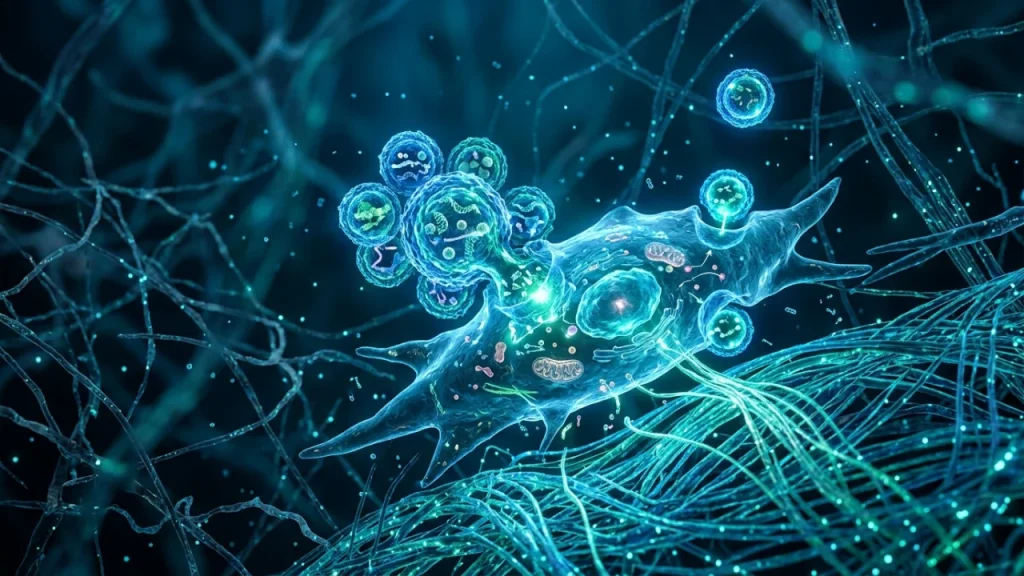
What Are Exosomes and Why Should You Care About Skin Rejuvenation?
How Do Exosomes Enhance Skin Rejuvenation Therapy?
Exosomes act as precise cellular messengers. They carry specific instructions to your skin cells. These instructions tell older or damaged cells how to repair themselves. Think of them as a software update for your skin’s biology.
The process starts with signaling. Exosomes deliver proteins and genetic material like RNA. This material enters target cells, such as fibroblasts. Fibroblasts are the cells that make collagen and elastin. These are the fibers that keep skin firm and youthful.
How do exosomes enhance skin rejuvenation therapy? They make the natural repair process smarter and more efficient. Traditional treatments often rely on causing controlled damage. The body then heals this damage. Exosomes work differently. They directly instruct cells to begin regenerative activities.
Here is what happens step by step. First, exosomes bind to the surface of a target cell. Then, they release their cargo inside. This cargo includes growth factors and communication molecules. These molecules switch on specific genes within the cell’s nucleus.
The activated genes start producing more beneficial proteins. The main results are visible and measurable. – Collagen production increases significantly. Collagen is the main structural protein in skin. – Elastin fibers are repaired and renewed. This improves skin elasticity. – New blood vessel formation is supported. This improves nutrient delivery and creates a healthy glow. – Inflammation is reduced. Chronic, low-level inflammation speeds up skin aging.
This method is efficient because it uses the body’s own language. The signals are natural, not foreign. Therefore, the risk of adverse reactions is very low. The therapy aims to restore the skin’s own ability to heal.
Exosome therapy is often combined with other procedures. For example, microneedling creates tiny channels in the skin. These channels help deliver exosomes deeper into the dermis. The exosomes then work in the ideal environment for repair.
The effects are not just superficial. They occur at a foundational, cellular level. This leads to improvements that develop over weeks and months. The skin does not just look temporarily plumped. It genuinely remodels itself from within.
Key benefits include improved texture and tone. Fine lines appear softened because the skin is thicker and better supported. Hydration improves because the skin barrier function gets stronger. The overall result is skin that behaves like younger skin.
This approach represents a shift from simple replacement to true regeneration. It is not about adding filler to a line. It is about teaching the skin cells beneath that line to rebuild their own support structure. The goal is long-term function, not just short-term appearance.
In summary, exosomes enhance rejuvenation by optimizing cellular communication. They turn on your skin’s innate repair programs with high precision. This leads to a natural, gradual improvement in health and appearance. The next logical question explores the practical application of this science in a treatment setting.
Why Exosomes Are Better Than Simple Creams for Skin Health
Most skincare creams work on the skin’s surface or its very top layers. They cannot reach the living cells where aging truly happens. Their ingredients are often too large to penetrate deeply. They also face the skin’s strong barrier function, which is designed to keep things out. Exosomes are different by their very nature. They are designed for delivery. Their tiny size, measured in nanometers, allows them to pass through barriers. More importantly, cells naturally accept them. This is key to understanding how do exosomes enhance skin rejuvenation therapy.
Think of your skin’s structure. The outer layer, the epidermis, is like a wall of bricks. Creams sit on or between these bricks. The deeper dermis is where collagen, elastin, and fibroblasts live. This is the skin’s engine room. Aging damages this area. Surface creams send signals downward, but they are weak and indirect. Exosomes deliver their instructions directly to the engine room’s workers, the fibroblasts.
The action happens inside your cells. A cream with peptides might tell a surface cell to send a vague “repair” message. An exosome delivers a precise toolkit and blueprint. It carries specific microRNAs. These are like software code. They enter the cell and tell it exactly what proteins to make. They can turn down inflammation genes. They can switch on collagen production genes. This is reprogramming, not just stimulation.
Let’s look at moisture. A good moisturizer contains humectants like hyaluronic acid. It draws water to the skin’s surface. This plumps lines temporarily. When you wash your face, much of this effect rinses away. Exosomes approach hydration differently. They send signals that strengthen the skin’s own barrier lipids. They help cells produce more of their natural moisturizing factors. The result is skin that retains water better on its own, from the inside.
Repair signals from exosomes are also timed perfectly. Your body’s natural healing process has phases. Inflammation comes first, then proliferation, then remodeling. A cream applies a constant, unchanging signal. Exosomes released after an injury like microneedling mimic the body’s own rhythm. They provide the right signals at the right phase. This guides healing toward an optimal outcome, not just a fast one.
Consider the longevity of effects. Topical results depend on continuous application. Stop using a retinoid cream, and cell turnover slows again. Exosome therapy aims for a lasting change. By resetting cellular behavior and improving the tissue environment, the benefits persist long after the exosomes themselves are gone. The cells continue their improved function.
Here is a simple comparison of mechanisms:
- Creams: Work primarily on surface layers. Provide external ingredients that may indirectly influence deeper cells. Effects are often maintenance-oriented and reversible.
- Exosomes: Act within the deep dermis. Deliver genetic instructions that directly change cell protein production. Effects can remodel tissue structure for long-term change.
This is not to say creams are useless. They are essential for daily protection and surface health. Sunscreen is the best anti-aging cream ever made. But for genuine regeneration of damaged skin structures, surface treatment has limits. You cannot fix a crumbling foundation by painting the wall. You must repair the support beams.
Exosome therapy addresses those foundational supports. It provides the missing signals that aged or damaged skin cells need to rebuild correctly. This is why it represents a different category of treatment altogether—one of cellular communication versus topical application. The next step is understanding what this feels like during an actual treatment session and what realistic expectations look like over time.
What Makes Exosomes Different from Stem Cells in Treatments
You might have heard about stem cells in beauty treatments. Stem cells are living cells. They can turn into different cell types. This ability is called differentiation. In theory, stem cells could replace damaged skin cells. But using living cells in treatments is complex. These cells must survive, integrate, and function correctly. Their behavior can be unpredictable. Exosomes take a completely different path. They are not cells at all. Think of them as tiny message carriers. They are released by cells, including stem cells. Their job is communication, not replacement.
This is a key safety distinction. A living cell can multiply. It can react to its environment in unforeseen ways. An exosome is a sealed nanoparticle. It carries a cargo but cannot replicate. It delivers its instructions and then is naturally broken down. It acts as a signal, not a resident. This reduces potential risks associated with introducing whole living cells into your body. The focus shifts from cell transplantation to cell instruction. Your own skin cells receive new information. Then they do the repair work themselves.
What exactly is inside an exosome? Their cargo is precise and powerful. – Growth factors: These are proteins that tell cells to grow or heal. – Messenger RNA (mRNA): This is a set of instructions. It tells your cell’s machinery which proteins to make. – MicroRNA: These are tiny regulators. They can turn specific genes on or off in the target cell.
This cargo is protected within the exosome’s lipid membrane. The membrane acts like a secure envelope. It ensures the message arrives intact at the target cell. The target cell absorbs the exosome. Then it reads the instructions. The result is a change in that cell’s behavior. It might start producing more collagen. It might improve its energy metabolism. This process shows how do exosomes enhance skin rejuvenation therapy. They provide the exact signals that aged cells have stopped sending or receiving.
Stem cell treatments rely on the hope that the implanted cells will secrete helpful factors. Exosome therapy skips the middleman. It uses the helpful factors directly. Scientists harvest exosomes from stem cells grown in labs. They carefully collect and purify these vesicles. The final product contains concentrated healing signals without the original cells. This allows for precise dosing and standardized treatment. You get the beneficial communication without the variables of living cell therapy.
Consider a construction site. Stem cell therapy is like bringing in new, untrained workers. You hope they will figure out the blueprint and start building. Exosome therapy is like giving a detailed instruction manual and better tools to your existing experienced crew. Your crew already knows the site. They just needed updated guidance to work more effectively. The outcome is more predictable and controlled.
The practical benefits for skin rejuvenation are clear. Treatments avoid issues of cell rejection or mismatched donor cells. There is no need for genetic matching. The risk of unwanted tissue formation is extremely low because exosomes cannot create new cells. They only influence existing ones. This makes the treatment profile favorable for cosmetic use where safety is paramount.
Understanding this difference helps set realistic expectations. Exosome therapy does not magically grow new skin from scratch. It optimizes and redirects your native skin cells. It helps your skin remember its youthful functions. The goal is to restart your body’s innate repair processes that have slowed down over time. This cellular refresh leads to improved texture, tone, and firmness from within.
The next logical question involves the treatment experience itself. How are these powerful messengers actually delivered into the skin to start their work?
How Exosomes Deliver Healing Messages to Your Skin
Exosomes are tiny delivery trucks. Their cargo is what makes them powerful. They carry molecular instructions directly to your skin cells. These instructions are not random. They are carefully selected signals.
The main cargo includes proteins and RNA. Proteins can be enzymes or growth factors. RNA is a type of genetic message. Think of RNA as a software update for a cell. It tells the cell to change its behavior.
One key instruction is for collagen production. Collagen is the main support structure of your skin. Your skin cells make it naturally. As we age, this production slows down. Exosomes deliver signals that tell your cells to make more collagen. They do not make the collagen themselves. They instruct your existing fibroblasts, which are your skin’s collagen factories, to become active again.
This is how do exosomes enhance skin rejuvenation therapy. They provide a direct command. The process is precise and efficient.
Here is a step-by-step look at the delivery. – First, exosomes travel through the fluid between your cells. – Second, they dock onto the surface of a target skin cell. – Third, they fuse with the cell’s membrane or are absorbed inside. – Finally, they release their cargo into the cell’s interior.
Once inside, the proteins get to work immediately. The RNA messages are read by the cell’s machinery. This triggers new activity. The cell starts producing more of its own beneficial proteins. The effect multiplies from one cell to its neighbors.
The signals are not just about collagen. Exosomes carry a full rejuvenation program. They can tell cells to: – Increase elastin for snap-back elasticity. – Ramp up hyaluronic acid for deep hydration. – Boost antioxidant defenses against daily stress. – Calm inflammation that can break down healthy tissue.
This multi-target approach is why results look natural. The skin improves its own overall function. You see better texture and firmer tone because the cellular workforce is more productive.
The source of exosomes matters greatly. Exosomes from mesenchymal stem cells are often used. These stem cells are experts at repair. Their exosomes carry a specialized toolkit for healing. The vesicles mirror their parent cell’s regenerative intent without the risks of using whole cells.
This messaging system is fast. Cellular changes can begin within hours of treatment. The effects then build over weeks as cells follow their new instructions. This leads to gradual, sustained improvement.
The science shows this is not a superficial change. It is a fundamental retuning of your skin’s biology. The goal is to shift aged cells back toward a more youthful state of activity. This cellular refresh has visible results.
Understanding this cargo and delivery explains the treatment’s logic. It is not about adding foreign material. It is about upgrading your skin’s internal communication network. The next step is seeing how this science translates into an actual clinical treatment experience.
The Science Behind Exosomes and How They Work in Your Body
How Exosomes Travel Between Cells to Start Repair
Exosomes begin their journey inside a cell. They form in small compartments called endosomes. These endosomes mature and pack their molecular cargo. Then, they move to the cell’s outer membrane. The cell releases these packed vesicles into the surrounding fluid. This process happens constantly in your body.
These released exosomes now navigate the extracellular space. Think of this space as the fluid environment between your cells. It is not empty. It is filled with a complex mesh of proteins and sugars. Exosomes must travel through this matrix. Their small size is a major advantage. They are typically 30 to 150 nanometers wide. That is about one-thousandth the width of a human hair. This tiny scale lets them move through tiny channels in your tissue.
Their travel is not random. Exosomes have targeting signals on their surface. These signals act like addresses or docking codes. They help exosomes find the right recipient cells. The signals ensure an exosome from a stem cell finds a skin cell in need of repair. It will not accidentally dock with a liver cell. This targeting is key to their precision.
The journey uses the body’s own highways. Exosomes move through bodily fluids. They travel in your blood plasma. They move in your lymph fluid. They also diffuse through the interstitial fluid between your skin cells. This systemic travel means an exosome released in one area can affect cells somewhere else. This is a form of long-distance cellular communication.
Once an exosome reaches its target cell, docking begins. The surface proteins on the exosome bind to receptors on the target cell’s membrane. This binding is like a key fitting into a lock. It triggers one of several entry methods. The exosome might fuse directly with the cell’s membrane. It could also be engulfed by the cell in a process called endocytosis.
Imagine the cell membrane pinching inward to form a little bubble around the exosome. This bubble brings the exosome inside the cell. Now, the cargo delivery can start. The vesicle’s membrane breaks down inside the cell’s interior. This releases the precious molecular instructions into the cell’s cytoplasm.
The released cargo includes different types of molecules. – MicroRNAs can directly silence or activate specific genes. – Growth factors can trigger pathways for collagen production. – Enzymes can help repair damaged cellular components.
This cargo immediately goes to work. It changes the cell’s behavior from the inside. The cell starts following new instructions. It may begin producing more structural proteins. It might ramp up its energy production. It could also start dividing to replace old cells.
This entire process answers how do exosomes enhance skin rejuvenation therapy. They act as nature’s perfect delivery vehicles. They protect their fragile cargo during transit. They find the right cells efficiently. They ensure their message is delivered intact and read correctly.
The speed of this system is remarkable. From release to uptake can take just minutes or hours. The cellular changes then build over days and weeks. This explains the gradual improvement seen after treatment. The skin is not being coated with something new. Its cells are being reprogrammed to perform better.
Understanding this journey highlights a critical point. The therapy’s success depends on this natural biological process working correctly. Providing high-quality exosomes gives your body more of these intelligent messengers. It supercharges a communication network that already exists but may have slowed down with age.
The next logical question is about what happens after delivery. How exactly do these molecular instructions turn into visible, firmer, younger-looking skin?
What Signals Exosomes Send to Boost Collagen Production
Collagen is the most abundant protein in your skin. It forms a strong, fibrous network. This network provides structure and firmness. As we age, our cells produce less collagen. The existing network also breaks down. This leads to wrinkles and sagging skin. Exosomes address this problem directly. They carry precise orders to ramp up collagen production.
Think of a skin cell as a factory. The cell’s DNA holds the blueprint for collagen. But the factory needs a manager to activate that blueprint. Exosomes deliver those management instructions. They do not become part of the cell permanently. Instead, they release their cargo of signaling molecules. These molecules bind to specific targets inside the cell.
One primary signal is for a pathway called TGF-β. This is a key regulator. It tells the cell to start the collagen production process. The exosome’s cargo activates this pathway. The cell then reads the collagen gene more actively. It transcribes more messenger RNA. This mRNA is the detailed work order for the protein.
Another signal can increase the production of pro-collagen. This is the precursor molecule. Cells release pro-collagen into the spaces around them. Enzymes then stitch these precursors together. They form mature, strong collagen fibers. Exosomes can boost every step in this chain. They signal for more raw materials. They also signal for better assembly.
The instructions are not just about making more collagen. They are also about making better quality collagen. Aged skin often has fragmented, disorganized collagen. Exosomes can help restore a healthier pattern. They promote the formation of Type I collagen. This is the main structural type in young, resilient skin.
The signals also work on other skin cells. Fibroblasts are the main collagen producers. But exosomes also communicate with keratinocytes. These are the outer skin cells. Signals to keratinocytes improve overall skin function. This creates a better environment for fibroblasts to work in. It is a coordinated team effort.
Here is a simplified list of key signals exosomes send: – Activate the TGF-β pathway to start collagen gene expression. – Increase production of enzymes needed for collagen processing. – Downregulate signals that break down collagen (MMPs). – Promote cross-linking for stronger, more stable fibers.
This process answers how do exosomes enhance skin rejuvenation therapy at a molecular level. They do not just add temporary volume. They reprogram the cellular machinery to rebuild its own support structure. The effect is not instant like a filler. It is gradual and biological.
New collagen takes time to synthesize and organize. Visible firming develops over weeks. This is because the skin is genuinely remodeling itself from within. The therapy provides the instructions. Your body’s cells execute the building plan.
The result is not just more collagen, but a functional network. This improves elasticity and tensile strength. Skin can better resist folding and creasing. The improvement is natural because it uses your body’s own processes.
Understanding these signals highlights a key advantage. The approach works with your biology. It guides your cells to perform their natural functions more effectively. This is different from introducing a foreign substance.
The next logical step is to look at the full effect on skin architecture. Collagen boost is central, but other proteins are crucial too for complete rejuvenation.
Why Exosomes Help Reduce Inflammation in Skin
Inflammation is your body’s alarm system. It sends immune cells to fix damage or fight germs. This is good for short-term problems like a cut. But in skin, low-grade inflammation can become a constant background issue. This chronic state silently damages tissue. It slows repair and breaks down collagen.
Exosomes are expert communicators in this scenario. They carry specific instructions to immune cells. Their main goal is to calm the overactive alarm. They help switch the response from “attack” to “repair.” This is crucial for effective skin rejuvenation therapy.
Consider a key immune cell called a macrophage. These cells have two main modes. The M1 mode is pro-inflammatory. It attacks threats. The M2 mode is anti-inflammatory. It cleans up debris and promotes healing. Chronic inflammation can trap macrophages in the M1 state.
Exosomes send signals that encourage the shift to the M2 state. They deliver microRNAs and proteins that change the cell’s behavior. This tells the macrophage to stop fighting and start fixing. The environment becomes more peaceful for regeneration.
The vesicles also talk to other cells. They can reduce signals from cells called keratinocytes. These skin cells often send out distress calls that attract more immune cells. Exosomes help quiet these calls. This reduces overall redness and swelling.
Another target is the fibroblast, the collagen-making cell. Inflammation releases enzymes known as MMPs. These enzymes chop up collagen and elastin. It is a destructive process. Exosomes help downregulate this enzyme production. They protect the existing structural proteins from being destroyed.
This protective action works alongside their collagen-building instructions. It is a two-part strategy. First, they shield the current support network. Second, they command the creation of a new one. This answers how do exosomes enhance skin rejuvenation therapy by addressing both sides of the equation.
The reduction of inflammation has direct visible benefits. Skin looks less red and irritated. Puffiness decreases. This calm state allows other processes to work better. Nutrients and energy can go toward rebuilding, not constant defense.
Healing after procedures like lasers or microneedling also improves. These treatments work by creating controlled damage. The body must then heal it. But sometimes the inflammatory phase is too strong or long. Recovery feels uncomfortable and slow.
Exosomes applied after such treatments can guide the response. They help manage the initial inflammatory spike. Then they promptly encourage the transition to the next phase. This can lead to faster recovery times with less downtime.
The mechanism is about resetting balance. It is not about suppressing immunity entirely. That would be dangerous. Instead, exosomes promote a timely and appropriate resolution. They tell the immune system the job is done and it’s time to rebuild.
Think of it as a skilled mediator entering a busy construction site. The mediator doesn’t stop all work. They coordinate the teams to avoid conflicts and delays. The demolition crew (inflammation) finishes its necessary task efficiently. Then the building crew (repair cells) can move in without obstruction.
This results in skin that is not just thicker from new collagen, but also calmer at a cellular level. A calm cellular environment is more resilient. It is less reactive to daily stressors like sun exposure or pollution.
The combined effect is profound. You get structural reinforcement and a settled biological state. One supports the other. Stronger skin is less prone to micro-injuries that trigger inflammation. Calmer skin preserves its structural proteins longer.
This synergy is key to the therapy’s logic. The approach treats skin as a dynamic, living system. It uses natural communication to optimize multiple processes at once. The end goal is a self-maintaining, healthy appearance.
Reducing inflammation clears the path for lasting renewal. It removes a major barrier to youthful function. The next step is to see how these actions improve the skin’s surface texture and tone directly
How Exosomes Speed Up Wound Healing After Procedures
Exosomes directly instruct your skin to heal faster and cleaner. They achieve this by delivering precise molecular commands to the cells at the wound site. Think of them as a fleet of smart delivery trucks. Each truck carries a special toolkit for repair.
These toolkits contain growth factors, proteins, and genetic instructions. They are not random. They are carefully selected cargo for regeneration. The exosomes travel to the target cells, like fibroblasts and keratinocytes. These cells are your skin’s builders.
The exosomes fuse with the builder cells. They unload their cargo. This delivery tells the cells to switch into high-gear repair mode. The process is efficient and targeted. It happens naturally, but exosome therapy provides a concentrated boost.
The healing sequence has several key stages. Exosomes optimize each one.
First, they enhance the formation of new blood vessels. This stage is called angiogenesis. New capillaries must grow to supply oxygen and nutrients to the healing tissue. Exosomes carry signals like VEGF. This signal tells the body “build more blood vessels here.” Improved blood flow means building materials arrive faster.
Second, they directly activate collagen production. Collagen is the main structural protein of your skin. It is the scaffolding for new tissue. After a procedure, fibroblasts need to make large amounts of new collagen quickly. Exosomes deliver the blueprints and tools for this.
- They increase the rate of collagen synthesis.
- They promote the formation of strong, organized Type I collagen.
- They help align the collagen fibers neatly. This reduces scar formation.
Third, they guide skin cell migration and proliferation. The outer layer of skin must cover the wound. Cells called keratinocytes from the edges move to seal the gap. Exosomes send signals that say “move here” and “multiply now.” This speeds up re-epithelialization. The wound closes faster.
Scarring is often a result of messy, rushed healing. The body lays down collagen in a haphazard way. It creates thick, disorganized bundles. Exosomes promote a more organized process. They help modulate the balance between different collagen types.
They also regulate enzymes called MMPs. These enzymes remodel the new tissue. Without proper control, they can degrade too much good collagen. Exosomes help maintain a healthy balance of construction and remodeling. The result is stronger, more elastic skin with less visible scarring.
The clinical benefit is clear. Faster healing means less downtime after treatments like laser therapy or microneedling. Redness and swelling subside more quickly. The skin transitions to the rebuilding phase without delay.
This efficient process also improves safety. A quickly sealed wound has a lower risk of infection. The skin’s barrier is restored sooner. This protects the delicate new tissue underneath.
Ultimately, this is how exosomes enhance skin rejuvenation therapy at a fundamental level. They don’t just add a temporary plumping effect. They actively rewrite the body’s own healing script. They make it more efficient and effective.
The outcome is not just faster healing, but better-quality healing. The skin regenerates with improved texture and integrity. This sets the stage for the final visual improvements in tone and clarity that patients see in the mirror.
Benefits of Using Exosomes for Skin Rejuvenation Therapy
How Exosomes Make Skin Look Younger and Brighter
The final goal of any skin treatment is a visible improvement. You want skin that looks younger and brighter. Exosomes help achieve this by renewing your skin’s cells from within. This is a key way how exosomes enhance skin rejuvenation therapy. They go beyond surface-level changes.
Think about what makes young skin look radiant. It has an even tone. It reflects light well. It feels smooth. As we age, our skin cells become less active. They do not turn over as quickly. Old, tired cells linger on the surface. This leads to a dull, rough complexion.
Exosomes deliver precise instructions to these aging cells. They tell sluggish cells to become more active. One major instruction is to boost collagen and elastin production. These are the skin’s support fibers. More collagen improves skin density and firmness. This reduces the appearance of fine lines.
But exosomes do much more than just boost collagen. They also target skin tone and clarity. A major factor in uneven tone is melanin overproduction. Melanin is the pigment that gives skin its color. Sun exposure or inflammation can trigger melanocytes to produce too much pigment. This leads to dark spots and patches.
Exosomes carry molecules that help regulate this process. They can calm overactive melanocytes. This helps prevent the formation of new dark spots. They also support a more orderly and faster shedding of the skin’s top layer. This natural exfoliation helps fade existing discoloration over time.
The result is a more uniform complexion. Skin tone becomes clearer and more even. This happens without harsh chemicals or aggressive treatments that can cause irritation.
Brightness, or glow, comes from light reflection. Rough, dry skin with a disorganized surface scatters light. It looks dull. Smooth, well-hydrated skin with a tight barrier reflects light evenly. It appears luminous.
Exosomes promote this smooth surface in several ways. – They enhance the health of keratinocytes. These are the primary cells in the skin’s outer layer. – They improve the skin’s natural moisture barrier. This helps skin retain hydration. – They encourage proper cell maturation and turnover. New, plump cells rise to the surface regularly.
This cellular renewal is continuous. It is not a one-time event. The signals from exosomes can reset the cellular environment for weeks or months. Your skin maintains its renewed activity cycle.
The combined effect on tone and texture creates a profound visual change. – Pores appear smaller because the surrounding skin is tighter. – Fine lines are softened due to better hydration and support. – The overall complexion looks fresher and more vibrant.
This is not a temporary mask or a glittery highlight. It is a genuine glow from healthier, better-functioning skin cells. The light comes from within your own revitalized tissue.
The process is natural but guided. Your body knows how to create beautiful skin. Exosomes simply provide the updated blueprint and the urgent memos to get the work done efficiently. They align the efforts of millions of cells toward a common goal: visible rejuvenation.
Ultimately, younger-looking skin is simply healthy skin functioning at its best. By renewing cellular communication, exosomes help restore that optimal function. The improvement in tone and brightness is the clear, visible sign that this deeper regeneration is working successfully.
Why Exosomes Help Fight Wrinkles and Fine Lines
Wrinkles and fine lines form when skin loses its elastic support. Think of young skin like a new, firm mattress. It has a strong inner structure. This structure is made of collagen and elastin fibers. They form a supportive network. Over time, this network breaks down. Sun exposure and natural aging are the main causes. The skin’s mattress sags and develops creases. This is where exosomes make a critical difference.
Exosomes deliver precise instructions to the cells that build this network. These cells are called fibroblasts. Fibroblasts live in the dermis, the skin’s deeper layer. They are the construction crews for collagen and elastin. As we age, these crews slow down. They also produce poorer quality materials. Exosomes reverse this trend.
The vesicles carry specific signals. These signals tell fibroblasts to become active again. They encourage two key actions. – First, fibroblasts increase production of new collagen. This is the main structural protein. – Second, they improve the organization of these fibers. Neat, dense fibers provide better support than a messy, loose web.
This process directly targets wrinkle depth. New collagen plumps the skin from beneath. It fills in the grooves that make fine lines visible. Think of it like refilling the mattress with fresh, high-quality padding. The surface becomes smoother.
Elastin restoration is equally important. Elastin gives skin its snap-back quality. Healthy elastin lets skin stretch and then return to its original shape. Exosome signals help maintain this vital protein. They support the environment that keeps elastin functional. This combats the constant sagging that leads to folds.
The result is a dual reinforcement of the skin’s architecture. It is not just about adding more material. It is about improving the quality and arrangement of that material. This is how exosomes enhance skin rejuvenation therapy at a foundational level. The therapy rebuilds from within.
The effect on dynamic wrinkles is notable. These are lines from repeated movements, like smiling or squinting. They appear because the skin’s elastic recovery weakens. By strengthening the support matrix, exosomes help skin bounce back more effectively after these motions. Static lines, which are always visible, also soften as the dermis thickens.
This mechanism works in harmony with surface-level improvements. Better hydration from a strengthened moisture barrier, as mentioned before, plumps the very top layer. Meanwhile, new collagen from below provides deeper structural smoothing. The two effects work together from different directions.
The timeline for this benefit is key. Collagen synthesis is not an instant process. Fibroblasts need time to receive signals, produce new proteins, and assemble them. Patients often see initial brightness quickly from enhanced cell turnover. The significant softening of lines comes later as new collagen matures. This can take several weeks to a few months.
This underscores the regenerative nature of the treatment. It is not a filler that physically pushes wrinkles up. It is a biological process that restores your skin’s own ability to stay smooth and tight. The outcome is more natural and integrated with your physiology.
Understanding this helps set realistic expectations for how do exosomes enhance skin rejuvenation therapy. The therapy does not erase expression lines completely. Instead, it gives your skin the resources to maintain better firmness and recover from daily stress. The goal is resilient, functionally younger skin.
Ultimately, fighting wrinkles is about restoring structural integrity. Exosomes provide the cellular communication needed to direct that repair. They shift the biological focus from breakdown back to building. The next logical step is to consider how this internal renewal translates to lasting results and skin that not only looks better but behaves in a more youthful way.
How Exosomes Improve Skin Texture and Firmness
Skin texture and firmness depend on your skin’s support system. Think of it like a mattress. The collagen and elastin fibers are the springs. The surrounding gel-like substance is the padding. Over time, springs sag and padding thins. The surface becomes uneven and soft. Exosomes address both parts of this structure.
They send precise orders to skin cells. One major order is to ramp up collagen production. This is not just about making more collagen. It is about making the right types. Type I collagen gives strength. Type III collagen provides flexibility. A healthy young skin has a balanced mix. Exosomes help restore that balance.
New collagen fibers weave into the existing network. They reinforce the weakened areas. This adds density from within. The skin’s foundation becomes stronger. You do not see this process happen. You feel its result as increased firmness. The skin resists pinching and gravity better.
But texture is about surface smoothness. Here, exosomes work on another front. They optimize cell turnover. Your outer skin layer constantly sheds dead cells. New cells rise to take their place. This cycle can become slow and messy with age.
Dead cells accumulate like dust on furniture. They create a dull, rough surface. Exosomes communicate with keratinocytes. These are the main cells in your skin’s outer layer. The message is to regulate this renewal process.
The result is more orderly shedding. Fresh, plump cells reach the surface consistently. This leads to a smoother tactile feel. Your skin feels soft to the touch. It also looks more radiant because light reflects evenly.
Exosomes also improve the skin’s hydration matrix. Hyaluronic acid holds water in the skin. Fibroblasts make this substance too. Exosome signals can boost its natural production. Better hydration plumps up the skin from the inside.
Plumped skin has fewer tiny surface lines. It feels supple and resilient. This is different from surface moisturizers. It is a foundational improvement in water retention capacity.
The combined effect on texture is clear. – Minimized pores: Pores appear larger when surrounding collagen sags. Tighter skin makes pores look smaller. – Softer feel: Uniform cell renewal eliminates rough patches. – Smooth appearance: Better hydration and a strong matrix reduce fine crinkles.
Firmness improves through structural reinforcement. – Enhanced density: New collagen adds literal volume to the dermis. – Improved elasticity: Better-quality fibers help skin snap back. – Stronger support: The entire network becomes more robust.
This shows how do exosomes enhance skin rejuvenation therapy. They do not just fill wrinkles. They upgrade the skin’s living architecture. The change is gradual but substantial.
You might first notice your makeup applies more evenly. Then you feel that your skin is tighter when you wash your face. Finally, you see a smoother reflection without a loss of natural expression.
The outcome is skin that behaves like younger skin. It maintains its form better throughout the day. It recovers faster from irritation. This functional improvement is the core benefit. The next aspect to explore is how these changes create a lasting defensive effect against future aging signs.
Why Exosomes Are Good for Sensitive or Damaged Skin
Exosomes offer a unique advantage for skin that is easily irritated or already damaged. Their mechanism is fundamentally gentle. They work by delivering messages, not by force. This makes them ideal for conditions where traditional treatments might be too harsh.
Think of sensitive skin as having overactive alarm systems. Procedures like lasers or chemical peels can trigger these alarms. They cause controlled damage to stimulate healing. But for reactive skin, this often leads to redness and prolonged recovery. Exosomes take a different path. They bypass this alarm altogether. They provide the instructions for repair without the initial injury signal.
Sun damage is a prime example. Ultraviolet rays from the sun do two harmful things. They break down collagen and elastin fibers. They also create unstable molecules called free radicals. These molecules cause further chaos inside skin cells. Exosomes can help address both issues.
First, they calm inflammation. Inflamed skin is red, hot, and uncomfortable. Exosomes carry specific instructions that tell immune cells to reduce their aggressive response. This quiets the irritation faster than skin can manage alone.
Second, they boost the skin’s own antioxidant defenses. Antioxidants neutralize free radicals. Exosomes can instruct skin cells to produce more of these protective molecules internally. This helps stop ongoing damage at a cellular level.
The repair process for damaged skin follows a logical sequence. – Communication: Exosomes fuse with target cells in the damaged area. – Instruction delivery: They release growth factors and RNA blueprints. – Cellular response: Recipient cells activate their repair programs. – Tissue remodeling: New, healthy proteins are synthesized to replace damaged ones.
This sequence shows how do exosomes enhance skin rejuvenation therapy for compromised skin. They guide the natural healing process to be more efficient and less inflammatory.
For those with conditions like rosacea or eczema, this gentle approach is key. These conditions involve barrier defects and immune dysregulation. Exosomes can send signals to strengthen the skin’s barrier function. A stronger barrier keeps irritants out and moisture in. They also help recalibrate the local immune response, reducing frequent flare-ups.
The results are tangible. After exosome therapy, sensitive skin often shows improved tolerance. It may react less to common triggers like weather changes or skincare products. Sun-damaged skin can show a more even tone and texture. The repair focuses on the deeper layers where sun injury accumulates.
This method is also compatible with other treatments. It can be used after a gentle procedure to speed up recovery. It minimizes downtime and reduces potential side effects. The goal is to achieve results without pushing the skin into a state of distress.
The benefit is resilient, healthier-functioning skin. It is not just about appearance. It is about improving the skin’s capacity to handle daily challenges. This creates a lasting defensive effect against future damage, which we will explore next.
How Exosome Treatments Are Done and What to Expect
How Doctors Prepare Exosomes for Skin Therapy
Exosomes used in skin therapy are not simply extracted and immediately injected. They undergo a strict preparation process. This ensures safety, purity, and activity. Doctors rely on specialized laboratories for this critical work.
The journey begins with a source of healthy cells. These cells are grown under controlled conditions. They are nourished in a clean environment called a bioreactor. Here, the cells thrive and naturally release exosomes into their growth medium. Think of it as a superfood soup that the cells live in. The valuable exosomes are floating in this liquid.
The next step is isolation. Scientists must separate the tiny exosomes from everything else in the soup. This includes leftover cell fragments and proteins. They use advanced methods for this separation. – One common method is ultracentrifugation. Machines spin the liquid at extremely high speeds. The exosomes, being denser, gather at the bottom. – Another method uses filters with incredibly small pores. These filters trap larger particles while letting the exosomes pass through. – Specialized kits can also be used. They bind to exosomes using antibodies or chemicals, pulling them out of the solution.
After isolation, the exosomes are purified further. This removes any remaining impurities. The goal is to get a concentrated sample of just exosomes. This sample is then tested rigorously. Safety and quality checks are non-negotiable.
Testing confirms several key factors. First, scientists verify the identity of the vesicles. They check specific markers on the surface. This proves they are truly exosomes and not other particles. Second, they measure the concentration. They count how many exosome particles are in a given volume. This allows for precise dosing in treatments.
Third, and crucially, they test for sterility. The sample is checked for bacteria, fungi, and viruses. It must be completely free of pathogens. Fourth, they may test the biological activity of the exosomes. This can involve seeing how they affect target cells in a lab dish.
Once the batch passes all tests, it is prepared for clinical use. The exosomes are often suspended in a sterile saline solution. This solution is compatible with the body. The final product is then frozen for storage and transport. It is kept at very low temperatures to preserve its potency.
Doctors receive the exosomes in vials as a clear liquid. They thaw it carefully before a treatment session. The preparation ensures what is injected is pure, safe, and active. This meticulous process is fundamental to how do exosomes enhance skin rejuvenation therapy reliably.
Patients do not see this complex lab work. But it is the foundation of a safe treatment. Knowing these steps exist provides confidence. The focus shifts from the science of preparation to the experience of the procedure itself.
What Happens During an Exosome Treatment Session
An exosome treatment session is a precise clinical procedure. It typically takes less than one hour from start to finish. The goal is to deliver the prepared exosomes to your skin cells efficiently. This is how do exosomes enhance skin rejuvenation therapy directly.
The process begins with preparation of your skin. The treatment area is thoroughly cleansed. A topical numbing cream is often applied. This cream sits on the skin for about 20 to 30 minutes. It makes the procedure very comfortable for most people. You will simply relax during this time.
The doctor then removes the numbing cream. The skin is cleaned again with a medical antiseptic. This step ensures a sterile environment for the treatment. It prevents any surface bacteria from entering the skin.
Next comes the method of delivery. There are two primary techniques used by clinicians. The first and most common method is micro-injections. The second method is topical application combined with a device that creates micro-channels.
Micro-injections use very fine, short needles. These are often arranged in a mesotherapy gun or a similar device. The device holds a vial of the liquid exosome solution. It makes dozens of tiny, controlled injections into the superficial dermis. This is the layer of skin where collagen and elastin live.
The injections place the exosomes exactly where they are needed. The process feels like a quick series of tiny pinpricks. Most patients report minimal discomfort. The numbing cream makes a big difference here.
The second method uses a specialized device after topical application. The doctor first applies the exosome liquid directly onto your skin. They then use a tool like a microneedling pen or a fractional laser.
This device creates microscopic openings in the skin’s surface. These openings are incredibly small. They are not visible to the naked eye. These channels allow the exosomes to penetrate deeply into the skin.
The choice of method depends on your specific goals and skin condition. Your doctor will recommend the best approach for you. Both methods aim to overcome the skin’s natural barrier. They get the exosomes into the tissue where they can communicate with your cells.
The actual injection or device application is quite fast. It often takes only five to ten minutes for a full face treatment. The doctor works in a systematic pattern. They cover the entire treatment area evenly.
You might notice some immediate effects after the procedure. The skin usually appears slightly pink or flushed. This is a normal, temporary reaction. It shows increased blood flow and minor inflammation in the area.
This controlled inflammation is actually part of the healing signal. It tells your body to start its repair processes. The exosomes then guide these processes toward regeneration.
There is no significant downtime required after a session. You can resume most normal activities right away. However, you will receive specific aftercare instructions from your clinic.
These instructions are important for optimal results and safety. They typically include avoiding sun exposure for a few days. You should also avoid strenuous exercise for about 24 hours. Do not use harsh skincare products on the treated area immediately.
Gentle cleansing and moisturizing are encouraged. Using a high-quality mineral sunscreen is essential. Protecting your skin helps create the ideal environment for healing.
You will not see dramatic changes in the mirror right after leaving the clinic. The real work happens beneath the surface over the following weeks. The exosomes are now interacting with your fibroblasts and other skin cells.
They are delivering their molecular instructions quietly and efficiently. This cellular communication sets the stage for new collagen production and tissue renewal. The clinical experience is designed to be straightforward and manageable, placing sophisticated science into a simple, accessible patient visit that initiates profound biological change from within.
How Long It Takes to See Results from Exosome Therapy
You will not see your final results on the day of your treatment. The visible changes from exosome therapy follow your skin’s natural biological schedule. This process cannot be rushed.
Think of it like planting a seed. First, it takes root underground before any green shoot appears. Similarly, your skin cells need time to receive new instructions and then act on them.
The initial changes happen at a cellular level. Fibroblasts are your skin’s collagen factories. The exosomes deliver signals that switch these cells into a more active state. This is how exosomes enhance skin rejuvenation therapy. They provide the precise molecular blueprint for renewal.
Most people begin to notice the first subtle improvements around the three to four week mark. Your skin may start to look more refreshed. It often has a better hydrated appearance.
This early glow comes from improved cellular function and increased hyaluronic acid production. Your skin is better at holding moisture. Tone can begin to look more even.
The most significant changes typically become visible between six to eight weeks after your session. This is when new collagen and elastin fibers mature. You may observe these key improvements:
- Improved skin texture and smoothness
- A reduction in the appearance of fine lines
- Enhanced firmness and elasticity
- A more radiant, healthy complexion
These results continue to develop for several months. Collagen remodeling is a slow process. Your skin keeps building and organizing new structural proteins long after the treatment day.
The longevity of your results depends on several factors. Your age and general skin health play a role. Your lifestyle choices after treatment are also critical.
Sun protection is non-negotiable for maintaining results. Ultraviolet radiation is the primary cause of skin aging. It breaks down collagen.
Using a broad-spectrum sunscreen every day shields your new collagen. It protects the healthy cellular environment you have nurtured.
A good skincare routine supports the therapy. Gentle products that support your skin barrier are ideal. Avoid harsh scrubs or irritating ingredients.
Healthy habits extend your results. Staying hydrated helps your cells function well. A balanced diet provides necessary nutrients for repair. Managing stress can reduce cortisol, which can break down collagen.
Most clinicians recommend a follow-up or maintenance session. This is often scheduled around six months after the initial treatment.
A follow-up session provides a fresh signal to your skin cells. It helps sustain the regenerative activity. Think of it as a reinforcement of the original instructions.
This approach helps maintain optimal results over time. The goal is long-term skin health, not just a temporary fix.
Individual responses can vary. Some people see changes quickly. Others notice a more gradual transformation over three months.
Your provider can give you a personalized timeline during a follow-up consultation. They can assess your progress.
The entire journey from treatment to full results takes patience. You are supporting your skin’s innate ability to heal and renew itself. Exosome therapy offers a sophisticated way to guide this natural process toward a more youthful outcome.
The final outcome is skin that looks healthier and functions better from within. This sets the stage for discussing how to choose a qualified provider for this advanced treatment.
Why Exosome Treatments Have Minimal Downtime
One major advantage of exosome therapy is its minimal recovery period. Most patients return to their normal activities immediately after the appointment. This is a key difference from many other cosmetic procedures.
The reason lies in how the treatment works. Exosomes are not abrasive. They do not physically wound the skin’s surface. The process does not rely on creating controlled damage to trigger a healing response.
Instead, exosomes deliver precise instructions. They provide a regenerative signal directly to your skin cells. Think of it as sending a software update rather than rebuilding hardware.
The application method is very gentle. After preparing the skin, the clinician applies the exosome solution topically. It is often followed by a delivery method like micro-needling or specialized ultrasound.
These methods create tiny, invisible channels. The channels help the exosomes reach the deeper layers of the skin. The channels are micro-scopic. They close within hours.
This process causes very little trauma. You might experience mild, temporary redness. This redness typically fades within a few hours. Some people see it disappear by the next morning.
There is usually no significant pain involved. A slight tingling sensation during application is common. Numbing cream is often used for comfort if micro-needling is part of the procedure.
The lack of downtime is directly tied to cellular communication. Exosomes work by signaling. They tell your fibroblasts to make more collagen and elastin. They instruct cells to reduce inflammation and repair themselves.
This signaling happens at a biochemical level. It does not require a dramatic inflammatory wound response from your body. Your skin gets regenerative messages without first going through a major injury phase.
Compare this to a laser treatment. A laser works by creating precise thermal injury. The skin must then heal from that injury over days or weeks. Exosome therapy skips the injury step entirely.
The goal is regeneration, not repair of a wound. This fundamental difference is why you can get back to your day so quickly. Your skin’s energy goes toward renewal, not recovery.
Let’s look at what you can expect right after your session. – Your skin may feel warm or look pink, similar to a mild sunburn. – This effect is superficial and temporary. – You can apply gentle, non-irritating moisturizer and sunscreen immediately. – There are no open wounds or peeling skin to manage.
You do not need bandages or special dressings. Makeup can usually be applied within a few hours if desired. There are very few activity restrictions post-treatment.
You should avoid intense heat and sweating for about 24 hours. This means skipping hot tubs, saunas, and vigorous exercise for one day. This precaution helps minimize any potential irritation.
You should also use a high-quality mineral sunscreen daily. Protecting your skin from UV rays is always important. It is especially crucial when supporting new cellular activity.
The safety profile contributes to the easy experience. Exosomes are naturally derived and biocompatible. Your body recognizes them as friendly messengers, not foreign invaders.
This reduces the risk of adverse reactions or rejection. The treatment aligns with your skin’s own biological language. This is how exosomes enhance skin rejuvenation therapy without disrupting your life.
The minimal downtime makes it a practical option for busy people. There is no need to plan for days of hiding indoors. You can schedule a treatment during a lunch break and go back to work.
It also allows for more consistent treatment schedules. Since recovery is fast, follow-up sessions are easier to plan. This consistency helps achieve and maintain optimal results over time.
Remember, the visible results develop gradually in the following weeks. The immediate ease after treatment is just the beginning. The real work happens inside your skin as cells respond to the new instructions.
This seamless integration into daily life reflects the sophisticated science behind the method. The next logical consideration is ensuring this advanced treatment is performed correctly and safely by a qualified professional.
Safety and Future of Exosomes in Skin Care
How Exosomes Are Tested for Safety in Medicine
Exosomes must pass strict safety checks before they touch your skin. This process is not simple or fast. It involves multiple scientific steps to ensure purity and function.
First, scientists must collect the exosomes from their source cells. These cells are grown under controlled laboratory conditions. The environment is sterile and monitored constantly. This prevents contamination from bacteria or viruses.
The cells are not stressed or harmed during this growth phase. Healthy, calm cells produce the best exosomes. After a period, the liquid surrounding the cells is collected. This liquid contains the exosomes along with many other particles.
Separating the exosomes is a crucial step. Scientists use advanced methods like ultracentrifugation. This technique spins the liquid at extremely high speeds. The exosomes, due to their tiny size and weight, gather in a specific layer.
Other methods include size-based filtration or chromatography. The goal is the same: to get a pure sample of exosomes. All leftover cell debris and unrelated proteins must be removed. A pure sample is a safe sample.
Next, the exosomes are identified and counted. Researchers use machines to analyze their size. They confirm these particles are truly exosomes, not other vesicles. Specific markers on their surface act like fingerprints.
They also measure the concentration. This tells how many exosome particles are in a given volume. Consistent dosing is important for both safety and results.
Then comes critical safety testing. The exosome preparation is checked for pathogens. Tests look for bacteria, fungi, and endotoxins. Even tiny amounts of these can cause problems.
A key test is for sterility. A sample is placed in a growth medium for days. If any microbial life grows, the batch fails. It must be completely sterile.
Another test checks for endotoxins. These are toxins from certain bacteria. They can cause fever and inflammation. The test must show endotoxin levels are far below the safety limit.
The function of the exosomes is also verified. Scientists test them on cultured skin cells in a dish. They look for positive cellular responses. These include increased collagen production or faster cell movement.
This proves the exosomes are not just empty shells. They are active and capable of delivering their regenerative signals. This is how exosomes enhance skin rejuvenation therapy safely—through proven biological activity.
Finally, the entire manufacturing process is documented. Every step follows strict guidelines called Good Manufacturing Practices (GMP). This ensures every batch is made the same safe way.
Regulatory bodies review this data for clinical use. The process creates a safety profile from start to finish. It moves from lab studies to controlled human trials.
These trials observe participants closely. Doctors note any reactions, like redness or swelling. They compare results to a control group that did not receive exosomes.
Long-term follow-up is also part of safety research. Scientists want to understand the lasting effects of treatments. This ongoing research builds confidence in the therapy.
The future of this testing involves even more precision. New technologies may allow us to “read” the exact cargo inside an exosome batch. We could confirm it carries the ideal mix for skin repair.
Researchers are also improving targeting methods. The goal is to make exosomes even more efficient at finding specific skin cells. This could lower the required dose while improving outcomes.
The strict testing framework exists for your protection. It transforms a natural biological process into a reliable treatment. Safety is not an afterthought; it is the foundation.
This careful science ensures that when you choose this therapy, you are choosing a vetted and validated path to skin health. The next step is understanding who is qualified to deliver this advanced treatment reliably
Why Exosomes Are a Natural Choice for Long-Term Skin Health
Exosomes work with your skin’s own language. They are not foreign chemicals. Your cells make these tiny messengers every day. They carry instructions between cells. This natural process is key for long-term skin health.
Think of a typical skin cream. It might add moisture or a specific ingredient. Its effects often stop when you stop using it. Exosomes work differently. They deliver a blueprint to your living skin cells. This tells your cells how to repair themselves. The goal is to improve your skin’s own function.
So, how do exosomes enhance skin rejuvenation therapy for lasting results? They focus on the source, not just the symptom. They target fibroblast cells in your dermis. These cells make collagen and elastin. These proteins give skin its firmness and bounce. As we age, fibroblast activity slows down. Exosomes can restart it.
The messages inside exosomes are complex. They contain growth factors. These are signals that tell a cell to grow or multiply. They also carry microRNAs. These are tiny bits of genetic code. They can turn specific cell functions on or off. This cargo instructs older, slower cells to act young again.
The effect is a cascade of natural activity. Your treated fibroblasts get to work. They produce more new collagen. They build a stronger support network under the surface. This is not a temporary plumping effect. It is your skin rebuilding its foundation. This process takes time but leads to durable change.
The benefits are designed to last because the mechanism is biological. Here is what happens after a treatment: – Your cells receive the exosome signals. – They begin their normal repair process, but at a heightened rate. – New collagen forms and integrates into your skin’s structure. – This improved structure can maintain itself for months.
This contrasts with treatments that simply dissolve or wear off. The results from exosomes unfold over weeks. They can continue improving for several months. The therapy aims for a cumulative effect. Each treatment session adds to a longer-lasting foundation.
Long-term skin health depends on good cell communication. Inflammation and sun damage disrupt this talk between cells. Exosomes can help restore clear communication channels. They reduce inflammatory signals. They promote a balanced cellular environment. Healthy communication means healthy skin function.
Future applications look even more promising. Scientists are learning to tailor exosome cargo. One day, a treatment could be designed for your specific needs. It could target sun damage or specific signs of aging precisely. The principle remains the same: using the body’s own system for intelligent repair.
Choosing exosome therapy is choosing a regenerative approach. It supports your skin’s innate ability to heal and maintain itself. The focus shifts from constant external correction to internal revitalization. This aligns with a modern view of aesthetics and wellness.
The natural logic of this process offers a compelling path forward for sustained skin vitality.
How Exosomes Could Change the Future of Cosmetic Science
The future of cosmetic science is moving from general solutions to precise, personal ones. Exosomes are central to this shift. Their natural role as messengers offers a unique tool. Scientists can now engineer these vesicles. They can load them with specific instructions for skin cells. This turns them into targeted delivery systems. Think of them as smart packages. They carry orders directly to your cells.
Current treatments use exosomes as general signals. They tell cells to repair and renew. Future treatments could be far more specific. The cargo inside an exosome determines its effect. Researchers are learning to customize this cargo. This process is called bioengineering. It allows for the design of exosome-based therapies for individual needs.
One key area is targeting specific aging concerns. Different people have different primary issues. For some, it’s deep wrinkles from sun damage. For others, it’s loss of firmness or uneven tone. A future clinic might analyze your skin at a molecular level. The analysis would identify your dominant aging pathways. A treatment would then be prepared just for you.
- It could contain exosomes loaded with molecules to rebuild elastin.
- Another version might carry signals to calm hyperpigmentation.
- A third could focus on reinforcing the skin’s moisture barrier.
This is how exosomes could change the future of cosmetic science. They move us beyond one-size-fits-all. The goal is a therapy designed for your unique biology.
Another promising direction is sustained release systems. Today, exosomes are applied in a single session. Their effects last for months. Future technology could extend this further. Scientists are experimenting with special gels or materials. These materials would release exosomes slowly over a much longer time. Imagine a topical cream or an implantable patch. It would provide a continuous, low-level signal to your skin cells. This could maintain an optimal regenerative state almost indefinitely.
Combination therapies will also evolve. Exosomes work well with other procedures. They enhance results from lasers or microneedling. In the future, these combinations will be smarter. The exosome cargo could be chosen to perfectly complement another treatment. For example, a laser treatment causes controlled damage to stimulate healing. An accompanying exosome therapy could be designed to precisely guide that healing phase. It would minimize side effects and maximize collagen quality.
Safety research is unlocking further potential. As we understand exosome biology better, we learn how to make them even safer and more effective. A major focus is source cells. The cells that produce the exosomes matter greatly. Future standards will likely use highly controlled cell sources. These cells will be screened and selected for their ideal messenger profiles.
The ultimate vision is predictive and preventive care. Exosome technology could help assess your skin’s future needs. A detailed analysis might show your collagen production is slowing before wrinkles even appear. A preventive treatment could then be deployed. It would nudge your cellular activity back to a youthful baseline. This shifts the paradigm from fixing damage to preventing its visible signs altogether.
This approach represents a fundamental change in cosmetic medicine. It treats the skin as a dynamic, living system. The focus is on supporting its intrinsic functions with intelligent signals. How do exosomes enhance skin rejuvenation therapy? In the future, they will do so by becoming a customizable communication language between science and your skin’s own biology. The next chapter in this story involves integrating these advanced concepts into current practice, ensuring they are delivered safely and ethically as they transition from lab to clinic.
What You Can Do Now to Learn More About Exosome Therapy
Knowledge is your most important tool when considering advanced treatments. The science of exosomes is moving quickly. You can take active steps to understand it. This prepares you for informed conversations with professionals. Start by focusing on the source of information. Seek out content from established medical and dermatology associations. Look for universities and research hospitals. These institutions publish science without commercial bias. Their goal is public education.
You must learn to evaluate a clinic or provider. Do not simply search for a service near you. Instead, investigate the practitioners themselves. Look for board-certified dermatologists or plastic surgeons. These specialists have deep training in skin biology. They are best equipped to understand exosome mechanisms. Schedule consultations to ask direct questions. A reputable expert will welcome your curiosity.
Prepare a list of specific questions for any consultation. This shows you are serious and informed. Your questions should cover key safety and science points.
- What is the source of the exosomes used here? Are they derived from human cells? What type of cells?
- How are the exosomes processed and stored to ensure their activity?
- What peer-reviewed research supports the specific use you are proposing for my skin concern?
- How do you integrate exosome therapy with other procedures? Can you explain the protocol?
Listen carefully to the answers. Vague or marketing-heavy language is a warning sign. Clear explanations of biology and safety protocols are a good sign. Remember, how do exosomes enhance skin rejuvenation therapy is a core question. A good answer will explain the signaling process simply. It will describe how messages tell your skin cells to repair themselves.
Follow new research through reliable channels. You do not need to read complex study papers. Many science journalists and medical organizations translate findings for the public. Subscribe to updates from trusted journals’ news sections. This helps you track real progress versus hype. You will learn about ongoing clinical trials. You will see when concepts move from theory to proven practice.
Understand the current regulatory landscape. This area is evolving. In many regions, exosomes for aesthetic use are regulated as biologic products. This means strict rules about their manufacture and claims. A provider should be transparent about compliance. They should explain how their products meet safety standards. This is crucial for your protection.
Connect with the scientific community indirectly. Attend public lectures at local universities if possible. Many researchers present their work to general audiences. These events offer deep insights into cell communication science. You will hear about the latest discoveries in regenerative medicine. This builds a strong foundation for understanding all future treatments.
Finally, practice patience with your own learning curve. This field is complex. It is fine if you do not grasp every detail immediately. Focus on the big principles: exosomes are natural messengers; they carry instructions; they work by activating your own cells. With this base, you can discern valuable information from noise. Your journey to learn more makes you a partner in your own care. It leads to better decisions and realistic expectations for any treatment you may choose. This proactive approach is the first step toward truly personalized skin health.