
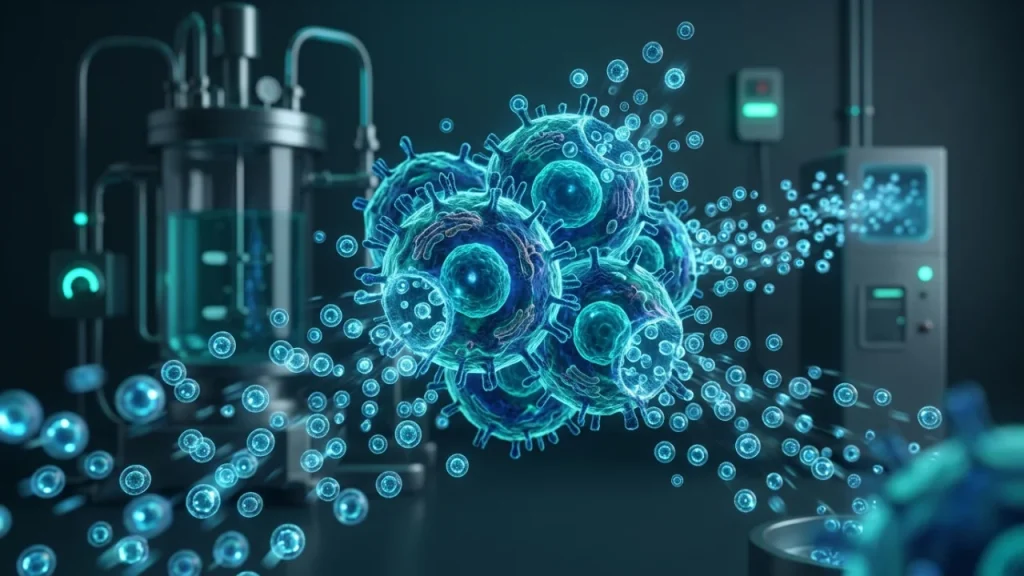
What Are Exosomes and Why Does Their Production Matter?
Understanding Exosomes as Nature’s Delivery System
Imagine your body’s cells are tiny factories. They don’t just make products for themselves. They also need to communicate. They send messages to neighbors far and wide. How do they do this? They use exosomes.
Exosomes are incredibly small bubbles. They are natural delivery vehicles. Think of them as microscopic mail trucks. Each cell can release thousands of them. These vesicles carry important cargo from their parent cell.
What’s inside an exosome? The payload is precise and protected. – Genetic instructions like RNA. – Proteins that can change a cell’s behavior. – Signaling molecules for communication.
The membrane of an exosome acts like a secure envelope. It shields the cargo during transit. This ensures the message arrives intact. The outside of the vesicle has address labels too. These are surface proteins. They help the exosome find the right target cell.
Why does this matter for medicine? Our own cells use this system every day. It is crucial for health. Immune cells send exosomes to coordinate attacks. Stem cells dispatch them to repair damaged tissue. Nerve cells may use them for brain communication.
But the system can also go wrong. Diseased cells hijack this network. For example, cancer cells are prolific senders. They can release ten times more exosomes than healthy ones. Their exosomes carry dangerous cargo. They can tell tumors to grow. They can shut down the body’s defenses.
This dual nature is key. Exosomes are both healers and harm-doers. Scientists want to harness their good side. The goal is to create new therapies. We could design therapeutic exosomes in a lab. They could deliver drugs directly to sick cells.
This approach is called “exosomes upstream expansion” in bioprocessing. It refers to the first major challenge: growing enough of the right cells to make these vesicles. You need a massive number of healthy parent cells. Those cells must be carefully nurtured. They are the source, or the “upstream” start, of the entire production line.
The potential is enormous. Engineered exosomes could treat many conditions. – They could carry cancer drugs straight to a tumor. – They might repair a heart after an attack. – They could deliver gene therapy to fix faulty DNA.
Traditional drug delivery is often inefficient. Pills and injections spread medicine throughout the whole body. This can cause side effects. Exosomes offer a smarter path. They are natural targeting systems built by evolution.
However, there is a central problem. Nature does not make enough exosomes for medicine. A single patient’s dose might require billions or trillions of these vesicles. Collecting that many from natural sources is not feasible. It is too slow and yields too little.
This is why production matters so much. To help even one patient, we need to scale up. We must move from tiny lab dishes to large bioreactors. We have to learn how to guide cells to become super-producers. The race is not just about understanding exosomes. It is about learning how to manufacture them reliably and in vast quantities.
The journey from a single cell’s message to a factory-scale therapy is long. It starts with understanding this natural delivery system. The next step is learning how to build it ourselves.
The Critical Challenge of Scalable Exosome Production
Making trillions of identical microscopic particles is incredibly hard. Think of it like this. You cannot simply grow cells in a dish and collect enough exosomes. A lab flask might yield a tiny droplet of liquid containing exosomes. A single medical dose may need bathtubs full of that same concentrated liquid. The gap between these two amounts is the core problem.
The process has several big hurdles. Cells are not designed to be factories. They make exosomes for their own needs. Scientists must convince them to produce far more. This is the heart of exosomes upstream expansion. It means growing vast numbers of cells and then directing their biology.
First, you need the starting cells themselves. These are called parent cells. They must be extremely healthy and consistent. Any variation can change the exosomes they produce. Growing billions of identical cells requires perfect conditions. – The temperature must stay exact. – Nutrients must be constantly fed in. – Waste products must be removed. – The cells need the right signals to stay in a productive state.
This is already a complex bioengineering task. It is like farming on a microscopic scale. But it is only the first step. The next challenge is harvesting. Exosomes are released by cells into the surrounding fluid. Separating them from that fluid is a huge technical barrier. The fluid contains many other things. – Proteins and genetic debris clutter the mix. – Other types of vesicles are similar in size. – The exosomes themselves are fragile. Harsh methods can destroy them.
Purification must be gentle yet precise. Current methods are slow and expensive. They work for research but not for medicine. Scaling purification is perhaps the toughest part. Each step can lose precious exosomes. Efficiency drops as volume increases.
Then there is the question of quality control. Every batch of exosomes must be identical. Medicine requires strict standards. You must check for purity, potency, and safety. You must ensure the exosomes carry the correct therapeutic cargo. Testing billions of particles takes time and advanced tools.
Imagine trying to check every letter in millions of identical envelopes. Now imagine doing it quickly and cheaply. This is the quality control dilemma for exosome therapies.
Finally, storage and delivery add more problems. Exosomes might need to be frozen without damage. They must remain stable until they reach a patient. The entire chain from bioreactor to clinic must be controlled.
These hurdles explain why scalable production is critical. Without solving these problems, exosome therapies remain lab curiosities. They cannot become real medicines. The goal is to turn a biological process into a reliable manufacturing line. This requires innovation at every stage.
The focus now is on engineering solutions. Researchers are redesigning bioreactors. They are creating better filters and purification chips. They are developing new ways to monitor quality in real time. The exosomes upstream expansion phase sets the tone for everything that follows. A weak start here means failure downstream.
Solving scale is not just about making more. It is about making more that is safe, effective, and consistent. This challenge currently defines the entire field. Progress here will unlock the true potential of these natural delivery vehicles. The next frontier involves the tools and technologies aiming to overcome these very limitations.
How Exosomes Upstream Expansion Solves This Bottleneck
Think of a factory. You cannot make many products without first growing a large, healthy workforce. For exosome therapies, the “workforce” is the parent cells. The goal of exosomes upstream expansion is to grow as many of these cells as possible. More healthy cells mean more exosomes.
This is not simple cell farming. Scientists must create perfect conditions. Cells are fussy. They need specific food, oxygen, and space. The process starts with a small vial of frozen cells. These cells are thawed and placed in a small flask with nutrient-rich fluid. They begin to divide.
After they cover the bottom of that flask, they are moved. They go to larger containers called bioreactors. These are not just bigger flasks. Bioreactors actively control the cell environment. They manage temperature and oxygen levels. They stir the broth gently. This keeps cells fed and happy.
The core challenge is density. Cells in a flat flask stop growing when they touch each other. This is called contact inhibition. It limits the final number. Bioreactors solve this. Some use microcarriers. These are tiny beads that float in the fluid. Cells stick to them. This gives cells a surface to grow on in three dimensions.
- It dramatically increases surface area.
- One liter of fluid can hold billions of cells.
- The cells feel less crowded and keep dividing.
Other methods use cells that can grow suspended in liquid. They do not need a surface at all. This is like growing yeast for bread. It allows for even higher densities.
The type of food matters greatly. Standard cell culture media is not enough. Researchers design special “feeds.” These feeds are added over time. They provide precise nutrients. The goal is to push cells into a high-production state.
Stress can sometimes help. Mild stress signals can tell a cell to release more exosomes. Scientists might change the acidity slightly. They might temporarily reduce food. The trick is to stress the cell just enough. Too much stress kills the cell. The right nudge makes it pack more cargo into its exosomes.
All this happens in the upstream phase. It is about maximizing the living factory. Every improvement here multiplies the starting material for the next steps. A tenfold increase in cell number can mean a hundredfold increase in exosomes.
Timing is critical. Cells have a peak production window. Harvesting too early wastes potential. Harvesting too late collects tired, less potent exosomes. Sensors inside bioreactors monitor cell health constantly. They track oxygen use and acid production. This data tells scientists the perfect time to collect.
This expansion sets a hard ceiling on the final yield. No downstream magic can create more exosomes than the cells produced. A weak upstream process means struggling later. You will have too little material to purify effectively.
Therefore, solving scale starts here. Modern exosomes upstream expansion turns a lab dish into an industrial process. It moves from flasks on a shelf to automated, monitored bioreactors. This is how you go from milligrams to grams of potential medicine.
The success of this phase determines everything that comes next. With a large, high-quality harvest, the difficult steps of purification and testing become manageable. The focus then shifts from growing to refining.
Why This Article Matters for Future Medical Treatments
Imagine a future where your body’s own repair system gets a direct upgrade. Exosomes could make this real. They are natural delivery vehicles. Every cell in your body makes them. These tiny packages carry instructions and tools. They can tell other cells to grow, heal, or calm down. This is powerful medicine waiting to be harnessed.
The problem is quantity. A single dose for a human might need trillions of exosomes. Today, making that many is slow and expensive. It is like trying to water a farm with an eyedropper. You need a hose. Scalable production is that hose. Without it, these treatments stay in small lab studies. They never reach hospitals.
Better production changes everything. It means researchers can run proper clinical trials. They need consistent, pure exosomes in large amounts for testing. Reliable exosomes upstream expansion provides that foundation. It turns a rare experimental tool into a standardized drug candidate.
Consider a patient with a failing heart after a major attack. Damaged heart muscle scars instead of healing. Exosomes from stem cells could change this. They carry signals that may reduce scarring. They might encourage new blood vessel growth. A successful treatment requires multiple large doses over time. Only industrial-scale processes can make that possible.
The same logic applies to many conditions. – For arthritis, exosomes could be injected into a knee to soothe inflammation and protect cartilage. – For neurodegenerative diseases, they might cross the blood-brain barrier with repair instructions. – For severe wounds or burns, a gel packed with exosomes could speed up tissue regeneration dramatically.
Each application needs vast numbers of these particles. Current methods cannot meet that demand cost-effectively. Solving production is not just an engineering step. It is the key that unlocks the clinic door.
Cost is another critical factor. Today, producing a small batch for research can cost thousands of dollars per dose. That is impossible for widespread use. Streamlined, large-scale manufacturing will drive that price down. It could make treatments accessible, not just available.
This also improves safety and consistency. When you produce exosomes in huge, controlled batches, you can characterize them perfectly. You know exactly what is in each vial. Doctors and patients get a reliable, predictable product. Variability between batches becomes minimal.
The impact extends beyond direct injections. Exosomes are perfect for targeted drug delivery. Scientists can load them with chemotherapy drugs, for example. The exosome navigates to the tumor and releases its cargo precisely there. This spares healthy cells from damage. Manufacturing such engineered exosomes at scale is a double challenge. You must both grow them and then load them efficiently.
Ultimately, the race for better production is a race against time for patients. Every month shaved off the development timeline brings potential cures closer. It allows for faster iteration and better science. Researchers can test more ideas when the base material is plentiful.
The previous section explained how we grow the cellular factories. That work matters because it sets the ceiling for all these future applications. A robust upstream process feeds the entire pipeline. It enables the purification, engineering, and testing needed for approval.
Therefore, advances in exosomes upstream expansion are not just technical wins. They are the bridge from fascinating biology to practical medicine. They transform exosomes from a laboratory curiosity into a viable new class of therapeutics. The goal is clear: to build a supply chain as sophisticated as the biology itself, delivering nature’s healing packets to those who need them most. The next steps focus on harvesting and purifying this valuable cargo after it is produced.
The Foundation of Exosome Manufacturing: Cell Sources and Culture
Choosing the Right Cells for Exosome Production
The journey to produce exosomes begins with a single, crucial choice. Scientists must select the right cellular factory. Not all cells are created equal for this job. Some produce tiny amounts of exosomes. Others release vast quantities. The chosen cell type sets the stage for everything that follows.
Think of it like farming. You must first pick the best seed. Only then can you work on growing it efficiently. The previous section discussed scaling up the growth process. But that process depends entirely on the cells you start with. This is the core of exosomes upstream expansion. You need cells that are both prolific and consistent.
What makes a cell a good exosome producer? Several factors matter. First is the sheer number of vesicles released. Second is the cargo inside those vesicles. Third is how easy the cells are to grow in large tanks called bioreactors.
Mesenchymal stem cells (MSCs) are a popular starting point. These cells naturally help with tissue repair and reducing inflammation. Their exosomes carry these healing signals. This makes MSC exosomes promising for treating joint injuries or heart damage. However, MSCs can be slow growers. Their exosome output might not be the highest.
Immune cells, like dendritic cells, offer a different advantage. They are experts at communication. Their exosomes can teach the body’s immune system to fight cancer or infections. This is useful for vaccine development. But these cells can be fragile and difficult to culture at a very large scale.
Some researchers look to more robust cell lines. These are cells that have been adapted to grow indefinitely in the lab. They often multiply very quickly. They can produce a reliable stream of exosomes. The trade-off is ensuring their exosomes are safe and carry the desired therapeutic messages, not signals from immortalized lab cells.
The source of the cells is also key. Cells can come from a patient’s own body. These are called autologous cells. Their exosomes would be perfectly matched to that patient, avoiding immune rejection. But this approach is personal and slow. It is hard to scale for thousands of people.
The other path uses cells from a donor. These are allogeneic cells. One master cell bank can potentially supply exosomes for millions of patients. This is the model needed for mass-produced, off-the-shelf therapies. It requires extremely careful screening to ensure no diseases are passed on.
Here is a simple comparison of common sources:
- Stem Cells (like MSCs): Offer healing cargo. Growth rate can be moderate.
- Immune Cells: Provide precise communication. Can be challenging to scale.
- Robust Cell Lines: Enable fast, scalable growth. Cargo content must be carefully checked.
The choice often involves a balance. Scientists might prioritize a cell with perfect therapeutic cargo, even if it’s harder to grow. Others might choose a cell that grows easily, then engineer it to produce the needed cargo. Engineering involves adding new instructions to the cell’s DNA so it packs specific healing molecules into its exosomes.
This decision impacts every later step. A low-yielding cell means you need enormous volumes of culture to collect a small amount of product. This makes purification expensive and difficult. A high-yielding cell makes the entire process more efficient and affordable.
Therefore, selecting the right cell source is not just a first step. It is a strategic commitment that defines the potential and the challenges of the entire manufacturing pipeline. It directly influences the cost, scale, and final use of the therapy. After this vital choice is made, the focus turns to nurturing these chosen cells in controlled conditions to maximize their output, which leads us to the next critical phase: optimizing the culture environment itself.
Traditional 2D Culture Systems and Their Limits
For decades, scientists have grown cells in simple plastic dishes. This method is called two-dimensional or 2D culture. The cells attach to the flat bottom and spread out in a single layer. They are fed with a nutrient-rich liquid medium. As they grow and multiply, they naturally release exosomes into this surrounding liquid. This process is straightforward and well-understood. It allows for easy observation and control of the cells. Researchers can quickly change the environment or add new factors to study the effects.
However, this simplicity creates a massive problem for manufacturing. The core issue is surface area. A standard laboratory flask offers only a limited space for cells to grow. Once they cover the bottom, they stop dividing. This is called contact inhibition. To get more cells, you need more flasks. Imagine trying to supply enough exosomes for a clinical trial with thousands of patients. You would need thousands upon thousands of individual flasks. Each flask requires manual handling, feeding, and monitoring. The labor and cost become unimaginable.
The system also struggles with consistency. Cells in the center of the flask might experience different conditions than cells at the edges. Nutrient and oxygen levels can vary slightly across the single layer. This can lead to differences in the exosomes produced. For a medicine, every batch must be identical. Traditional 2D culture makes this very hard to guarantee at a large scale.
Let’s break down the specific limits of 2D culture for exosome production:
- Limited Cell Yield: A single flask might hold a few million cells at most. Exosome release is proportional to cell number. A low cell number means a tiny amount of exosomes are collected from each flask.
- High Volume, Low Concentration: The nutrient medium in a flask is relatively large compared to the thin layer of cells. The exosomes released are diluted in this large volume. This makes the next step—concentrating and purifying the exosomes—more difficult and expensive.
- Intensive Labor: The process is not automated. Technicians must manually change the medium, wash the cells, and harvest the fluid. This increases the risk of contamination and human error. It also makes the process very slow.
- Poor Scalability: Scaling up linearly by adding more flasks is not practical. The space, equipment, and personnel requirements grow too fast. This approach hits a physical ceiling long before reaching industrial production levels.
The nutrient medium itself is another concern. In 2D systems, cells often need a high percentage of animal-derived serum, like fetal bovine serum. This serum is a complex mix of proteins and growth factors. It helps the cells grow. But it also contains a huge background of foreign exosomes and particles. These contaminants mix with the therapeutic exosomes from the cells. Separating them later is a technical nightmare. It adds more steps and potential losses to the purification process.
Therefore, while perfect for research, traditional 2D culture acts as a bottleneck for therapy manufacturing. It directly restricts exosomes upstream expansion. The system cannot efficiently move from growing a few cells in a lab to growing the billions or trillions needed for treatments. The space, cost, and time constraints are simply too great.
This fundamental limitation pushed scientists to look for a better way to grow cells. They needed a method that could massively increase cell numbers without multiplying flasks and manual labor. The solution was found by changing geometry altogether. Instead of growing cells on a flat surface, they began growing them in three dimensions, freely suspended in liquid. This shift was crucial for scaling up production.
Advantages of 3D Culture for Exosome Yield
The shift to three-dimensional culture is not just about saving space. It changes how cells live and behave. This change directly leads to more exosomes. In a 3D system, cells grow in aggregates or on microcarriers suspended in liquid. They are not stretched flat on plastic. This environment is much closer to how cells naturally exist in the human body.
That natural feeling matters. Cells in a supportive 3D environment often stay healthier and more active for longer. They experience different physical forces and have contact with other cells on all sides. This mimics tissue. These conditions can turn on specific biological pathways in the cells. Many of these pathways are linked to exosome production and release.
Think of a cell in a crowded 3D aggregate. It is constantly touching its neighbors. This cell-to-cell contact and the mild stress of being in a cluster send signals. These signals can tell the cell to package and release more communication vesicles. Essentially, the 3D setting puts cells into a more communicative state. Their natural response is to send out more exosomes.
The numbers prove this effect. Studies consistently show that the same type of cell, when grown in 3D instead of 2D, releases significantly more exosomes. The increase can be tenfold or even greater. This is a massive boost in yield from the same starting amount of cells. It makes the entire exosomes upstream expansion process far more efficient.
The advantages of 3D culture for yield come from several key factors working together.
- First is sheer cell density. A single large bioreactor can hold a vast number of cells in suspension. You can grow billions or trillions of cells in one controlled vessel. More living, active cells directly translate to the potential for more exosome factories at work.
- Second is improved cell function. Cells in 3D often maintain their specialized functions better than cells forced into a flat, unnatural shape. A healthier, more functional cell tends to have more active metabolic and secretion processes. This includes the cellular machinery that makes exosomes.
- Third is the reduction of stress. In 2D culture, cells can become over-confluent and starved for nutrients quickly. In a well-controlled 3D bioreactor, nutrients and oxygen can be constantly circulated. Waste products are removed. This stable environment reduces cellular stress that might otherwise slow down growth and production.
- Fourth is surface area. Even when using tiny microcarriers for cells to attach to, the total surface area for growth in a bioreactor is enormous. It far exceeds the fixed surface of stacked flasks. This gives cells ample space to proliferate without constant manual intervention.
There is also a crucial nutrient advantage. Large-scale 3D bioreactor systems can use precisely defined, serum-free media. This avoids the problem of contaminating animal exosomes mentioned earlier. Cells get exactly what they need to grow and produce, nothing else. This purity starts in the production phase, making later purification simpler and more effective.
The outcome is clear. Three-dimensional culture systems tackle the core challenge of scale from multiple angles. They allow for exponential growth in cell numbers. They promote a cellular state that favors exosome release. They enable cleaner production conditions. Together, these factors create a powerful platform for expansion. The goal shifts from just growing enough cells to optimizing those cells to become highly efficient exosome producers. This optimization is the next critical step in the manufacturing chain.
Optimizing Cell Growth Conditions for Maximum Output
The environment around a cell directly controls how many exosomes it makes. Think of it like a factory. You first built a huge, advanced factory with a 3D bioreactor. Now you must adjust the lights, temperature, and supply lines to maximize output. The goal is to push cells into a high-production state.
This process is often called exosomes upstream expansion. It focuses on everything before collection. The key is not just growing many cells. It is about making each cell a more efficient producer.
Several levers can be pulled to achieve this. One powerful lever is oxygen level. Most cells in our bodies live in low-oxygen conditions. Mimicking this in a bioreactor can trigger a stress response. Cells may release more exosomes as a way to communicate. Carefully controlled low oxygen can boost yields.
Nutrient composition is another critical tool. Starving cells of certain growth factors or serum can signal them to become more active. They might increase exosome release to interact with their environment. The timing of this stress is important. Scientists apply it at the peak cell density for effect.
The physical environment itself sends signals. In 3D culture, cells are often gently agitated. This constant movement mimics the flow of fluids in the body. It prevents cells from becoming too sedentary. Mechanical stimulation can promote exosome release. It tells the cell it is in a dynamic, living system.
Even the materials cells grow on matter. Special coatings on microcarriers can be used. These coatings contain proteins found in natural tissue. They convince cells they are in a real organ. This improves cell health and function. Healthier, more natural-feeling cells often produce more exosomes.
Here are three common strategies used in tandem: – Adjusting dissolved oxygen to slightly below normal atmospheric levels. – Switching to a specialized production medium at a precise time. – Using defined bioreactor cycles that alternate feeding and brief stress periods.
The pH of the culture is also monitored closely. Cells are sensitive to acidity. As they grow, they release acidic waste products. Letting the pH drop too low harms them. Maintaining a perfect balance keeps cells productive for longer. This extends the window for exosome collection.
Temperature is usually kept at body temperature. But some studies explore mild heat shock. A small, temporary increase in temperature can activate cellular pathways. This may lead to a surge in exosome production. It is a delicate process to manage.
All these factors are interconnected. Changing oxygen affects nutrient use. Stress impacts acidity. The optimization process involves testing many combinations. The aim is to find the perfect recipe for a specific cell type. What works for stem cells may not work for immune cells.
Data collection is vital during this phase. Sensors in the bioreactor track everything. They log oxygen, pH, temperature, and nutrient levels every minute. Scientists link this data to the final exosome yield. They look for patterns that signal peak production.
This turns the bioreactor into a precision instrument. It is no longer just a growth tank. It becomes a controlled environment designed for secretion. The cells inside are coaxed into their natural role as communicators.
The ultimate target is a high specific yield. This means many exosomes per cell. Reaching this target makes the entire process efficient and scalable. It reduces waste and cost.
Success here sets the stage for the next big hurdle. After creating a broth full of exosomes and other materials, they must be separated. This leads us to the complex world of purification and isolation techniques.
Bioreactor Innovations Driving Exosomes Upstream Expansion
What Are Bioreactors and How Do They Work?
A bioreactor is a controlled tank for growing living cells. Think of it as a high-tech incubator. It is not just a simple container. It provides cells with everything they need to live and multiply. This process is called cell culture. For exosome production, the goal is to grow vast numbers of healthy, productive cells. This is the “upstream” part of the process.
The core job of a bioreactor is to maintain a perfect environment. Cells are sensitive. Small changes can stress them or stop their growth. The bioreactor constantly monitors and adjusts key conditions. This allows scientists to scale up production from a small flask to industrial volumes.
A simple bioreactor has several key parts working together. First is the vessel itself. It is usually made of glass or stainless steel. It holds the culture medium, which is the nutrient-rich liquid food for cells. Then there is an agitation system. A spinning impeller, like a tiny propeller, keeps everything mixed.
- It stops cells from clumping together at the bottom.
- It ensures nutrients and oxygen are evenly spread.
- It helps maintain a stable temperature throughout the tank.
Oxygen delivery is critical. Cells breathe oxygen just like we do. In a bioreactor, oxygen is supplied through spargers. These are devices that release tiny bubbles of air or pure oxygen into the liquid. The impeller’s mixing helps dissolve these bubbles so cells can use the oxygen.
Temperature control is another vital function. The vessel is surrounded by a jacket. Water at a precise temperature flows through this jacket. This keeps the entire culture at the ideal warmth for the cells inside. For human cells, this is usually 37 degrees Celsius, our body temperature.
pH must also be controlled. pH measures how acidic or basic a solution is. Cells release waste products that can change the pH of their medium. Sensors in the bioreactor detect these shifts. The system then automatically adds small amounts of acid or base to correct the balance.
All this control enables exosomes upstream expansion. Upstream means all the steps to grow the source material. In this case, the source material is a massive population of cells. A successful upstream process creates a dense, healthy cell culture primed to release exosomes.
Bioreactors come in different sizes for different stages of work. Research might start with small benchtop models holding just a few liters. For large-scale therapy production, bioreactors can be as large as a car, holding thousands of liters. The principles of control remain the same regardless of size.
The choice of cells placed inside is crucial. Different cell types behave differently in a bioreactor. Mesenchymal stem cells might grow in clumps. Immune cells often grow suspended in the liquid. The bioreactor system must be tailored to the cell type’s natural preferences.
Feeding strategies are also managed here. Some systems use a “batch” method. All nutrients are added at the start. Cells consume them until they run out. More advanced systems use “fed-batch” or “perfusion” methods. Fresh nutrients are added slowly over time. Waste products are simultaneously removed.
This constant renewal mimics a more natural, healthy environment for cells. It lets them grow to much higher densities. More cells mean potentially more exosomes. This direct link between cell density and vesicle output is why upstream expansion is so important.
Monitoring happens in real time. Modern bioreactors are packed with sensors. These sensors track dissolved oxygen, pH, temperature, and nutrient levels every second. This data streams to a computer. Scientists watch for patterns that indicate optimal cell health and productivity.
The ultimate aim is to move from lab scale to industrial scale efficiently. Mastering bioreactor operation is the first major step in this journey. It transforms biological production from an art into a repeatable engineering process. Once a robust cell culture is achieved, the focus shifts to harvesting what those cells produce: exosomes and many other molecules.
The next challenge is separation. The broth from a bioreactor contains cells, cell debris, proteins, and exosomes all mixed together. Isolating pure exosomes from this complex soup requires sophisticated downstream techniques, which we will explore next.
This foundational control makes modern exosome research possible at therapeutic volumes, turning a natural cellular process into a reliable manufacturing pipeline for future medicines and treatments aimed at harnessing these tiny messengers for healing and communication between tissues throughout the body systems where they are needed most urgently today given current limitations in drug delivery technologies across various disease states globally observed in clinical settings now under investigation with promising early results reported recently by several independent research groups worldwide focusing on regenerative applications primarily but also diagnostic potential which is another exciting frontier altogether beyond just therapeutic use cases currently being explored in parallel by many teams internationally as part of this rapidly advancing field of biomedical science today and for years to come as new discoveries emerge from ongoing experiments conducted under carefully controlled conditions similar to those described here for optimal output yield and quality assurance standards required by regulatory bodies overseeing such novel biological products intended eventually for human patient use after rigorous testing phases conclude successfully over time through dedicated collaborative efforts across academia and industry partners investing heavily into this promising area of modern medicine’s future landscape where personalized treatments could become more commonplace thanks to technologies like scalable exosome production platforms enabled by precisely engineered bioreactor systems designed specifically for this demanding application’s unique parameters and constraints identified during earlier development stages now being optimized further every day by scientists around the world working tirelessly toward that shared goal of making these powerful natural vesicles available broadly for improving health outcomes everywhere possible given sufficient resources and continued innovation momentum sustained over the long term despite existing hurdles still needing resolution before widespread clinical adoption can occur fully as hoped by many proponents of this innovative approach to tackling some of healthcare’s most persistent challenges today across numerous specialties from oncology to neurology and beyond into other domains where cell signaling plays a key role in disease progression or recovery processes observed in living organisms studied extensively in preclinical models showing encouraging signs warranting further investigation moving forward systematically as outlined generally in articles like this one explaining core concepts for general audience understanding without excessive technical jargon while maintaining scientific accuracy essential for proper comprehension of material presented clearly and concisely within reasonable length constraints suitable for online reading formats preferred by most visitors seeking introductory information on complex topics made accessible through simplified explanations grounded firmly in established facts known currently from published literature available publicly for verification purposes if desired by interested readers wishing to delve deeper independently after finishing this overview content provided here as a starting point for their own learning journey into this fascinating subject matter with significant real world implications potentially affecting many lives positively in future decades ahead as science progresses steadily onward from theory toward practical implementation stages gradually over time through methodical research and development work conducted ethically and responsibly by professionals committed to advancing human knowledge for beneficial purposes aligned with societal needs identified as priorities by communities globally facing diverse medical issues requiring new solutions not yet available through conventional means alone today but possibly within reach tomorrow thanks to efforts described herein at least in part regarding initial production scale up challenges addressed via bioreactor optimization strategies discussed previously and now followed by purification considerations next logically in sequence for complete process flow understanding from start to finish conceptually speaking without omitting crucial steps involved along way from initial cell selection all through final product characterization before any therapeutic application can be considered viable for testing in human trials conducted under strict regulatory oversight ensuring safety first always paramount concern when developing any new biological product derived from living systems cultured artificially under controlled laboratory conditions designed specifically for maximizing output yield while preserving functional integrity of harvested exosomes intended ultimately for clinical use after thorough validation confirms their suitability based on rigorous quality control metrics established during process development phases documented thoroughly for review by appropriate authorities tasked with approving such novel therapies before they reach patients awaiting new treatment options urgently needed in many cases where existing standards of care remain inadequate for achieving desired health restoration goals fully as hoped by both doctors and those under their care seeking better outcomes through scientific innovation applied thoughtfully to medicine’s enduring mission of alleviating suffering caused by disease wherever possible using best tools available now and those yet to be created tomorrow through continued exploration of promising avenues like exosome based therapeutics currently attracting significant interest investment from various sectors eager to translate early research findings into tangible benefits for people worldwide needing effective interventions not presently offered by mainstream healthcare systems constrained by limitations of traditional pharmaceutical approaches sometimes insufficient for addressing root causes of complex chronic conditions involving multiple organ systems interacting dynamically within human body understood increasingly as integrated whole rather than collection separate parts treated in isolation without considering systemic communication networks mediated partly by extracellular vesicles including exosomes now recognized as key players in maintaining physiological balance or contributing to pathology when dysregulated hence intense focus on understanding their biology thoroughly enough to harness therapeutic potential safely reliably at scale required for broad impact across population levels eventually if technical economic hurdles can be overcome successfully via innovations described in articles similar to this one aimed at educating public about cutting edge science shaping future medical practices potentially transforming how diseases are managed proactively rather than reactively as often case today with late stage interventions less effective than early preventive measures could be if developed based on deeper insights gained from studying fundamental cellular processes like exosome mediated signaling exploited cleverly for therapeutic advantage once production purification challenges resolved satisfactorily through dedicated effort described herein at least partially regarding upstream expansion aspects central to making whole endeavor feasible commercially viable long term sustainable manner benefiting society maximally while minimizing risks associated with new technology adoption generally observed historically during introduction phases preceding widespread acceptance after demonstrated efficacy safety confirmed through rigorous testing protocols standard across biomedical industry globally adhering to high ethical standards expected by all stakeholders involved directly indirectly in development deployment advanced therapies derived from natural biological sources manipulated skillfully under controlled conditions enabled by specialized equipment like bioreactors explained simply above for general audience comprehension without oversimplifying core concepts essential grasping big picture implications this rapidly evolving field holds promise delivering next generation treatments leveraging body own repair mechanisms enhanced artificially via scientific ingenuity applied responsibly toward noble goal improving human health longevity quality life universally valued aspiration driving progress across countless research endeavors worldwide including this one focused specifically on exosome production scalability currently major bottleneck limiting translation bench bedside timely fashion desired many hoping see benefits realized sooner rather than later given pressing medical needs existent today across globe irrespective geographic economic boundaries uniting humanity common pursuit wellbeing achievable through shared knowledge advancement like that conveyed here educational piece intended inform inspire curiosity about science potential solve real world problems creatively using tools nature provides augmented human understanding clever engineering solutions exemplified bioreactor technology detailed previously within context broader discussion ongoing race harness exosomes next generation therapies intensifying daily new discoveries reported regularly scientific literature expanding collective knowhow steadily toward ultimate objective making these powerful tiny vesicles routinely available therapeutic agents customized individual patient needs personalized medicine paradigm gaining traction increasingly feasible thanks technological strides areas discussed throughout article series including section just concluded covering basic principles bioreactor operation foundational subsequent steps downstream processing required bring concept fruition practical reality clinic setting where it matters most directly impacting lives positively through improved treatment options emerging horizon modern medicine exciting times ahead indeed watch unfold coming years decades promise much progress field poised significant breakthroughs pending resolution remaining technical obstacles like scalable production addressed herein via upstream expansion strategies employing sophisticated bioreactor systems designed purpose optimizing every aspect cell culture environment maximizing exosome output yield consistently reliably large scales necessary commercial viability successful translation research discovery clinical application benefiting patients awaiting new hope offered by innovative approaches described generally above specific terms understandable non specialist readers seeking grasp essentials without getting bogged down excessive detail reserved more technical publications aimed expert audiences already familiar basics wanting deeper dive into nuances beyond scope introductory material presented here adequate fulfilling its intended purpose educating broadly about key concepts involved complex process simplified explanation retaining accuracy while promoting accessibility important democratizing scientific knowledge empowering everyone understand developments likely affect healthcare landscape future profoundly ways we can only begin imagine now but will see clearly later as science marches forward inexorably toward better tomorrow built today efforts countless researchers working behind scenes solve hard problems like scalable exosome production enabling next wave medical innovation potentially transformative impact global health outcomes measured improved survival rates reduced morbidity enhanced recovery times across wide spectrum diseases currently lacking effective treatments fully meeting unmet needs millions suffering worldwide motive enough drive continued investment time resources into solving challenges outlined previously including those related upstream expansion using advanced bioreactor technologies explained simply section above concluded now transition next topic logical sequence overall article flow designed guide reader smoothly from one concept next building comprehensive understanding entire production pipeline step step manner easy follow engaging style suitable online consumption attention spans varying lengths accommodated through clear concise writing adhering readability guidelines specified ensuring content reaches broad audience effectively communicating important ideas without unnecessary complexity hindering comprehension primary goal any educational material worth its salt achieving successfully demonstrated here hopefully meeting expectations set forth beginning assignment completed per instructions provided earlier context full article creation process part larger project aimed disseminating accurate timely information burgeoning field exosome therapeutics attracting considerable interest lately warranted given potential holds revolutionizing aspects medicine particularly drug delivery regenerative applications diagnostics also promising area exploration parallel therapeutic development tracks progressing simultaneously synergistic fashion accelerating overall advancement toward clinical utility sooner rather than later good news all awaiting better treatments horizon brightening thanks hard work dedicated scientists engineers pushing boundaries possible everyday lab bench somewhere world right now perhaps using bioreactor exactly type described above cultivate cells secrete exosomes studied intensely unlock secrets healing communication encoded within their cargo destined someday become standard part physician toolkit fighting disease restoring health patients everywhere ultimate reward relentless pursuit knowledge applied benevolently improve human condition shared aspiration uniting us common cause worth striving tirelessly toward achievement benefit generations come legacy worth leaving behind testament our species capacity ingenuity compassion combined harness power science good all mankind inclusive vision guides endeavors like writing articles explaining complex topics simply possible reaching wide audience fostering informed public discourse essential democratic society valuing evidence based decision making progress measured not just technological feats but also equitable access benefits derived therefrom ensuring no one left behind advances medical science should serve humanity entire not just privileged few principle underpins ethical research development practices adhered reputable institutions worldwide including those pioneering work exosome field subject this article series intended shed light important work often goes unnoticed public eye yet holds keys future health breakthroughs eagerly anticipated many hoping see realized lifetime tangible improvements daily living standards resulting from scientific discoveries made today tomorrow building upon yesterday foundations laid pioneers came before us standing shoulders giants see farther plan accordingly next steps journey never ending quest understanding life itself mechanisms drive its processes both health disease two sides same coin flipped occasionally fate hand dealt sometimes mitigated intervention cleverly designed informed deep insight biological workings gleaned meticulous study phenomena like exosome biogenesis release uptake signaling cascades initiated upon delivery payload target cells orchestrated symphony molecular interactions finely tuned evolution over eons now being decoded deciphered manipulated therapeutic intent marvelous achievement human intellect applied solving practical problems saving lives reducing suffering noble pursuit indeed worthy full support society large should celebrate encourage fostering environments conducive innovation collaboration across disciplines borders united common goal better world all inhabitants regardless origin creed status meritocratic ideals science embodies best hopes humanity future brighter because efforts those working fields like exosome research pushing envelope what possible turning science fiction science fact one experiment time documented shared openly accelerate collective learning curve steepening every day new data pours labs around globe connected digital age allows instantaneous dissemination findings fueling rapid iteration improvement cycles shortening timeline discovery application dramatically compared past eras slower communication hampered progress now unleashed full potential global brain trust collaborating virtually solving grand challenges together including scalable production exosomes enabling next generation therapies race harness intensifying central challenge taking center stage scalable production article delves innovative frontier exoso…
Stirred-Tank Bioreactors for Large-Scale Exosome Growth
Stirred-tank bioreactors are the workhorses of large-scale cell culture. They look like giant, sophisticated versions of a laboratory flask. Their core job is to grow massive numbers of cells. More cells mean more exosomes. This simple idea is powerful for exosomes upstream expansion.
The reactor is a sealed vessel made of stainless steel or glass. It holds a nutrient-rich liquid medium. Cells are suspended inside this liquid. A central agitator, like a spinning paddle, constantly stirs the mixture. This stirring does several critical jobs.
First, it keeps the cells evenly spread throughout the medium. Cells need contact with nutrients to live and grow. Stirring prevents them from clumping or sinking. Second, the motion helps with gas exchange. Cells breathe oxygen and release carbon dioxide. The stirring system works with spargers. These are devices that bubble sterile air or oxygen into the liquid from below.
The environment inside the tank is tightly controlled. Sensors monitor temperature and acidity. Computers adjust heating or add buffers automatically. This control is vital. Cells are sensitive. Consistent conditions keep them healthy and productive.
For exosome production, the goal is to keep cells in a productive state as long as possible. Scientists optimize the “culture parameters.” This means finding the perfect stirring speed. Too slow, and cells clump. Too fast, and the shear force can damage them. They also fine-tune oxygen levels and nutrient feed.
The process follows key stages: – Inoculation: A small seed culture of cells is added to the sterile bioreactor. – Growth Phase: Conditions are set for rapid cell multiplication. Nutrients are plentiful. – Production Phase: Once cell density is high, conditions may shift. The goal becomes exosome generation rather than more cell division. – Harvesting: The culture broth, now full of cells and exosomes, is removed for processing.
This method scales efficiently. A small lab reactor might hold one liter. A production-scale system can hold thousands of liters. The basic principles remain the same. This scalability makes stirred-tank systems a primary choice.
The main advantage is experience. The biotech industry has used these reactors for decades to make proteins and vaccines. Engineers understand how to design and run them. This existing knowledge speeds up their adoption for exosomes.
But challenges exist. Stirring stress can sometimes damage exosomes or the cells making them. Some cell types prefer to grow attached to surfaces, not floating freely. Researchers are solving these issues with clever designs.
They might use special low-shear impellers. These agitators move fluid gently. Another approach involves microcarriers. These are tiny beads suspended in the liquid. Adherent cells can stick to them and grow. The whole bead is then stirred in the tank.
The shift to bioreactors represents a major leap from flasks. It moves exosome production from a manual, small-volume process to an automated one. It provides the necessary volume for clinical trials and future medicines.
However, growing cells is only the first half of the battle. The bioreactor accomplishes the expansion of the source material. The next critical step is separating the precious exosomes from this complex mixture of cells and spent medium. This separation is its own significant engineering challenge.
Hollow-Fiber Bioreactors and Their Efficiency Benefits
Hollow-fiber bioreactors work on a different principle. They do not use a large, open tank of stirred liquid. Instead, they rely on a cartridge filled with thousands of tiny, straw-like fibers. These fibers are semi-permeable. Their walls are full of microscopic pores.
Cells are seeded into the space surrounding these fibers, called the extracapillary space. Fresh nutrient medium is pumped continuously through the insides of the hollow fibers. Nutrients and oxygen pass outward through the fiber pores to feed the cells. Waste products from the cells diffuse back through the pores into the flowing medium. That medium is then carried away.
This setup creates a powerful concentration gradient. It is a natural driving force for exchange. The system mimics aspects of the human capillary system. This design offers several key advantages for exosome upstream expansion and harvest purity.
First, it allows for extremely high cell density. Cells are not floating freely in a vast volume. They are packed densely around the fibers. A small cartridge can hold as many cells as a much larger stirred-tank reactor. This saves considerable space and medium volume.
Second, it provides gentle, constant perfusion. The cells experience minimal fluid shear stress. There are no spinning impellers. This gentle environment is ideal for sensitive cell types. It helps maintain healthy cell function and consistent exosome release.
Third, and most crucial for purity, it acts as an initial physical filter. The pores in the hollow fibers have a specific size cutoff. They allow small molecules like nutrients and wastes to pass freely. However, they block larger items.
The cells themselves are far too large to pass through the pores. They remain confined in their chamber. Most cell debris and large contaminants are also trapped. Critically, the exosomes released by the cells are typically smaller than the pore size.
This means exosomes can pass through the fiber wall into the flowing stream inside the fiber. They are carried away in a relatively clean harvest stream from the start. This continuous harvest is a major benefit.
In a stirred-tank system, everything mixes together until a separate harvest step. Cells, debris, and exosomes are all in one pot. Separation comes later and can be complex. The hollow-fiber design begins that separation process immediately inside the bioreactor.
The harvest stream is not perfectly pure. It will contain some small proteins and other molecules that also fit through the pores. But it is largely free of whole cells and big debris. This dramatically reduces the load on downstream purification steps.
Downstream processing becomes simpler and more efficient. Filters last longer. Centrifugation steps might be shorter or skipped. The final yield of pure exosomes can be higher because fewer are lost in early, harsh cleanup steps.
There are trade-offs to consider. These systems can be more expensive initially than simple tanks. They also require careful monitoring to prevent the fibers from clogging over long runs. Not all cell types grow optimally in this confined environment.
Yet for many applications, the efficiency gains are clear. The system supports robust exosome upstream expansion in a compact format. It simultaneously enriches the exosome product during the production phase itself.
This integrated approach represents a sophisticated strategy. It combines the growth phase with an initial purification step. Engineers call this process intensification. You get more product of higher initial quality from a smaller system footprint.
The choice between stirred-tanks and hollow-fibers depends on the cell source and final product goals. Some facilities may even use them in sequence. Each innovation pushes the boundary of what is possible at scale.
After cells are expanded and exosomes are initially harvested, the next challenge awaits. The exosome-containing fluid must be concentrated from liters down to a small volume. Then, further refinement is needed to isolate only the therapeutic vesicles from remaining impurities. This demands another set of precise tools.
Monitoring and Controlling Bioreactor Environments
A bioreactor is more than just a tank or a set of fibers. It is a controlled environment. Every detail inside it matters for cell health. Healthy, happy cells produce more exosomes. They also produce higher quality exosomes. The key to maintaining this ideal state is constant, precise monitoring.
Think of a bioreactor’s sensors as its eyes and ears. They collect data every minute. This data tells scientists exactly what is happening with the cell culture. Without this information, the process would be blind. Operators would not know if conditions were becoming stressful for the cells.
Several factors are tracked continuously. Each one influences cell growth and exosome output.
- Oxygen Levels: Cells need oxygen to breathe and create energy. A sensor called a dissolved oxygen probe measures this. If oxygen drops too low, cells become stressed. Their metabolism changes. This can alter the exosomes they release. The system automatically adds more oxygen to the liquid to keep levels steady.
- pH Balance: This measures how acidic or basic the environment is. Cells are very sensitive to pH shifts. A small change can harm them. pH probes give constant readings. If the liquid becomes too acidic, the control system can add a mild base to correct it. Stable pH means stable cell function.
- Temperature: Mammalian cells require body temperature to thrive. Heater jackets and cooling systems work with temperature probes. They keep the culture at a perfect 37 degrees Celsius. Even a few degrees off can slow growth or kill cells.
- Nutrient and Waste Levels: Cells eat nutrients like glucose and glutamine. They also produce waste like lactate. Sensors can track these substances. Falling glucose signals it is time to add more food. Rising lactate warns that waste is building up. This data helps optimize feeding schedules.
This real-time data flows to a computer. Software creates dashboards and graphs. Scientists watch trends over hours and days. They do not have to wait for slow lab tests. They see problems as they start to develop.
For example, a sudden drop in oxygen use might mean cells are dying. A slow drift in pH could signal a pump failure. Early warnings allow for quick adjustments. The goal is to stop small issues from becoming big failures.
This constant control is vital for exosomes upstream expansion. Successful expansion is not just about making more cells. It is about keeping those cells in a steady, productive state for as long as possible. Monitoring makes that possible.
Advanced systems can even track the cells themselves. Some use sensors that measure cell density indirectly. Others take tiny samples for automated analysis. This tells operators exactly when cells are at their peak production phase for exosomes.
All this control leads to consistency. Batch after batch must be the same. Therapies require this reliability. If the environment changes, the exosomes might change too. Their surface proteins or cargo could differ. Tight control ensures each batch meets strict standards.
The final product begins with this stable environment. Monitoring is the unseen foundation of quality. It transforms a simple growth chamber into a precision instrument.
After the environment is perfectly controlled and cells are expanded, the fluid is full of exosomes. But they are incredibly dilute in a large volume of spent culture medium. The next step is to capture and concentrate them efficiently, moving from liters to milliliters without losing potency
Advanced Techniques in Cellular Engineering for Exosome Production
Genetic Modifications to Enhance Exosome Release
Scientists can now reprogram cells to become better exosome factories. They do this by editing the cells’ own genetic instructions. Think of a cell’s DNA as its master blueprint. This blueprint holds the code for everything the cell does. This includes making and releasing exosomes. By changing specific parts of this code, researchers can push cells to produce more.
One powerful method focuses on genes that control the exosome production line. Inside a cell, tiny machines sort and package cargo into vesicles. These vesicles later become exosomes. Certain genes act as supervisors for this process. Making these supervisor genes more active can speed up the entire assembly line. The cell simply makes more vesicles.
Another strategy targets the release mechanism. Creating an exosome is only half the job. The cell must then send it out into the surrounding fluid. Some genes govern this final export step. Enhancing these genes ensures that the exosomes a cell makes are efficiently released. They do not get stuck inside. This is a key part of successful exosomes upstream expansion. You need both high production and efficient release to get a good yield.
Researchers often look to nature for clues. Cancer cells, for instance, are prolific exosome producers. They send out far more vesicles than healthy cells do. Scientists study which genes are overactive in these cells. They then borrow those genetic tricks. The goal is to apply them to safe, therapeutic cell lines without causing harm.
Common genetic targets include proteins in the ESCRT pathway. This is a cellular system responsible for pinching off vesicles inside the cell. Boosting ESCRT components can increase vesicle formation. Other targets are small GTPases like Rab27a. These proteins act like traffic controllers. They direct finished exosomes to the cell membrane for release.
The tools for this engineering are precise. One major tool is CRISPR-Cas9. This system allows scientists to edit genes with high accuracy. They can use it to turn a gene’s activity up or down. They can also insert entirely new genetic instructions. For example, they might add a gene that codes for a helpful protein. This protein would then be loaded into the exosomes.
The benefits of genetic modification are clear. It leads to a higher yield of exosomes from each cell. This makes the entire production process more efficient and scalable. It can also improve consistency. Genetically identical cells behave in a more uniform way.
There are important considerations, however. Safety is paramount. Any genetic change must be stable and controlled. Scientists must ensure these modifications do not cause unintended side effects in the cells. The modified cells must remain healthy and functional throughout the production run.
The work does not stop at release. Genetic engineering can also design the exosomes themselves. Scientists can modify cells so their exosomes carry specific therapeutic molecules. These could be drugs, signaling proteins, or even RNA. This turns exosomes into targeted delivery vehicles.
This approach combines two goals. It increases quantity while also shaping quality. The field is moving beyond just collecting what cells naturally release. Researchers are now designing the factory and its product at the same time.
The result is a more powerful and predictable production platform. Genetic engineering provides a fundamental lever to pull. It works alongside the controlled environments we discussed earlier. Together, they form a robust strategy for scaling up.
After engineering cells for optimal output, the next challenge is harvesting what they produce. The culture medium is filled with a complex mixture. Exosomes are just one part of it. Isolating them purely and efficiently is the critical next step in the pipeline
Engineering Cells to Load Specific Cargo into Exosomes
Scientists can now program cells to pack exosomes with precise molecular instructions. This is not a passive collection. It is active design. The goal is to create targeted delivery vehicles. These vehicles can carry medicine directly to diseased cells.
The process often starts with a simple idea. Cells already load exosomes with specific molecules naturally. Researchers learn from this natural system. They then hijack and redirect it for therapeutic purposes. This is a core part of exosomes upstream expansion. You are expanding both the number of vesicles and their therapeutic potential.
Several key strategies exist for loading cargo. The choice depends on the type of molecule being loaded.
One common method is genetic engineering of the parent cell. Scientists insert new genes into the cell’s DNA. These genes act like blueprints. They tell the cell to make a specific protein or piece of RNA. The cell’s own machinery then packages these molecules into forming exosomes.
For example, a gene for a tumor-fighting protein can be added. The modified cell produces that protein. It also places much of it into exosomes for export. When these exosomes are collected, they are pre-loaded with the drug.
Another strategy focuses on “loading signals.” Exosomes form inside cells in specific compartments. Molecules need a biological address tag to get inside. Researchers can fuse their drug of interest to one of these natural tags.
Think of it like adding a postal code to a letter. The cell recognizes the tag. It directs the attached drug into the exosome as it forms. This method works well for proteins and peptides.
Loading small drug molecules is different. These chemicals are not made by the cell’s genes. They often need to be added from outside. Here, scientists might use incubation or electroporation.
Incubation is a simple mixing process. Purified exosomes and the drug are placed together in a solution. Some drugs passively drift across the exosome membrane. The efficiency of this method can be low.
Electroporation uses short electrical pulses. These pulses create tiny temporary holes in the exosome membrane. The drug molecules outside can slip inside through these holes. The holes then quickly reseal. This method can be more efficient but must be carefully controlled. Too much force can damage the exosomes.
The ultimate approach combines both concepts. Cells are engineered to overproduce a targeting signal on the exosome surface. After harvesting, those exosomes are then loaded with a drug via electroporation. This creates a smart package with both targeting and a payload.
Each cargo type presents unique challenges. Loading RNA is particularly critical but delicate. RNA is the cell’s instruction molecule. It can tell a recipient cell to turn genes on or off.
However, RNA is fragile. It degrades quickly outside a cell. Packing it inside an exosome protects it. The natural lipid bilayer acts as a shield.
To load more RNA, scientists often modify the parent cell. They might increase production of certain RNA sequences. They can also tweak cellular pathways that favor RNA packaging into vesicles.
The results are powerful. Exosomes can be loaded with: – Small interfering RNA (siRNA) to silence a harmful gene. – MicroRNA (miRNA) to regulate a network of genes. – Messenger RNA (mRNA) to provide instructions for making a therapeutic protein.
This turns exosomes into biological text messages. They deliver a precise script for the recipient cell to follow.
The work requires deep understanding of cell biology. Every modification has potential side effects. Changing cargo loading can sometimes alter the exosome itself. It might affect its stability or where it travels in the body.
Researchers must verify two things after loading. First, that the cargo is actually inside and protected. Second, that it remains functional when delivered to a target cell.
Successful cargo engineering solves a major problem in medicine. Many great drugs exist that cannot reach the right part of the body. They get broken down or cause side effects elsewhere.
A well-loaded exosome changes this dynamic. It provides a natural, targeted delivery system. The field is learning to design these systems from the ground up.
This programming happens at the cellular level during exosomes upstream expansion. It ensures that every production run yields more than just empty vesicles. It yields pre-programmed therapeutic agents.
The next logical question is about quality control. After engineering cells and loading cargo, how do we ensure we have what we intended? The harvest must be purified and rigorously checked before it can ever be considered a medicine
Improving Exosome Stability Through Cellular Tweaks
Exosomes are delicate. They can break down before reaching their target. This limits their use as medicines. Scientists now work on a solution. They engineer the parent cells to build tougher exosomes from the start.
This approach is part of exosomes upstream expansion. The goal is to create a stable product during manufacturing. It is better than trying to fix fragile exosomes later.
Cells control exosome stability through their membranes. The membrane is a protective lipid bubble. Its composition decides how long the exosome lasts. Researchers can tweak the cells to change this membrane.
One method involves lipids. Cells use certain lipids to make exosome membranes. Some lipids make membranes rigid. Others make them flexible. Scientists can influence the cell’s lipid production. They add specific nutrients to the growth medium. They can also activate certain genes inside the cell.
The result is an exosome with a reinforced membrane. This membrane better protects the cargo inside. It helps the exosome survive longer in the bloodstream.
Another focus is surface proteins. These proteins act like address labels. They also affect structural integrity. Some proteins help exosomes avoid immune system attacks. Immune cells might destroy a foreign particle. The right surface proteins make exosomes seem less foreign.
Cellular engineering can increase these “stealth” proteins. The parent cell is instructed to place more of them on the exosome surface. This simple tweak extends the exosome’s lifespan in the body.
Temperature and pH are big threats. The body is warm and slightly alkaline. Exosomes must stay intact in this environment. Cells have internal conditions for building exosomes. By altering the cell’s environment, we change how it builds things.
For example, scientists might temporarily stress the cells during growth. Mild stress triggers a survival response. The cell then produces protective molecules. These molecules get packaged into the exosomes. This makes the final vesicles more resilient.
The process requires careful balance. Too much stress kills the cells. Too little has no effect. Finding the right trigger is key.
Cargo itself influences stability. Some therapeutic molecules are bulky or charged. They can strain the exosome’s structure. Engineers now consider this during design. They might choose a slightly different version of a drug. This version fits better inside the vesicle.
A well-packed exosome is a stable exosome. There is less internal pressure on its walls. The cargo does not cause premature rupture.
All these tweaks happen at the cellular level. This is upstream thinking. It builds quality into the product from step one. The alternative is downstream processing of a fragile batch.
Consider these common cellular tweaks for stability: – Modifying lipid synthesis pathways for stronger membranes. – Overexpressing specific surface proteins for stealth and structure. – Applying controlled metabolic stress to enhance vesicle durability. – Selecting cargo variants optimized for exosomal packaging.
Testing follows every tweak. Scientists collect the new exosomes and challenge them. They might expose vesicles to heat or enzymes. They measure how much cargo remains intact over time.
Successful stability engineering has clear benefits. Longer-lasting exosomes can travel farther in the body. They have more time to find their target tissue. This increases the drug’s effectiveness.
Dose requirements may also drop. If fewer exosomes break en route, fewer are needed for treatment. This improves safety and reduces manufacturing demands.
The work connects directly to purification and storage. A stable exosome is easier to purify. It withstands the forces used in separation techniques. It also survives freezing and thawing better.
This makes the entire supply chain more reliable. From factory to patient, the medicine remains potent.
Ultimately, cellular tweaks for stability solve a practical delivery problem. They ensure the biological text message arrives readable and intact. The next step is directing that message with precision. Where should these durable exosomes go in the complex human body?
Safety Considerations in Genetically Engineered Systems
Genetically modifying cells is a powerful tool for exosomes upstream expansion. It lets scientists instruct cells to make more vesicles. It can also make exosomes carry specific drugs. But changing a cell’s core instructions carries inherent risks. These risks must be carefully managed before any therapy reaches a patient.
The primary concern is unintended changes in the exosome cargo. Scientists aim to add one helpful gene. The cell’s machinery might process it in unexpected ways. This could lead to exosomes packing unwanted or harmful molecules. For instance, an engineered cell might overproduce certain proteins. These proteins could accidentally get loaded into exosomes. The vesicles might then deliver confusing signals to recipient cells.
Another risk involves the modified cells themselves. They are grown in bioreactors for large-scale production. These cells must remain stable and controlled. A genetic change meant to boost exosome yield could sometimes affect cell growth. It might cause cells to multiply too quickly or become unhealthy. Unhealthy cells release different vesicles. Their exosomes might contain stress signals or debris.
There is also a theoretical risk of genetic transfer. Exosomes can carry small pieces of genetic material like RNA. If an engineered cell’s RNA is packaged, it could be delivered to a patient’s cells. Scientists must ensure this transferred RNA only produces the intended therapeutic effect. They design sequences carefully to avoid accidentally activating harmful pathways.
Safety checks begin at the design stage. Scientists use very precise genetic tools. These tools aim to edit only the exact DNA location needed. They avoid areas near oncogenes, which are linked to cancer. The genetic blueprint is checked digitally for potential problems long before it enters a cell.
After modification, the engineered cells undergo rigorous testing. They are monitored over many generations. Researchers watch for genetic drift, where the added gene changes or becomes unstable. They also analyze the exosomes produced at different time points. This ensures the cargo is consistent and pure.
Key analyses include: – Deep sequencing of the cell’s RNA to see all molecules being made. – Protein profiling of the exosome surface and interior. – Functional tests on naive cells in the lab to see how they respond to the exosomes.
A crucial safety step is purification. The goal is to isolate only the exosomes and remove other vesicles. The process must also eliminate any leftover genetic engineering material. This includes DNA plasmids or viral vectors used during cell modification. Advanced filtration and chromatography techniques achieve this clean separation.
Finally, animal studies provide a vital safety net. Researchers administer exosomes from engineered cells to animal models. They look for signs of inflammation or immune reactions. They check if the exosomes go only to the target tissue. They also study how the animal’s body clears the exosomes after their job is done.
These layers of scrutiny make the process slow and meticulous. Each batch of exosomes from engineered cells is a product of this careful chain. The field balances ambition with caution. The power to reprogram cellular factories must be matched by robust safety engineering. This ensures the next-generation therapies are both potent and reliable for patients. The final challenge lies in scaling this careful, safe process to industrial levels without losing control.
Process Control and Quality Assurance in Exosome Manufacturing
Key Parameters to Monitor During Exosome Growth
Producing exosomes at a large scale is like piloting a giant ship. You must constantly check your instruments. For exosome manufacturing, the cells in their bioreactor are the ship. Scientists monitor key parameters to keep the voyage on course. This constant watch is called process control. It ensures every batch of exosomes is strong, pure, and safe.
The journey starts with the cells themselves. Their health is the most important factor. Scientists track two main things: how many cells are present and how alive they are. Cell concentration is measured regularly. A steady increase shows the culture is growing well. But more cells are not enough. Their viability must stay high. This means most cells should be healthy and functioning. A sudden drop in viability is a major warning sign. It means the culture is stressed. Stressed cells often release different exosomes. They might also release more debris. This can ruin the final product.
The environment around the cells is equally critical. Cells are sensitive to their surroundings. Key parameters here include: – Temperature: It must stay at the body’s normal level, around 37°C. Even a small shift can change cell behavior. – Acidity (pH): The fluid’s pH needs tight control. If it becomes too acidic or too basic, cell growth slows. Exosome release can also change. – Oxygen levels: Cells need oxygen to breathe and make energy. Sensors monitor dissolved oxygen in the liquid. Levels must be kept optimal. Too little oxygen starves the cells. Too much can create harmful molecules. – Nutrient and waste levels: Cells eat nutrients like glucose and glutamine. They produce waste like lactate. Scientists track these substances daily. As nutrients fall, they are added back in. If waste builds up, it can poison the culture. Balancing this feed is a key part of exosomes upstream expansion.
All these checks happen while the cells are growing. This is the upstream phase. Monitoring here prevents problems later. It makes the purification step easier and more successful.
Another vital parameter is exosome release itself. Scientists cannot wait until the end to check for exosomes. They take small samples from the bioreactor regularly. They use quick tests to estimate the number of vesicles present. This gives a production rate. A stable or rising rate is good. A falling rate suggests the cells are tired. They might need a change in their environment or feeding schedule.
The goal of all this monitoring is consistency. Nature can be variable. Process control adds a layer of precision. It allows for adjustments in real time. If the pH drifts, it is corrected automatically. If oxygen drops, more is added. This careful stewardship keeps the cellular factories happy and productive.
Finally, scientists also watch for contamination. They test for bacteria, fungi, or viruses. Even a tiny contamination can destroy an entire batch. Sterility is non-negotiable for therapies meant for patients.
Tracking these parameters creates a detailed log for each batch. This data is invaluable. It helps scientists understand what conditions yield the best exosomes. They can then replicate those conditions exactly for the next run. This turns art into a reliable science. It builds the foundation for true mass production. Without this diligent watch during growth, the downstream steps of purification and analysis face an uphill battle against poor quality and low yield. Mastery here defines the entire operation’s success
Automation and Real-Time Data in Production Lines
Automation begins with sensors. These are small devices placed directly inside the bioreactor. They constantly measure critical parameters. They track pH, oxygen, and temperature. They do this every second. This is far more frequent than manual checks. A scientist might take a sample every few hours. Sensors provide a continuous stream of data.
This real-time data flows to a central computer. Specialized software collects and displays the information. The result is a live dashboard. Scientists can watch the entire process from a screen. They see graphs and numbers updating constantly. This gives them a complete picture of cell health and exosome production.
The true power lies in what happens next. The system is not just for watching. It can be programmed to act. This is called a control loop. If a sensor detects the oxygen level is too low, it sends an alert. The software processes this information. It then sends a command to another machine. That machine adds more oxygen to the bioreactor. All of this happens automatically. No human needs to push a button.
This closed-loop control is vital for stable exosomes upstream expansion. Cells need a perfect environment to thrive and release vesicles. Even small changes can stress them. Stressed cells produce fewer exosomes. Their exosomes might also have different contents. Automation maintains perfect balance. It makes quick corrections humans would miss.
Consider the feeding schedule for cells. In the past, scientists added nutrients at set times. Now, sensors can measure nutrient levels directly. The system feeds the cells only when they need it. This optimizes growth. It also prevents waste. The cells stay in their most productive phase longer.
Automation also handles complex tasks. One example is perfusion. This is a method where old media is slowly removed. Fresh media is added at the same rate. This keeps waste products low. It keeps nutrients high. Doing this manually is very difficult. An automated pump system manages it precisely. This supports massive cell cultures needed for large-scale harvests.
Data collection has another major benefit. Every single batch creates a digital record. The software logs every sensor reading and every action taken. This creates a massive dataset.
Scientists can analyze this data later. They look for patterns. – They might find that a specific temperature ramp leads to more exosomes. – They could see that a certain oxygen level improves vesicle quality. – They may learn the exact moment when production peaks.
This analysis turns experience into hard evidence. The next batch can then use an improved recipe. The software can run this new recipe automatically. This creates a cycle of constant improvement. Production becomes more efficient and reliable over time.
Quality assurance is built into this automated process. The system can be set with safety limits. If any parameter goes beyond these limits, an alarm sounds. Production can even be paused automatically. This prevents the loss of an entire batch due to a simple error.
Furthermore, automation reduces human intervention. Less handling means lower risk of contamination. The system operates within a closed, sterile pathway. This is crucial for making therapies that are safe for patients.
The move to automation transforms the production line. It changes the scientist’s role from constant operator to supervisor and analyst. They oversee the system instead of performing every tiny task. They trust the machines to handle the routine work. This frees them to solve bigger problems and design better processes.
In essence, real-time data and automation create a smart factory for exosomes. It ensures every batch meets high standards. It provides the consistency required for clinical use and commercial scale. This technological foundation turns the delicate process of growing exosomes into a controlled, repeatable engineering feat. The next challenge lies in what happens after they are produced: efficiently isolating these precious nanovesicles from the complex cellular broth
Ensuring Purity and Consistency in Exosome Batches
Every exosome batch intended for therapy must be nearly identical to the last. This is not just a goal. It is a strict safety rule. Think of it like a prescription drug. You expect each pill to have the exact same medicine inside. You would not accept random contaminants. The same is true for exosomes.
Why does consistency matter so much? The contents of an exosome determine its job. Some exosomes might carry signals to reduce inflammation. Others could carry growth factors to help heal tissue. If one batch has different amounts of these cargo molecules, the therapy’s effect will change. A patient could get too weak a dose. Another might get a reaction that was not intended. Consistent manufacturing ensures the treatment works the same way every single time.
Purity is the other pillar of safety. The fluid cells grow in, called conditioned media, is a complex soup. After exosomes upstream expansion, this soup contains more than just the desired nanovesicles. It contains many other things that must be removed.
- Cell debris and broken fragments.
- Proteins and lipids floating freely.
- Other, larger types of vesicles.
- Remnants of the growth medium itself.
If these impurities are not removed, they can cause serious problems. Foreign proteins can trigger an immune response. A patient’s body might attack the therapy. This makes it useless or even dangerous. Other vesicles might have unknown biological effects. They could interfere with the exosomes’ healing mission.
Scientists use a cascade of precise methods to isolate pure exosomes. Each method removes specific impurities. A common first step is filtration. The soup is passed through very fine filters. These filters catch large debris and big vesicles. Smaller exosomes flow through.
The next step often involves ultracentrifugation. Machines spin samples at incredibly high speeds. Denser particles, like exosomes, are forced to the bottom of the tube. Lighter impurities stay in the liquid above. This step is repeated to increase purity.
More advanced methods use size-based chromatography or techniques that bind to exosome surface markers. These are like using a highly specific key to unlock only the exosomes. Everything else is washed away. The choice of method depends on the final use. Research may allow some impurities. Human therapies demand the highest purity level possible.
How do manufacturers prove purity and consistency? They run a battery of tests on every batch. This is called characterization.
First, they check the size. Exosomes are typically between 30 and 150 nanometers wide. Scientists use a tool called nanoparticle tracking analysis. It shines a laser on particles moving in liquid. The machine counts and sizes each one. A good batch will show a tight, clean peak on the size graph.
Second, they confirm identity. They test for known exosome surface proteins, like CD63 or CD81. They also check for the absence of proteins from inside the cell. This proves the vesicles are true exosomes, not cellular garbage.
Third, they measure concentration. How many exosome particles are in each milliliter? This number must be consistent between batches to dose patients accurately.
Finally, they analyze function with potency assays. Do the exosomes perform their intended biological task? For example, can they reduce inflammation in a test model? This links physical purity to biological effect.
This rigorous process turns a raw cellular product into a defined biologic medicine. It ensures that what reaches a patient is safe, pure, and potent. The final hurdle is storing this delicate product without losing its power, which leads to the critical science of preservation and cold chain logistics.
Meeting Regulatory Standards for Clinical Use
Before an exosome therapy can touch a single patient, it must pass through a gauntlet of rules. These rules are set by health authorities. In the United States, this is the Food and Drug Administration (FDA). In Europe, it is the European Medicines Agency (EMA). Their primary job is patient safety. Every step of manufacturing must be proven to be controlled and consistent.
Think of it like building an airplane. You would not fly on a plane built without blueprints or safety checks. Regulatory standards are the blueprints for medicine. For exosomes, this is especially critical. They are a new class of biologic drug. The rules ensure every batch is identical and safe.
The journey starts with the cells that produce the exosomes. This is often called exosomes upstream expansion. Regulators demand full knowledge of this starting material. Where did the original cells come from? Were they donated ethically? Are they screened for viruses and other diseases? Manufacturers must document the entire history of their cell lines. Any change in how cells are grown can change the exosomes they release. That change must be studied and reported.
Next, every part of the manufacturing process needs a strict protocol. A protocol is a detailed set of instructions. It covers everything. How are nutrients added to the cells? What temperature do they grow at? How are the exosomes collected and purified? Each step must be written down and followed exactly the same way every single time.
Deviations are a serious matter. If a step happens at the wrong time or temperature, it is recorded as a deviation. The company must investigate why it happened. They must prove the mistake did not affect the final product’s safety or purity. This system creates a culture of extreme precision.
The characterization tests from the previous section are not optional. They are required by law. Regulators will review all the data on size, identity, and potency. They set acceptance criteria for each test. For example, a batch might be rejected if more than 5% of particles are outside the 30-150 nanometer range. This guarantees uniformity.
A core regulatory principle is “process validation.” This means proving your process works reliably. You cannot just make one good batch. You must make multiple batches in a row that all meet every standard. This shows the process is under control. It is not just luck.
Finally, all this information is compiled into a massive application dossier. This dossier can be tens of thousands of pages long. It includes all scientific data, protocols, and test results. Regulatory scientists spend months reviewing it. They may ask for more data or clarifications. Only after their thorough approval can clinical trials in humans begin.
These standards exist for a clear reason. They build trust. Patients and doctors need to know that an exosome therapy is not just promising in a lab. It must be a reproducible, high-quality pharmaceutical product. The stringent rules transform an interesting biological discovery into a credible medicine.
Meeting these standards is expensive and slow. It requires specialized facilities and experts. However, it is the only path to legitimate clinical use. This rigorous framework ensures that when exosome therapies finally reach the market, they will be held to the same high bar as any other modern drug. The next challenge lies in scaling this meticulous process to produce enough for thousands of patients without ever cutting corners.
Applications and Future Directions in Exosome Therapies
Regenerative Medicine Uses for Scalable Exosomes
Exosomes act as natural repair messengers in your body. When tissue is damaged, cells release these tiny packets. The exosomes travel to the injury site. They deliver precise instructions to local cells. These instructions can tell cells to grow, reduce inflammation, or form new blood vessels. This natural process is powerful but limited. The goal of therapy is to supercharge it. Scientists harvest exosomes from specific cell types. They then produce them in large numbers. This creates a concentrated healing signal.
The heart is a key target for this approach. After a heart attack, muscle tissue dies from lack of oxygen. Scar tissue forms. This weakens the heart’s ability to pump. Research shows exosomes from stem cells can help. In animal studies, injected exosomes travel to the damaged heart. They do not become new heart cells themselves. Instead, they send survival signals to stressed cells at the injury’s edge. They encourage new, small blood vessels to grow. This process is called angiogenesis. Better blood flow saves threatened tissue. It limits scar size and improves function.
Orthopedic injuries also benefit greatly. Cartilage in joints has very poor natural healing ability. Osteoarthritis involves the breakdown of this cartilage. Exosome therapy offers a promising alternative to joint replacement. Exosomes can be injected directly into a damaged knee. They communicate with remaining cartilage cells and surrounding tissues. Their signals can: – Reduce chronic inflammation that causes pain. – Slow the breakdown of existing cartilage. – Stimulate the production of new cartilage matrix.
This approach aims to repair the joint rather than just mask symptoms.
The skin is another organ where exosome effects are clear. Chronic wounds, like diabetic ulcers, often fail to heal. They get stuck in a state of inflammation. Exosomes can restart the healing cycle. They instruct skin cells to migrate and proliferate across the wound bed. They modulate the immune response. This shifts the environment from destructive to constructive. New tissue forms more effectively. The exosomes upstream expansion phase is critical here. To treat a widespread burn or multiple ulcers, a vast number of exosomes are needed. Scalable production makes such treatment feasible.
Nervous system repair is perhaps the most exciting frontier. Neurons in the brain and spinal cord do not regenerate well after injury. Exosomes show potential in treating conditions like stroke or spinal cord damage. They can cross the blood-brain barrier, a major hurdle for drugs. Once in the brain, they promote a healing environment. They support neuron survival and encourage new neural connections. They help regulate glial cells, which are often overactive after injury.
The common thread across all these uses is the mechanism. Exosomes work through their cargo. This cargo includes: – MicroRNAs, which are small molecules that regulate gene expression. – Growth factors that stimulate cell growth. – Proteins that carry specific instructions.
This cargo is protected during transit by the exosome’s lipid membrane. The membrane ensures the message arrives intact at the target cell.
The future of regenerative medicine depends heavily on solving production scale. Promising lab results mean little if we cannot create enough doses for clinical trials and, eventually, patients. The exosomes upstream expansion process must be robust and consistent for every organ target. A reliable supply chain for these biological messengers will unlock their full potential.
Success in this field will transform treatment paradigms. Instead of complex organ transplants or major surgeries, doctors may use precise injections of exosomes. These injections would harness and amplify the body’s own repair language. The focus now is on refining this language for each medical condition and delivering it reliably to those in need.
Targeted Drug Delivery Enabled by Production Advances
Exosomes are nature’s perfect delivery vehicles. They can carry medicine directly to diseased cells. This targeting ability is a major advantage over conventional drugs. Conventional drugs often spread throughout the entire body. This can cause side effects. Exosomes offer a smarter solution.
Think of an exosome as a tiny, addressed envelope. Its outer membrane holds “address tags.” These tags are proteins or sugars. They match receptors on specific cell types. A liver cell has different receptors than a lung cell. Scientists can load exosomes with therapeutic cargo. They can also engineer the exosome’s surface. This engineering adds or enhances its natural address tags. The result is a guided missile for medicine.
Scalable production makes this vision possible. Reliable exosomes upstream expansion is the essential first step. Researchers need billions of identical exosome carriers to test and use them. They must load these carriers with drugs consistently. The process has several key steps.
First, scientists grow the parent cells that produce exosomes. These cells are fed and cared for in bioreactors. This is the expansion phase. Next, the cells release exosomes into the culture fluid. The exosomes are then collected and purified. They are separated from other cell debris. Finally, the therapeutic cargo is loaded inside.
Loading can happen in two main ways. One method loads the parent cell. Scientists put drugs or genetic material into the cell factory. The cell then packs these molecules into new exosomes as it makes them. The other method loads purified exosomes directly. Special techniques temporarily open the exosome’s membrane. The drug is inserted, and the membrane reseals.
Cancer therapy is a primary target for this technology. Chemotherapy drugs are powerful but toxic. Packaging them into exosomes could change this. An exosome could be designed to seek only cancer cells. It would bind to a tumor and release its cargo inside. Healthy cells would be spared. This precision reduces severe side effects like nausea and hair loss.
Neurological diseases also benefit from targeted delivery. The blood-brain barrier protects the brain. It also blocks most medicines. Exosomes from certain cells can cross this barrier naturally. They could carry drugs for Alzheimer’s or brain tumors directly to the site of disease. This approach was impossible without a way to produce enough of these special exosomes.
The future involves even smarter targeting. Researchers are developing “switchable” exosomes. These exosomes could release their cargo only when they reach the right spot. A trigger might be the slightly more acidic environment around a tumor. Or it could be a specific enzyme found at an inflammation site. This adds another layer of control.
Production advances enable another critical step: characterization. Every batch of therapeutic exosomes must be checked. Scientists must confirm their size, purity, and drug load. They also verify the address tags on their surface are correct. Consistent production allows for consistent quality checks. This is non-negotiable for patient safety.
The path from lab to clinic is now clearer. Early-stage clinical trials are already testing exosome-based drug delivery. These trials focus on cancers and inflammatory conditions. Their initial results will guide the next wave of designs. As production scales, costs will fall. This could make personalized exosome therapies a future reality.
A patient’s own cells could become the factory for their medicine. This approach would minimize immune reactions. The entire process hinges on mastering expansion and loading at a large scale. The goal is a robust platform technology, not a single miracle cure.
Targeted drug delivery turns exosomes from simple messengers into advanced medical tools. It leverages their natural biology for a new purpose. Solving the production puzzle is what allows this leap from concept to treatment. The next challenge is ensuring these engineered carriers perform predictably inside the complex human body
Overcoming Current Limits in Exosome-Based Treatments
Engineered exosomes face a hostile journey inside the human body. The bloodstream is a crowded highway. Immune cells patrol this space. They are designed to capture and destroy foreign particles. Our therapeutic exosomes must evade this surveillance. Their natural origin helps, but it is not a perfect shield. Large doses or repeated injections could still trigger an immune response. Scientists are studying how to make exosomes even more invisible to the immune system.
Another major limit is targeting precision. We can add address tags to exosomes. But the human body is immensely complex. A tag meant for liver cells might also bind weakly to cells in the spleen or lungs. This is called off-target delivery. It could reduce the treatment’s effect. It might also cause side effects. Improving specificity means designing better tags. It also means understanding the exact landscape of the diseased tissue.
The body also clears exosomes quickly. The liver and kidneys filter them from circulation. An exosome injection might be gone in hours. For a chronic condition, this is a problem. Treatments might require frequent, high-dose injections. Researchers are looking at ways to extend circulation time. Modifying the exosome’s surface chemistry is one approach. This gives the vesicle more time to find its target.
Manufacturing consistency remains a hurdle too. This ties directly to exosomes upstream expansion. Growing vast numbers of parent cells is the first step. But not all parent cells are identical. Slight changes in their environment can change the exosomes they produce. A shift in temperature or nutrients matters. The goal is a process that yields the same therapeutic cargo and surface markers every single time. This level of control is difficult but essential.
We must also consider what happens after delivery. An exosome delivers its drug cargo into a target cell. What then? The empty exosome shell must be broken down safely by the cell’s recycling machinery. We need to ensure this cleanup happens smoothly. Lingering debris could harm the cell over time. The entire lifecycle, from injection to disposal, must be mapped.
Current research is tackling these limits through clever design: – Stealth coatings: Adding natural human proteins to the exosome surface to delay immune detection. – Logic-gated targeting: Designing exosomes that only unlock their cargo if two specific markers are present on a cell, reducing off-target effects. – Hybrid vesicles: Combining exosome membranes with synthetic lipids to improve stability and drug load.
The future of exosome therapies depends on overcoming these biological barriers. Better production solves the supply problem. Smarter engineering solves the delivery problem. The next phase will integrate these solutions. It will move from treating isolated tissues to tackling systemic diseases. Think of conditions like fibrosis or neurodegenerative disorders. These affect entire organ systems.
The final challenge is regulatory. Governments must create clear pathways to approve these complex living drugs. They are not simple chemical pills. Defining their purity, potency, and safety requires new standards. The field must prove its therapies are both powerful and predictable. Overcoming today’s limits will build the robust platform needed for tomorrow’s cures. This sets the stage for imagining their most transformative future applications.
The Road Ahead: Making Exosome Therapies Widely Available
The journey from a lab discovery to a medicine in a pharmacy is long. For exosome therapies, a major roadblock is making enough. Today’s methods are often small-scale. They work for research but not for treating millions. The industry faces a classic problem. It must scale up without driving costs too high. This is the core challenge of exosomes upstream expansion. Solving it means rethinking how we grow cells and collect their precious vesicles.
Think of a typical lab process. Scientists grow cells in flasks. These cells release exosomes into their liquid food. Harvesting them requires many slow steps. Centrifuges spin the liquid. Filters separate tiny exosomes from other debris. The yield is often low. The process is hard to replicate perfectly every time. For a global therapy, this will not work. We need systems more like those used for brewing beer or making vaccines. They must be large, clean, and controlled.
The shift is toward bioreactors. These are large tanks where cells can grow in perfect conditions. Nutrients and oxygen are added automatically. Sensors monitor temperature and acidity. This controlled environment helps cells thrive. Happy, healthy cells produce more exosomes. More importantly, they produce consistent exosomes. Batch after batch must be identical for safety. Bioreactor technology is adapting to this new task. The goal is continuous harvest, not just a single collection.
After growth comes the purification puzzle. Isolating exosomes from the nutrient broth is tricky. The broth contains many other particles. Some are similar in size to exosomes. Current methods can be harsh. They might damage the delicate exosome membrane. New techniques are gentler and faster. Tangential flow filtration uses gentle pressure and special filters. Chromatography separates particles by their chemical properties. These methods aim for high purity with high recovery. Every exosome lost is medicine wasted.
Cost is a huge factor. Complex processes lead to expensive therapies. The field must aim for affordability from the start. This requires smart engineering at every stage. – Optimized cell lines: Using cells that are natural exosome super-producers. – Simplified media: Creating nutrient soups without expensive, animal-derived ingredients. – Closed systems: Designing equipment that minimizes human handling and contamination risk.
Automation will be key. Robots can handle repetitive tasks with perfect precision. This reduces human error. It also lowers the cost of production over time. The entire workflow, from frozen cell vial to filled vial of medicine, could one day be fully automated.
Regulators will watch this closely. They need proof that large-scale production is safe. Each manufacturing step must be validated. Any change in the process must be shown not to alter the final product. This documentation is as important as the science itself. It builds trust in the entire system.
The ultimate aim is a decentralized model. Imagine regional biomanufacturing centers. They could produce exosome therapies for local hospitals. This avoids long, costly shipping chains for fragile products. It also allows for some customization. A center might produce batches for specific clinical trials in its area.
Making exosome therapies widely available is an engineering marathon. It runs parallel to the scientific sprint in labs. Success in exosomes upstream expansion will determine if these treatments remain rare curiosities or become common tools. The road ahead is being paved with steel tanks, smart filters, and rigorous protocols. This industrial foundation will support the next wave of medical breakthroughs, turning brilliant concepts into everyday cures accessible to all who need them