
What Are Exosomes and Why Should You Care About Skin Health?
Understanding Exosomes as Tiny Cellular Messengers
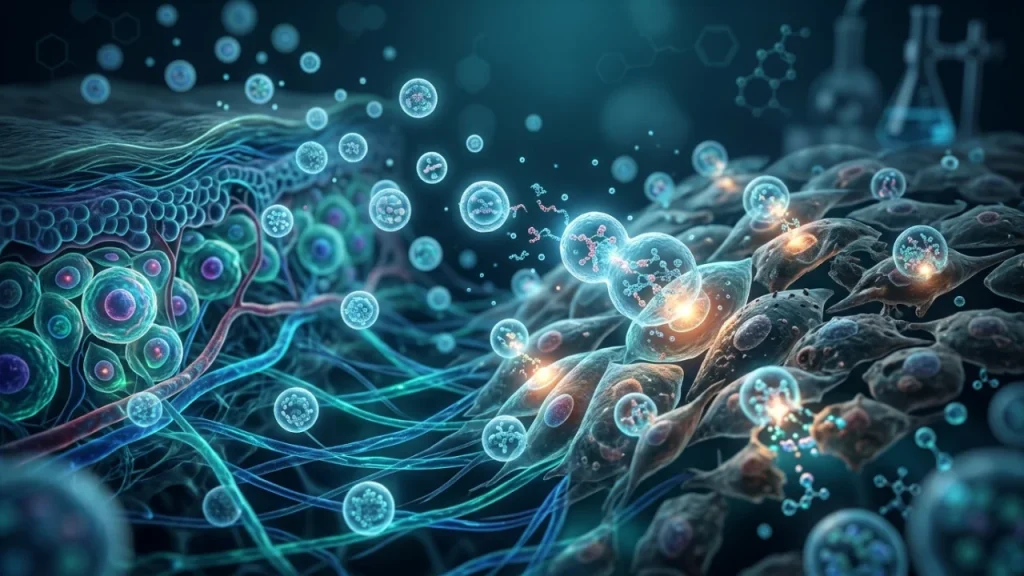
Imagine your body’s cells are like a vast city. They need to communicate to keep everything running smoothly. They don’t use phones or emails. Instead, they send tiny biological packages. These packages are called exosomes.
Exosomes are incredibly small vesicles. Think of them as microscopic bubbles. They are released by nearly every cell type in your body. Their job is to carry messages from one cell to another.
These messages are not simple notes. They are complex cargo. Each exosome carries a precise mix of molecules. This cargo tells the receiving cell what to do.
What’s inside an exosome? The contents are vital for their function. – They contain proteins. These can act as signals or building blocks. – They carry lipids. These help maintain the vesicle’s structure. – Most importantly, they hold nucleic acids like RNA. This RNA can change the activity of the cell that gets it.
This system is a natural part of your biology. Healthy cells use it to coordinate repairs. They also use it to maintain balance. For example, a stressed skin cell can send out exosomes. These exosomes alert neighboring cells. They tell them to prepare for a challenge.
The process is very targeted. An exosome released from a stem cell will have different instructions than one from a skin cell. The receiving cell has special receptors. These act like docks for the exosome. It’s a lock-and-key system. This ensures messages go to the right place.
Why does this matter for your skin? Your skin is your largest organ. It is constantly under stress. Sunlight, pollution, and time all affect it. Skin cells need clear communication to stay healthy and repair damage.
Traditional skincare products work from the outside. They moisturize or create a barrier. But they often cannot send specific repair commands deep into your skin’s layers. This is where the science of exosomes becomes so promising.
Researchers study how these natural messengers work. They look at how exosomes help with healing. For instance, an exosome from a mesenchymal stem cell might carry instructions to boost collagen production. Collagen is the protein that keeps skin firm.
The key idea is signaling. Exosomes are signaling vesicles. They don’t work because they become part of the cell permanently. They work by delivering a temporary, powerful set of instructions. Then they are recycled by the body.
This makes them fundamentally different from whole stem cells. Using isolated exosomes focuses on the communication, not the cell itself. It’s like using the text message instead of sending the entire person.
Understanding this messenger role is the first step. It explains why there is so much interest in exosomes skin research. Scientists want to learn how to use this natural system. The goal is to support the skin’s own repair processes with precise biological information.
In essence, your cells are already using this advanced technology every second. The next sections will explore how this science is being applied to help skin look and function at its best.
How Exosomes Differ from Traditional Skincare Ingredients
Most skincare ingredients face a tough biological barrier. This is your stratum corneum. It is the outermost layer of your skin. Think of it as a protective brick wall. Creams and serums are designed to work on or within this top layer. Their molecules are often too large to go deeper. They hydrate and protect the surface. This is useful but limited.
Active ingredients like retinoids or vitamin C aim to do more. They try to send signals into the living layers of skin. Yet their journey is difficult. The skin’s barrier is designed to keep things out. Only a small fraction of these actives get through. Their effectiveness depends on penetration. This is a major hurdle for traditional formulas.
Exosomes take a different path entirely. They are not absorbed like a cream. They function as biological communication packets. Your own cells naturally recognize and take them in. This process is called endocytosis. It is how cells talk to each other. This allows exosomes to deliver their messages directly to target cells deep in the dermis.
Think about the difference in targets. – Surface-level ingredients work on the stratum corneum. They improve smoothness and hydration there. – Penetrating actives aim for the epidermis. They can help with cell turnover and pigmentation. – Exosome signaling targets the dermis. This is where collagen, elastin, and blood vessels live. It is the structural foundation of your skin.
The mechanism is also completely different. A vitamin C serum provides antioxidant molecules. These molecules neutralize free radicals on contact. They are used up in the process. The effect ends when the molecules are depleted.
An exosome from a stem cell carries instructions. It might deliver microRNAs and proteins. These tell a fibroblast cell to make more collagen. The exosome does not become collagen itself. It triggers the cell’s own machinery. The effect can continue after the exosome is gone.
This addresses a core problem in skin aging. Aging skin cells get lazy or confused. Their communication breaks down. They produce less collagen. Signals for repair get lost. Topical ingredients can supply materials or nudge cells. But they cannot effectively reset cellular communication.
Exosomes aim to restore that dialogue. They carry specific orders. For example, orders might be to reduce inflammation, speed up wound healing, or boost energy production in cells. This is a targeted approach. It works with your skin’s biology.
Consider wound healing as a clear example. When you get a cut, your body releases exosomes immediately. These vesicles coordinate the repair response. They tell cells to move in, rebuild tissue, and form new blood vessels. Scientists are learning from this natural process.
Traditional skincare cannot replicate this coordinated signal. It is like the difference between giving someone tools versus giving them a detailed blueprint and a foreman. The tools help, but the blueprint directs the entire project.
This deeper action is why exosomes skin research is so focused on regeneration. The goal is not just to coat the surface. It is to instruct from within. This represents a shift from cosmetic improvement to fundamental cellular support.
Of course, this does not make traditional skincare useless. Surface care remains vital for protection and hydration. The future likely involves combination strategies using both methods for comprehensive skin health.
Understanding this distinction clarifies the innovation at hand. It moves us beyond simple application to intelligent biological signaling for lasting skin health benefits
The Natural Role of Exosomes in Your Body’s Repair System
Your body already uses exosomes. It has done so for a very long time. These tiny messengers are not a lab invention. They are a fundamental part of your biology. Every day, your cells release billions of them into your bloodstream and tissues. This is a constant, quiet conversation.
Think of a minor skin injury. A paper cut is a good example. The moment your skin breaks, damaged cells send out signals. They release specific exosomes into the area. These vesicles act as emergency dispatchers. They carry urgent molecular messages to nearby healthy cells.
The messages are clear and direct. One exosome might tell a cell to multiply quickly. Another might order blood vessels to grow new branches. Yet another could instruct immune cells to calm inflammation. This coordination is precise and efficient. It is your body’s built-in repair system at work.
This natural process highlights why exosomes skin research is so promising. Scientists are not creating a foreign substance. They are learning to enhance and guide a system that already exists. The goal is to support what your body naturally tries to do.
Exosomes work because they carry a precise cargo. This cargo includes different types of instructions. – Proteins can tell a cell to start building collagen. – RNA fragments can switch specific genes on or off. – Lipids help the exosome fuse with a target cell’s membrane.
This delivery system is key. It is protected and targeted. The exosome’s membrane shields its cargo from degradation. It travels safely through the tissue environment. When it finds the right cell, it delivers its instructions directly inside.
The scale of this activity is immense. A single cell can release thousands of exosomes. In a healing wound, trillions of these messengers are at work. They create a network of communication. This network ensures all cells work toward the same goal: repair.
Healing is just one natural role. Exosomes also help with routine maintenance. They remove cellular waste products. They help coordinate immune responses to minor threats. They even aid in the natural recycling of old cells. This keeps tissues healthy and functioning.
As we age, this system can become less efficient. Cells may send fewer exosomes. The messages might become less clear. This slowdown contributes to slower healing and thinner skin. Supporting this native messaging network is a logical step for advanced skincare.
Understanding this natural role changes how we view skin health. It is not just about applying external substances. It is about supporting internal communication. Healthy skin relies on clear signals between its cells.
The body’s own exosomes set the standard for regenerative signaling. They show us what is possible. The next step in science is learning how to apply these principles consistently for lasting skin health benefits. This bridges our understanding from natural repair to potential future applications.
Why Exosomes Skin Science Is a Big Deal Right Now
Traditional skincare faces a fundamental barrier. It is the skin’s own top layer, the stratum corneum. This layer is designed to keep things out. Most creams and serums cannot pass it deeply. Their ingredients sit on the surface or penetrate only slightly. This limits their ability to influence living skin cells where renewal happens.
Exosome science offers a different path. It works with the body’s own language. Remember, your cells already use exosomes to talk. Scientists are now learning to use these natural messengers. The goal is to support skin health from within its own communication network.
Why is this a big deal right now? Several key advances have converged. First, laboratory techniques have improved dramatically. Researchers can now collect and study exosomes with great purity. They can identify what specific messages these vesicles carry. This was not possible just a decade ago.
Second, we understand their stability. Exosomes are tough. Their protective lipid bilayer shields their cargo. This means they can be formulated into products that remain active. They are not as fragile as once thought.
Third, the results from early studies are compelling. Research shows exosomes can influence crucial skin processes. They send signals that tell cells to make more collagen. Collagen is the protein that gives skin its firmness and bounce. They can also reduce inflammation. Inflammation is a key driver of aging and redness.
Let’s look at the specific signals. Exosomes from certain stem cells carry instructions for: – Boosting fibroblast activity. Fibroblasts are the skin cells that build collagen and elastin. – Enhancing new blood vessel formation. This improves nutrient delivery and creates a healthy glow. – Calming overactive immune cells. This soothes irritated or sensitive skin.
This is not science fiction. It is published biology. The excitement comes from applying this knowledge in a new way. It shifts the strategy from forcing an effect with an acid or retinoid to gently guiding the skin’s own repair systems.
The potential for non-invasive solutions is huge. People want effective results without downtime or injections. Exosome-based topical treatments aim for this. They seek to deliver complex instructions, not just single ingredients. A single exosome can carry hundreds of signaling molecules working in harmony.
Think of it like updating the software of your skin cells. A cream might supply a new material, like hyaluronic acid. An exosome treatment could send a signal for your skin to make its own hyaluronic acid, collagen, and antioxidants. It encourages the skin to sustain itself.
Of course, this field is still young. Rigorous clinical trials are ongoing. Not all exosome sources are equal. The science must be precise. Yet the core principle is sound and revolutionary. It moves us beyond surface-level care to cellular dialogue.
This represents a true category shift in advanced skincare. It is not just another new ingredient. It is a new method of delivery based on biology’s own design. The focus turns to supporting the skin’s inherent intelligence for long-term health.
The next logical question is how these laboratory insights translate into real-world benefits for skin facing daily challenges and environmental stress.
The Core Science Behind Exosomes and Skin Renewal
How Exosomes Carry Instructions to Skin Cells
Exosomes are tiny biological delivery vehicles. They carry precise molecular instructions from one cell to another. This process is fundamental for skin renewal.
Think of a skin cell under stress. It might be damaged by UV rays or pollution. This cell can package specific molecules into an exosome. It then releases this exosome into the space between cells.
The exosome now travels. Its membrane acts like a protective envelope. Inside, it carries a vital cargo. This cargo is not random. It is carefully selected for communication.
What exactly is inside? The cargo includes several key types of molecules. – MicroRNAs are small pieces of genetic code. They do not carry blueprints for proteins. Instead, they act as master switches. They can turn specific genes in the target cell on or off. – Proteins like cytokines and growth factors are direct signals. They can bind to receptors on a target cell. This binding starts a chain reaction inside that cell. – Enzymes can help start or speed up chemical reactions in the recipient cell.
The exosome must find the right cell. It does not broadcast its message to everyone. The surface of the exosome has addressing molecules. These are like shipping labels or keys.
A target skin cell, like a fibroblast or keratinocyte, has matching locks. These are surface receptors. When the exosome’s key fits the cell’s lock, they bind together.
Fusion is the next critical step. The exosome’s membrane merges with the target cell’s membrane. It delivers its cargo directly into the cell’s interior. The instructions are now inside.
This direct delivery is key. It protects the fragile signaling molecules. Acids and enzymes in the skin’s environment would break them down if they traveled alone. The exosome’s lipid bubble provides safe passage.
Once inside, the cargo gets to work. A microRNA might silence a gene linked to inflammation. A growth factor protein might activate pathways for collagen production. The target cell changes its behavior based on these new commands.
This system is remarkably efficient. One exosome can deliver hundreds of these molecules at once. They work in a coordinated symphony. This is far more complex than a single ingredient like retinol hitting one receptor.
The source of the exosome matters greatly. An exosome from a young, healthy stem cell carries different instructions than one from a stressed or aged cell. The “message” depends entirely on the original sender cell’s state.
For skin renewal, the goal is to provide beneficial messages. We want to send signals that promote repair, calm inflammation, and boost energy production in skin cells. Exosomes from certain stem cells are rich in these positive instructions.
The entire process mimics the skin’s own natural communication network. It simply enhances it with a concentrated dose of constructive signals. The skin cell recognizes these signals because they are biological, not synthetic.
This explains how exosomes can influence deep skin processes from the surface. They use the body’s own language and mailing system. They tell cells not just to temporarily plump up but to fundamentally behave in a younger, healthier way.
Understanding this cargo-and-delivery mechanism shows why exosome science is so precise. It is not about dumping ingredients. It is about sending intelligently packaged commands that skin cells are evolved to obey for renewal and repair.
The Process of Exosome Formation from Stem Cells
Stem cells are not just simple containers. They are active factories. These factories constantly produce tiny messengers called exosomes. The process is deliberate and highly organized. It ensures each exosome carries a specific set of instructions.
The formation starts inside the cell’s command center. This area is called the endosomal system. Think of it as the cell’s mail room. Here, the cell gathers the molecules it wants to send out. These molecules include growth factors and RNA instructions.
A key structure forms here. It is known as a multivesicular body, or MVB. This MVB is like a sorting hub. Inside its membrane, small pockets begin to bud inward. These pockets trap the selected cargo inside them. Each pocket will become a single exosome.
The cell then makes a critical decision. It must choose where to send this MVB full of parcels. One path leads to destruction. The other path leads to delivery. For exosome release, the cell chooses delivery.
The MVB travels to the cell’s outer border. It fuses with the cell’s main membrane. This action is like a shipping dock opening to the outside. The tiny vesicles inside are now ejected. They enter the surrounding space as independent exosomes.
The entire process is tightly controlled by the cell’s genes. The stem cell’s health directly shapes this operation. A young, thriving stem cell runs an efficient factory. Its machinery selects optimal cargo for packaging.
What goes into the exosome is carefully chosen. The cargo is not random debris. It is a curated snapshot of the stem cell’s state and intent. This cargo typically includes several key components.
- Signaling proteins tell a target cell to grow or repair itself.
- MicroRNAs are small pieces of genetic code. They can silence harmful genes in aging skin cells.
- Enzymes help boost energy production in tired cells.
- Protective molecules shield skin from oxidative stress.
The type of stem cell determines the cargo mix. A mesenchymal stem cell may pack different instructions than a different stem cell type. The source tissue also influences the message.
The production rate is not constant. Cells release more exosomes when they receive certain signals. For example, a mild stress signal can increase output. This primes the system for repair and communication.
This manufacturing process is natural and continuous. Our bodies make exosomes every second. The goal in advanced skincare is to harness this natural system. We use exosomes from optimal sources to support skin renewal.
Understanding this formation process shows why exosomes are so sophisticated. They are not just broken-off pieces of a cell. They are purpose-built, nano-scale delivery vehicles. Their formation ensures their precision.
This biological assembly line is the foundation for their potential in skin care. It explains how they carry coherent, beneficial messages. The next logical step is to see how these freshly made messengers actually reach and enter a target skin cell to deliver their renewal commands.
Key Molecules Inside Exosomes That Affect Skin
Exosomes carry a precise toolkit for skin renewal. Think of them as tiny supply packets. Each packet contains special molecules. These molecules give instructions to your skin cells.
The cargo includes powerful signaling proteins. One key group is growth factors. These are not like fertilizer for plants. They are more like precise commands.
For example, TGF-β is a common protein in exosomes. It tells fibroblasts to make more collagen. Collagen is the main support structure of your skin. Another protein, VEGF, helps build new, healthy blood vessels. This improves nutrient delivery and creates a healthy glow.
These proteins work together. They turn on the skin’s own repair systems. The goal is not to force cells to act. It is to remind them of their natural, youthful functions.
Another vital part of the cargo is microRNA. These are small pieces of genetic code. They do not carry instructions for making proteins. Instead, they control which genes are active.
Aging skin often has overactive harmful genes. These genes can promote inflammation or break down collagen. Exosome microRNAs can silence these genes.
For instance, miR-21 might be downregulated by therapeutic exosomes. This can reduce a pathway that leads to scarring. miR-145 might help calm cellular stress signals. This precise genetic regulation is a key advantage.
Enzymes form a third critical group. Catalase is a common enzyme in exosomes. It directly breaks down hydrogen peroxide. Hydrogen peroxide is a damaging reactive oxygen species.
This is a direct antioxidant defense. It happens inside the cell where it matters most. Topical creams often cannot deliver enzymes this deeply.
Other enzymes support cellular energy factories called mitochondria. With better energy, skin cells perform all their duties better. They repair damage more efficiently and renew themselves.
The combined effect of this cargo is coordinated renewal. It is not one molecule doing one job. It is a symphony of signals.
- Signaling proteins activate repair pathways.
- MicroRNAs fine-tune gene expression for youth.
- Enzymes protect and energize the cell.
This molecular mix directly targets the hallmarks of aging skin. It addresses weak collagen production and poor cell turnover. It also fights chronic, low-level inflammation known as inflammaging.
Research on exosomes skin applications focuses on this cargo profile. Scientists study which stem cells produce the most beneficial mix. The ideal exosome for skin health carries a balanced set of these molecules.
The impact is cellular communication at its finest. An old or stressed skin cell receives the exosome’s payload. It then changes its behavior based on the instructions inside.
The cell might start building more structural proteins. It might decide to divide and create a fresh new cell. It could also release its own healthy signals to neighbors.
This creates a positive ripple effect in the tissue. One cell’s improved function influences others nearby. The goal is a widespread renewal response.
Understanding these key molecules solves a puzzle. It shows why exosomes are more than simple carriers. They are master regulators of skin cell function.
Their power comes from this natural, complex cargo. No single synthetic ingredient can mimic this precise combination. The next question is how these molecules are safely delivered into the living layers of skin where they can work.
How Exosomes Cross Barriers to Reach Deep Skin Layers
The skin’s surface is a formidable barrier. This outer layer, the stratum corneum, is made of dead, tightly packed cells. It acts like a protective wall. Most skincare ingredients cannot cross this barrier. They sit on top or penetrate only slightly. This is a major limit of traditional topicals.
Exosomes use a different strategy. They are natural navigators. Their small size is their first advantage. An exosome measures about 30 to 150 nanometers in diameter. This is incredibly tiny. A nanometer is one billionth of a meter. For scale, a human hair is about 80,000 nanometers wide.
Their tiny size lets them move through small spaces. But size alone is not enough. They must also be recognized. Exosomes have specific proteins on their outer surface. Think of these proteins as identification cards or keys.
Skin cells have corresponding receptors. These receptors act like locks. When an exosome’s surface protein finds a matching receptor, it can bind. This binding is a critical signal. It tells the skin cell to welcome the exosome inside.
The process of entering a cell is called uptake. Cells use several methods for this.
- Receptor-mediated endocytosis is a common path. The cell membrane folds inward around the exosome. It forms a small pouch called a vesicle. This vesicle carries the exosome into the cell’s interior.
- Some exosomes fuse directly with the cell membrane. They merge with it like two soap bubbles joining. This releases the exosome’s cargo directly into the cell’s fluid.
- Other pathways involve phagocytosis or macropinocytosis. These are forms of cellular “drinking” or “eating.”
This targeted uptake is efficient. It means exosomes are not passively drifting. They are actively recruited by the cells that need their signals most. Stressed, aging, or damaged cells often show more of these receptor “locks.” This draws more exosomes to them.
Once inside, the exosome’s mission continues. The vesicle carrying it may travel deeper into the cell’s cytoplasm. The exosome can then release its payload. The signaling proteins, microRNAs, and enzymes are set free.
They go to work on the cell’s machinery. The previous section detailed this molecular symphony. This delivery ensures the instructions reach the exact place they are needed. It happens inside the living cell, far beneath the skin’s dead surface layer.
Research on exosomes skin renewal confirms this journey. Studies track fluorescently labeled exosomes. Scientists watch them move through skin models. The data shows exosomes reaching the vital dermal layer within hours.
The dermis is where collagen and elastin live. It is the skin’s structural foundation. Topical creams rarely reach this depth effectively. Exosomes, however, can deliver renewing signals directly to fibroblasts there.
This deep delivery solves a historic skincare problem. We can now send complex instructions to the skin’s living factories. The barrier is no longer a stop sign. It becomes a selective gateway.
The science shows a precise two-step mechanism. First, physical navigation due to small size. Second, biological entry via specific cellular recognition. Together, they ensure the regenerative cargo arrives at its destination ready to work.
This reliable delivery system sets the stage for the next logical question. What visible changes occur in skin when these signals are received?
Exosomes Skin Benefits: What You Can Really Expect
Stimulating Collagen Production for Firm Skin
Collagen is your skin’s support framework. Think of it as the steel beams inside a building. Fibroblasts are the cells that make this collagen. As we age, these cells slow down. They also get damaged by sun and pollution. The result is thinner, weaker skin. It loses its firmness.
Exosomes address this problem at its source. They carry specific instructions for fibroblasts. These are not simple nutrients. They are precise biological commands. The previous section explained how exosomes reach these deep cells. Now, let’s see what happens next.
The exosome releases its payload of microRNAs and proteins. These molecules enter the cell’s nucleus. The nucleus is the control center. Here, our DNA holds the blueprint for making collagen. The exosome’s signals act like a switch. They turn on the genes responsible for collagen production.
This process is called upregulation. It means increasing the activity of a gene. The fibroblast gets a clear message: make more collagen. It is not a vague stimulus. It is a targeted command.
The mechanism involves several key steps: – Signaling proteins bind to receptors on the fibroblast. – This triggers a cascade of events inside the cell. – Specific microRNAs silence genes that suppress collagen. – Other microRNAs activate the collagen-producing machinery. – Enzymes help assemble the long collagen protein chains.
New collagen fibers are then exported from the cell. They integrate into the existing dermal matrix. This adds new structure to the skin. The network becomes denser and stronger. Research on exosomes skin rejuvenation measures this effect. Studies show a measurable increase in collagen types I and III. These are the most important types for skin strength.
The new collagen is your own. It is not injected or applied topically. Your cells produce it naturally. This is a fundamental difference from many traditional treatments. Those often try to protect existing collagen. Exosomes tell your body to create new collagen.
The timeline for this is biological, not instant. Cells need time to receive signals and act. Visible firming does not happen overnight. It follows the natural cycle of skin renewal. Studies suggest changes begin at a cellular level within days. Structural improvements in the matrix build over weeks.
This process also improves collagen quality. Young, healthy collagen forms strong, organized bundles. Aged or sun-damaged collagen is often fragmented and disorganized. Exosome signaling helps normalize this structure. It encourages the formation of a robust, functional matrix.
The benefit is cumulative and sustainable. Each fibroblast that receives the signal contributes to the overall effect. The goal is to restore a more youthful pattern of protein production. This leads to genuinely firmer, more resilient skin.
The stimulation of collagen is a core example of regenerative skincare. It moves beyond surface care or temporary plumping. It aims to rebuild the skin’s foundational layer. This sets the stage for other visible improvements in texture and tone.
Accelerating Wound Healing and Reducing Scar Tissue
Exosomes play a crucial role in how your skin heals from injury. They help coordinate every step of the repair process. This goes beyond simple collagen production. It involves precise cellular communication to fix damage quickly and cleanly.
The healing process has distinct phases. First comes inflammation to clean the wound. Then new tissue forms. Finally, remodeling occurs. Exosomes are active in all these stages. They carry instructions that tell cells what to do next.
One key task is reducing initial inflammation. Excessive inflammation can slow healing. It can also lead to worse scarring. Exosomes from stem cells send calming signals. These signals help control the immune response. This creates a better environment for repair.
Next, exosomes speed up the growth of new blood vessels. This process is called angiogenesis. New vessels bring oxygen and nutrients to the damaged area. They are essential for building new skin. Exosome signals encourage endothelial cells to form these tiny networks rapidly.
Fibroblasts are then recruited to the site. These are the same cells that make collagen. In a wound, their job is urgent. They must quickly produce new matrix to fill the gap. Exosomes boost fibroblast activity and movement. This leads to faster granulation tissue formation.
The quality of this new tissue is vital. Exosomes help ensure it is organized and functional. They guide fibroblasts to produce the right types of collagen in the right arrangement. This reduces the chance of forming weak, disorganized scar tissue.
Scar improvement is a major focus. A scar forms when the remodeling phase is not perfect. The collagen bundles remain thick and misaligned. They lack the basket-weave pattern of healthy skin. This makes scars look raised, red, or discolored.
Exosome therapy aims to change this outcome. The messages in exosomes can modify the remodeling phase. They encourage the breakdown of excessive collagen. They simultaneously promote the synthesis of new, properly structured fibers. This dual action helps normalize the scar.
The result is a softer, flatter, and more flexible scar. The color often improves, becoming closer to your natural skin tone. This is not just masking the scar. It is actively improving its underlying architecture.
The mechanism for scar reduction is intelligent. Exosomes do not erase the scar completely. They instead help guide the body toward a more natural repair. They shift the process from one of simple patching to one of more refined regeneration.
This has clear implications for post-surgical care. It also applies to healing from acne lesions, burns, or other trauma. The goal is to minimize long-term visible evidence of the injury.
The timeline for wound healing benefits can be relatively fast. Cellular signals begin immediately upon application. The acceleration of early stages may be noticeable within days. Improved scar appearance develops over subsequent weeks and months.
It is a proactive strategy. The best results often come from early intervention during the active healing phase. This is when cellular instructions can have the greatest influence on the final result.
Consider the steps exosomes take in wound repair: – They modulate inflammation to prevent excessive damage. – They accelerate the formation of new blood vessels. – They recruit and activate fibroblasts for matrix production. – They guide tissue remodeling to improve scar quality.
This coordinated action makes exosomes a powerful tool for repair. It showcases their function as master regulators of skin biology. They do not just add a substance; they direct an intelligent program.
The benefit for skin is a faster return to normal function and appearance. It also means less lasting damage from life’s inevitable cuts, scrapes, and procedures. This accelerates the journey back to healthy, intact skin.
This healing capability naturally connects to another visible benefit: tone and pigment correction. After repair, achieving even color is often the next concern for skin vitality.
Calming Inflammation for Healthier Skin Balance
Inflammation is not always a visible flare-up. It can be a quiet, ongoing process beneath your skin’s surface. This low-grade irritation weakens your skin’s foundation over time. Exosomes directly address this root cause. They carry specific instructions to calm overactive immune cells.
Think of your skin’s immune cells as security guards. Sometimes, they react too strongly to minor triggers. These triggers can be sun exposure, pollution, or even stress. The guards sound a prolonged alarm. This causes chronic redness and sensitivity.
Exosomes deliver messages that help recalibrate this response. They tell the guards to stand down when the threat is minor. This reduces the constant release of inflammatory signals. Key signals like TNF-alpha and IL-6 are modulated. The skin’s environment becomes more peaceful.
The result is a stronger, more resilient skin barrier. A calm barrier is better at keeping moisture in and irritants out. This break from constant inflammation allows your skin to focus its energy on repair and maintenance. It can finally perform its normal healthy functions.
The benefits for your skin balance are clear: – A visible reduction in persistent redness and flushing. – Less reactivity to common skincare products or environmental changes. – Decreased sensations of stinging, itching, or general discomfort. – A more even and comfortable complexion overall.
This calming effect is fundamental. It sets the stage for all other improvements in skin health. You cannot effectively address tone or texture if underlying inflammation persists. Exosomes create the stable base needed for lasting results.
The process is biological, not just cosmetic. It is about resetting your skin’s internal communication. Traditional topicals often work on the surface to suppress symptoms. Exosomes work within the cellular language itself. They promote a state of balance known as homeostasis.
Consider common conditions driven by inflammation. Rosacea and certain types of acne are prime examples. These are not just surface issues. They involve complex immune pathways deep within the skin. The exosomes skin approach targets these pathways precisely.
The effects build over time with consistent use. The initial change might be a feeling of comfort. Visible calm often follows. This is not an instant blurring effect. It is a gradual return to your skin’s natural, balanced state.
Healthy skin balance also means better long-term aging outcomes. Chronic inflammation breaks down collagen and elastin. This process is known as inflammaging. By calming this fire, exosomes help protect your skin’s supportive structure. They support both immediate comfort and future resilience.
Ultimately, managing inflammation is about giving your skin a chance to thrive. It moves from a defensive mode to a renewal mode. This shift is crucial for achieving a clear, even, and vibrant complexion. Calm skin is the canvas upon which all other regenerative benefits become truly visible. This foundational balance naturally leads us to consider another key sign of vitality: the skin’s glow and luminosity.
Improving Skin Texture and Smoothness Over Time
Skin texture improves when your skin rebuilds its foundation. Exosomes guide this rebuilding process. They send clear instructions to your skin’s worker cells.
Think of skin texture like a lawn. Bumpy, rough skin has patches of thick grass and bare dirt. It is uneven. Smooth skin is like a lush, even turf. To fix a bumpy lawn, you need to reseed thin areas and level the soil. Your skin works in a similar way. Exosomes help reseed and level.
The key cells for texture are fibroblasts. They live deep in your skin. Fibroblasts make collagen and elastin. These proteins are the support structure of your skin. They are like the springs and padding inside a mattress. Over time, these springs can sag or break. Sun exposure and inflammation speed up this damage. The mattress becomes lumpy.
Exosomes skin therapy tells fibroblasts to become more active. They start producing new, well-organized collagen. This is not just more collagen. It is better quality collagen. The new fibers form a strong, neat network. This network fills in minor scars and softens fine lines from within. The surface begins to level out.
Smoothness also comes from proper hydration and shedding. The outermost layer of your skin is the stratum corneum. It is made of dead skin cells. In healthy skin, these cells shed evenly. In textured skin, they can clump together. This creates a rough, flaky feel.
Exosomes improve communication with keratinocytes. These are the cells that create the skin’s surface. Signals from exosomes help normalize the turnover cycle. Old cells shed more regularly. New, plump cells rise to the surface in an orderly way. The result is a smoother tactile feel.
You can expect changes in stages. The first stage is often a change in softness. People notice their skin feels smoother to the touch within several weeks. This is due to better surface hydration and cell turnover.
The second stage involves visual evenness. After consistent use, diffuse redness from tiny surface capillaries may lessen. Minor acne scars or large pores can appear less defined. This happens because new collagen slowly fills depressions from below. It is a gradual blurring effect.
The third stage is improved resilience. Skin with a robust collagen matrix bounces back better. It does not crease as easily. It may resist forming new fine lines from repeated expressions.
Here is what the process targets directly: – Collagen depletion: Boosts production of Type I and Type III collagen. – Irregular shedding: Promotes balanced cell turnover for a polished surface. – Barrier function: Strengthens the skin’s moisture barrier, plumping up texture. – Micro-injuries: Aids in the organized repair of daily wear and tear.
Do not expect dramatic changes overnight. This is not an acid peel that strips surface layers. It is a cellular renovation project. The timeline mirrors your skin’s natural regeneration cycle, which is about 30 to 40 days per layer. Most people see meaningful texture improvement over three to four months.
The final look is not glassy or artificial. The goal is your healthiest possible skin texture. It should feel supple and look even under natural light. This refined canvas allows light to reflect uniformly, which leads us directly to the next hallmark of revitalized skin: a radiant, natural glow.
How Exosomes Combat Visible Signs of Aging
Reducing Fine Lines and Wrinkles with Cellular Signals
Fine lines start deep within your skin. They are not just surface folds. They are a sign of slowing cellular communication. As skin ages, its cells send fewer repair signals. The production of vital proteins like collagen drops. This is where exosomes make a key difference.
Think of an exosome as a tiny instruction packet. It is released by a healthy, young cell. It travels to an older target cell. Then it delivers a precise set of commands. These commands tell the aging cell to act young again.
For wrinkles, the main command is: “Make more collagen.”
But how does this packet deliver its message? It uses two main methods. First, it carries proteins on its surface. These proteins latch onto receptors on your skin cells. This docking action triggers a chain reaction inside the cell. It turns on genes for repair.
Second, the exosome can be absorbed whole. The target cell engulfs it. Once inside, the exosome releases its cargo. This cargo includes microRNAs. These are small pieces of genetic code. They do not change your DNA. Instead, they directly influence how your cell reads its own instructions. They can silence genes that cause inflammation. They can activate genes that build structure.
The result is a targeted reboot of your skin’s factory settings.
This process focuses on two primary structural proteins. Type I collagen gives skin its firmness and strength. Type III collagen provides flexibility and elasticity. Aging reduces both. Exosome signals help restore their balanced production.
The effect on wrinkles is multi-layered. It works from the bottom up.
- Deep static wrinkles: These are permanent grooves. They form from a major loss of structural support. Exosomes cannot erase them completely. They can help plump the underlying area. This may make the wrinkle appear shallower.
- Dynamic expression lines: These come from smiling or squinting. They are more responsive to treatment. Better collagen and elastin allow skin to snap back faster after movement.
- Fine surface lines: Often from dryness or minor damage. Improved barrier function and hydration smooth these quickly.
The timeline for seeing changes follows a biological schedule. You will not see immediate filling of lines. First, cells must receive the new signals. Then they start synthesizing new proteins. This fresh collagen needs time to organize into strong fibers.
You might notice initial softening of fine lines within several weeks. This is often due to better hydration and cell turnover. Deeper improvements in wrinkle depth take longer. Significant change requires months of consistent renewal cycles.
This method differs from common topical treatments. Most creams work on the surface layers only. They may plump skin with humectants temporarily. Procedures like injections fill lines physically from outside. Exosomes aim to fix the root cause inside your cells.
They encourage your own skin to rebuild its foundation.
The goal is natural-looking resilience. Skin should move and flex without deep creasing. The reduction in lines should be subtle and progressive. It mirrors how those lines formed slowly over years.
This cellular signaling also has a protective effect. By promoting healthier cell behavior, skin may become more resistant to new damage from UV light and pollution. It strengthens its own defenses from within.
Ultimately, reducing wrinkles with exosomes is about restoring clear communication. It helps aging cells remember their vital tasks. The next logical step is to examine how this renewed cellular activity impacts another universal sign of aging: the loss of firmness and contour in the face’s architecture.
Restoring Elasticity for Youthful Bounce and Lift
Young skin bounces back after being pressed or pulled. This snap-back quality is called elasticity. It comes from a network of proteins within your skin’s support layers. The most important of these proteins is elastin. Think of elastin as tiny, coiled springs. They let skin stretch and then return to its shape.
Aging skin loses this bounce. It can start to sag or feel loose. This happens for several clear reasons. First, your skin makes much less new elastin as you get older. Second, the existing elastin fibers get damaged. Sun exposure is a major cause of this damage. Third, other support structures that hold these springs in place break down.
Exosomes address this loss directly. They carry specific instructions to your skin cells. These instructions tell cells to ramp up production of crucial proteins. Elastin is one of the main targets. But the process is more sophisticated than just making more springs.
Exosomes also promote the creation of a supportive framework. This framework is made of proteins like fibrillin and fibulin. These proteins form a scaffold. The new elastin fibers attach to this scaffold. This ensures they are organized and functional. Without this support, new elastin would be weak and disorganized.
The signaling from exosomes does another vital job. It helps regulate enzymes in the skin. Some enzymes, called elastases, break down elastin. In aging skin, these enzymes can become too active. They destroy the elastic fibers faster than they can be replaced. Exosome messages can help balance this activity. They support the natural inhibitors that keep these destructive enzymes in check.
The result is a dual approach to restoring elasticity. – It boosts the production of new, healthy elastin. – It helps protect the existing elastic network from further breakdown.
This process takes time. You are essentially guiding your skin to rebuild an intricate system. The initial effects often relate to hydration and texture. Skin may feel smoother and more supple first. The true lifting and bouncing effect comes later.
It emerges as new elastic fibers integrate into the dermis. This can lead to a gradual tightening of the skin’s appearance. Jowls may look slightly firmer. The contour of the cheek might appear more defined. This is not the same as the sudden pull from a surgical lift. It is a subtle restoration of your skin’s inherent architecture.
The concept of exosomes skin renewal is rooted in this cellular retraining. The goal is not to add a foreign filler. The goal is to empower your cells to rebuild what was lost. This method supports the skin’s natural physics.
Elasticity also depends on good hydration and circulation. Exosome signaling improves overall cell health. Healthier cells produce better components for the skin matrix. They also manage moisture more effectively. Well-hydrated skin allows elastic fibers to function optimally.
Think of a rubber band. A dry, old rubber band cracks and loses its stretch. A cared-for rubber band remains supple and resilient. Exosomes help provide the internal care your skin’s elastic network needs.
This restoration of bounce has a visual impact. Skin looks more vibrant and alive when it has good elasticity. It reflects light in a healthier way. It moves smoothly with facial expressions without forming permanent creases.
The journey from loss to recovery is a cellular one. Each new signal from the exosomes guides fibroblasts—your skin’s builder cells—toward a more youthful blueprint. These cells slowly weave new elasticity into the fabric of your skin.
Ultimately, restoring bounce is about re-engineering support from within. It complements the work on collagen for wrinkles. Together, they tackle two pillars of youthful structure: firmness and flexibility. When skin regains both, it doesn’t just look younger—it acts younger, responding to movement with resilient grace. This sets the stage for addressing another layer of the aging puzzle: the vitality and evenness of the skin’s surface tone itself.
Enhancing Skin Luminosity and Natural Glow
Skin luminosity comes from within your cells. It is not about surface shine or makeup. True glow is light reflecting off a smooth, clear, and healthy skin surface. Dull skin often has a rough texture. It also has poor cell turnover. Exosomes address these core issues directly.
Your skin cells constantly communicate. They send signals to coordinate renewal and repair. As we age, this communication slows down. Messages get lost or delayed. Cells become less efficient. This leads to a buildup of old, tired cells on the surface. These cells are flat and reflect light poorly. They create a dull, uneven finish.
Exosomes act as a cellular update. They deliver fresh instructions to your skin’s living layers. These instructions tell cells to optimize their basic functions. Think of it like restarting a stalled engine. The cells begin to work better. Three key improvements then happen.
First, cell renewal speeds up. The process where old surface cells shed is called desquamation. Healthier cells follow a more youthful schedule. They shed old layers more efficiently. This reveals newer, fresher cells underneath. These young cells have a plump, uniform shape. They sit flush against each other. This creates a smoother surface for light to bounce off.
Second, cellular energy increases. Each cell has tiny power plants called mitochondria. Exosome signaling can help mitochondria work better. A cell with more energy performs all its duties more effectively. It hydrates itself. It repairs damage. It produces essential proteins. An energized cell is simply healthier. Healthy cells have a natural vibrancy that translates to visible glow.
Third, exosomes support the skin’s natural antioxidant network. Daily life creates free radicals from sun and pollution. These molecules damage cells and cause inflammation. This makes skin look tired and gray. Exosomes carry messages that boost the skin’s own defenses. Cells become more resilient against this stress. With less background inflammation, skin looks clearer and more radiant.
The result is a multi-layered improvement in light reflection. – A smoother surface scatters less light. More light reflects directly back, creating a sharp shine. – Plumper, well-hydrated cells have a translucent quality. Light penetrates slightly and bounces back with a deeper, softer radiance. – Clearer skin with less redness or grayness allows for a purer reflection of your natural tone.
This glow is fundamentally different from artificial methods. Scrubs polish only the very top layer of dead cells. Moisturizers temporarily add surface sheen. Exosome skincare works on the living biology beneath. It helps your skin produce its own lasting luminosity from the source.
The change is gradual but profound. You do not simply add shine. You remove the biological causes of dullness. Your skin begins to behave like younger skin once did. It renews itself with purpose. It manages energy and stress better. The glow that emerges is the visual sign of this restored cellular health.
This journey from dull to radiant completes a key transformation in skin appearance. We have moved from structure to surface quality. Yet one final frontier remains for a truly youthful look: the clarity and evenness of the skin’s color itself.
Strengthening Skin Barrier Function for Protection
Your skin barrier is your body’s frontline defense. Think of it as a wall made of living cells and mortar. This wall keeps good things in and bad things out. It holds moisture. It blocks pollutants and irritants. A weak barrier leads to problems. Skin can become dry, sensitive, and easily damaged.
Exosomes deliver specific instructions to reinforce this wall. They do not simply add a temporary layer. They teach your skin cells to build a stronger, smarter barrier themselves. This process involves several key actions.
First, exosomes signal for increased production of ceramides. Ceramides are the essential “mortar” between your skin cells. They hold everything tightly together. More ceramides mean fewer gaps in your barrier. This prevents water from escaping. It also stops irritants from slipping in.
Second, they support the cells that produce keratin. Keratin is a tough protein. It forms the sturdy “bricks” of your skin’s wall. Healthy keratin gives skin its strength and integrity. Exosomes help ensure these proteins are made correctly and in good supply.
Third, exosomes promote the creation of natural moisturizing factors. These are molecules inside skin cells that attract and hold water. They act like tiny sponges. This hydration keeps cells plump and functional. A plump cell fits better with its neighbors, leaving no weak spots.
The result is a barrier that performs better under stress. It is more resilient to daily challenges. – It better retains moisture, reducing trans-epidermal water loss. – It withstands exposure to harsh environmental elements. – It reduces reactivity to common irritants found in soaps or fabrics. – It recovers more quickly from minor damage, like light scratching.
This strengthening has a direct visual impact. A robust barrier means skin is better hydrated from within. Well-hydrated skin looks smoother and more supple. It has fewer fine lines from dryness. The surface reflects light more evenly, contributing to a healthy glow.
Furthermore, a strong barrier prevents a cycle of inflammation. When irritants penetrate a weak barrier, they trigger immune alerts. This causes background redness and sensitivity. By fortifying the wall, exosomes help keep these triggers out. This leads to calmer, clearer-looking skin over time.
The science behind this is precise. Exosomes carry microRNAs and proteins. These molecules directly influence gene activity in skin cells. They turn on genes responsible for barrier repair and maintenance. This is cellular communication at its most effective. Your skin receives a clear message to build its defenses.
Consider how traditional products often work. Heavy creams sit on top of the barrier. They can occlude and protect temporarily. But they do not teach the skin to improve its own structure. Exosome skincare works on a foundational level. The goal is lasting resilience, not just a temporary shield.
This protective benefit is crucial for long-term skin health. Every day, your skin faces threats like UV rays and pollution. A resilient barrier minimizes the cumulative damage from these exposures. This directly combats visible signs of aging that stem from daily wear and tear.
Strengthening the skin barrier is therefore a proactive strategy. It is about prevention as much as correction. By building a stronger defense, you help prevent future damage before it starts. This sets the stage for the next critical aspect of a youthful appearance: achieving even tone and clarity by addressing pigmentation at its source.
The Practical Future of Exosomes in Skincare
Integrating Exosomes into Daily Skincare Routines
Exosome skincare is moving beyond the clinic. The goal is to bring its foundational benefits into daily routines. This shift requires stable formulations. Scientists are mastering this challenge. They encapsulate exosomes in protective layers. These layers shield the delicate vesicles until they reach the skin.
Think of your current skincare steps. You likely use a cleanser, a serum, and a moisturizer. Future exosome products could fit into these familiar slots. The most likely entry point is the serum step. Serums are designed to deliver active ingredients deep into the skin. An exosome serum would work on this principle. It would deliver billions of these biological messengers directly to your cells.
A daily regimen would focus on consistent support. It is like taking a vitamin for your skin cells. Instead of a one-time repair, it provides ongoing instruction. This helps skin maintain its optimal functions every day. The result is cumulative improvement over weeks and months.
The application process would be simple. You would apply an exosome formula to clean, dry skin. Gentle patting would help with absorption. Following with a moisturizer would seal in hydration. This routine mirrors what many people already do. The difference lies in the intelligence of the active ingredient.
Key benefits of daily integration include sustained barrier reinforcement. Remember, your skin barrier faces daily assaults. Pollution and stress weaken it constantly. Regular exosome signaling could help cells continuously repair minor damage. This prevents small issues from becoming larger problems.
Another benefit is adaptive response. Your skin’s needs change with seasons and environment. Exosomes carry information that can help cells adapt. In dry weather, they might boost hydrating protein production. In humid weather, they could focus on balancing oil levels.
Let’s consider what this means for exosomes skin health long-term. The core idea is cellular education. Your skin cells become better at their jobs. They communicate more effectively with each other. This leads to a more harmonious and resilient organ.
Potential product formats are under research: – Stabilized serums for morning or evening use. – Lightweight emulsion creams for all-day support. – Mist toners for a quick refresh and barrier boost.
Stability is the main hurdle for home use. Exosomes must survive in a bottle on your shelf. Advanced lipid packaging solves this. These packages break open only upon contact with skin cells. This ensures the exosomes remain potent and active.
The user would not see immediate dramatic changes. The action is subtle and cellular. Visual improvements would appear gradually. Skin would look more even-toned and plump over time. Sensitivity episodes would likely become less frequent.
This approach complements professional treatments. A clinic procedure might provide a major reset. Daily home care would then maintain and extend those results. The two modalities would work together in a complete plan.
Safety for daily use is paramount. Exosomes from certain sources, like mesenchymal stem cells, have a high safety profile. They do not replicate like live cells. They simply deliver their messages and are naturally recycled by the body.
The future of skincare is intelligent maintenance. Integrating exosomes into daily routines represents this shift. It moves us from covering up issues to proactively managing skin health at the source. This foundational care supports every other cosmetic goal, from anti-aging to clarity, by ensuring the skin itself functions at its best.
What to Look for in Exosome-Based Skincare Products
Choosing an exosome-based skincare product requires careful attention. Not all formulas are equal. Their effectiveness depends on several key factors. You need to look beyond marketing claims. Focus on the science behind the product.
First, consider the source of the exosomes. The origin matters greatly for safety and function. Exosomes from mesenchymal stem cells are widely studied. These cells come from ethical sources like donated umbilical cord tissue or fat. This source is known for its regenerative signals. It also has a strong safety profile. The exosomes should be thoroughly purified. They must be free from the original cells. This prevents any unwanted reactions.
The concentration of exosomes is another vital detail. This is often listed as particle count. A higher number is not always better. But a meaningful quantity is necessary. It must be enough to trigger a biological response in your skin. Some products might use a very low dose. This could limit their impact. Look for products that disclose this information clearly.
The delivery system is perhaps the most critical part. Exosomes are fragile. They can break down in a simple serum. Advanced lipid packaging protects them. These tiny fat bubbles shield the exosomes until they reach your skin. Upon contact, they fuse with your skin cells. This releases the exosomes directly where they are needed. Without this protection, the messengers might not survive.
You should also check for third-party testing. Independent labs can verify the product’s contents. They confirm the particle count and purity. They also check for sterility. This means no harmful bacteria are present. This testing provides an extra layer of trust. It shows the company values proof over promises.
Examine the entire ingredient list. The formula should be clean and supportive. It should avoid harsh preservatives or alcohols. These could damage your skin barrier. They could also degrade the exosomes. Look for complementary ingredients like peptides or ceramides. These support skin health alongside the exosomes.
The product’s stability claims are important too. Exosomes lose power if not stored correctly. Some products require refrigeration. Others are stable at room temperature for a certain period. Understand the storage needs before you buy. Check the expiration date as well.
Be wary of products that promise instant miracles. Exosome skincare works at a cellular level. Changes are gradual and foundational. Realistic claims are a sign of a credible brand.
Here is a simple checklist for your evaluation: – Source: Ethical, well-documented stem cell origin. – Concentration: A disclosed and meaningful particle count. – Delivery: A protective system like lipid packaging. – Verification: Third-party testing for purity and count. – Formula: A clean, supportive ingredient list. – Stability: Clear storage instructions and shelf life.
Understanding these factors empowers you to make an informed choice. You can navigate this new category with confidence. This knowledge helps you find products that truly support your skin’s health from within.
The journey does not end with selecting a product. How you use it is the final step for success.
Safety and Efficacy Considerations for Exosomes Skin Use
Safety starts with understanding what exosomes are and are not. They are natural messengers. Your own cells make them every day. In skincare, we use a concentrated form. This form comes from controlled lab settings.
A key point is purity. Exosome preparations must be free from whole cells or harmful agents. Reputable suppliers test for this extensively. They ensure only the tiny vesicles are present. Think of it like filtering pure water from a stream. You remove the leaves and debris. You keep the clean water.
The source of exosomes matters for safety. Most derive from mesenchymal stem cells. These are often from human or plant tissues. The process must follow strict guidelines. These guidelines prevent contamination. They also ensure consistency from batch to batch. Your skin recognizes these signals as natural. It is not a foreign invasion.
Now consider efficacy. How do exosomes actually work on skin? They deliver instructions and materials to your cells. They do not act like a typical acid or retinoid. Those ingredients work by forcing a change. Exosomes work by sending a request.
For example, an exosome might carry a message for collagen production. Your fibroblast cells receive this message. They then start their natural work of building support fibers. The result is firmer, more resilient skin over time. This process is gentle. It is also fundamental.
Application technique influences results greatly. Always start with clean, dry skin. This removes barriers to absorption. Apply the exosome product as directed. Usually this is after cleansing and before heavier creams.
Pat the product gently onto your face. Do not rub aggressively. Rubbing can shear the delicate vesicles. It might break them apart before they can work. Think of applying a delicate serum, not scrubbing a surface.
Frequency is another factor. Most products are designed for daily use. Consistency is crucial here. You are providing your skin with regular, supportive communication. Skipping applications is like missing important meetings for your skin cells.
Pairing exosomes with other products requires thought. Avoid using them immediately after strong exfoliants like AHAs or BHAs. These can alter your skin’s pH. They might also compromise the skin barrier temporarily.
It is better to apply exosomes first on calm skin. Wait a minute for absorption. Then you can apply a moisturizer or sunscreen on top. The moisturizer can act as a protective seal.
Sun protection is non-negotiable during any regenerative treatment. UV radiation creates inflammation and free radicals. This noise can drown out the precise signals from the exosomes. Use a broad-spectrum SPF 30 or higher every morning.
What can you realistically expect? Changes are measured in weeks and months, not days. The first noticeable effect is often improved hydration and radiance. Skin starts to look more alive.
Later, improvements in texture and firmness emerge. Fine lines may appear softened because the skin is better supported from within. This is the true goal of exosomes skin therapy: long-term renewal.
Some people may experience a brief period of adjustment. Mild tingling is possible but not common. Actual redness or irritation is rare with pure exosomes. If significant irritation occurs, you should stop use. Consult a professional.
This underscores a final safety rule: listen to your skin. Exosome skincare is a powerful technology. Yet it must work in harmony with your unique biology.
Research into exosomes skin applications continues to evolve. Future formulations may become even more targeted. They could address specific concerns like hyperpigmentation or scarring with greater precision.
For now, using today’s products with knowledge and care offers a direct path to their benefits. You support your skin’s innate intelligence safely and effectively, paving the way for visible, lasting health
The Long-Term Impact of Exosomes on Skin Vitality
The true power of exosomes skin science lies beneath the surface. It works at the cellular level. Think of your skin cells as a busy city. Over time, communication breaks down. Waste piles up. Repair crews slow down. Traditional creams work like street cleaners. They tidy the surface. Exosomes act as a system-wide upgrade. They deliver new instructions and tools directly to the city’s workers, the cells themselves.
This leads to a lasting change called improved cell vitality. Cells become better at their core jobs. They produce high-quality structural proteins like collagen and elastin for longer. These proteins form your skin’s support framework. More consistent production means skin stays firmer and more resilient over time. The effect is cumulative. It builds with continued, proper use.
The long-term impact is seen in several key areas of skin health.
First, consider skin barrier strength. Your barrier is a protective shield. It keeps moisture in and irritants out. Exosomes help fortify this shield. They signal cells to produce essential lipids, the mortar between your skin bricks. A stronger barrier means less water loss. It also means less reactivity to environmental stressors like pollution or weather changes. Your skin becomes more self-sufficient.
Second, look at cellular renewal. Your skin naturally sheds old cells and makes new ones. This process slows with age. Exosomes can help optimize this turnover. They encourage healthier regeneration from the deepest layers. The result is a consistent, natural glow. Skin texture remains smoother because fresh cells surface more reliably.
Third, think about damage control. Our skin faces daily attacks from UV rays and free radicals. This causes cumulative damage. Exosomes support the skin’s innate repair systems. They help cells manage this stress more efficiently. This does not replace sunscreen. Instead, it helps your skin better recover from the small amounts of stress that inevitably get through your defenses.
The timeline for these deep changes is measured in skin cycles. A full skin renewal cycle can take about 30 to 40 days in adults. Significant improvements in vitality often become apparent after several cycles. This is why patience is key. You are not just treating symptoms. You are upgrading the system that creates your skin.
What does this mean for aging? It means addressing the root causes, not just the signs. Fine lines often form from weakened support and dryness. By improving cellular output and barrier health, exosomes help skin maintain its volume and hydration from within. This can lead to a natural softening of lines. The goal is not to freeze the face but to restore its inherent vitality.
Future applications may become even more precise. Research is exploring how different exosome signals could be used for specific long-term goals. One set of signals might focus on reinforcing the barrier for very sensitive skin. Another might target the fading of stubborn dark spots by calmly regulating pigment production over months.
The ultimate promise of exosomes skin therapy is a shift in approach. It moves skincare from a constant battle against symptoms to a sustainable support of skin biology. The long-term impact is skin that not only looks better but also functions better, longer. It is an investment in foundational health that pays dividends in resilience and radiance for years to come.
This leads us to consider how this technology integrates with a complete, intelligent skincare philosophy for the future