
What Is Microneedling with Exosomes and Why It Matters
Understanding Microneedling Basics
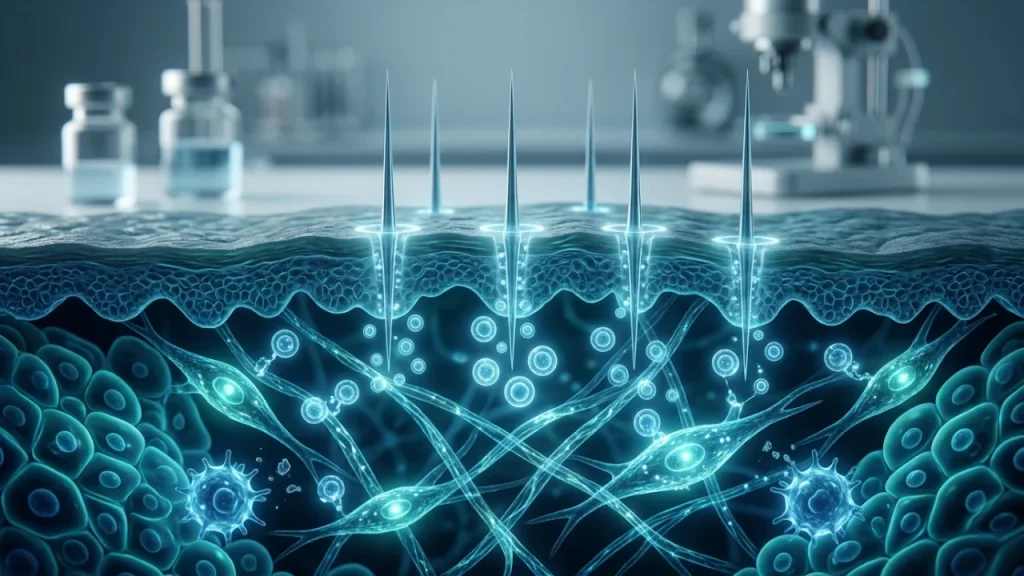
Microneedling creates controlled micro-injuries in the skin. This process is also called collagen induction therapy. It uses a device with many fine needles. These needles are incredibly small. They create tiny, precise channels in the top layers of skin.
This is not like a cut or a scrape. The injuries are microscopic. They are intentional and therapeutic. The skin recognizes these tiny channels as a signal to heal. This triggers the body’s natural wound repair system.
The healing process has several key stages. First, the body sends inflammatory signals to the area. Then, new collagen and elastin production begins. These proteins are the building blocks of firm, youthful skin. Finally, the skin remodels itself over time.
The channels themselves are crucial. They are temporary pathways through the skin’s outer barrier. This barrier is called the stratum corneum. It is designed to keep things out. Microneedling briefly creates access points through this shield.
This allows for much better absorption of topical products. Serums and solutions can reach deeper skin layers. Without these channels, most product ingredients sit on the surface. They cannot get to where they are needed most.
The benefits of microneedling with exosomes start with this basic principle. The needles prepare the skin to receive powerful ingredients. Think of it like preparing a garden bed before planting seeds. The micro-channels make the skin ready and receptive.
The procedure is precise. Needle depth can be adjusted. This targets different skin concerns. Shallow depths work on texture and fine lines. Deeper settings can address more significant scars.
The skin’s response is predictable and powerful. Here is what happens internally after treatment: – Blood flow increases to deliver nutrients and oxygen. – Fibroblast cells become active to make new collagen. – The skin’s renewal cycle speeds up temporarily.
This process does not cause severe damage. It stimulates the skin just enough. The goal is to kickstart renewal without a long recovery. The micro-channels typically close within a day.
The results come from your body’s own ability to heal. Microneedling simply guides that process. It directs energy and resources to specific skin areas. This leads to gradual, natural-looking improvement.
Understanding microneedling basics shows why it is an ideal partner for advanced treatments. The technique opens a door. Next, we must discuss what we can deliver through that door for even greater effect.
What Are Exosomes and Their Role in Skin Health
Exosomes are tiny natural messengers. Your body’s own cells create them. They are not a synthetic ingredient or a drug. Think of them as microscopic delivery trucks. Each exosome carries a precious cargo of proteins, lipids, and genetic instructions.
Cells release these vesicles constantly. They travel between cells in your body. Their job is communication. A skin cell in distress can send out exosomes. These exosomes signal nearby healthy cells for help. This starts a repair process.
The role of exosomes in skin health is fundamental. They carry the exact blueprints for renewal. Their cargo tells your skin cells what to do. It can instruct cells to calm inflammation. It can order them to build fresh collagen and elastin. It can direct them to multiply for healing.
This system is precise and efficient. As we age, this natural communication slows down. Our cells send fewer repair signals. The signals we do send become less clear. Skin regeneration becomes slower and less effective. This leads to visible signs of aging.
Exosome therapy aims to restore this dialogue. It provides a concentrated dose of clear instructions. These instructions come from healthy, young, active cells. The exosomes used are purified and carefully prepared. They are applied topically to the skin.
The benefits of microneedling with exosomes rely on this synergy. Microneedling creates temporary pathways. Exosomes use these pathways to reach living skin layers. They deliver their regenerative instructions directly to the cells that need them most.
Without this delivery method, exosomes struggle to penetrate. The skin’s outer barrier is very effective. It keeps most large molecules out. Microneedling temporarily bypasses this shield. It allows the exosomes to reach their target.
Once inside, exosomes go to work. They do not force the skin to do anything unnatural. Instead, they enhance and guide the skin’s own biological processes. They make the natural repair response smarter, faster, and more complete.
The key mechanisms are straightforward: – Exosomes reduce inflammation quickly. They carry anti-inflammatory signals. – They attract your body’s own stem cells to the treatment area. – They directly stimulate fibroblast cells. This boosts collagen and elastin production. – They enhance blood vessel formation. This improves nutrient delivery.
This is why the combination matters so much. Microneedling alone stimulates repair through minor injury. Adding exosomes changes the game. It provides the specific instructions for optimal healing. The skin does not just heal randomly. It heals in a better, more youthful way.
The process taps into your body’s innate intelligence. You are not introducing a foreign chemical. You are amplifying a language your skin already understands. The results are therefore more harmonious with your biology.
Consider a simple analogy. Microneedling is like plowing a field and planting seeds. The exosomes are like adding a perfect fertilizer and a detailed gardener’s manual. The seeds will grow without them. But with them, the growth is stronger, healthier, and more abundant.
In summary, exosomes are the missing link in targeted skin regeneration. They are the information carriers that tell your skin how to rebuild itself beautifully. Microneedling ensures this vital information gets delivered to the right address deep within the skin’s structure. Together, they create a powerful regenerative treatment with profound potential for improving skin health and appearance from within
How Microneedling and Exosomes Work Together
Microneedling creates precise temporary channels in the skin. These are not just wounds. They are access points. The micro-channels allow topical exosome solutions to bypass the skin’s tough outer barrier. This delivery is direct and efficient. The exosomes reach the living dermal layer where repair happens.
Think of your skin as a fortified city. The stratum corneum is a high, thick wall. Creams and serums often cannot get through it. Microneedling creates secure gates through that wall. Exosomes are the specialized messengers who can now enter. They deliver their instructions right to the city’s workshops, the fibroblasts.
The synergy operates on a clear timeline. First, microneedling initiates the healing cascade. This is a controlled alert signal. Your body sends inflammatory cells and growth factors to the area. It prepares the site for regeneration. This phase is crucial but general. The skin knows to repair, but not necessarily to optimize.
Exosomes arrive at this precise moment. They guide the generic repair response. They help shift the process from simple scarring to intelligent rejuvenation. One key benefit of microneedling with exosomes is this directional guidance. The exosomes carry specific codes for collagen type I and III formation. They tell fibroblasts to make more of the right kind of structural protein.
The combination also significantly speeds up recovery. Microneedling alone can cause redness for a day or two. Exosomes calm inflammation rapidly. They carry anti-inflammatory molecules like cytokines and microRNAs. This means the visible downtime is often shorter. The skin transitions from repair to rebuilding faster.
Another major advantage is the quality of the final result. Stimulating collagen is one thing. Organizing it properly is another. Exosomes promote not just more collagen, but better-organized collagen fibers. They encourage elastin production too. This leads to a stronger, more resilient skin network. The improvement is in both texture and tensile strength.
The process leverages natural biology at every step. – Microneedling uses the body’s injury response. – Exosomes use the body’s own communication system. – Together, they create a targeted treatment with minimal external input.
The benefits of microneedling with exosomes are cumulative and progressive. The initial treatment sets a new cellular blueprint. Fibroblasts become more active and efficient. They continue producing improved matrix components for weeks after the session. This is why results often improve over a month or more. The skin is not just temporarily plumped. It is fundamentally remodeled from within.
This collaborative mechanism explains why the outcomes surpass either technique alone. Microneedling provides the opportunity. Exosomes provide the expert instruction. The skin then executes a superior regeneration plan. The final effect is clearer, tighter, and more youthful-looking skin achieved through the body’s own enhanced capabilities. This sets the stage for understanding what to expect during and after a treatment session.
Key Benefits of Microneedling with Exosomes for Daily Life
The benefits of microneedling with exosomes extend far beyond the clinic. They translate into real advantages for your daily schedule and long-term skin confidence. One of the most significant practical benefits is reduced downtime. Traditional microneedling alone creates micro-injuries that require healing. Exosomes change this process. They deliver precise instructions that accelerate repair. This means redness and swelling often fade faster. Many people can return to normal activities within a day or two. The skin settles quickly.
This faster recovery is not just about convenience. It reflects a more efficient healing process. Your skin spends less time in a reactive state. It moves faster into a productive rebuilding phase. You get the regenerative stimulus without a prolonged visible recovery. This makes the treatment easier to fit into a busy life.
The results themselves are designed for daily life. They are not a temporary mask. The improvements build from within your skin’s structure. Think about your morning routine. You may notice less time needed to apply makeup to cover texture or redness. Your foundation might sit more smoothly on your skin. The need for heavy concealers can diminish over time. This is a direct result of better-organized collagen and improved surface texture.
The long-term nature of the results is another key benefit. The treatment does not offer a quick fix that fades in weeks. The cellular instructions from exosomes promote lasting change. Fibroblasts remain active for an extended period. They continue to produce quality structural proteins. This means your skin can maintain its improved appearance for months. You are not locked into a cycle of constant treatments just to keep baseline results.
Consider these practical impacts on daily skin concerns: – Fine lines appear softened. This can make your face look less tired without cosmetic procedures. – Skin elasticity often improves. Your skin may feel firmer and more resilient to touch. – Overall tone becomes more even. Discolorations from sun or age can gradually fade. – Pore appearance can refine. Pores look smaller because the skin around them is tighter.
The treatment also supports your skin’s daily defense systems. A stronger dermal matrix is better at handling environmental stress. This includes pollution and UV exposure. Your skin becomes more robust. It may show less sensitivity or reactivity over time. This is the benefit of a fundamentally healthier skin foundation.
You invest in a process that works continuously after the session. The initial treatment is just the start. Your cells keep working with the new blueprint they received. This progressive improvement is a core advantage. You might see the best results several weeks after your appointment. Your skin keeps getting better.
This approach aligns with modern lifestyle values. It seeks effective results with minimal disruption. It uses the body’s own intelligent systems to achieve a natural-looking outcome. The goal is healthier skin function, not just a temporary visual change.
Ultimately, these benefits matter because they are sustainable and integrated. They offer a way to enhance your skin’s health in a manner that respects your time and biology. The next logical step is understanding how to prepare for such a treatment to maximize these daily advantages.
The Science Behind Exosome-Enhanced Microneedling
How Exosomes Deliver Growth Factors to Skin Cells
Exosomes are tiny messengers. Your own cells make them naturally. Think of exosomes as small delivery trucks. They carry important cargo from one cell to another.
This cargo includes growth factors and proteins. These are instructions for repair and renewal. Microneedling creates temporary micro-channels in your skin. These are like opening tiny doors.
The treatment applies an exosome solution topically. The micro-channels let these messengers bypass the skin’s tough outer layer. They go directly into the living layers of skin. This direct delivery is a key advantage.
Exosomes do not work like a drug. They do not force cells to act. Instead, they provide information. They signal to your skin’s cells that it is time to regenerate.
The process has specific steps. First, exosomes bind to target cells. Your skin cells have receptors for them. It is like a key fitting into a lock.
Next, the exosome transfers its cargo. This can happen in two main ways. The exosome can fuse with the cell’s membrane. It can also be swallowed whole by the cell.
Inside the cell, the instructions are read. The growth factors activate cellular machinery. This tells the cell to start specific jobs.
These jobs include making new collagen. They also include creating fresh elastin fibers. The cell may also speed up its own repair processes.
The signals are precise and natural. Your cells already understand this language. The exosomes simply boost the volume of the message.
This method is efficient. Topical creams often cannot penetrate deeply. Their large molecules sit on the surface. Exosomes are designed for this exact journey.
The benefits of microneedling with exosomes come from this targeted delivery. Growth factors go exactly where they are needed most. This leads to a stronger healing response compared to microneedling alone.
Consider a construction site. Microneedling prepares the land and brings in workers. The exosomes then deliver the detailed blueprints and high-quality tools. The project finishes faster and better.
The science shows this is a fundamental shift. It moves beyond simple injury and response. It adds intelligent communication to the process.
Your skin cells become more active and coordinated. They work together with a clear purpose. This cellular teamwork creates the visible improvements in your skin.
The result is not just superficial change. You are guiding your skin’s innate biology. You provide the precise signals it needs to rebuild itself effectively.
This understanding turns a treatment into a logical biological upgrade. It explains why improvements continue for weeks. Your cells keep following the new instructions they received, building healthier skin day by day.
The Process of Collagen Production After Treatment
Collagen is your skin’s main support protein. Think of it as the steel framework of a building. Over time, this framework weakens and breaks down. Microneedling with exosomes directly addresses this problem.
The process starts with the micro-channels. These tiny openings do more than just create pathways. They trigger a natural alarm in your skin. Your body senses a need for repair at a cellular level. This initial signal is important. It prepares the area for rebuilding.
Exosomes arrive with precise instructions. They carry genetic messages called microRNA. These messages enter your skin cells, specifically fibroblasts. Fibroblasts are your body’s collagen factories. The exosome messages tell these factories to switch into high gear.
The fibroblasts get to work. They read the new blueprints from the exosomes. Their machinery starts producing more procollagen. Procollagen is the raw material for mature collagen fibers. This is a key step in the benefits of microneedling with exosomes. The treatment does not just cause random growth. It guides the production of high-quality, well-structured protein.
The entire production cycle has several phases: – First, fibroblasts build long chains of amino acids inside their structure. – Next, they modify these chains and send them outside the cell. – Then, enzymes trim these chains to form proper collagen molecules. – Finally, these molecules assemble into strong, triple-helix fibrils.
This assembly is crucial. Properly formed fibrils are resilient and flexible. They weave together into a dense network under the surface of your skin. This new network pushes upward gently. It fills in fine lines from below. It also improves skin firmness and elasticity.
The timeline for this is not instant. You will not see new collagen the next day. The biological process takes time to complete. Most of the visible firming occurs in the weeks following treatment. Your fibroblasts remain active for a long period. They continue producing new support structures.
This sustained activity is a major advantage. A single treatment session provides instructions that cells follow for months. The micro-injuries heal quickly, but the regenerative signals keep working. Your skin keeps rebuilding its foundation day after day.
The result is neocollagenesis. This term means “new collagen formation.” It is not just about adding more collagen. It is about adding better, younger-acting collagen. This new matrix integrates with your existing skin. It creates a stronger overall structure.
Think of it like repairing an old road. Simply adding fresh asphalt on top is a temporary fix. The treatment instead replaces the damaged gravel base layer first. Then it lays down a new, stable surface. The final road is smoother and lasts much longer.
Your skin’s texture improves because of this deeper change. Pores can appear smaller because the surrounding skin is tighter. Hydration often improves because the denser collagen network holds moisture better. The glow comes from healthier, more reflective skin cells supported by a firm base.
This explains the long-term improvements in skin tone and tightness. You are not just plumping skin temporarily. You are actively guiding its biology to rebuild its core architecture. The process uses your body’s own systems, simply making them more efficient and focused.
The outcome is fundamentally different from surface-level treatments. It addresses aging at the source, within the dermis where collagen lives. This scientific approach leads to durable, natural-looking results that develop over time as your skin diligently constructs its new framework.
Why Exosomes Improve Skin Elasticity and Texture
Exosomes carry precise instructions for skin repair. They do not just tell cells to grow. They tell them exactly what to build. One key target is a protein called elastin. Elastin is what gives skin its snap-back quality. Think of a rubber band. Young skin has fresh, springy elastin fibers. Over time, these fibers fray and break. Sun exposure and aging degrade them. Skin then loses its ability to bounce back. It begins to sag and wrinkle.
Microneedling creates micro-channels. These channels allow exosomes to reach the dermis directly. The dermis is where elastin lives. Exosomes deliver signals to fibroblast cells. Fibroblasts are the skin’s construction workers. The signals tell fibroblasts to produce more elastin. More importantly, they guide the proper assembly of new elastin fibers. This process is called elastogenesis.
New elastin must be organized correctly. It is not helpful if it forms a tangled clump. Exosomes help guide the structure. They promote the formation of a healthy, cross-linked network. This network works alongside new collagen. Together, they create a dense, supportive mesh. This mesh is the true foundation of firm skin.
The benefits of microneedling with exosomes extend beyond elastin alone. Exosomes also influence other vital proteins.
- They upregulate fibrillin. Fibrillin is a scaffolding protein. It provides a structure for elastin to deposit onto.
- They modulate glycosaminoglycans (GAGs). GAGs are like sponges in the skin. They attract and hold vast amounts of water. This deeply hydrates the tissue from within.
- They improve cell-to-cell communication. This leads to more coordinated tissue remodeling. The repair process is efficient and organized.
Texture improves because of this multi-protein approach. Surface roughness often comes from an uneven dermal foundation. Collagen bundles may be clumped or sparse. Elastin fibers may be fragmented. The new, uniform matrix smoothes that underlying foundation. Imagine placing a sheet over a lumpy mattress versus a smooth one. The surface (your epidermis) lies much flatter.
Pore appearance is also tied to elasticity. Pores are not holes that open and close. They are fixed structures. When surrounding skin loses its tight support, pores can dilate and look larger. The new elastin and collagen network tightens this support structure. It pulls gently on the pore walls. This makes pores appear smaller and less noticeable.
The process also enhances skin barrier function. Exosomes carry lipids and proteins that help repair the outermost layer. A stronger barrier keeps irritants out and moisture in. This leads to a healthier, more resilient complexion. The skin feels smoother and looks more radiant.
Results develop over weeks and months. This is not an instant plumping effect. It is the timeline of true biological rebuilding. Fibroblasts need time to synthesize new proteins. Those proteins need time to integrate into the existing skin architecture. The final outcome is skin that behaves like younger skin. It is more supple, more resilient, and has a finer texture.
This comprehensive regenerative action explains the lasting improvements seen with this treatment combination. The focus shifts from simple collagen induction to holistic matrix renewal. The next logical question is how this cellular activity translates into visible changes for common skin concerns like scars or hyperpigmentation
Comparing Traditional Microneedling to Exosome Methods
Traditional microneedling works through a simple principle. It creates controlled micro-injuries in the skin. This injury triggers the body’s natural wound healing response. The process is a general alarm signal. Your skin knows it needs to repair itself. It sends inflammatory signals and activates fibroblasts. These cells then produce new collagen and elastin. The results depend entirely on your body’s innate healing capacity. This capacity can vary with age, health, and genetics. The signal is broad, and the response is sometimes incomplete.
Think of it like rebuilding a house after a storm. Microneedling is the storm damage. It tells the crew to start working. But it does not provide new blueprints or extra workers. The crew uses available materials and old plans. The repair happens, but it might not be optimal. The foundation might not be fully reinforced. The finish might be rough. Similarly, microneedling alone stimulates repair. Yet it does not guide how that repair should happen at a cellular level.
Adding exosomes changes this dynamic completely. It provides specific instructions. Exosomes are not just another ingredient. They are information carriers. They deliver precise molecular messages directly to your skin cells. These messages tell fibroblasts exactly what to do. They instruct them to produce more collagen of the right types. They also tell them to make more elastin and hyaluronic acid. This turns a general alarm into a coordinated construction project with a detailed plan.
The benefits of microneedling with exosomes stem from this guided communication. The microneedling channels are crucial here. They allow these exosome messengers to bypass the skin’s tough outer barrier. The exosomes are delivered deep into the dermis where fibroblasts live. This ensures the instructions reach the right cells at the right time. The process becomes more efficient and effective.
Here is a direct comparison of the two methods:
- Signal Type: Traditional method sends a general distress signal. The exosome method sends targeted repair instructions.
- Cellular Guidance: Alone, microneedling relies on the body’s often-diminished response. With exosomes, cells receive direct commands to optimize their output.
- Inflammation: The traditional process involves significant inflammatory signaling. Exosomes can modulate this inflammation, promoting a cleaner, more regenerative environment.
- Result Quality: Alone, results can be inconsistent and focus mostly on collagen. With exosomes, the matrix renewal is balanced, targeting collagen, elastin, and barrier lipids for holistic improvement.
- Recovery: The added communication can help calm the skin faster, potentially reducing downtime.
The core difference is biological intelligence. Traditional microneedling asks your skin to fix itself. Exosome-enhanced microneedling shows your skin how to fix itself better. It supplies the missing signals that youthful cells send naturally. This leads to more predictable outcomes. It also leads to more comprehensive rejuvenation.
For example, treating acne scars often requires remodeling different types of tissue. Microneedling alone may build some collagen in the scar pit. Exosomes can additionally send signals to normalize texture and color. They support the regeneration of healthier, more normal-looking skin architecture.
The combined approach addresses the root cause of aging or damaged skin: failed cell communication. By restoring this dialogue, the treatment does not just stimulate. It truly regenerates. This scientific upgrade explains the consistently superior clinical outcomes reported with the combination therapy. Understanding this mechanistic contrast sets the stage for seeing its practical application against specific skin concerns like scarring or pigmentation issues
Who Can Benefit from Microneedling with Exosomes
Treating Acne Scars with Exosome Therapy
Acne scars are more than surface pits. They represent a complex wound where healing went wrong. The skin’s architecture is damaged. Traditional microneedling works to rebuild collagen in these areas. Yet scars often need more than just filler. They need organized, healthy tissue.
Exosome therapy provides precise instructions for this repair. The micro-channels created by needling deliver these signals directly to the scar site. This starts a coordinated regeneration process. It targets the scar’s multiple problems at once.
First, exosomes help modulate chronic inflammation. Old scar tissue can harbor low-grade inflammation. This inflammation blocks proper healing. Exosomes send calming messages to local immune cells. This resolves the inflammatory environment. It prepares the site for constructive work.
Next, they promote balanced matrix rebuilding. Collagen is crucial. But scars need the right type and arrangement of collagen. Exosomes guide fibroblasts, the skin’s building cells. They encourage these cells to produce organized, type I collagen. This is the strong, flexible collagen found in youthful skin. It replaces the weak, disorganized type III collagen common in scars.
The process also addresses texture and color. – Exosomes support elastin fiber production. This improves skin pliability. – They promote angiogenesis, the formation of new tiny blood vessels. This improves nutrient delivery and removes waste. – They carry signals that can help normalize pigment production. This reduces both hyperpigmentation and hypopigmentation around scars.
The benefits of microneedling with exosomes include this multi-pathway approach. It does not just fill a hole. It remodels the entire area. The skin begins to behave like undamaged skin should. Each treatment cycle encourages further improvement.
Visual results develop over weeks and months. Initial changes often include smoother skin texture and a more even tone. The depth of icepick or boxcar scars gradually softens. Rolling scars become less apparent as the underlying foundation strengthens. The skin’s overall health improves alongside scar reduction.
This method is particularly valuable for stubborn, atrophic scars. These scars have lost volume. Microneedling creates a stimulus for filling. Exosomes ensure the filling is high-quality and integrated. The new tissue blends seamlessly with the surrounding skin.
Patient experiences often note shorter recovery periods. The regenerative signals may help accelerate the initial healing phase after treatment. Redness and swelling can subside faster compared to microneedling alone. This is due to the enhanced communication promoting an efficient repair cycle.
The outcome is a fundamental change in the scar’s biology. The goal shifts from simple camouflage to true tissue restoration. This leads to natural-looking, lasting improvements. The skin’s function and appearance are renewed together.
This targeted action on scar tissue demonstrates the power of intelligent regeneration. It shows how restoring cellular dialogue can fix even long-standing damage. The principle now extends to other common concerns, like the visible signs of aging and sun damage.
Reducing Wrinkles and Fine Lines Effectively
Fine lines and wrinkles are not just surface folds. They are signs of deeper structural decline. Skin loses its supportive framework over time. This framework is made of collagen and elastin. Production of these proteins slows down. Existing fibers can become damaged. The skin’s ability to repair itself weakens. This leads to visible creases and sagging.
Microneedling with exosomes addresses this decline directly. The micro-channels do more than create pathways. They trigger a precise wound-healing signal. This signal calls the skin’s repair cells to action. These cells are called fibroblasts. Fibroblasts are responsible for building new collagen. The microneedling process essentially gives them a clear work order.
Exosomes deliver the exact instructions needed for high-quality work. They carry growth factors and signaling molecules. These signals tell fibroblasts to become more active. They guide them to produce new, well-structured collagen fibers. This is not a general stimulus. It is a targeted regenerative command. The new collagen forms in an organized network. This network gradually fills in and supports wrinkled areas from within.
The process improves different wrinkle types. – Dynamic lines appear from repeated muscle movements, like frown lines. The strengthened dermal foundation can make these lines less pronounced at rest. – Static wrinkles are visible even when the face is relaxed. These respond well as new tissue adds volume beneath them. – Fine crêpe-like texture results from surface-level thinning. Enhanced cellular renewal can improve skin density and smoothness here.
One of the key benefits of microneedling with exosomes is the quality of regeneration. The goal is not just to plump the skin temporarily. It is to restore its natural biology. The new collagen integrates with your existing tissue. This leads to natural-looking smoothing. The skin feels firmer and more resilient. Results develop progressively over several months as collagen remodels.
This approach also supports the skin’s extracellular matrix. Think of this matrix as a supportive gel between cells. It holds water and provides cushioning. Exosome signals can help improve the health of this environment. Better hydration and support further soften the appearance of lines.
The treatment offers a strategic advantage for aging skin. It combines immediate mechanical stimulation with intelligent biological signaling. The microneedles set the stage for renewal. Exosomes then guide the entire cellular crew to perform optimally. This synergy can lead to more significant outcomes than either element alone.
Patients often notice improved skin tone alongside wrinkle reduction. Enhanced cellular communication promotes overall vitality. The skin can look fresher and more luminous. This holistic improvement is a core part of the treatment’s value.
Ultimately, smoothing wrinkles this way is about functional restoration. You are not just filling a line. You are encouraging the skin to behave younger again. This method tackles the root cause of aging signs—slowed regeneration and lost communication. The result is a refreshed appearance that originates from truly healthier skin. This foundational principle also applies to improving other concerns, such as uneven pigmentation and sun spots.
Fading Hyperpigmentation and Sun Damage
Sun spots and uneven skin tone stem from an overproduction of melanin. Melanin is your skin’s natural pigment. It is made by cells called melanocytes. These cells can become overactive. Triggers include sun exposure and hormonal shifts. The result is patches of skin that look darker than the surrounding area.
Traditional approaches often try to bleach or peel this pigment away. Microneedling with exosomes takes a smarter path. It addresses the root cause: faulty cellular communication. The benefits of microneedling with exosomes include recalibrating this biological conversation.
Here is how the process works. Microneedles create precise micro-channels. These channels deliver exosomes deep into the skin’s living layers. Exosomes are tiny messaging vesicles. They carry instructions from healthy, normal cells.
These instructions can influence melanocyte behavior. Think of an overactive melanocyte as a factory on overtime. Exosome signals can help turn down the production line. They do not destroy the factory. They help it return to a normal, balanced schedule.
The messages within exosomes are complex and powerful. They can carry specific types of genetic information and proteins. This cargo can target multiple steps in the pigmentation process. – Some signals may slow down the enzyme (tyrosinase) that kickstarts melanin production. – Other signals can encourage a more even distribution of pigment granules. – Further messages may support healthier skin cell turnover. This helps shed pigmented surface cells more efficiently.
The microneedling itself also contributes directly. The controlled micro-injuries stimulate a renewal cycle. Your body replaces damaged and pigmented cells with new ones. This natural exfoliation is gentle but consistent. Combining it with exosome guidance creates a dual-action strategy.
One action clears existing pigment-loaded cells. The other action calms future pigment overproduction. This combination is key for lasting results. Simply removing surface pigment often leads to quick recurrence. Guiding the melanocytes offers a more sustainable solution.
Patients with sun damage often see a gradual evening of their skin tone. Dark spots may lighten over several weeks. The overall complexion can appear clearer and more uniform. This change happens without harsh chemicals or aggressive lightening agents.
The treatment is particularly strategic for melasma. Melasma is a stubborn form of hyperpigmentation. It is often driven by hormones and inflammation. Exosomes may deliver anti-inflammatory signals. This can help soothe the skin and reduce a key trigger for discoloration.
Safety is a major advantage here. You are using your body’s own signaling language. You are not introducing foreign bleaching substances. The goal is restoration, not just suppression.
Results develop progressively like collagen remodeling does. Patience is important. The skin needs time to respond to these biological cues. Most patients require a series of treatments for optimal improvement. Maintenance sessions may be recommended for persistent conditions like melasma.
Ultimately, fading dark spots this way supports skin health at a fundamental level. You achieve a more even tone by improving how your skin cells talk to each other. This restores balance to a system that was out of sync. The next logical step is to consider how this powerful combination strengthens the skin’s barrier and defenses against daily stress.
Improving Skin Firmness and Luminosity
Loose skin and a dull complexion share a common root. This root is a decline in foundational skin cells. Fibroblasts are the key cells here. They produce collagen and elastin. These proteins form your skin’s support structure. They are like a mattress’s springs and padding. As we age, fibroblast activity slows. Environmental stress also damages these cells. The result is thinner, less resilient skin. It can look tired and lack its youthful glow.
Microneedling with exosomes directly targets this cellular slowdown. The microneedles create precise micro-channels. These are not just wounds. They are strategic signals. They tell your skin it is time to repair itself. This triggers a natural healing cascade. Fibroblasts wake up and get to work. But aging or sun-damaged fibroblasts may be sluggish. They need clear instructions to rebuild properly.
This is where exosomes provide a decisive advantage. Exosomes carry specific instructions for skin cells. Think of them as software updates for your fibroblasts. They deliver growth factors and nucleic acids directly into the cells. This powerful cargo tells fibroblasts to ramp up production. They start making more new collagen. They also produce fresh elastin fibers and hyaluronic acid.
The process rebuilds the skin from within. New collagen fibers weave a stronger network. This network provides better support. Skin begins to feel tighter and more firm. Improved elastin allows skin to snap back better. Hyaluronic acid draws in moisture. This adds essential plumpness. The combined effect reduces the appearance of fine lines. It can also improve the look of shallow wrinkles.
Luminosity comes from this internal renewal. Dull skin often has a rough texture. Dead cells accumulate on the surface. The skin’s natural light reflection becomes uneven. New, healthy collagen creates a smoother subsurface. Better hydration increases light refraction. Exosomes also promote better cell turnover. This leads to a fresher, more refined skin surface.
The benefits of microneedling with exosomes are clear for firmness and glow. The treatment does not just fill wrinkles temporarily. It encourages your skin to rebuild its own support system. The results are progressive and natural-looking.
People often notice changes in a specific order. – First, skin often feels more hydrated and looks brighter within days or weeks. – Improved firmness and texture typically become apparent after several weeks. – New collagen formation continues for months following a treatment.
This method is ideal for those with early signs of laxity. It also helps anyone whose skin has lost its vibrant radiance. The approach is holistic. You are not just treating a single symptom like looseness or dullness alone. You are improving the overall health and function of your skin’s infrastructure.
The restoration of firmness and luminosity fundamentally changes the skin’s appearance. It moves from looking tired to looking revitalized. This renewed strength also prepares the skin to better handle future challenges. A robust skin barrier is its own best defense. The next consideration is how this strengthened barrier specifically protects against common environmental aggressors that accelerate aging every day.
What to Expect During and After Treatment
Step-by-Step Guide to a Typical Session
A typical microneedling with exosomes session follows a precise sequence. It usually takes about 60 to 90 minutes from start to finish. Your comfort and safety are the top priorities throughout. The process is methodical and controlled.
Your session begins with a thorough consultation. Your provider will review your skin goals and medical history. They will examine your skin closely under good light. This ensures the treatment plan is right for you. Any questions you have will be answered here.
Next comes the crucial cleansing step. All makeup, oil, and surface debris must be removed. This is done with a gentle medical-grade cleanser. A perfectly clean surface prevents any bacteria from being introduced. It allows for optimal product absorption later.
A topical numbing cream is then applied to your entire treatment area. This cream usually needs 20 to 30 minutes to take full effect. It significantly reduces any sensation during the procedure. You will feel a cooling, tingling feeling as it works. Your skin will become temporarily numb.
While the numbing cream works, the exosome solution is prepared. The provider will carefully open a sealed vial. They will mix the exosome concentrate with a sterile solution if needed. This creates the active serum for your treatment. Everything remains sterile to ensure purity.
The provider then removes the numbing cream completely. Your skin is wiped clean with a sterile gauze. A final pass with an antiseptic solution is common. This creates the most sterile environment possible for the microneedling.
The microneedling device itself is a handheld pen. It has a disposable tip containing very fine needles. The needle length is selected based on your skin’s needs. Shorter lengths are for surface renewal. Deeper settings target collagen in the dermis.
The provider glides the device over your skin in systematic patterns. You will hear a faint buzzing sound. You may feel a vibration or mild pressure. The sensation is often described as light sandpaper. The numbing cream makes it very manageable.
The exosome serum is applied during or immediately after needling. Some providers apply it layer by layer as they work. Others infuse it right after creating the micro-channels. This timing is key for the benefits of microneedling with exosomes. The fresh channels allow direct delivery of exosomes into the skin.
The microneedling part itself is relatively quick. It often takes only 10 to 15 minutes for a full face treatment. The provider works methodically across each zone like forehead, cheeks, and chin. They avoid sensitive areas like the eyelids.
After needling, a final layer of exosome serum is smoothed on. Your skin will look flushed and feel warm, similar to a sunburn. This is a normal and expected inflammatory response. It shows the regenerative process has started.
A soothing mask or calming serum is often applied next. This helps reduce redness and cools the skin immediately. You will rest comfortably for a few minutes as this settles.
Your provider will then give you clear aftercare instructions verbally and in writing. – Use only gentle, recommended cleansers and moisturizers for the first few days. – Avoid sun exposure strictly and use a high-SPF mineral sunscreen. – Do not use active ingredients like retinols or acids for about one week. – Expect slight peeling or dryness as old skin cells shed. – You can usually apply makeup after 24 to 48 hours if needed.
You can resume most normal activities right away. Your skin will be sensitive, so plan a calm evening. Avoid strenuous exercise, sweating, and hot showers for 24 hours. The initial redness typically fades within several hours to a couple of days.
The immediate post-treatment period is about supporting your skin’s healing. The micro-channels close within hours, but the biological work continues inside. Your cells are already receiving signals from the exosomes. This seamless procedure sets the stage for the renewal process you can expect in the coming weeks and months. Understanding this journey helps you partner effectively in your own skin’s recovery and results
Managing Downtime and Recovery Tips
Your skin’s recovery follows a clear, predictable timeline. The first 24 hours are most important for calming the initial response. Keep your skin clean and hydrated with the products your provider recommended. Avoid touching your face unnecessarily. This prevents introducing bacteria while the micro-channels are sealing.
You might see tiny micro-crusts by day two or three. This is normal. Do not pick or scratch at them. These are simply dried serum and exosomes at the treatment sites. They will flake off naturally within a couple of days. Gentle cleansing helps this process.
Redness typically resolves fully within 48 to 72 hours for most people. Some pinkness might linger a bit longer if you have sensitive skin. This is not a cause for concern. It simply means your skin is still actively healing beneath the surface.
Dryness and peeling are common around days three to five. This is a sign of cellular turnover. Your old, damaged skin cells are making way for new ones. Support this phase with a gentle, fragrance-free moisturizer. Apply it frequently to maintain a good skin barrier.
Avoiding sun exposure is non-negotiable for at least two weeks. UV rays can cause inflammation and hyperpigmentation in healing skin. Use a broad-spectrum mineral sunscreen every single day. Reapply it every two hours if you are outdoors.
You should also avoid certain activities and products for a specific period: – Avoid strenuous exercise, saunas, and hot tubs for 72 hours. Heat and sweat can irritate the skin. – Do not use exfoliating scrubs or brushes for one full week. – Postpone chemical peels, laser treatments, and injectables for at least four weeks. – Hold off on using retinols, vitamin C serums, or glycolic acid for 10 to 14 days.
The benefits of microneedling with exosomes become visible as you heal. Initial glow and improved texture often appear after the first week. This early result comes from intense hydration and initial signaling. The deeper regenerative work continues for months.
Your skin may feel unusually dry or tight during week one. This is temporary. It happens because the treatment temporarily disrupts your skin’s outer layer. Consistent moisturizing counteracts this feeling effectively.
Makeup can usually be resumed after 48 hours. Use clean brushes and non-comedogenic products. Always remove makeup very gently at the end of the day.
Schedule your next treatment based on your provider’s plan. Most people need a series of sessions for cumulative results. Typical spacing is four to six weeks apart. This allows your skin to complete one full cycle of renewal before starting the next.
Listen to your skin’s signals during recovery. Mild itching can occur as part of healing. A cool compress can soothe it. Any persistent pain, swelling, or signs of infection are not normal. Contact your provider immediately if you notice these.
The goal of managing downtime is to protect your skin’s biological process. You create the ideal environment for exosomes to communicate with your cells. This partnership between your care and the technology leads to optimal outcomes. Proper recovery ensures you get the full value from your treatment investment, setting the stage for long-term improvement in skin health and appearance.
Timeline for Seeing Results from Exosome Microneedling
Results from microneedling with exosomes unfold in distinct phases. Your skin does not change all at once. The process follows your body’s natural biological schedule.
The first changes are not visible to the eye. They happen at a cellular level within minutes and hours. The micro-channels created during treatment allow direct delivery. Exosomes enter the deeper layers of your skin. They immediately begin sharing their regenerative signals with your local cells.
This communication instructs your skin cells to start several key processes. Cells are told to boost collagen production. They are also instructed to improve elastin creation. Another signal tells them to ramp up skin renewal. This initial phase sets the entire recovery in motion.
You will start to see early surface changes within the first week. These initial benefits of microneedling with exosomes are often subtle. Most people notice a healthy glow and improved hydration first. Your skin texture may feel smoother. Redness from the procedure fades during this time. These early signs come from that intense cellular signaling and increased hydration.
The most significant visual improvements typically emerge between weeks four and six. This marks the end of your skin’s first full renewal cycle after treatment. Fresh, new skin cells reach the surface. You may observe clearer fading of hyperpigmentation. Fine lines can start to look softer. Skin tone often appears more even and radiant.
The regenerative work continues deep below the surface for months. New collagen and elastin take time to form and organize. This is a slow and steady process. You may see further refinement in skin firmness and elasticity for up to three to six months after a single session. The full benefits of microneedling with exosomes develop progressively.
Results are cumulative with a recommended series of treatments. Most plans involve three to four sessions. Each session builds upon the progress of the last. Think of it like training for fitness. One workout brings some benefit, but a consistent program creates lasting change.
- After one treatment: Expect improved glow, texture, and initial hydration.
- After a full series: Look for visible reduction in lines, better firmness, and more even tone.
- Long-term maintenance: Results can last a year or more, influenced by your age, genetics, and skincare habits.
Your own biology influences this timeline. Factors like your age and skin health play a role. A younger person may see faster collagen response. Someone with significant sun damage might notice a more dramatic improvement in pigmentation over time. Lifestyle choices like sun protection directly affect how long results last.
This treatment offers a dual outcome. You get immediate improvements in skin quality and ongoing anti-aging effects. The timeline shows it is not a quick fix but a methodical rejuvenation. Understanding this schedule helps you appreciate each stage of your skin’s transformation. This knowledge leads us to consider how these results measure against other aesthetic options for lasting skin health.
Safety Considerations and Side Effects
Microneedling with exosomes is a controlled medical procedure. Its safety profile is strong when performed correctly. Understanding what is normal helps you have a realistic and calm experience.
The process begins with a clean slate. Your skin will be thoroughly cleansed. A topical numbing cream is then applied. You wait for about twenty to thirty minutes. This ensures your comfort during the treatment itself. The actual microneedling part is relatively quick. You will feel a vibrating or rolling sensation. Most patients describe it as mild pressure or prickling. Discomfort is typically minimal due to the anesthetic.
Immediate after-effects are common and expected. They are signs your skin’s repair process is starting. These reactions are usually mild. They often resolve within a few days.
- Redness: Your skin will look flushed, similar to a sunburn. This is normal inflammation from the micro-channels. It typically fades within 24 to 48 hours.
- Swelling: Mild puffiness, especially in delicate areas like around the eyes, may occur. It usually subsides within one to three days.
- Dryness and Peeling: As the skin heals, it may feel tight and flake slightly around day two or three. This is old skin cells shedding.
- Pinpoint Bleeding: Minor bleeding can happen. It stops quickly and is part of the process.
Serious side effects are rare with a qualified provider. The main risk is infection. This is why sterile technique is non-negotiable. Your provider uses sterile, single-use needle cartridges. Proper aftercare at home is your key responsibility to prevent problems.
Your post-treatment routine is crucial for safety and results. Follow your provider’s instructions exactly. They will give you a simple regimen.
- Keep it clean: Use only the gentle cleanser they recommend for the first few days.
- Moisturize aggressively: Apply a provided or recommended moisturizer frequently. This soothes the skin and supports the barrier.
- Use sunscreen daily: New skin is sun-sensitive. Use a broad-spectrum SPF 30 or higher every single day.
- Avoid irritants: Do not use active ingredients like retinols or acids for about five to seven days. Avoid strenuous sweat and pools.
The exosomes themselves are highly compatible with your body. They are natural signaling vesicles. This minimizes the risk of allergic reaction. The core benefits of microneedling with exosomes arise from this biological synergy, not from a foreign substance.
Choosing an expert is your primary safety step. Seek a licensed medical professional experienced in advanced procedures. A proper consultation reviews your medical history. This screens for conditions that might need caution, like active acne or certain allergies. Do not hesitate to ask about their training and protocols.
Listen to your skin during healing. Expected tenderness is normal. However, contact your provider immediately if you notice signs of infection. These include increasing pain, yellow pus, or excessive heat at the site. Severe blistering is also not typical and requires prompt attention.
The healing phase is an active part of your results. Those micro-channels stay open for a short window. This allows continued absorption of supportive products. Your skin is busy rebuilding. The mild side effects are temporary markers of this regenerative work. They give way to the improved texture and glow discussed earlier.
This straightforward approach to safety ensures you can proceed with confidence. Knowing what to expect demystifies the process. With a qualified provider and proper care, you can focus on the outcome—healthier, rejuvenated skin that reflects the combined power of these technologies.
Maximizing the Benefits of Microneedling with Exosomes
How to Prepare Your Skin Before Treatment
Proper skin preparation creates the ideal environment for regeneration. Think of it as preparing fertile soil before planting seeds. Healthy, well-cared-for skin responds better to microneedling with exosomes. This proactive approach can enhance your results significantly. It supports the core benefits of microneedling with exosomes.
Start by consulting your provider at least two weeks before your appointment. This gives enough time to adjust your routine. They will review your current products. You may need to pause certain active ingredients. Common agents like retinoids or strong acids can sometimes irritate sensitized skin.
Gentle cleansing is a foundational step. Use a mild, non-abrasive cleanser twice daily. This maintains your skin’s natural lipid barrier. A strong barrier helps protect against external stressors. It also creates a clean canvas for the treatment itself.
Consistent hydration is equally important. Drink plenty of water in the days before your session. Well-hydrated skin is more pliable and resilient. Apply a simple, fragrance-free moisturizer. This supports barrier function and overall skin health.
Sun protection is non-negotiable. Avoid excessive sun exposure for two weeks prior. Always use a broad-spectrum sunscreen daily. Sunburn or a tan is a strict contraindication for treatment. UV damage can compromise skin integrity and healing.
Consider these key steps in your pre-care plan: – Discontinue use of topical retinoids or vitamin A derivatives as advised. – Stop using alpha-hydroxy or beta-hydroxy acid products temporarily. – Avoid facial waxing, chemical peels, or laser treatments in the treatment area. – Inform your provider of all supplements and medications. – Refrain from alcohol for 24-48 hours before your session.
Nutrition also plays a supportive role. Focus on foods rich in antioxidants and vitamins. These nutrients aid your body’s natural repair systems. Reduce intake of processed foods and excess sugar. This can help minimize potential inflammation.
Get adequate sleep in the week before treatment. Your body repairs itself during sleep. Skin cells regenerate more efficiently from a rested state. Manage stress through light exercise or meditation. High stress can affect inflammation levels and healing.
Do not shave the treatment area on the day of your procedure. Arrive with a clean, makeup-free face. This minimizes the risk of introducing bacteria into the micro-channels. Wear comfortable, loose clothing to your appointment.
This preparation optimizes your skin’s biological readiness. It ensures your cells can focus their energy on repair and renewal. Well-prepared skin is more receptive to the regenerative signals from exosomes. This careful groundwork leads to a smoother recovery. It also helps maximize the visible improvements in texture and tone. Your commitment to preparation directly supports the treatment’s success, setting the stage for optimal rejuvenation.
Post-Treatment Skincare Routine for Enhanced Effects
Your skin is in an active state of repair immediately after a microneedling with exosomes session. The micro-channels are temporary pathways into your skin. A proper post-treatment routine protects these pathways. It also supports the exosomes working inside your skin. This care helps you get the most from your treatment. It makes your results last longer.
The first 24 to 48 hours are critical. Your skin barrier is temporarily compromised. Treat it like a fresh, minor wound. This mindset guides your initial actions.
Use only the gentle cleanser recommended by your provider. Cleanse with lukewarm water. Pat your face dry with a clean towel. Do not rub or scrub. Avoid all exfoliants for at least five to seven days. This includes physical scrubs and chemical acids. Your skin is already shedding old cells naturally through the healing process.
Hydration is your top priority. Apply a simple, pure hyaluronic acid serum to damp skin. Hyaluronic acid pulls moisture into the skin. It does this without clogging the micro-channels. Follow this with a basic moisturizer. Look for formulas with ceramides or panthenol. These ingredients help repair the skin’s protective barrier.
Sun protection is non-negotiable. UV rays cause inflammation and pigment changes in healing skin. Use a mineral sunscreen with zinc oxide every single day. Reapply it every two hours if you are outside. Wear a wide-brimmed hat for extra protection. This habit is key for maintaining an even skin tone.
Avoid certain activities for the first few days. – Skip intense exercise and sweating. Sweat can irritate the skin. – Do not swim in pools or the ocean. Chlorine and salt are irritants. – Avoid saunas, steam rooms, and very hot showers. – Do not apply makeup for at least 24 hours. When you do, use clean brushes.
Your skin may feel tight, look pink, or have minor swelling. This is normal. A cool compress can soothe this feeling. Do not use ice directly on the skin. Some pinpoint bleeding or tiny scabs may appear. Let them fall off naturally. Picking can cause scars.
After the first week, you can slowly reintroduce active ingredients. Start with antioxidant serums like vitamin C. These help protect new skin cells from environmental damage. Always patch test a new product first. Listen to your skin. If it stings or turns red, stop using that product.
Long-term habits lock in the benefits of microneedling with exosomes. – Stay consistent with gentle cleansing and deep moisturizing. – Never skip your daily sunscreen. – Drink plenty of water to hydrate your skin from within. – Eat a diet rich in vitamins and antioxidants to fuel cell health.
The exosomes continue their signaling work for weeks. Your daily routine creates the ideal environment for this process. Think of your skincare as ongoing support for cellular renewal. Good habits defend the new collagen and elastin your skin is building.
This dedicated aftercare does more than just heal the surface. It maximizes the regenerative potential started during your treatment. A strong routine leads to lasting improvements in texture, firmness, and glow. Your commitment after the procedure is just as important as your preparation before it. This comprehensive approach ensures you see the full value of your investment in advanced skin health.
Frequency and Number of Sessions Needed
The benefits of microneedling with exosomes are not usually achieved in a single visit. This process works through cumulative signaling. Your skin needs repeated, gentle encouragement to rebuild its foundation. Think of it as training for your skin cells. One workout brings improvement. A consistent plan creates lasting change.
Most people start with a series of sessions. A common plan includes three to four treatments. These are spaced about four to six weeks apart. This timing is deliberate. It aligns with your skin’s natural renewal cycle. The initial micro-injuries heal within days. The deeper regenerative work, guided by exosomes, continues for weeks.
The space between sessions allows one phase to finish before the next begins. Collagen production takes time. New proteins need weeks to form and organize. A new session too soon could interrupt this vital process. Waiting too long might let the signaling effect fade. The four-to-six-week window hits the ideal balance.
Your specific number of sessions depends on your goals. Addressing fine lines may require fewer treatments. Improving deeper wrinkles or significant scarring often needs more. Sun damage and general skin rejuvenation respond well to a standard series. Your provider will assess your skin’s starting point. They will tailor a plan just for you.
The condition of your skin also influences frequency. Thinner or more sensitive skin may need longer intervals between appointments. Resilient, thicker skin might tolerate a slightly shorter schedule. Always follow your provider’s personalized advice. They design the plan based on your unique biology.
Here is what a typical journey looks like: – Session 1 introduces exosomes to the skin environment. Initial repair pathways activate. – Session 2 builds on the first treatment. The renewed cells are primed to respond again. – Session 3 consolidates gains. Collagen and elastin networks become stronger. – Optional Session 4 addresses any remaining concerns for maximum refinement.
After your initial series, maintenance becomes key. The results are long-lasting but not permanent. Your skin continues aging and faces daily environmental stress. A single maintenance session every six to twelve months can protect your investment. This refreshes cellular communication and supports ongoing repair.
Combining treatments affects the plan too. If you pair microneedling with other procedures, spacing may change. Your provider will create an integrated calendar. This ensures each treatment works in harmony without overwhelming your skin.
Patience is essential with regenerative medicine. You will see early glow and texture changes quickly. The most substantial benefits of microneedling with exosomes develop over months. True collagen remodeling shows up gradually. Final results are often fully visible three to six months after your last session.
Consistency in your schedule is as important as consistency in your skincare routine at home. Skipping or delaying sessions can diminish the overall outcome. Adhering to the planned intervals gives your skin a predictable, steady signal to renew itself.
This structured approach ensures sustained benefits. It transforms a one-time treatment into a true rejuvenation strategy. Your commitment to the process directly influences the quality and duration of your results. Understanding this timeline helps you set realistic expectations and achieve your skin health goals. This leads logically to considering the long-term value and science behind this combined therapy.
Combining with Other Skincare Practices
Your daily skincare routine is a powerful partner to your treatments. It must change after a microneedling with exosomes session. The first goal is always protection. Your skin channels are open and active for about 24 to 72 hours. This is a critical window.
You must avoid any aggressive products during this time. Do not use retinoids or alpha hydroxy acids. Skip vitamin C serums for a few days. These ingredients can cause major irritation. They can also disrupt the delicate signaling from the applied exosomes.
Gentle cleansing is non-negotiable. Use only a mild, non-foaming cleanser. Harsh soaps can strip the skin. This compromises your fragile barrier. Pat your face dry with a clean towel. Do not rub or scrub the treated area.
Hydration becomes your top priority. A simple hyaluronic acid serum is excellent. It pulls moisture into the skin without irritation. This supports the plumping effect of new collagen. Follow this with a basic moisturizer. Look for ingredients like ceramides or squalane.
Sunscreen is your most important product. UV exposure can reverse your progress. It creates inflammation and breaks down collagen. Use a mineral sunscreen with zinc oxide every single day. Reapply it every two hours if you are outside.
After the initial recovery phase, you can reintroduce active ingredients. Wait at least five to seven days. Always get approval from your provider first. Start slowly with your actives. Use them every other night at first.
This careful approach protects your investment. It allows the benefits of microneedling with exosomes to fully develop. Your routine should support cellular repair, not fight against it.
Think of your skin as being in a learning phase after treatment. The exosomes have delivered new instructions to your cells. Your job is to provide a stable environment for those cells to follow the instructions. Chaos from harsh products creates confusing signals.
Here is a simple timeline for integrating products: – Days 1-3: Cleanse gently, hydrate deeply, and protect with sunscreen. – Days 4-7: Continue basics. You may add a peptide serum to support cellular communication. – Week 2 onward: Slowly reintroduce one active ingredient at a time. Monitor your skin’s response.
Do not introduce multiple new products at once. If irritation occurs, you will not know the cause. This methodical process helps you identify what truly works for your newly rejuvenated skin.
Consistency in your daily habits matters as much as your treatment schedule. The regenerative process does not stop when you leave the clinic. It continues for months as collagen rebuilds. Your daily routine provides the raw materials and safe space for this long-term work.
Pairing the right products with your treatments creates a synergy. The microneedling opens channels and stimulates repair. The exosomes deliver precise regenerative messages. Your supportive skincare at home ensures those messages are heard and acted upon efficiently.
This integrated approach maximizes every aspect of the procedure. It turns a powerful treatment into a complete lifestyle for skin health. Your daily discipline directly influences the longevity and quality of your results, building naturally on the foundation of your clinical schedule. This holistic view leads us next to examine the science that makes this synergy possible.
Future Trends in Exosome and Microneedling Technology
Innovations in Exosome Research for Skin Care
Exosome research is moving beyond simple extraction from stem cells. Scientists now engineer exosomes for specific tasks. This field is called bioengineering. It allows for precise control over the vesicles’ cargo and targeting. Think of it as programming a delivery drone. Researchers can load exosomes with exact amounts of growth factors or silencing RNA. This cargo can then be directed to particular skin cells. The goal is unmatched accuracy in skin repair.
One major innovation involves sourcing. New methods aim to create exosomes without needing donor stem cells. This approach uses cell-free systems. These systems mimic cellular machinery in a controlled environment. They produce exosomes with consistent properties. This improves safety and scalability. It also reduces batch-to-batch variability. Consistency is crucial for reliable clinical results.
Another trend is personalization. Future treatments may use your own cells. A small skin sample could be taken. Exosomes would then be harvested from your cultured fibroblasts. These autologous exosomes carry your unique biological signals. They are perfectly matched to your immune system. This minimizes any risk of reaction. It maximizes the relevance of the regenerative messages sent.
The benefits of microneedling with exosomes will grow with these advances. More potent engineered exosomes could mean fewer treatments are needed. Deeper, more targeted delivery could improve results for scar remodeling. The synergy between the microneedling channels and the exosome payload will become more refined.
Research is also improving how we track exosomes. Scientists use fluorescent tags or magnetic nanoparticles. These tags let them see where exosomes go after application. This imaging confirms they reach the intended layers of skin. It verifies the mechanism of action. This data helps refine application techniques and dosages.
Here are key areas of current laboratory focus: – Cargo Loading: Actively packing exosomes with therapeutic molecules like antioxidants or collagen genes. – Surface Modification: Altering the exosome membrane to bind only to aged or damaged skin cells. – Hybrid Systems: Combining exosomes with other biocompatible materials for sustained release. – Diagnostic Exosomes: Using exosomes from skin to detect early signs of aging or inflammation before they are visible.
The ultimate goal is a closed-loop system. Sensors could one day monitor skin health continuously. They would detect subtle changes in need of repair. This data would trigger a personalized exosome formulation. The formulation would be delivered via a smart microneedling device. This represents true precision medicine for aesthetics.
These innovations remain largely in labs today. Their transition to clinical practice will take careful validation. Yet the direction is clear. The future points toward smarter, more specific, and individually tailored regenerative therapies. This scientific progress ensures that the powerful combination of microneedling and exosomes will continue to evolve, offering ever more effective pathways to healthy, resilient skin.
How Personalized Treatments Are Evolving
Personalized skincare is moving beyond simple product recommendations. The future lies in treatments designed for your unique biology. Microneedling with exosomes is at the forefront of this shift. This combination offers a powerful platform for customization. The benefits of microneedling with exosomes multiply when the therapy is tailored.
The first step is advanced diagnostic profiling. This is more than looking at your skin. It involves analyzing specific biomarkers. These biomarkers can come from a small skin sample or even a blood test. They tell a detailed story about your skin’s current state.
Key biomarkers guide the creation of your personal treatment plan. These markers show levels of inflammation, collagen breakdown, and cellular stress. They can also reveal your skin’s inherent regenerative capacity. This data helps select the most effective exosome type and dose for you.
For example, one person’s profile may show high inflammatory signals. Their treatment would use exosomes known for calming immune responses. Another person’s test might reveal slow collagen production. Their formula would be rich in exosomes that directly stimulate fibroblast cells.
The personalization extends to the microneedling procedure itself. The device settings are no longer one-size-fits-all. Needle depth is adjusted based on your skin thickness and target concern. The pattern and density of micro-channels are also customized. This ensures optimal delivery of your personal exosome blend.
Treatment frequency and the number of sessions become data-driven. Your initial response to the first treatment is measured. Follow-up biomarker tests can track progress at a molecular level. The next session is then adjusted based on these results. This creates a dynamic, adaptive treatment cycle.
Future systems may even use real-time feedback. Imagine a microneedling device with integrated sensors. As it creates micro-channels, it could assess skin impedance or hydration. It could then modify its action on the spot. The applied exosome serum could be mixed from cartridges just before application.
This approach turns skincare into a precise science. It moves away from trial and error. The goal is to deliver the right signal, to the right cells, at the right time. This maximizes results and improves efficiency. It also enhances safety by avoiding unnecessary or mismatched therapies.
Personalized treatments represent the next logical step. They build on the foundational science of regeneration. They use new diagnostic tools to cut through guesswork. The outcome is a treatment plan as unique as your fingerprint, designed to work with your body’s own language for healing and renewal. This evolution makes advanced skincare truly individual and optimally effective.
The Growing Popularity of Minimally Invasive Procedures
People today want real results without long recovery times. This simple fact fuels the rise of procedures like microneedling with exosomes. Patients seek treatments that fit into busy lives. They want to return to work or social events quickly. Minimally invasive options meet this demand perfectly.
Consider the traditional alternative: surgical facelifts. Surgery often requires weeks of recovery. It carries higher risks and more visible scars. In contrast, a microneedling session takes about an hour. Most people resume normal activities within a day or two. There is no major wound to heal. Only minor redness appears, and it fades fast.
The appeal is not just about convenience. It is also about gradual, natural-looking improvement. Drastic changes can look unnatural. The benefits of microneedling with exosomes build up over several sessions. Your skin improves steadily. Friends may notice you look refreshed, not different. This subtlety is now a major goal in aesthetic care.
Social media and video calls have changed our perspective. We see our own faces more than ever before. This increases awareness of skin texture and tone. People want to look good on camera every day. They cannot take months off for recovery. Quick treatments support a consistently polished appearance.
The science supports this shift. Research shows the skin can regenerate effectively without major trauma. Controlled micro-injuries trigger healing. Exosomes then guide that process precisely. This combination delivers significant results. It avoids the collateral damage of more aggressive methods.
Let’s list key reasons for this growing popularity: – Minimal downtime allows immediate return to daily life. – Lower risk of complications compared to surgery. – Natural-looking results that avoid a “done” appearance. – Cost is often lower than major surgical procedures. – Treatments can be repeated easily for maintenance.
The healthcare system also sees advantages. Shorter procedure times mean clinics can help more patients. There is less strain on surgical facilities. The risk of infection is greatly reduced without large incisions. This makes advanced skincare more accessible to a wider audience.
Technology accelerates this trend. Better devices make treatments safer and more consistent. Improved exosome production increases their potency. Patients get reliable outcomes they can trust. This builds confidence in choosing minimally invasive paths.
The economic factor is clear. People invest in their appearance to feel confident. They seek value from their investment. Procedures with short downtime protect their income and social commitments. They do not lose work days while improving their skin.
This preference shapes the entire industry. Clinics now design their services around these protocols. Training focuses on perfecting needle technique and product application. The conversation with patients centers on smart, efficient rejuvenation.
Future development will likely enhance this convenience further. Imagine even shorter treatment times or faster resolution of redness. The core appeal will remain the same: effective care that respects your time and lifestyle.
The move toward minimal intervention is a permanent change. It reflects a deeper understanding of skin biology. We now know how to stimulate healing without causing excessive damage. This principle guides the next generation of aesthetic medicine, making advanced care a practical part of modern life.
Long-Term Outlook for Skin Rejuvenation
The skin’s healing process is a complex cascade of signals. Future technology aims to guide every step of this cascade with precision. Microneedling creates the initial signal for repair. Exosomes deliver the instructions. Next-generation approaches will make these instructions incredibly specific.
Scientists are learning to tailor exosome cargo. Think of exosomes as tiny delivery trucks. Today, they carry a general mix of healing goods. Tomorrow, they could carry custom orders for your skin. One person’s treatment might focus on rebuilding collagen fibers. Another’s could target stubborn pigmentation or calm inflammation. This is personalized regenerative medicine.
The benefits of microneedling with exosomes will expand beyond surface appearance. The goal shifts from fixing damage to preemptively strengthening skin. Future protocols may act as a cellular training program. They could teach skin cells to be more resilient against daily stress. This includes pollution, blue light, and natural aging processes.
Long-term skin health depends on the dermis, the skin’s supportive layer. This is where collagen and elastin live. Advanced treatments will focus on the dermal environment, or niche. The aim is to make this niche ideal for fibroblast cells. These are the cells that produce new collagen.
Future techniques may use smarter microneedling devices. These devices could sense skin resistance in real time. They would adjust needle depth for perfect channel creation. This ensures exosomes reach the exact target zone every single time. Consistency leads to more reliable results for patients.
Exosome science is also advancing rapidly. Researchers are exploring new sources for these vesicles. Different cell types produce exosomes with unique capabilities. Some may be exceptional at promoting blood vessel growth. Others might specialize in calming the immune system. Combining these types could address multiple concerns in one session.
We can expect treatments to become more proactive. People might begin regimens earlier in life. The purpose would not be to reverse severe aging. Instead, it would be to maintain optimal skin function for decades. This is a shift from corrective care to preventative biology.
The concept of treatment intervals will evolve. Instead of occasional sessions, we may see brief, regular maintenance. This mimics the body’s own natural signaling rhythms. Small, frequent prompts could keep regenerative pathways active. It would be like ongoing cellular communication.
Here are key areas for future development: – Targeted exosomes designed for specific skin layers or cell types. – Biomarkers to test skin condition before customizing exosome blends. – Integrated devices that perform microneedling and immediate exosome application in one automated step. – Formulations that include cues to direct exosomes to precise locations.
The endpoint is durable skin quality. Success will not be measured just after one month. It will be seen in skin that remains strong and vibrant years later. The true outcome is a robust biological foundation. This foundation supports appearance and overall skin health.
The synergy of these technologies points toward a new standard. Skin rejuvenation becomes a predictable, science-driven process. It moves closer to the ideal of true cellular regeneration. This long-term outlook promises not just younger-looking skin, but functionally younger skin. The next frontier is integrating these tools into holistic health practices.
Taking the Next Step Toward Healthier Skin
Evaluating If This Treatment Is Right for You
Deciding on any skin treatment requires honest self-assessment. Microneedling with exosomes is a significant investment in your skin’s biology. It is not a one-size-fits-all solution. The first step is understanding your primary skin concern. This treatment excels at addressing specific issues related to skin repair and regeneration.
Consider these common goals that align well with this procedure: – Improving the appearance of fine lines and early wrinkles. – Reducing the look of shallow acne scars or other textured scars. – Fading post-inflammatory hyperpigmentation from past breakouts. – Enhancing overall skin tone, radiance, and smoothness. – Fortifying skin that feels thin, fragile, or chronically dry.
Your current skin condition is a major factor. The procedure works best on skin that is generally healthy but showing signs of aging or damage. Active inflammation is a temporary barrier. This includes severe, cystic acne or conditions like rosacea during a flare-up. Skin must be calm and stable for treatment. A consultation with a qualified provider is essential for this evaluation.
Realistic timing is another key point. The benefits of microneedling with exosomes unfold over weeks. You will not see final results immediately after your session. The process involves cellular communication and collagen remodeling. This biological activity takes time. Most people plan for a series of treatments. Typical plans involve three sessions spaced about a month apart.
Think about your lifestyle and recovery. Microneedling creates controlled micro-injuries. Your skin will need a short period of downtime. Expect redness and sensitivity similar to a sunburn for 24 to 48 hours. You must commit to a gentle skincare routine afterward. Sun protection becomes non-negotiable. New skin cells are vulnerable to UV damage.
Your overall health plays a role too. The body’s healing response is part of the treatment’s success. Factors that slow healing can affect outcomes. These include smoking, poor nutrition, and certain medications. Discuss your full medical history with your provider. Be transparent about any supplements or drugs you take.
This treatment is a powerful tool for rejuvenation. It is not a substitute for surgical procedures for deep folds or significant excess skin. It improves skin quality from within. The goal is healthier, more resilient skin tissue. The visual improvements follow this internal upgrade.
Ask yourself about your long-term commitment to skin health. This procedure offers remarkable results. Maintaining those results requires a consistent home care regimen. Think of it as a catalyst that gives your skin a powerful reset. You then support that reset daily with good practices.
Evaluating fit means balancing your goals with biological reality. It requires understanding the process from start to finish. The right candidate has specific concerns matched by the treatment’s strengths. They also have the patience for the body’s natural timeline. A thorough professional consultation will finalize this assessment. It ensures your path forward is clear, informed, and tailored to you.
Finding a Qualified Professional for Consultation
Choosing the right professional is crucial for your safety and results. This decision directly impacts your treatment experience. It also affects the final outcome you will see in the mirror. Do not choose a provider based on price alone. The skill of the practitioner matters most.
Look for a licensed medical doctor or a nurse under direct supervision. These professionals have deep training in skin anatomy. They understand how to manage the healing process. They can also handle any rare side effects properly. Aestheticians may offer microneedling in some regions. For treatments combining microneedling with exosomes, a medical setting is strongly advised.
Verify their specific experience with advanced regenerative procedures. Ask how many similar treatments they perform each month. An experienced provider will have a consistent routine. They will use proven techniques for even application. They understand how depth and pattern influence exosome delivery.
The consultation is your key opportunity to evaluate them. A thorough consultation should last at least thirty minutes. It is not a quick sales pitch. The provider should review your full medical history again. They should examine your skin closely under good light. They should discuss your goals with realistic expectations.
Prepare a list of questions for this meeting. Your questions help gauge their expertise and openness. Do not be shy about asking for details.
- Ask about the source and type of exosomes they use. Reputable providers use exosomes derived from ethical, regulated laboratories.
- Inquire about their storage and handling procedures. Exosomes are delicate biological products.
- Request to see before-and-after photos of their actual patients. Look for cases similar to your own concerns.
- Discuss their post-care protocol in detail. What specific products and instructions do they provide?
Listen carefully to their answers. A qualified expert explains complex science in clear terms. They welcome intelligent questions. They do not promise miraculous, permanent fixes from one session. They should outline a typical plan, often involving multiple sessions for cumulative benefits.
The clinic environment itself offers clues. The facility should be clean and professional. All equipment should appear well-maintained. Staff should be knowledgeable and courteous. The atmosphere should feel focused on care, not just sales.
Trust your instincts during the interaction. You should feel heard and respected. You should feel confident in the provider’s knowledge. A good provider prioritizes your health and informed consent. They ensure you understand all steps and potential risks.
This careful selection process protects you. It maximizes your investment in the procedure. The benefits of microneedling with exosomes are best achieved under expert guidance. A skilled professional tailors the treatment to your unique skin biology.
Your next step is to schedule consultations with two or three potential providers. Compare their approaches, answers, and your comfort level. This due diligence builds a foundation for trust and success. It transforms your decision from a hope into a strategic plan for skin health.
Setting Realistic Expectations for Your Journey
Setting realistic expectations begins with understanding skin’s natural pace. Your skin does not change overnight. It follows a biological clock. Microneedling with exosomes works with this clock. It does not replace it. The initial micro-injuries trigger a repair cycle. This cycle takes time. Exosomes deliver instructions to guide this repair. Think of it as upgrading a building’s blueprint while the construction is already underway. The construction crew still needs days and weeks to build.
You will likely see changes in phases. The first phase is recovery. Redness may last for 24 to 72 hours. This is normal. It shows your skin’s healing signals are active. Minor swelling can occur. Your skin may feel tight or sensitive. This initial period is crucial. Follow your provider’s aftercare exactly. Proper care protects the channels and supports the exosomes.
The true benefits of microneedling with exosomes unfold after this. You are not simply healing tiny wounds. You are remodeling your skin’s foundation. New collagen and elastin take weeks to form. This is not instant. Most people notice initial texture changes in about two to four weeks. Skin often feels smoother first. Tone may begin to even out.
Significant results typically require a series. One session is a powerful start. It is rarely a complete solution. Multiple sessions allow for cumulative improvement. Each session builds on the last. Your provider will suggest a plan based on your goals. Common plans involve three to four sessions. These are spaced about four to six weeks apart. This spacing matches your skin’s regeneration cycle.
What can you realistically expect from a full series? Your goals should be clear and measurable. – Improved skin texture: Less roughness, fewer visible pores. – Enhanced firmness: A more supported, lifted appearance. – Brighter tone: Reduced dullness and more even color. – Improved hydration: Better moisture retention from within. – Reduction in fine lines: Softer appearance of wrinkles.
Do not expect deep wrinkles or significant scars to vanish completely. The treatment improves them. It does not erase them. Results are also not permanent. Your skin continues to age. Environmental damage still happens. Maintenance sessions help preserve your results. A common schedule is one or two sessions per year after your initial series.
Patience is your most important tool. Comparing your day-five skin to your goal is unfair. Compare your month-three skin to your starting point instead. Take photos under consistent lighting. This helps you see the gradual progress you might otherwise miss.
Your journey relies on partnership with your provider and consistency in your care. The next logical step is understanding how to support your results daily through proper skincare and lifestyle choices after your treatments are complete.
Embracing a Holistic Approach to Skin Wellness
Your skin is not an isolated organ. It reflects your body’s overall health. Think of it as a living canvas. Its appearance is shaped by internal processes and external factors. Microneedling with exosomes provides a powerful reset. It creates an optimal environment for repair. Yet lasting skin wellness depends on your daily choices. This is a holistic approach. It combines targeted treatments with consistent, supportive habits.
The core principle is simple. You must support your skin’s biological functions. These functions include barrier protection, collagen production, and cellular turnover. Your daily routine either helps or hinders these processes. The benefits of microneedling with exosomes can be amplified. They can also be preserved longer with the right care. This care extends far beyond the treatment room.
Start with foundational nutrition. Your skin needs specific building blocks. Key nutrients act as raw materials for repair. Protein provides amino acids for new collagen. Vitamin C is essential for linking collagen fibers together. Zinc supports wound healing and controls inflammation. Omega-3 fatty acids help maintain your skin’s lipid barrier. This keeps hydration locked in. Aim for a colorful plate of vegetables and fruits. Their antioxidants neutralize free radicals. These molecules accelerate aging.
Hydration is a direct factor. Water is crucial for cellular function and nutrient transport. Dehydrated skin can look dull and feel tight. It may also heal more slowly. Drink water consistently throughout your day. Do not wait until you feel thirsty. Herbal teas and water-rich foods also contribute. Limit dehydrating drinks like alcohol and excessive caffeine.
Sleep is non-negotiable for skin regeneration. Your body enters its main repair phase during deep sleep. Growth hormone release increases. Cellular cleanup and collagen synthesis peak. Poor sleep disrupts these cycles. It can lead to increased cortisol. This stress hormone breaks down collagen. Aim for seven to nine hours of quality sleep per night. A consistent sleep schedule is most effective.
Stress management is another critical pillar. Chronic stress creates systemic inflammation. This inflammation can undermine skin health. It can worsen conditions like redness and sensitivity. Find techniques that work for you. This could be daily walking, meditation, or focused breathing exercises. Even five minutes of deep breathing can signal safety to your nervous system.
Your topical skincare routine must be gentle and supportive post-treatment. Use a mild, pH-balanced cleanser. Apply a broad-spectrum sunscreen every single morning. Sun exposure is the primary cause of external aging. It can reverse hard-won results. At night, use moisturizers with ingredients like ceramides and peptides. These support your skin barrier without causing irritation.
Avoid common saboteurs. Do not use harsh physical scrubs on treated skin. Skip active ingredients like strong retinoids or acids for the first week after your session. Always follow your provider’s specific aftercare instructions. They are designed for your safety.
Protection is the final key concept. Shield your skin from pollution when possible. Antioxidant serums can offer a defense layer. Wear protective clothing and hats in the sun. These habits create a shield around your new, healthier skin.
This holistic view turns a treatment into a true transformation. You are building a resilient system from the inside out and the outside in. Your skin’s health becomes a reflection of your overall well-being. This integrated path leads to sustained radiance that lasts far beyond any single procedure.
The journey continues with understanding the future of these technologies and making informed choices for long-term care
Conclusion
In essence, microneedling with exosomes represents a paradigm shift from simple stimulation to intelligent cellular communication. It leverages the skin’s natural wound-healing cascade, not merely to rebuild, but to optimally guide that reconstruction. The exosomes act as precise biological messengers, instructing fibroblasts and other cells to enhance their regenerative output. This results in a more efficient, prolonged, and qualitatively superior renewal of the skin’s foundational matrix. The outcome is not just correction, but a holistic revitalization of texture, tone, and intrinsic vitality.
The clinical benefits are clear: targeted action with broader restorative effects. This synergy addresses both superficial concerns and deeper structural deficits. It offers a compelling solution for those seeking significant improvement without the extended downtime of more invasive procedures. By working in concert with the body’s own language, the treatment promotes resilience from within. This approach fosters a radiant complexion that is fundamentally healthier and more sustainable over time.
Your next step is to seek a consultation with a qualified, experienced provider who specializes in this advanced protocol. Discuss your specific aesthetic goals and medical history openly. A reputable practitioner will evaluate your skin’s condition and determine if you are an ideal candidate for exosome-enhanced microneedling. They will create a personalized treatment plan, outlining realistic expectations for your journey toward rejuvenated skin. This informed decision is the first stride toward unlocking a new tier of personalized aesthetic science.