
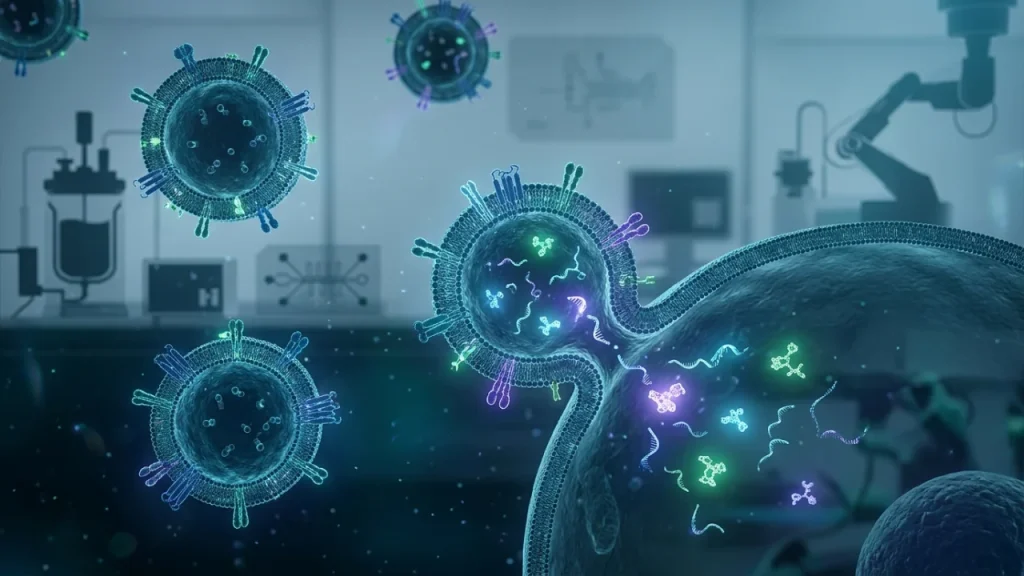
Why Small Bubbles Called Exosomes Matter for Your Health
What Are Exosomes and Why Are They Important?
Your body is home to trillions of cells that must work together every single day. These cells are not silent neighbors; they talk to each other constantly to keep you healthy. They do this by sending out tiny bubbles called exosomes. These bubbles are so small that you could fit millions of them on the tip of a needle. Scientists often call them extracellular vesicles. This name simply means bubbles that live outside of a cell. Even though they are tiny, they carry the most important secrets of your health.
Think of an exosome as a high-tech mail envelope. Inside this envelope, a cell places specific instructions. These instructions can be proteins, fats, or bits of genetic code. The cell then wraps these items in a tough, fatty shell. This shell acts like a protective coat. It keeps the message safe as it travels through your blood or other body fluids. Without this protection, the message would break down before it reached its destination. This system allows a cell in your brain to send a specific “letter” to a cell in your liver.
An exosomes research summary shows that these bubbles are much more than just cellular trash. For many years, doctors thought cells used these bubbles to throw away waste. We now know that they are actually vital tools for healing and growth. When a part of your body gets hurt, cells send out exosomes to call for help. These bubbles tell the immune system where the trouble is. They can also carry the blueprints needed to build new tissue or repair a wound. This makes them a key part of how your body fixes itself after an injury.
The way these bubbles work is very organized and precise. – A “sender” cell packs the bubble with a specific set of molecules. – The bubble travels through the body to find a “receiver” cell. – The receiver cell has special sensors on its surface that recognize the bubble. – Once the bubble attaches, it dumps its cargo into the new cell. – The receiver cell reads the instructions and changes what it is doing.
This process happens billions of times every second inside you. It is how your heart knows to beat faster when you run and how your skin knows to heal a scratch. If these bubbles send the wrong messages, it can lead to health problems. Scientists are now studying how to read these messages to find diseases early. They are also looking for ways to use these bubbles to carry medicine directly to sick cells. By understanding these tiny mail carriers, we are learning the true language of the human body. This sets the stage for understanding how cells build these complex packages from scratch.
The Big Impact of Tiny Bubbles on Your Daily Life
Muscle cells release millions of exosomes every time you move your body or lift something heavy. These tiny bubbles act like fitness coaches for your entire system. They travel through your blood to reach your liver and your fat cells. Once they arrive, they deliver a message that tells your body to burn energy. This is a major reason why physical activity keeps your whole body healthy instead of just making your muscles bigger. Without these messengers, your organs would not know how to coordinate their work during a workout.
Your brain also relies on these bubbles to keep you smart and focused. Inside your head, billions of neurons are constantly talking to each other. They use electricity for fast talk, but they use exosomes to send complex blueprints for long-term storage. These blueprints help your brain build new connections when you learn a new skill. If you are practicing a sport or learning a new language, your cells are busy packing and shipping these tiny envelopes. This constant flow of information helps your brain stay flexible and strong as you get older.
The immune system uses these bubbles as a high-speed warning network. When a germ enters your body, the first cells that see it do not stay quiet. They quickly create exosomes that contain pieces of that germ. These bubbles act like posters that show the rest of your immune system what the enemy looks like. This allows your body to build a defense team before the germ can spread too far. In a modern exosomes research summary, scientists often highlight how these bubbles are the first line of defense against many common illnesses.
These bubbles are also essential for the basic maintenance of your body. Every day, your body goes through a lot of wear and tear. You might get a small cut or a bruise without even noticing. Exosomes carry the repair kits to those spots immediately. – They tell skin cells to divide and fill in a gap. – They signal to blood vessels to stop a leak. – They help bones stay hard by moving minerals to the right places. – They clear out old proteins that might cause clogs in your cells.
Even when you are asleep, these bubbles are busy. While you rest, your body uses the time to do deep repairs. Your cells send out night-shift exosomes to fix damage from the sun or pollution. This is why a good night of sleep makes you feel fresh and healthy. Your cells have finished their deliveries and the body is ready for a new day. By watching these daily tasks, we can see how these tiny bubbles are the secret to staying strong and full of energy. This constant activity shows that the instructions inside these bubbles must be very complex to handle so many different jobs.
How Scientists Study These Small Packages Today
Scientists can now catch a single exosome from a tiny drop of blood. This was impossible just a few years ago because these bubbles are very small. They are about 1,000 times smaller than the width of a human hair. For a long time, they looked like tiny dots of dust under a regular microscope. Today, new tools allow us to look inside these packages like never before. This change is helping doctors find diseases much earlier than they used to.
One of the most important tools is the super-resolution microscope. These machines use special lasers to light up the proteins on the surface of the bubble. It is like turning on a bright flashlight in a dark room to see a small toy. Scientists can see the shape of the exosome and what is stuck to its “skin.” This helps them identify which organ sent the bubble. For example, an exosome from the brain looks different than one from the liver.
In a modern exosomes research summary, experts often talk about a process called liquid biopsy. In the past, doctors had to cut out a piece of an organ to see if it was sick. This is called a traditional biopsy, and it can be painful. Now, we can just look at the exosomes in a blood sample. These bubbles act like a biological postal service. They carry letters from every part of the body. By “reading” these letters, we can check on the health of distant organs without any surgery.
To get these bubbles out of the blood, scientists use a machine called a centrifuge. This machine spins the blood very fast in a circle. It spins thousands of times every minute. – The heavy parts of the blood, like red cells, sink to the bottom. – The medium parts stay in the middle. – The tiny, light exosomes stay at the very top. – Scientists then use a small straw to pick up the exosomes.
Once they have the bubbles, they use another tool to read the genetic code inside. This code is usually made of RNA. RNA is like a set of instructions for building things in the cell. If a cell is getting sick, it sends out “emergency” instructions. Scientists use a process called sequencing to read these instructions. They can see if a cell is asking for help or if it is growing too fast. This allows us to catch problems like cancer long before a person feels sick.
Another cool tool is called nanoparticle tracking. This allows scientists to watch how exosomes move in real-time. They can see how the bubbles bounce around and where they go. They use a camera that takes hundreds of pictures every second. This helps us understand how the bubbles find their target. We are learning that exosomes are not just floating randomly. They have a specific “address” on their surface that tells them where to land.
By using these tools, we are turning exosomes into a window into the body. We can see how the body reacts to food, stress, or medicine. We can even see how the body fights off a cold before we start sneezing. This new way of looking at cells is changing everything we know about health. It shows that even the smallest parts of us have a very big story to tell. This deep look into the bubbles is leading us to a future where medicine is much more precise.
How Your Body Makes Tiny Messengers in Cells
The Step-by-Step Process of Making an Exosome
Every single cell in your body acts like a tiny, busy factory that never sleeps. These factories do not just make things for themselves. They also need to send parts and messages to other factories far away. This is where the exosome comes in. Making an exosome is a very careful process that happens in several main steps. It is not a random accident. It is a planned event that requires a lot of energy and the right tools.
First, the cell starts by pulling a piece of its outer skin inward. Imagine pushing your finger into a soft balloon until a pocket forms. The skin of the cell folds back to create a small pouch. This pouch is called an endosome. It is like a shopping bag that the cell uses to collect materials from the outside or from its own internal parts. At this stage, the bag is still quite large.
Second, the cell begins to fill this bag with cargo. This cargo is not random. The cell chooses specific proteins and pieces of genetic code to put inside. It uses special worker proteins to pick the right items. This is a key part of any exosomes research summary because it shows that cells are very smart about what they share. They only send out what is necessary for the next cell to hear. They might pack instructions on how to grow or warnings about a virus.
Third, the “bubbles inside a bubble” phase begins. The large endosome bag starts to pinch off even smaller bubbles inside itself. These tiny bubbles are the actual exosomes-to-be. Scientists call the large bag a multivesicular body. Think of it like a large shipping box filled with many small, padded envelopes. Each envelope has its own message. This step is important because it protects the tiny bubbles until they are ready to leave.
Fourth, the cell must make a big choice. It can send the large bag to the “trash can” of the cell to be broken down and recycled. Or, it can send it to the edge of the cell to be shipped out. If the cell decides to ship it, the bag moves toward the outer wall. It travels along tiny tracks inside the cell like a train on a rail.
Fifth, the big release happens. The bag touches the outer wall of the cell and merges with it. When they touch, the bag opens up and spills all the tiny bubbles into the space outside the cell. These bubbles are now officially called exosomes. They are free to float through the blood or other fluids to find their target.
- The cell membrane folds inward to make a pouch.
- Special worker proteins sort the cargo into the pouch.
- Tiny bubbles form inside the big pouch.
- The cell moves the pouch to its outer edge.
- The pouch opens and releases the exosomes into the body.
This process happens millions of times every second in your body. It allows a cell in your toe to talk to a cell in your brain. By understanding how these bubbles are made, we can learn how to fix the process when it goes wrong. If a cell starts sending “bad” messages, we can try to stop the factory line. This is the next big step in keeping people healthy. Now that we know how they are made, we can look at what happens when they arrive at their destination.
How Cells Decide Which Messages to Send Out
Cells use a very strict system to choose which messages they send to their neighbors. A single cell can produce thousands of different molecules every day. However, it does not just throw all of them into an exosome. Instead, the cell acts like a smart mailroom. It picks only the most important instructions to pack into each tiny envelope. This choice is vital because the wrong message could cause problems in other parts of the body.
One of the main things cells pack is called RNA. You can think of RNA as a set of blueprints or recipes. When a cell sends RNA to a neighbor, it is giving that neighbor a new set of instructions. For example, a heart cell might send a recipe for a protein that helps repair damage. The cell must find that specific recipe in its large library. It then uses special “worker” proteins to grab that recipe and pull it toward the growing exosome.
Scientists call this process “sorting.” It is not a random act. In a typical exosomes research summary, experts point out that certain proteins act like magnets. These proteins have a shape that only fits specific RNA strands. When they find a match, they lock onto the RNA. Then, they guide it into the pouch that will become an exosome. This ensures that the message is clean and easy to read for the cell that receives it.
The cell also packs proteins and fats that act like a “zip code.” These molecules sit on the outside of the exosome. They tell the bubble exactly where to go. Some bubbles are meant for the cell next door. Others are meant for a tissue on the other side of the body. Without these specific tags, the messages would get lost in the blood.
- Cells use protein tags to label each piece of cargo.
- Sorting machines inside the cell pull the right RNA into the bubble.
- The cell checks the “stamps” on the bubble before it leaves.
- Healthy cells send growth signals, while sick cells might send “help” signals.
- Only the most useful recipes are chosen for long-distance travel.
This level of control is why exosomes are so powerful. If a cell is under attack by a virus, it changes its sorting rules. It stops sending growth recipes and starts sending “danger” signals. These signals warn the rest of the body to get ready for a fight. By choosing the right cargo, the cell can control how the whole body reacts to a problem. This careful selection process is the reason why these tiny bubbles can do so much work. Now that the cell has picked its message and packed the bag, the exosome is ready to begin its journey to find a new home.
The Role of the Cell Membrane in Releasing Vesicles
A single cell can release thousands of tiny bubbles into your blood every hour. These bubbles wait inside a larger sac called a multivesicular body. Think of this sac as a crowded bus station. The bubbles are the passengers waiting for the doors to open. The cell membrane is the outer wall of the station. It keeps the inside of the cell safe from the outside world. To let the bubbles out, the cell must open a temporary door. This process is a precise movement that requires energy and specific tools.
The large sac moves toward the edge of the cell. It travels along tiny tracks called microtubules. These tracks act like a train system inside the cell. Once the sac reaches the outer wall, it must find the right spot to land. Special proteins wait at the edge to catch the sac. These proteins act like a docking station for a ship. If the sac lands in the wrong spot, it cannot release its cargo. This ensures that the cell only sends out messages when it is ready.
When the sac touches the cell membrane, special molecules called SNARE proteins take over. These molecules work like a zipper on a jacket. One half of the zipper is on the sac. The other half is on the cell wall. When they meet, they lock together and pull tight. This pull is strong enough to force the two layers to blend into one. Scientists often look at these protein zippers in an exosomes research summary to understand how cells talk. If these proteins break, the cell cannot send its messages. This can lead to health problems because the body loses its communication network.
The moment of fusion is like two soap bubbles touching and becoming one larger bubble. The outer layer of the sac becomes part of the cell’s outer wall. As the sac opens up, the tiny exosomes inside spill out into the fluid around the cell. They are now free to travel. Some will float to the cell next door. Others will enter the bloodstream to travel to the brain or the heart. This release happens fast. The cell does not lose its own internal parts during this process. It only lets the specific bubbles go.
- The sac moves to the edge of the cell on tiny tracks.
- Protein zippers pull the sac and the cell wall together.
- The two layers melt into each other to create an opening.
- Exosomes spill out into the body to start their journey.
- Calcium and energy control the timing of the release.
The cell membrane also acts as a filter during this release. It checks the surface of the exosomes one last time. Only the bubbles with the right exit pass can leave. This prevents the cell from accidentally sending out waste or broken parts. The membrane is made of fats that are flexible but strong. This flexibility allows the cell to change shape as it pushes the bubbles out. It is a smooth process that happens millions of times across your body every second.
Releasing these bubbles takes a lot of energy. The cell uses a molecule called ATP to power the zippers and the movement. If a cell is low on energy, it might stop sending messages. This is why you might feel tired when your cells are not communicating well. The cell also uses calcium to trigger the release. A small spark of calcium tells the sac to fuse with the wall. This allows the cell to control exactly when a message is sent. It is a planned event rather than a random leak.
This exit through the cell membrane is the final step of the manufacturing process. The cell has built the message, packed the bag, and now opened the door. Once the exosome is outside the cell, it is on its own. It must survive the harsh environment of the blood and find its target. The way these bubbles leave the cell determines how well they can survive their trip. Now that the exosome is free, we can look at how it swims through the body to find a new home.
What Is Inside These Microscopic Envelopes?
Understanding the Genetic Instructions Carried by Exosomes
Every exosome acts like a tiny envelope filled with secret codes. These codes are not just random scraps of material. They are precise genetic instructions that tell other cells how to behave. Inside these small bubbles, the cell packs different types of genetic tools. The most important ones are RNA and DNA. These molecules are the language of life. When an exosome reaches its target, it delivers these messages directly into the new cell. This allows a cell in your brain to send a specific “to-do list” to a cell in your liver or your skin.
The most common cargo found in these envelopes is called messenger RNA, or mRNA. You can think of mRNA as a blueprint for a building. If a cell needs to build a new protein to repair damage, it needs that blueprint. An exosome can carry the mRNA blueprint from a healthy cell to a struggling one. Once the exosome enters the new cell, the cell’s factory reads the mRNA. It then starts building the protein immediately. This is how cells help each other grow and stay strong.
Another key part of the cargo is microRNA, or miRNA. These are much smaller than mRNA, but they are very powerful. Instead of being blueprints for building things, they act like light switches. They can turn specific genes on or off. If a cell is making too much of a certain protein, the miRNA can tell it to stop. This helps the body keep everything in balance. An exosomes research summary often shows that these small switches are the main way cells control distant tissues. By sending miRNA, one cell can change the entire mood or function of another cell far away.
Exosomes also carry fragments of DNA. This is like sending a page from the master instruction book of the cell. While DNA in exosomes is less common than RNA, it still plays a big role. It can tell the receiving cell about the history of the sender. It might even warn the new cell about a virus or a threat. This creates a fast-moving defense system throughout your body.
The way these instructions stay safe is also amazing. The blood is a dangerous place for genetic material. There are “scissors” in the blood called enzymes that usually chop up loose RNA or DNA. However, the exosome’s tough outer shell protects the cargo. The instructions stay perfect until they reach their destination. This protection is why exosomes are such great messengers.
- mRNA provides the blueprints to build new tools and proteins.
- miRNA acts as a switch to turn genes on or off.
- DNA fragments share vital information about the cell’s health.
- The fatty shell keeps these codes safe from being destroyed in the blood.
Scientists look at these genetic packages to learn about our health. An exosomes research summary helps doctors understand how diseases spread or how the body heals itself. By reading the “mail” inside these bubbles, we can see what the cells are talking about. This genetic communication is happening inside you every single second. It is a busy network of data moving through your veins. Now that we know what is inside the envelope, we can explore how these bubbles travel through the body to find the right address.
How Proteins Help Exosomes Do Their Jobs
Proteins make up a large part of each exosome, often acting like a specialized ID card for the cell. While the genetic code inside is the message, the proteins on the outside are the delivery instructions. Every exosome has a unique set of these proteins on its surface. They tell the exosome exactly where to go in the body. Without these proteins, the exosome would just float around and never find its target. Scientists call these surface proteins “markers.” Common markers include proteins named CD63 and CD81. These markers are like tiny flags that say, “I am a message from a lung cell” or “I am a message from a brain cell.”
The most important job for these proteins is finding the right lock. Every cell in your body has a surface covered in “receptors.” Think of these receptors as locks on a door. The proteins on the exosome are the keys. An exosome from a healthy liver cell might have a key that only fits into another liver cell. When the key fits, the cell opens up. This allows the exosome to dump its cargo inside. If the key does not fit, the exosome just bounces off and keeps moving. This system ensures that messages do not go to the wrong place. This is a vital part of any exosomes research summary because it explains why these bubbles are so precise.
Proteins also do more than just unlock doors. They help the exosome interact with the world around it in different ways:
- Adhesion proteins help the exosome stick to the target cell so it does not wash away.
- Transport proteins help move the exosome across the cell membrane once the door is unlocked.
- Signaling proteins tell the receiving cell to start a specific task immediately without even opening the envelope.
- Enzyme proteins can start chemical reactions outside the cell to prepare the area for the message.
Not all proteins are on the outside. Some proteins are hidden inside the envelope. These are often “scaffold” proteins. They help hold the RNA and DNA in place. They act like packing materials in a box. They keep the genetic instructions from getting tangled or broken during the trip. Once the exosome enters a new cell, these internal proteins help the cell read the instructions. They are like a setup crew that arrives with the furniture. They make sure everything is ready to go as soon as the door opens.
The number and type of proteins can change based on how the cell feels. If a cell is sick, it might put “danger” proteins on its exosomes. These proteins act like a flare gun. They signal the immune system to come and help. In some cases, proteins on exosomes can even stop a disease from spreading. They might block a virus from entering a cell. By studying these proteins, we can learn how to make better medicines. We are learning how to build our own “keys” to deliver medicine exactly where it needs to go. This protein-based navigation system is what makes exosomes so much better than simple drugs. Now that we understand the keys and the cargo, we can look at how these tiny envelopes travel long distances through the body.
The Way Lipids Protect the Message During Travel
The fatty wall of an exosome is only a few nanometers thick, but it is strong enough to survive the harsh environment of the human bloodstream. This wall is made of special fats called lipids. These lipids are not just a simple bag. They form a double
How Exosomes Travel Through Your Body to Deliver Messages
Moving Through Blood and Other Body Fluids
Exosomes enter the bloodstream as soon as a cell releases them into the body. Think of the blood as a massive, high-speed highway system. This highway connects every single organ and tissue in your body. A cell in your liver can send a message to your brain using this flowing network. The heart acts like a powerful pump that keeps this traffic moving at all times. Without this constant flow, these tiny envelopes would just sit near the cell that made them.
Scientists find these tiny bubbles in almost every fluid the body produces. This includes blood, saliva, tears, and even urine. In an exosomes research summary, experts often point out how many vesicles exist in a single drop of fluid. One milliliter of blood can hold billions of these tiny messengers. This high number ensures that at least some of the messages reach their goal.
Using fluids to travel offers several big advantages for the body: – Fluids allow for very fast travel across long distances. – The liquid environment keeps the vesicles from drying out. – Flowing paths reach deep into tissues through tiny tubes called capillaries. – Different fluids help messages reach specific areas like the gut or the lungs.
The trip through the blood is not always easy. The blood is a crowded place full of “chewing” proteins called enzymes. These enzymes act like tiny scissors. They try to break down and destroy anything they do not recognize. However, the lipid wall we talked about earlier acts like armor. It keeps the genetic cargo safe from these enzymes. This protection allows the exosome to survive for hours while it searches for the right destination.
Not all exosomes take the main blood highway. Some use the lymphatic system instead. This is like a secondary road system for your body. It is a key part of how the immune system stays informed. If a cell detects a germ, it sends an exosome through the lymph fluid. This alerts the “soldier” cells in the lymph nodes to get ready for a fight.
Exosomes do not swim on their own. They do not have tails or motors to move themselves forward. Instead, they drift with the current. They follow the natural flow of the fluid they are in. Your heart provides the power for this trip. Every time your heart beats, it pushes millions of these bubbles forward. They bounce off the walls of your veins and zip through your lungs. This movement is fast and covers the whole body in a very short time.
This journey is what makes them so important for new medical tests. Doctors can now study these traveling bubbles to see what is happening inside the body without doing surgery. By taking a small blood sample, they can “catch” the messengers and read the notes inside. This gives us a clear picture of how organs are talking to each other. Once the exosome finishes its long trip, it must find a way to stop and deliver its cargo.
How an Exosome Finds the Right Target Cell
Exosomes use a lock and key system to find the exact cell that needs their message. These tiny bubbles do not just wander aimlessly through your veins. They carry specific proteins on their outer surface that act like a digital address. This is a key point in any exosomes research summary. These proteins are the reason why a message meant for the lungs does not end up in the toes. The surface of every cell in your body is covered in docking stations. Scientists call these docking stations receptors.
When an exosome travels through the blood, it bumps into many different cells. Most of the time, it just bounces off and keeps moving. This happens because the “key” on the exosome does not fit the “lock” on that specific cell. If the exosome is looking for a muscle cell, it will ignore skin cells. It will ignore bone cells too. It only stops when it finds a perfect match. This matching process is fast and accurate. It ensures that the genetic instructions inside the exosome reach the correct destination without any mistakes.
There are several types of molecules that help with this targeting:
- Tetraspanins: These
What Happens When an Exosome Enters a New Cell
A single exosome can change how a cell behaves in less than an hour. Once the exosome finds its target, the delivery process begins immediately. This is the moment when the message moves from the outside of the cell to the inside. There are three main ways this happens. Each way ensures that the delicate genetic instructions arrive safely without getting destroyed.
The first way is called fusion. Imagine two small bubbles of oil floating on water. When they touch, they do not just stay side by side. They melt into each other and become one larger bubble. The outer layer of an exosome is made of the same material as the outer layer of your cells. Because they are the same, they can fuse together easily. When this happens, the exosome opens up like a trapdoor. Its internal contents spill directly into the fluid of the receiving cell.
The second way is called endocytosis. In this process, the cell acts like it is eating. When the exosome lands on the surface, the cell membrane starts to curve inward. It creates a small pouch that wraps around the exosome. This pouch eventually pinches off and moves deep into the cell. Scientists often look at this specific step in any exosomes research summary because it shows how active the receiving cell is. The cell is not just a passive target. It actively pulls the message inside to see what is there.
The third way is a bit different. Sometimes the exosome does not even need to go inside. It can just dock on the surface and send a signal through the cell wall. This is like someone ringing your doorbell to tell you there is a package on the porch. The exosome stays outside, but the message still gets through.
Once the cargo is inside the cell, the real magic happens. The exosome carries “recipes” called RNA. Your cells have tiny machines that read these recipes to build proteins. When the new RNA arrives, the cell stops what it is doing and starts reading the new instructions. It is like a computer getting a software update. The hardware of the cell stays the same, but the way it works changes completely.
- The cell might start growing faster to heal a wound.
- It might start making chemicals to fight off a virus.
- It might send out its own signals to alert other nearby cells.
- It might even change how it uses energy to stay alive longer.
This change in behavior is the whole goal of the exosome. The tiny bubble protects the message during the long trip through the body. It ensures the message reaches the right “lock.” Finally, it delivers the instructions so the cell can act. This complex delivery system allows your brain to talk to your muscles or your heart to talk to your lungs. Every part of this process is a vital piece of the exosomes research summary that experts study today. By understanding how these messages are delivered, we learn how the body keeps itself healthy and balanced. This delivery leads to a chain reaction that can affect your entire health.
Keeping the Body Balanced with Extracellular Vesicles
How Exosomes Help Your Immune System Stay Strong
Immune cells use exosomes to share pictures of germs before those germs can spread. Your body has many different types of white blood cells that act like a security team. Some of these cells are scouts that look for danger. Others are soldiers that do the heavy fighting. The scouts move through your blood and tissues to find viruses or bad bacteria. When a scout cell finds a germ, it does something very smart. It does not just scream for help. It takes a small piece of the germ and packs it into an exosome.
This exosome acts like a “wanted poster” for the rest of the immune system. The scout cell releases thousands of these tiny bubbles into your body. They travel through your fluids to reach your lymph nodes. This is where your soldier cells, often called T-cells, wait for orders. When a T-cell catches one of these exosomes, it learns exactly what the enemy looks like. The soldier cell does not have to meet the actual germ to be ready for a fight. This saves a lot of time. If the germ starts to spread, the soldier cells are already trained and ready to attack.
Scientists look at this process closely in every exosomes research summary. They want to know how these bubbles help the body react so fast. Without these messages, the immune system might be too slow to stop a cold or a flu. The speed of the exosome message can be the difference between staying healthy and getting very sick.
Exosomes also help the immune system stay organized during a battle. They act like a radio system that keeps everyone working together. – They tell new immune cells exactly where the fight is happening. – They help cells stick together to trap germs in one place. – They carry signals that tell the body to make more white blood cells. – They even tell cells how to make special tools, like antibodies, to kill the germs.
But the immune system must also know when to stop. If your white blood cells fight for too long, they can start to hurt your healthy cells. This can cause swelling and pain that does not go away. This is where “calming” exosomes come into play. Once the germs are gone, certain cells send out bubbles that say the war is over. These messages tell the soldiers to stop fighting and go back to their normal jobs. This prevents the body from attacking its own healthy parts by mistake.
This balance is vital for your daily health. If the “stop” signal does not work, you might feel tired or sore all the time. If the “attack” signal is too weak, you might get sick more often. Every exosome is a tiny piece of data that keeps the system working perfectly. By studying these bubbles, we learn how to help the body defend itself better. These tiny envelopes are the most important messengers in your entire defense system. This constant talk between cells ensures that your body stays strong and ready for anything.
The Way Your Brain Uses Exosomes to Think and Feel
Your brain sends millions of tiny bubble messages every second to help you think and feel. These bubbles, called exosomes, act like a fast delivery service between brain cells. Scientists call these brain cells neurons. Neurons are like long, thin wires that carry electricity. But electricity alone cannot tell a cell how to grow or what to remember. For those complex jobs, the brain uses extracellular vesicles to carry physical instructions.
When you learn something new, your neurons must change. They might need to grow longer or build stronger connections with their neighbors. To do this, a neuron packs an exosome with special proteins and genetic code. It sends this bubble across the small gap between cells. When the neighboring cell receives the bubble, it reads the instructions and starts to change its shape. This is how a memory is physically built in your head.
An exosomes research summary shows that these bubbles are essential for keeping your mind sharp. Without this constant trade of information, your brain cells would not know how to work together. They use these bubbles for many different tasks:
- They carry instructions to build new connections between cells.
- They help move waste away from busy neurons to keep the brain clean.
- They protect fragile genetic messages from breaking down in the space between cells.
- They allow different types of brain cells to talk to each other quickly.
One important part of this system involves a protein called Arc. This protein acts like a master builder for your memories. It helps your brain change when you learn a new skill, like riding a bike or solving a math problem. Arc travels inside exosomes to move from one neuron to another. This travel allows one cell to “teach” another cell what it has learned. It is a way for your brain to share knowledge with itself. Without these tiny bubbles, your memories might disappear as soon as they are made.
Neurons are not the only cells in your head. They have helpers called glial cells. Think of neurons as the drivers in a car race and glial cells as the pit crew. The pit crew uses exosomes to send fuel and repair tools to the drivers. If a neuron gets tired, a glial cell sends a bubble filled with energy-boosting molecules. This teamwork ensures that your brain stays fast and smart all day long.
Exosomes also help clean the brain. When cells work hard, they create biological trash. If this trash stays in the brain, it can make you feel foggy or confused. Exosomes gather this waste and carry it away to be destroyed. This cleaning process often happens while you sleep. It is one reason why a good night of rest helps you think more clearly the next day. Every thought you have depends on these tiny envelopes moving through your brain. This constant flow of data ensures that your mind stays healthy and ready to learn more.
How Muscles and Organs Talk to Each Other
Your muscles make up nearly 40 percent of your total body weight. When you run or jump, your muscles do more than just move your bones. They act like a huge chemical factory. These cells create thousands of tiny bubbles called extracellular vesicles. Scientists often call them EVs for short. These bubbles carry special messages to every other part of your body. This process helps keep your whole system in a healthy state of balance.
One of the main stops for these muscle bubbles is the liver. The liver stores sugar for energy. When you exercise, your muscles send vesicles to tell the liver to release that sugar. This gives you the fuel you need to keep moving. Without this fast communication, your muscles would run out of gas very quickly. The vesicles act like a delivery service for vital information.
Muscles also talk to your fat cells using these tiny envelopes. The vesicles carry instructions that tell fat cells to break down. This process turns stored fat into usable energy for the body. It is like sending a text message that says, “We need more power right now!” This is why exercise helps people stay at a healthy weight. It is not just about burning calories during a workout. It is about the long-term signals your muscles send to your fat.
An exosomes research summary shows that these bubbles contain very specific proteins and genetic bits. These molecules can change how other organs work for the better. For example, some vesicles go straight to the heart. They help the heart muscle grow stronger and stay safe from stress. This is one reason why active people often have much healthier hearts.
The communication system works in several clear steps: – Muscles start working and create new vesicles. – These bubbles enter the bloodstream to travel long distances. – They find specific organs like the liver, heart, or lungs. – The vesicles dock with the cells in those organs. – They release their cargo to tell the organ how to react to the exercise.
Inside each bubble, there are tiny pieces of genetic code. These codes act like instruction manuals for the cells that receive them. When a vesicle reaches a target cell, it merges with the outer wall of that cell. The instructions spill inside. The target cell then starts making new tools based on those instructions. This is how a leg muscle can “teach” a distant organ how to be healthier.
Scientists are still finding new things in an exosomes research summary every year. They have found that the mix of molecules inside the bubbles changes based on your movement. A fast sprint sends different messages than a slow walk. This means your body can change its internal conversation based on what you are doing. This constant flow of data keeps your body running like a well-oiled machine. It connects your physical movement to your internal health in a way that protects every organ. This flow of information ensures that no part of your body has to work alone. This teamwork is what keeps you feeling strong and full of energy.
When Bad Cells Use Exosomes to Spread Disease
Why Cancer Cells Hijack Exosomes to Grow Faster
Cancer cells release up to ten times more vesicles than healthy cells do. These tiny bubbles act like secret messages that help the disease spread through the body. While healthy cells use these bubbles to help you stay strong, cancer cells use them to cause harm. They turn a helpful communication system into a dangerous weapon. This allows a tumor to grow much faster than it normally would.
Inside these cancer bubbles, the cargo is very different from healthy ones. Instead of helpful codes, they carry instructions that trick other cells. One main goal of these bubbles is to hide the cancer from the body’s defense system. Usually, your immune system finds and kills sick cells. Cancer cells send out exosomes to blind these defender cells. When the immune cells touch these bubbles, they get a message to stop attacking. This creates a safe zone where the tumor can grow without being stopped.
Cancer cells also need a lot of food and oxygen to grow quickly. They use exosomes to steal these resources from the rest of the body. The bubbles travel to nearby blood vessels and deliver a specific command. This command tells the blood vessels to grow new branches toward the tumor.
- The tumor sends out bubbles filled with growth signals.
- These signals reach the nearest blood pipe in the body.
- The pipe starts building new paths directly toward the cancer.
- The tumor gets a fresh supply of blood and nutrients.
- This extra food helps the cancer cells divide and multiply.
Another trick involves moving to new parts of the body. This process is called metastasis. Before cancer cells actually move, they send scout bubbles to distant organs like the liver or lungs. These scouts change the environment in those distant organs. They make the tissue sticky and welcoming for cancer cells. By the time the actual cancer cells arrive, the ground is already prepared for them to grow. This is why cancer often spreads to the same specific places in many patients.
An exosomes research summary often highlights how these bubbles act as markers for disease. Scientists can look at the bubbles in a person’s blood to see if cancer is hiding somewhere. Because cancer cells make so many of these bubbles, they are often easier to find than the cancer cells themselves. This helps doctors catch the disease much earlier. They can see the bad messages the cancer is sending before the tumor gets too big to treat.
Cancer also uses these bubbles to talk to healthy helper cells nearby. These helper cells are called fibroblasts. Normally, they help the body heal wounds. Cancer exosomes trick them into building a hard shell around the tumor. This shell protects the cancer from medicine. It acts like a thick wall that keeps doctors’ tools from reaching the sick cells. Understanding these tricks is the first step toward stopping them. By learning how cancer talks, we can find ways to cut the phone lines and stop the disease from spreading.
How Exosomes Help Viruses Hide from Your Body
Viruses are like tiny biological pirates that take over a cell’s internal machinery. They do not just enter a cell to make copies of themselves. They also steal the cell’s tools to help them spread to other parts of the body. One of the most important tools they steal is the exosome. By using these small bubbles, viruses can move through the blood without being caught by the body’s defenses.
The immune system acts like a team of security guards. These guards look for germs that do not belong in the body. When a virus floats alone in the blood, the guards can usually see it and destroy it. However, some viruses wrap themselves in an exosome bubble. This bubble is made from the body’s own cell material. To the immune system, the bubble looks like a normal, healthy part of the body. This trick allows the virus to hide in plain sight. It is like a thief wearing a police uniform to walk past a security desk.
Scientists call this process cloaking. It is a major focus in modern medicine. An exosomes research summary often explains how this cloaking makes it hard to create new vaccines. If the virus is hidden inside a natural bubble, the body does not know it needs to fight. This allows the virus to reach distant organs safely.
Viruses also use exosomes to travel in large groups. Usually, a virus might try to enter a cell one by one. This is a slow and risky way to spread. Instead, some viruses pack dozens of copies of themselves into a single large exosome. This is like a bus full of invaders. When this bus reaches a healthy cell, it delivers a massive dose of the virus all at once. This makes the infection much stronger and faster than normal.
- Viruses use bubbles to hide from the immune system’s guards.
- They use these bubbles to travel in groups for a stronger attack.
- They send out empty bubbles to distract the body’s defenses.
- They use the bubbles to enter cells they normally could not reach.
Another clever trick is the use of decoys. Some viruses force a sick cell to make thousands of empty exosomes. These empty bubbles look exactly like the ones carrying the real virus. The immune system spends all its energy attacking the empty bubbles. While the guards are busy with the decoys, the real viruses sneak into other cells. It is a game of distraction that keeps the virus safe from medicine.
These bubbles also help viruses jump between different types of cells. Normally, a virus can only attach to specific cells it “matches” with. But if a virus is inside an exosome, it can enter almost any cell it touches. The exosome acts like a universal key. This allows a disease to spread to parts of the body that the virus could not reach on its own.
Understanding these hidden paths is vital for finding new cures. If we can stop viruses from stealing these bubbles, we can make them visible again. Once the virus is out in the open, the immune system can do its job. This research shows us that the battle against germs is not just about the germs themselves. It is also about the tiny envelopes they use to travel. This knowledge helps us find new ways to protect the body from these tiny hijackers.
The Link Between Exosomes and Heart Problems
Heart cells send millions of tiny bubbles into the blood every single minute. These bubbles usually help the heart stay in rhythm and keep blood flowing. However, when a person gets sick, these messages change for the worse. Instead of helpful tips, the bubbles carry harmful orders that damage the body. These orders can tell the body to build up thick gunk inside the tubes that carry blood. This gunk is called plaque, and it is a leading cause of heart disease.
Inside your arteries, the walls should be smooth like a slide. This lets blood move through your body easily. When a person has high cholesterol, certain cells in the blood vessels get stressed. These stressed cells release exosomes that act like glue. They float to the artery walls and make them very sticky. Once the walls are sticky, fat and white blood cells start to clump together. This is how a clog begins to grow. Over time, the clog gets bigger and makes it hard for blood to pass.
Inflammation is another way these bubbles cause trouble. Usually, inflammation helps you heal from a cut. But inside the heart, too much of it is dangerous. Scientists have found that fat cells can send “alarm” signals through exosomes. These signals travel through the blood and reach the heart muscle. They tell the heart cells to stop working well. This is a key part of an exosomes research summary because it shows how one part of the body can hurt another part from far away.
When a part of the heart stops getting blood, it starts to die. This is what happens during a heart attack. The dying cells do not just go away quietly. They release a flood of “stress” exosomes. These bubbles carry bad news to the healthy parts of the heart. – They tell healthy cells to stop beating in the right way. – They cause the heart tissue to grow stiff and scarred. – They attract more inflammatory cells that cause extra damage. – They can even cause the heart to change its shape, which makes it weak.
Exosomes also play a big role in making blood thick. Some bubbles carry a special protein that makes blood turn into a gel. This is helpful for a scab on your knee, but it is bad inside an artery. A clot can block the blood flow completely. This stops oxygen from reaching the heart. By studying these bubbles, doctors hope to find ways to block these bad messages before they cause a disaster. This knowledge helps us find new ways to keep the heart pumping strong.
Using Exosomes as a Tool to Find Sickness Early
Why Doctors Call Exosomes a Liquid Biopsy
Every cell in your body leaves a tiny fingerprint in your blood by releasing exosomes. These tiny bubbles act like mail packages sent from different organs. They contain clues about the health of the cell that sent them. Doctors can now catch these packages to see if a person is healthy or sick without needing surgery. This method is what experts call a liquid biopsy. In the past, doctors often had to cut out a piece of an organ to study it. This is a traditional biopsy, and it can be painful or even dangerous. A liquid biopsy is different because it only needs a small amount of blood or other body fluids. This makes the process much easier and safer for the patient.
What makes these bubbles so special is the cargo they carry inside. Each exosome holds a mix of proteins and genetic instructions. If a cell is sick, the instructions inside the bubble change. For example, a cancer cell sends out different signals than a healthy lung cell. By looking at these signals, doctors can find out what is happening deep inside the body. This is a vital part of any exosomes research summary. It shows that the blood is not just a liquid that carries oxygen. It is a highway full of important data.
Using exosomes as a tool helps find sickness very early. Often, a person feels fine even when a disease is just starting. Traditional tests might miss these tiny changes. But cells start releasing “sick” exosomes the moment they begin to struggle. – They can show if a tiny tumor is starting to grow in the liver. – They can warn a doctor if a heart is under too much stress before a heart attack happens. – They can point to brain problems that are hard to see on a normal brain scan. – They can even show if a person is developing a sugar-related illness like diabetes.
Because these bubbles are so small, they can travel through almost any part of the body. They can move from the brain into the blood or from the liver into the urine. This gives doctors many ways to find them without using big needles.
There are many reasons why this new tool is better for patients. First, it is much faster than waiting for a large tumor to show up on an X-ray. Second, doctors can do the test many times. If a patient is taking medicine, the doctor can check the blood every week. They can see if the “bad” exosomes are going away. If the bubbles change back to a healthy state, the medicine is working. If the bubbles stay the same, the doctor knows they need to try a different treatment right away. This saves valuable time and helps the patient get better sooner.
Finding these bubbles is a complex task for scientists. They are much smaller than a single cell. A single drop of blood contains millions of them. Scientists use special machines to pull the exosomes out of the blood. One way is to spin the blood very fast in a machine. This separates the heavy parts from the light bubbles. Another way is to use a special filter. The filter has holes so small that only the exosomes can fit through. This is like sifting flour when you bake a cake. Only the finest parts get through. Once the scientists have the bubbles, they open them up to read the code inside. This code tells the story of the body’s health.
In the future, a liquid biopsy might be part of a normal check-up. You would go to the doctor for a quick blood draw. A few days later, the doctor would know if every organ in your body is doing its job. This is the power of studying these tiny envelopes. They turn the blood into a map of the entire body. This helps doctors stop sickness before it even starts to make you feel bad. By listening to these tiny messages, we can learn how to fix the body before the damage becomes permanent.
Finding Signs of Disease Before You Feel Sick
Sick cells start sending out distress signals long before you get a fever or feel any pain. These signals are packed inside tiny bubbles called exosomes. You can think of these bubbles as flares shot into the sky by a ship in trouble. In many cases, these bubbles change their cargo weeks or even months before a doctor can find a problem using an X-ray. This is because a tumor or an infection must grow quite large to be seen on a screen. However, exosomes are released by the very first few cells that become unhealthy. They enter the blood and travel everywhere in the body.
Scientists look for very specific markers inside these tiny envelopes. For example, in some lung diseases, the proteins inside the bubbles change while the person still feels healthy. An exosomes research summary shows that these bubbles can carry pieces of broken DNA that do not belong in a healthy body. If a doctor finds these pieces early, they can start treatment much sooner. This is the main goal of early detection. We want to find the problem while it is still small and easy to fix.
Exosomes are helpful for finding many different kinds of sickness: – They carry unique codes from the very first cancer cells in the body. – They show if a heart is under too much stress before a heart attack happens. – They carry proteins from the brain that can signal memory loss years in advance. – They change their outer shell to alert the immune system that a virus is hiding.
Why do cells send these messages so early? It is not always a warning for the rest of the body. Often, sick cells use exosomes to try to change the area around them. They want to make the body a friendly place for the disease to grow. But because these bubbles leak into the blood, we can catch them. It is like reading a secret letter before it reaches its destination. By reading these letters, we catch the “bad guys” while they are still making their plans. This makes the disease much easier to fight because it has not had time to spread.
In the brain, this early warning is even more important. Brain cells are very hard to study because they are protected by the skull. We cannot easily take a piece of the brain to check it. But brain cells release exosomes that can leave the head and enter the blood. We can find these “brain bubbles” in a simple blood test. They might show signs of sickness ten years before a person starts forgetting names. This gives doctors a huge head start to protect the brain. By the time we feel sick, the exosomes have been telling the story for a long time. This makes them the best tool we have for staying ahead of illness. Finding these signs early changes the way we think about being healthy. Moving forward, we can use these same bubbles not just to find sickness, but to deliver the cure.
How This Exosomes Research Summary Helps Doctors Save Lives
Cancer cells send out up to ten times more exosomes than healthy cells. This massive flow of information creates a clear signal for doctors to follow. In the past, doctors had to wait for a tumor to grow big enough to see on a scan. Now, they can look for these tiny bubbles in a single drop of blood. This method is called a liquid biopsy. It is much safer than cutting into the body to take a piece of a tumor. Because these bubbles are everywhere, doctors can find them in saliva, urine, or blood. Each bubble acts like a time capsule from the sick part of the body.
An exosomes research summary helps doctors make sense of billions of these tiny bubbles. Scientists have built large databases that list what every exosome should look like. They compare the bubbles from a patient to the bubbles in the database. If the proteins on the shell do not match a healthy profile, the doctor knows something is wrong. This data allows for a precision medicine approach. This means the treatment fits the specific person, not just the general disease. Doctors no longer have to guess which medicine might work. They can see exactly what the cell is asking for.
There are several ways this technology changes how we treat patients:
- Doctors can find cancer years before a physical lump appears.
- Patients do not need painful surgeries to get a basic diagnosis.
- Doctors can check if a drug is working in just a few days by watching the bubbles.
- Sickness can be tracked in real-time as it moves through the body.
- Doctors can see if a disease is coming back long before a patient feels sick again.
Speed is the most important factor in saving lives. When a disease is caught early, it is often much weaker. For example, treating a few sick cells is easier than treating a large tumor. Exosomes provide the fastest way to see these changes. Traditional tests might take weeks to show results. Exosome tests can give answers much faster because the signals are always moving through the blood. This saves time, and in a hospital, time is the same thing as a life. By using the data from an exosomes research summary, clinics can act before the patient even feels a symptom.
Scientists are also learning how to use these bubbles to predict how a patient will react to a specific treatment. If the exosomes show that a cell is resisting a drug, the doctor can switch to a new plan immediately. This prevents the patient from taking medicine that makes them feel sick without helping them get better. We are moving toward a world where a simple blood draw tells your whole health story. This is not just about finding sickness; it is about staying one step ahead of it. As we learn to read these messages perfectly, we can start to think about how to send our own messages back to the cells.
How Scientists Use Exosomes to Heal the Body
Using Exosomes to Deliver Medicine Directly to Cells
Scientists can turn exosomes into tiny delivery trucks that carry medicine directly to sick cells. In the past, medicine was like a giant rainstorm that hit a whole forest. If only one tree was sick, the whole forest still got wet. This often caused side effects in healthy parts of the body. Now, scientists use exosomes to act like a single drop of water for that one sick tree. This makes treatment much safer and more effective for the patient.
The process starts by choosing the right medicine to help the body. This could be a drug to kill cancer or a set of genetic instructions to fix a broken cell. Scientists then have to get that medicine inside the exosome. According to an exosomes research summary, there are three main ways to do this:
- Scientists can use small electric shocks to poke tiny holes in the bubble. The medicine slips inside, and then the holes close back up.
- They can mix the medicine with the bubbles in a lab and let them sit together. Over time, the medicine naturally moves inside the envelope.
- They can even change the “mother cell” that makes the exosomes. This forces the cell to build the medicine right into the bubble from the start.
Once the bubble is loaded, it needs a map to find its target. Every cell in your body has a unique “lock” on its surface. Scientists can put a “key” on the outside of the exosome. This key is a special protein that only fits the lock of a sick cell. When the exosome travels through the blood, it ignores healthy cells. It keeps moving until it finds the perfect match. When the key fits the lock, the exosome merges with the cell. It then pours the medicine directly inside. This prevents the medicine from touching or damaging healthy tissues.
This method is very helpful for treating the brain. The brain has a thick wall of cells that keeps most things out. This wall protects us from germs, but it also blocks helpful medicine. Exosomes are one of the few things that can cross this wall easily. They are small enough and look natural enough to get past the guards. This allows doctors to treat brain issues without using risky tools or surgery. By using these tiny bubbles, we can use much less medicine to get the same result. A smaller dose means the patient feels better while they heal. We are no longer just hoping the medicine finds the right spot. We are now driving it there ourselves. This ability to send specific instructions is also the key to how we can fix cells that have stopped working correctly.
How Exosomes Can Help Fix Damaged Skin and Tissue
Skin cells send out millions of tiny bubbles to fix a single cut. These bubbles, or exosomes, act like a construction crew for your body. When you get a scrape, your skin must act fast to protect you from germs. It does not just grow back by luck. Instead, healthy cells nearby release exosomes to lead the repair process. This is a key part of any modern exosomes research summary because it shows how our bodies talk to themselves. These bubbles carry the exact plans needed to build new layers of skin.
Inside these bubbles are special tools called growth factors and genetic instructions. Think of growth factors as tiny workers with blueprints in their hands. They tell the skin to make more collagen. Collagen is a strong protein that acts like the glue holding your skin together. Without enough collagen, a wound stays open or heals very slowly. Exosomes make sure the right amount of collagen arrives at the right time. They also tell the body to grow new, tiny blood vessels. These vessels bring oxygen and food to the healing area. This keeps the new tissue alive and healthy.
The healing process happens in three main steps managed by these bubbles:
- First, exosomes calm the area down. They tell the immune system to stop the swelling once the danger of germs is gone.
- Second, they order the cells to multiply. This fills the gap in the skin with new, fresh layers of cells.
- Third, they help organize the new tissue. This makes the skin look smooth and feel strong instead of lumpy or weak.
In many lab tests, wounds treated with exosomes healed 30 percent faster than those left alone. This is vital for people with health problems like diabetes. For these patients, even a small cut on the foot can be dangerous. Their bodies often forget how to send the right signals to start the repair. Scientists can now give these patients extra exosomes collected from healthy cells. These bubbles act like a jump-start for a car battery. They give the skin the instructions it is missing so it can close the gap.
Scars happen when the body builds skin too fast and too messy. It is like a rushed repair job on a house where the walls are crooked. Exosomes help the body build more carefully. They tell the cells to lay down collagen in a neat, organized pattern. This results in less scar tissue. The skin stays soft and stretchy rather than becoming hard and tight. Scientists are now looking at how this helps people with bad burns or deep injuries.
We are learning that skin is not just a covering. It is a busy communication hub. Exosomes are the messages that keep this hub running smoothly. By using these messages, we can help the body heal itself without heavy drugs. We are moving away from just covering a wound with a bandage. Now, we are talking directly to the cells to help them grow. This ability to rebuild skin is just the start. The same “construction” signals can also help fix other parts of the body, like our muscles and bones.
The Way Exosomes Might Treat Brain Diseases in the Future
The human brain is protected by a tight wall of cells called the blood-brain barrier. This wall acts like a strict security guard for the mind. It keeps out germs and toxins that could make us sick. However, this guard also stops 98 percent of all medicine from entering the brain. This makes it very hard for doctors to treat diseases that cause memory loss. Most drugs are too big or too “foreign” to get past the guard. Exosomes are different because they are natural parts of the body. They have a special pass that lets them slip through this wall without being stopped. This makes them the perfect delivery trucks for brain medicine.
Inside these tiny bubbles, scientists can pack special tools. These tools are often pieces of genetic code. When the exosome reaches a sick brain cell, it merges with the outside of that cell. It then releases its cargo directly into the center of the cell. This is much better than just flooding the whole body with drugs. It is like sending a private letter instead of shouting in a crowded room. An exosomes research summary shows that these bubbles can carry instructions to stop brain swelling. Swelling is a big reason why people lose their memory. When brain cells get swollen, they stop talking to each other. Exosomes carry “calming” signals that tell the brain to relax. This helps the brain stay healthy and keeps the connections between cells strong.
Scientists are finding many ways to use these bubbles in the brain: – They carry “cleaner” proteins to remove brain trash like sticky plaques. – They deliver new instructions to fix broken parts of a cell. – They reduce the swelling that causes brain fog and confusion. – They help grow new paths between cells so memories can travel faster.
The brain has a natural cleaning system, but sometimes it fails. In a healthy brain, cells get rid of old proteins every day. In a sick brain, these proteins stick together and form clumps. These clumps are like roadblocks on a highway. They stop the electrical signals that create our memories. Scientists are now testing ways to use exosomes to carry “scissors” that can cut these clumps apart. This could help a person remember the names of their family members again. By using the body’s own messaging system, we can fix the brain from the inside out. This new way of sending medicine might soon change how we treat the most difficult diseases in the world. This ability to target the brain is a major step toward total body repair.
What the Future Holds for Exosome Science and Medicine
New Technology for Seeing These Tiny Bubbles Better
Exosomes are 1,000 times smaller than the width of a human hair. Because they are so tiny, normal microscopes cannot see them at all. A regular microscope uses light to show us cells. However, light waves are actually too big to bounce off an exosome. It is like trying to catch a tiny gnat with a giant basketball net. The gnat simply flies through the holes in the net. For many years, this was a major problem for scientists. They knew these bubbles were important, but they could only see them as blurry clouds. An exosomes research summary shows that we need better tools to understand how these bubbles move.
Today, scientists are building new kinds of “super-microscopes” to solve this problem. One of these tools is called super-resolution microscopy. This technology uses special lasers to turn molecules on and off very quickly. It creates a very sharp picture by layering many images together. Instead of a blurry spot, we now see a clear circle. We can even see the proteins sitting on the outside of the bubble. These proteins act like a “zip code” that tells the bubble where to go.
Another amazing tool is called Cryo-Electron Microscopy. To use this, scientists freeze the exosomes instantly. They use a special liquid that is much colder than ice. This turns the water around the bubbles into a clear, glass-like state. It stops the bubbles from moving or breaking apart. Then, a beam of tiny particles called electrons shoots through the sample. This creates a 3D map of the exosome. We can see the cargo inside, such as the genetic instructions the cell is sending.
To watch these bubbles move in real-time, scientists use “glowing” tags. These tags are like tiny light bulbs that stick to the exosome. Here is how this technology helps us:
- Laser beams find the glowing tags inside a living body.
- High-speed cameras take thousands of pictures every second.
- Computer software removes the background noise to show only the bubbles.
- Scientists track the path of the bubble as it travels to a sick organ.
Watching these bubbles move in a living animal is a huge step forward. In the past, we could only look at dead cells on a slide. Now, we can watch a single exosome travel through the blood of a tiny fish. We can see it reach a tumor or a wound. We can see exactly when it opens up to deliver its medicine. This helps us make sure the treatment is working. If we can see the bubble, we can control the bubble. This new way of seeing the invisible will help us build better medicines for everyone. These tools are the eyes of the future, showing us how the body heals itself one tiny bubble at a time.
The Challenges Scientists Must Solve Next
A single milliliter of human blood can contain over billions of tiny exosomes. This sounds like a lot, but scientists need even more to create a single dose of medicine. Taking these bubbles out of a person is not enough to help millions of sick people. We must learn how to grow them in large amounts. This is the first big hurdle in our exosomes research summary. To do this, scientists use large tanks called bioreactors. These tanks act like giant, warm nurseries for cells. We feed the cells and keep them happy so they produce as many bubbles as possible. If the temperature changes by just one degree, the cells might stop working. We are still learning the best “recipe” to keep these cells productive for weeks at a time.
Once we have a large batch of bubbles, we face the problem of purity. A bioreactor is full of “trash” like leftover food, dead cell parts, and random proteins. We only want the specific exosomes that carry the healing message. Sorting them is like trying to find a few specific blue marbles in a swimming pool full of millions of clear ones. If we leave the trash in the medicine, the patient’s body might react badly. Their immune system might think the medicine is a germ and try to fight it. We need better filters that can separate the bubbles without popping their delicate skins.
There are several other questions that scientists must answer before these bubbles reach the local pharmacy:
- How do we make sure every bubble in a batch is the exact same size?
- Can we store these bubbles in a regular fridge, or do they need deep-freeze tanks?
- How many bubbles does a person need to take to get better?
- Which type of cell makes the safest and most effective bubbles for humans?
Loading the cargo is another tricky task. We want to put specific instructions or drugs inside the bubbles. Some scientists use “shaking” methods or mild electric shocks to open tiny doors in the bubble skin. This allows the medicine to slide inside. However, these methods can sometimes weaken the bubble. If the bubble is too weak, it will pop before it reaches the sick organ. We are looking for gentler ways to pack these nano-sized envelopes so they stay strong during their journey through the blood.
Finally, we must talk about the rules for safety. Every new medicine must pass strict tests to prove it does not cause harm. Because exosomes are “alive” in a way, they are harder to test than a simple aspirin pill. We need to show that the bubbles go exactly where we want them to go. We do not want a heart medicine bubble accidentally ending up in the toes. Solving these puzzles is hard work, but the reward is worth it. These tiny bubbles could soon replace heavy surgeries or toxic chemicals. They represent a new era where we use the body’s own mail system to deliver health. This journey from the lab to the hospital is the next great adventure in modern science.
Why Exosomes Will Change the Way We Treat Illness
Every drop of human blood contains about one billion exosomes. This is a massive number of messengers moving through your veins right now. These tiny bubbles are busy every second of the day. They carry notes between your brain, your heart, and your toes. Because they are natural, your body does not fight them or try to kick them out. This simple fact makes them the perfect tool for future doctors.
Modern medicine often feels like a heavy hammer. If you have a headache, you take a pill. That pill goes everywhere in your body. It touches your stomach, your liver, and your muscles. We call this a “shotgun” approach because it hits everything at once. Exosomes change this completely. They are more like a guided letter. We can address the letter to a specific group of sick cells. This means we can use less medicine to get a better result. It also means fewer side effects for the patient because healthy cells are left alone.
Doctors can also find diseases much earlier by looking at these bubbles. This is a major part of any modern exosomes research summary. Imagine finding a tiny spark before a whole forest catches fire. Exosomes carry “ID cards” from their home cells. If a cell is starting to get sick, its exosomes will show a warning sign. A simple blood test could find cancer or heart disease years before you feel a single symptom. This is the power of early detection through biological mail.
Exosomes can also tell the body to fix itself. Some cells, like stem cells, are the champions of repair. However, using whole stem cells in a hospital can be risky. They might grow in the wrong way or in the wrong place. Instead, we can just use the exosomes they send out. These bubbles carry the “repair manual” without the risk of the whole cell.
- Exosomes can travel through the brain’s “security gate” to deliver medicine to the mind.
- They act like tiny shields to keep medicine safe from the body’s natural acids.
- They can carry instructions to tell a damaged heart to grow new, healthy muscle.
- They help the immune system learn how to find and fight hidden germs.
We are moving away from using heavy chemicals to treat our bodies. In the future, your doctor might give you a shot of smart bubbles. These bubbles will find the exact spot that hurts. They will deliver the code to fix the problem and then they will simply dissolve. There is no trash left behind and no damage to the rest of your body.
Inside each bubble is a set of instructions. These instructions are like computer code for your body. Some codes tell a cell to stop growing too fast. Other codes tell a cell to make a specific protein to stay strong. When we learn to write these codes, we can help the body heal itself from the inside out. This is not just a dream for the future. It is happening in labs around the world right now. Understanding these tiny messengers is the key to a healthier life for everyone. This new way of thinking will turn the page on how we stay well.