
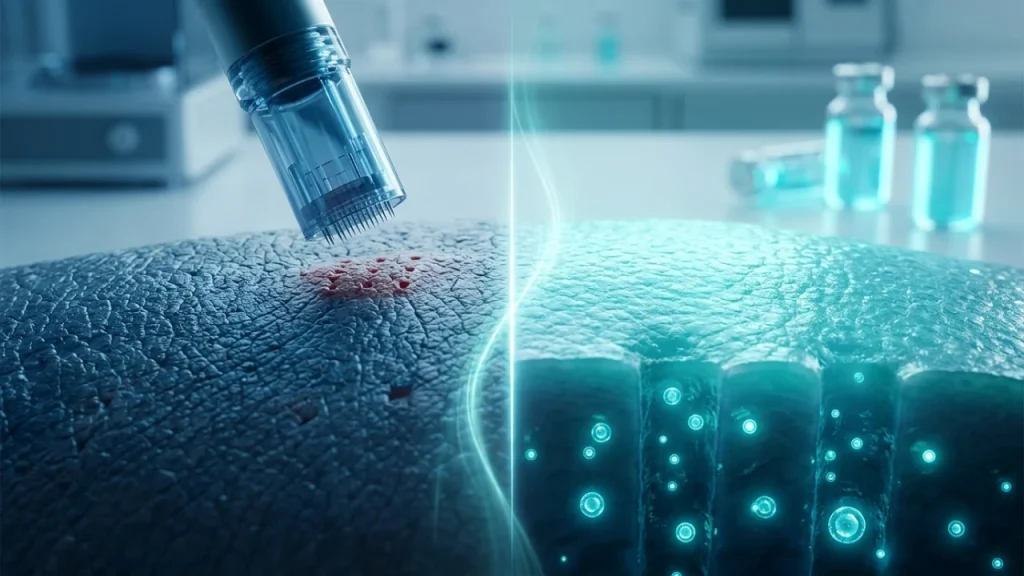
What Is Microneedling with Exosomes and Why Should You Care?
The Simple Truth About Skin Aging and Repair
Your skin is a living organ. It constantly repairs itself. This process slows down as you age. This slowdown is the core reason skin changes.
Young skin has a powerful repair system. Cells communicate and fix damage quickly. Collagen and elastin fibers provide structure. They are like a mattress’s supportive springs. New cells replace old ones at a good pace. This keeps skin looking full and smooth.
Aging disrupts this system. Several key processes lose their efficiency.
First, collagen production drops. Your skin makes less of this vital protein each year. Existing collagen fibers also break down. This leads to thin, weak skin structure. Fine lines and wrinkles begin to form.
Second, cell renewal slows. The top layer of skin does not shed as fast. New cells do not rise to the surface quickly. This can make skin look dull and rough.
Third, communication between cells weakens. Skin cells send signals to coordinate repair. These signals become less effective over time. It is like a team forgetting how to talk to each other. Damage from the sun and the environment adds up. The skin’s repair team cannot keep up.
The result is visible change. You see lines, loss of firmness, and uneven tone. This is not just surface damage. It is a deeper slowdown in your skin’s natural ability to heal itself.
This is where modern science looks for solutions. The goal is not just to add material from the outside. The better goal is to help your skin repair itself like it used to. We need to support the body’s own communication network.
That brings us to a key innovation. Researchers now focus on exosomes. These are tiny natural messengers. Your own cells create them. Exosomes carry instructions and materials to other cells. They tell cells to calm inflammation or make new collagen.
Think of a slowed repair crew. Exosomes act like a clear new set of blueprints and tools delivered directly to them. This can restart stalled processes.
Simply applying exosomes to the surface is not very effective. The outer barrier of your skin is very good at keeping things out. This is why microneedling exosomes before and after results show a different approach. The microneedles create tiny temporary channels. These channels allow exosomes to reach the living layers where repair happens.
The synergy is clear. Microneedling creates a controlled signal for repair. Adding exosomes provides the precise instructions for that repair. Together, they address the core issue of slowed cellular communication. This combination supports your skin’s own biology to improve its appearance from within.
How Microneedling Creates Microscopic Pathways in Skin
Your skin’s outer layer, the stratum corneum, is a brilliant shield. It blocks germs, toxins, and pollution every day. This same barrier also blocks most creams and serums. Their active ingredients sit on the surface. They cannot reach the living cells where repair happens.
Microneedling solves this problem with a direct method. It uses a sterile device tipped with fine needles. These needles are incredibly small. They range from 0.1 to 2.5 millimeters in length. For context, a sheet of paper is about 0.1 mm thick.
The device moves across the skin quickly. The needles create hundreds of microscopic channels per second. These are not cuts or wounds in a traditional sense. They are controlled, vertical pathways.
Think of a dense forest. The canopy is thick and blocks sunlight. Microneedling is like creating tiny, clear shafts straight down to the forest floor. Light can now reach the soil.
This process is precise and minimally invasive. The channels bypass the tough outer shield. They reach into the dermis. This is the skin’s middle layer. The dermis contains fibroblasts. These are the cells that make collagen and elastin.
The micro-channels trigger two important events. First, they cause a controlled, minor injury. Your body detects this instantly. It sends signals to start healing in that exact area.
Second, and most crucial for treatment, these channels are temporary doors. They stay open for a short window. This window typically lasts up to 24 hours. During this time, applied substances can travel deep down the channels.
This is where exosomes enter the story. A serum rich in exosomes is applied right after needling. The microscopic pathways let these messengers bypass the surface barrier. They deliver their instructions directly to the dermal cells.
The results of combining these steps are captured in microneedling exosomes before and after photos. The visual changes stem from this efficient delivery. Without these pathways, the exosomes would have little effect.
The procedure is carefully calibrated. Needle depth is chosen based on skin concerns. Shallow depths target pigment and texture. Deeper settings aim for firmness and scars.
- The outer layer is bypassed.
- A targeted repair signal is sent.
- A delivery route for actives is opened.
This triple action makes microneedling a powerful tool alone. Its real potential unlocks when paired with advanced agents like exosomes. The channels ensure these agents get to the right address. The next step is understanding what happens once they arrive at the cellular level.
What Exosomes Really Are and How They Work
Exosomes are tiny natural packages. Your own cells create them constantly. Think of them as microscopic mail trucks. They carry vital instructions from one cell to another.
These vesicles are incredibly small. Billions could fit on a pinhead. They are not synthetic or manufactured in a traditional sense. They are a fundamental part of your body’s communication network.
Cells release exosomes for many reasons. Healthy cells use them for routine chat. Injured or stressed cells send out urgent signals. The contents of each package change based on the sender’s needs.
What’s inside these packages? The cargo is precise and powerful. It includes proteins, lipids, and genetic material like RNA. This RNA carries blueprints for making proteins. It is not the same as DNA you inherit.
This cargo acts as a set of commands. When an exosome reaches a target cell, it delivers its instructions. The receiving cell then reads these new orders. It changes its behavior based on the message.
For skin health, this messaging is crucial. A fibroblast in your dermis might be idle. An exosome can tell it to wake up and make collagen. It provides the exact plan for how to do this.
The process is natural and efficient. Your body already uses this system for internal repair. The goal of treatment is to boost this signal. We add more messengers to direct the healing work.
Why does this matter for skin rejuvenation? Aging or damaged skin often has poor cell communication. Signals get weak or lost. Adding a high concentration of targeted exosomes restores clear commands.
The instructions are specific and safe. They tell cells to perform their normal, healthy functions. They encourage actions like collagen production and reducing inflammation. This is not a foreign or chemical command.
Results from this process are seen in microneedling exosomes before and after comparisons. The visual improvement comes from restored cellular dialogue. Skin cells finally get the clear memos they need to repair themselves.
Consider the key messages these vesicles carry: – Produce more structural proteins like collagen. – Calm down unnecessary inflammation. – Increase cellular energy and metabolism. – Promote the formation of new, healthy blood vessels. – Protect cells from oxidative stress and damage.
This is why the source of exosomes is important. They should come from healthy, young cells with robust instructions. The messaging must be correct to guide skin toward a healthier state.
The mechanism is elegant. It uses your body’s own language. This makes it fundamentally different from many topical creams. Creams often work on the surface or force a single change.
Exosome therapy supports the skin’s innate intelligence. It provides the information needed for optimal repair. The cells then execute the plan using their own machinery. This leads to stronger, more resilient tissue.
In essence, exosomes turn back the molecular clock. They remind older cells how to behave like younger versions of themselves. The effect is a global improvement in skin function and appearance.
The next logical question is about safety and origin. Understanding where these messengers come from ensures their quality and purpose align with natural healing pathways.
Why Combining These Two Methods Creates Synergy
Microneedling creates controlled micro-injuries in the skin. This is not just about making tiny holes. It triggers the skin’s natural repair process. The body sends healing signals to the area. Blood flow increases. New collagen production begins.
But this repair process can be limited. Older skin cells often send weak or confused signals. The healing response may be slow or incomplete. This is where exosomes change the game.
Think of microneedling as opening a delivery route. It creates temporary channels through the outer skin layer. These channels allow large molecules to enter. Topical creams usually cannot pass this barrier. Exosomes are perfectly sized to use these new pathways.
The synergy happens in three clear steps. First, microneedling prepares the tissue. It creates a state of active repair. Second, it delivers exosomes deep into the dermis. They reach the living cells that need instructions. Third, the exosomes immediately start working.
They enhance the healing that microneedling already started. The exosomes provide superior blueprints for repair. The result is a more efficient and effective rejuvenation process.
One method alone has clear limits. Microneedling alone relies on your body’s current cellular health. If your cells are tired or aging, their response may be modest. Exosomes applied topically without microneedling often cannot penetrate deeply enough. They may not reach their target cells in sufficient numbers.
Combining them solves both problems. The microneedling ensures deep delivery. The exosomes ensure high-quality cellular communication. This partnership leads to a better outcome.
You can see this in microneedling exosomes before and after photos. The improvements are often more pronounced and faster. Skin texture refines more noticeably. Redness and pigmentation fade better. The results appear more natural and lasting.
The science behind this is precise. Microneedling increases the expression of certain receptors on skin cells. These receptors can bind to exosomes. Essentially, the needles make cells more ready to receive the messages.
Furthermore, the micro-injuries release signaling molecules called cytokines. These cytokines attract fibroblasts to the area. Fibroblasts are the cells that make collagen. Exosomes then directly instruct these gathered fibroblasts to work harder and smarter.
This coordinated action amplifies every stage of healing. Inflammation is better controlled. Collagen and elastin production is more robust. New skin tissue is organized in a healthier pattern.
The synergy also means potential for fewer treatments. Because the process is more efficient, you might achieve goals in fewer sessions. The results also tend to last longer. This is due to the fundamental improvement in skin cell behavior.
Ultimately, caring about this combination is about efficacy. It represents a smarter use of biology. It leverages a physical method for delivery with a biological method for instruction. This mirrors how the body ideally works—systems cooperating for a common goal.
The next point to address is practical application. How is this combined procedure actually performed in a clinical setting?
The Science Behind Cellular Communication and Skin Healing
How Your Skin Normally Repairs Itself After Injury
Your skin is a dynamic organ designed for constant repair. When it sustains an injury, like a cut or a microneedling channel, a precise sequence of events begins. This process aims to close the wound and restore strength. It happens in four main, overlapping phases.
The first reaction is hemostasis and inflammation. Blood vessels constrict quickly to reduce bleeding. Platelets in your blood form a temporary clot. This clot acts as a natural bandage. It seals the wound from the outside world. Inflammation starts next. This is a crucial immune response. Blood vessels then dilate to allow immune cells into the area. These cells clear away bacteria and debris. You might see this as redness, warmth, or slight swelling. This phase typically lasts for several days.
Next comes the proliferation phase. This is the true rebuilding stage. It usually begins within a few days of the injury. Special cells called fibroblasts become key players. They migrate into the wound bed. Fibroblasts start producing new collagen and elastin fibers. These proteins are the building blocks of your skin’s structure. New blood vessels also form to supply nutrients. The wound begins to fill with this new, granulation tissue. It often looks pink and bumpy.
Simultaneously, re-epithelialization occurs. Skin cells at the edges of the wound multiply rapidly. They start to migrate across the new tissue underneath the scab. Their goal is to form a new protective barrier. This new skin layer is initially very thin and fragile.
The final phase is remodeling or maturation. This is the longest stage, lasting for months or even over a year. The body works to strengthen the repaired area. The initially disorganized collagen fibers are broken down and reorganized. They form stronger, more aligned bundles. This increases the tensile strength of the skin. However, this healed skin rarely regains one hundred percent of its original integrity. Scar tissue is functionally different.
The entire process relies on constant cellular communication. Cells send and receive chemical signals to coordinate each step. They use growth factors, cytokines, and other messenger molecules. Think of it like a construction site with many teams. Each team needs clear instructions to know when to start work.
This natural healing is effective but can be imperfect. Collagen production might be insufficient or disorganized. Inflammation can sometimes persist too long. The signals between cells may not be optimal as we age. Understanding this baseline is key to seeing why new approaches are developed.
The goal of advanced treatments is to support and optimize these innate processes. They aim to guide the body toward a more ideal healing outcome. This leads us directly to the next concept: enhancing communication. We can look at microneedling exosomes before and after results precisely because they influence this biological cascade. The procedure seeks to improve every phase, from inflammation control to collagen quality in the remodeling stage.
What Happens When Exosomes Enter the Skin Matrix
Exosomes are incredibly small. Their size is a key advantage. They measure between 30 and 150 nanometers in diameter. To visualize this, imagine lining up about 2000 exosomes across the width of a single human hair. This tiny scale allows them to navigate the complex terrain of the skin with unique efficiency.
The skin matrix is not an empty space. It is a dense network of structural proteins and sugars. Think of it as a dense forest. Large molecules struggle to move through it. They get stuck or break down before reaching deep target cells. Exosomes are like skilled navigators in this forest. Their lipid membrane protects their cargo. It acts like a durable delivery capsule.
Microneedling creates temporary micro-channels through the outer skin layer. This is the first critical step. It provides a direct pathway for exosomes to bypass the main barrier. The exosome solution is applied topically immediately after needling. The channels are open for a short window, typically just hours. During this time, exosomes begin their journey inward.
Their movement is not random. Exosomes travel through the interstitial fluid. This is the natural fluid that surrounds all our cells. They use two primary methods to reach fibroblasts and other target cells. – Passive diffusion: They spread from areas of high concentration to low concentration. – Active targeting: Their surface carries specific addressing molecules. These molecules can bind to receptors on particular cell types, like a key fitting a lock.
This targeted delivery is crucial. It means the regenerative signals go precisely where they are needed most. They are not wasted. Once an exosome reaches its target cell, several things can happen. The two main methods of communication are direct fusion and signal docking. In direct fusion, the exosome membrane merges with the cell’s membrane. This delivers the cargo directly into the cell’s interior. In signal docking, the exosome attaches to the cell surface without full fusion. It then sends signals through the membrane to change the cell’s behavior.
The cargo inside is the instruction set. It contains growth factors, signaling proteins, and genetic material like miRNA. This cargo does not force cells to act unnaturally. Instead, it provides clear, optimized instructions. It tells aging or stressed cells how to function more like youthful, healthy cells. The goal is to enhance the body’s own repair programs.
The effects are cumulative and cellular. You do not see immediate change because the work happens at an invisible level. Cells receive new instructions and begin executing them. This process explains the microneedling exosomes before and after transformation people observe. The visible improvements in skin texture and tone are the final result of this upgraded cellular dialogue.
This targeted communication reduces wasted signals and imprecise inflammation. It directly addresses the shortcomings of natural healing described earlier. The exosomes help coordinate a more organized and productive repair response from within. Their entire purpose is to improve the quality of information shared between skin cells during recovery. This sets the stage for understanding the specific clinical outcomes these biological changes can produce over time.
The Biological Instructions Exosomes Carry to Cells
Exosomes carry precise molecular commands. These commands tell skin cells to build more collagen and to heal calmly. Think of them as a set of blueprints and tools delivered directly to a construction site. The main instructions come in three forms.
First, exosomes contain growth factors. These are proteins that act as direct signals. They bind to specific receptors on skin cells like fibroblasts. This binding tells the fibroblast to wake up and start its collagen-making machinery. Key growth factors include TGF-β and VEGF. TGF-β specifically instructs cells to produce collagen type I. This is the main structural protein in young skin.
Second, exosomes carry microRNAs. These are tiny strands of genetic material. They do not code for proteins. Instead, they regulate gene activity. They can turn certain genes on or off. For example, some miRNAs silence genes that promote inflammation. Others block genes that break down collagen. This helps shift the cell’s activity from a reactive state to a regenerative one.
Third, exosomes deliver enzymes and signal modulators. These molecules fine-tune the cellular environment. They help ensure the new collagen forms strong, organized fibers. They also help calm overactive immune responses that cause redness and swelling.
The combined effect of this cargo is a dual action. It simultaneously boosts construction and reduces unnecessary demolition. Here is how that works step by step for microneedling exosomes before and after results.
- The growth factors provide the “start building” signal.
- The miRNAs protect the building instructions by turning off destructive processes.
- The modulators ensure the building materials are assembled correctly.
This targeted instruction set solves two big problems in aging skin. Skin naturally loses collagen each year. The production lines slow down. At the same time, low-grade inflammation often increases. This inflammation can further damage collagen and elastin.
Exosome cargo addresses both issues directly. It does not just add one growth factor and hope for the best. It provides a coordinated program. The miRNAs help quiet the inflammatory background noise. This allows the growth factors’ signals to be heard more clearly by the cells.
The result is more efficient healing after microneedling. The micro-channels created by the needles are like opening a delivery route. Exosomes use this route to reach deeper skin layers. Their cargo then directs the repair process toward high-quality tissue regeneration.
You can think of it as upgrading the software of your skin’s cells. The hardware—the cells themselves—is often still capable. But the operating instructions become outdated or corrupted over time. Exosome therapy provides a critical software update. It restores optimal programming for repair and maintenance.
This cellular programming leads to the visible improvements people see. Better collagen means firmer skin with fewer fine lines. Reduced inflammation means less redness and a more even tone. The skin’s texture improves because new collagen is laid down in an organized way.
The process takes time because cells need to act on their new instructions. They must manufacture new proteins and integrate them into the existing structure. This is why the dramatic microneedling exosomes before and after photos show changes over weeks, not days. The biological conversation initiated by exosomes continues long after the treatment itself ends.
Understanding this cargo explains the lasting nature of the results. The instructions alter cell behavior for a significant period. This creates a sustained cycle of improved repair and renewal. The next logical question is how this science translates into a real clinical procedure for patients seeking rejuvenation.
Why This Approach Changes the Healing Environment
Traditional microneedling creates a controlled injury. This triggers the skin’s standard wound healing response. That process can sometimes lead to inflammation or uneven repair. Exosomes change this entire scenario. They shift the healing environment from a state of simple repair to one of intelligent regeneration.
Think of inflammation as a necessary but messy first step in healing. It clears debris and signals for help. However, excessive or prolonged inflammation can damage tissue. It can also lead to poor scar formation. Exosomes carry specific messages to calm this response. They tell immune cells to reduce their aggressive signals. This creates a cleaner, more controlled workspace for rebuilding.
The cargo inside exosomes directly targets skin cells called fibroblasts. Fibroblasts are the collagen factories of your skin. In aged or damaged skin, these factories can become slow or disorganized. They might produce weak, fragmented collagen fibers. Exosomes deliver precise blueprints and tools. These instructions help fibroblasts build strong, healthy, and neatly organized collagen networks.
This approach also improves blood supply to the area. Exosomes encourage the formation of new, tiny blood vessels. This process is called angiogenesis. Better blood flow delivers more oxygen and nutrients to the working cells. It also removes waste products more efficiently. A well-fed cell is a more productive cell. This supports sustained renewal long after treatment.
The change in environment is why microneedling exosomes before and after results show such refined improvements. The skin doesn’t just look plumped. It looks fundamentally healthier. The quality of the new tissue is superior because the conditions for building it were optimized.
Key changes in the healing environment include: – Reduced inflammatory signals that can cause collateral damage. – Direct programming of fibroblasts to enhance their output and quality. – Improved local blood vessel networks for sustained nutrient delivery. – Signals that support the skin’s natural stem cells, guiding them toward repair.
This results in a cascade of benefits. Less inflammation means less post-treatment redness and a lower risk of hyperpigmentation. Better collagen structure means firmer, more resilient skin with improved elasticity. The overall skin cycle becomes more efficient.
The environment stays primed for improvement for weeks. Cells continue to communicate using the new protocols established by the exosomes. This explains the progressive nature of the results seen in clinical photos. The treatment does not just add something temporary. It upgrades the skin’s operational landscape permanently. This sets the stage for understanding the practical steps of receiving this treatment and what patients can realistically expect from the process.
Realistic Expectations: What Microneedling Exosomes Before and After Actually Shows
Understanding Treatment Timelines and Healing Phases
The healing process after microneedling with exosomes follows a distinct biological sequence. Your skin does not change overnight. It upgrades itself in clear phases. Understanding these stages helps set proper expectations. It also explains why microneedling exosomes before and after photos show such progressive improvement.
The initial 24 to 72 hours are the active repair window. Microneedling creates controlled micro-channels. This triggers the skin’s natural wound response. Exosomes are applied during this critical period. They immediately begin modulating the inflammation. You will likely experience redness and mild swelling. This resembles a sunburn. The skin may feel warm and tight. This phase is essential. It is when exosomes direct the cleanup and signal for new construction.
Days three through seven mark the transition into rebuilding. Visible redness typically fades significantly. Any minor peeling or flaking is normal. This is old, damaged skin cells making way for new ones. Underneath, fibroblasts are highly active. They have received precise instructions from the exosomes. These cells now produce new collagen and elastin fibers. You might not see these changes yet. But the foundational work is happening deep within the dermis.
The first visible improvements often appear around week two to four. The skin surface becomes notably smoother. Texture refines. A healthy glow emerges from improved hydration and circulation. This early result comes from enhanced cellular turnover and initial matrix remodeling. It is a preview of the deeper changes to come.
The most significant transformations occur in the following months. Collagen and elastin production peaks weeks after treatment. New proteins need time to organize into a strong, supportive network. This slow maturation is key for lasting results.
- Month 1-2: Improved firmness and elasticity become apparent. Fine lines may start to soften.
- Month 2-3: Continued refinement of skin quality. Pore appearance can improve as skin tightens.
- Month 3-6: Full collagen remodeling delivers optimal results. This is when before and after comparisons show maximum impact on skin density and youthful architecture.
The entire timeline relies on the biological cascade initiated during treatment. Exosomes do not provide an instant filler effect. They provide a sustained instructional program. Your cells follow this program for many weeks. This is why results are progressive and natural-looking.
Healing can vary based on individual factors. Your age, skin condition, and lifestyle play roles. Sun protection is non-negotiable during this period. UV exposure can disrupt signaling and damage new cells. Proper hydration and nutrition support the building blocks your skin needs.
A single session provides excellent improvement. However, most experts recommend a series for cumulative benefits. Each treatment builds upon the last. It further educates the skin’s repair system. Think of it as a training program for your complexion.
Patience is crucial when evaluating outcomes. Do not judge results at the one-week mark. The true test comes after three months. This timeline reflects genuine biological change, not temporary swelling or inflammation. The goal is durable rejuvenation that develops gracefully over time, establishing a new baseline for lasting skin health.
How Fine Lines Respond to Cellular Signaling Therapy
Fine lines are often the first visible sign of aging skin. They are not deep structural grooves. These lines are shallow creases in the epidermis. They form from a gradual breakdown of support. Collagen and elastin fibers weaken over time. This creates tiny folds in the skin’s surface. Microneedling creates controlled micro-channels. These channels allow exosomes to reach the ideal depth. The goal is the dermal layer where collagen lives.
Exosomes deliver precise instructions to aged cells. Think of them as a software update for skin repair. They carry specific signals called growth factors and microRNAs. These signals target fibroblasts. Fibroblasts are your skin’s collagen factories. Aged or sluggish fibroblasts receive these new instructions. They are prompted to become active again.
The therapy shifts cells from a passive to an active state. It does not just add temporary volume. It tells your cells to rebuild their own foundation. The signaling focuses on two key tasks. First, it increases the production of new Type I collagen. This is the main structural protein in skin. Second, it improves the organization of this collagen network. Disorganized collagen leads to weak skin. A neat, dense network provides strong support.
This process directly addresses fine lines from the bottom up. As new collagen forms, it gently pushes upward from below. This fills out the shallow creases from within. The skin’s foundation becomes more solid. The surface naturally smooths. Results are not about stretching skin tight. They are about restoring its inherent plumpness.
You can see this in authentic microneedling exosomes before and after galleries. Early changes are subtle. The skin often appears more hydrated and radiant first. This is due to improved cell activity and barrier function. Then, over weeks, fine lines begin to soften. They may not vanish completely in every case. Their depth and visibility should reduce significantly.
Several factors influence how well fine lines respond. – Line Depth: Very superficial lines often show excellent improvement. – Skin Type: The individual’s cellular capacity to respond is key. – Treatment Series: Multiple sessions provide cumulative signaling for better rebuilding.
The improvement is fundamentally different from a neurotoxin. A neurotoxin relaxes muscles to smooth lines. Exosome therapy rebuilds skin tissue itself. The outcome is natural texture, not a frozen look. Your skin moves normally because its structure is genuinely renewed.
This cellular signaling approach offers a logical solution for early aging signs. It treats the root cause, not just the symptom. The result is a gradual refinement of skin texture that aligns with your biology, setting the stage for addressing more pronounced signs of volume loss.
Acne Scarring Transformation Through Collagen Remodeling
Acne scars often leave permanent dips in the skin’s surface. These depressions form because severe inflammation destroys collagen during a breakout. The skin heals with a tissue deficit. Traditional microneedling alone creates controlled micro-injuries to trigger collagen production in these areas. Adding exosomes supercharges this natural repair process.
Exosomes deliver precise instructions to the local skin cells. They signal fibroblasts to produce new collagen and elastin. More importantly, they guide how this new matrix is organized. The goal is structured, functional tissue, not just bulk. This organized rebuilding is what can gradually elevate the floor of a depressed scar.
You will not see a scar vanish completely after one session. The transformation is gradual and cumulative. Authentic microneedling exosomes before and after photos for scarring show this timeline. Initial improvements often involve a softening of scar edges. The sharp, steep walls of an icepick scar can become less distinct. The overall texture of the area begins to even out.
The type of scar greatly influences potential results. – Rolling scars: These have broad, shallow depressions. They typically respond best. New collagen can effectively lift these areas. – Boxcar scars: These have sharper edges. They require significant collagen remodeling to smooth. Improvement is often seen as reduced depth. – Icepick scars: These are deep and narrow. They are the most challenging. Treatment can help soften their appearance but may not fill them entirely.
A series of treatments is essential for scarring. Each session adds another layer of cellular signaling and collagen deposition. Think of it like filling a hole with layers of new building material. The skin needs time to produce this material between sessions. Most protocols involve three or more treatments spaced a month apart.
Results become more visible months after the final treatment. Collagen takes time to mature and remodel. Patients might see continued improvement for six months or longer. The final outcome is not perfect, flawless skin. The realistic goal is a significant reduction in scar visibility and improved skin smoothness.
This process changes the shadow a scar casts. Depressions catch light and create shadows, making scars obvious. As collagen fills the depression, the shadow softens or disappears. The scar becomes less noticeable under everyday lighting. This optical improvement is a key marker of success.
The approach is fundamentally regenerative. It does not simply cut away scar tissue like some lasers. It works with your skin’s biology to rebuild from within. This leads to natural-looking integration with the surrounding healthy skin. The texture improvement is durable because it’s based on your own new collagen.
Addressing acne scarring requires patience and consistent signaling. The results are a testament to the skin’s ability to remodel itself when given the right instructions. This sets the stage for understanding how this combined therapy can also strengthen vulnerable, aging skin against future damage.
Hyperpigmentation Fading with Reduced Inflammation
Hyperpigmentation often starts with inflammation. When skin is injured, even mildly, it can trigger an inflammatory response. This inflammation sends signals to melanocytes, your skin’s pigment cells. These cells can then overproduce melanin. The excess pigment is deposited in the skin’s upper layers. This creates a dark spot or patch that remains long after the initial injury heals. Acne, sun exposure, and yes, even some skin treatments, can cause this chain reaction.
Traditional microneedling alone can sometimes worsen this issue. The micro-injuries it creates are meant to stimulate healing. However, for some skin types, this process can itself spark inflammation. This may lead to new dark spots forming after treatment. This is a key challenge in treating pigmentation concerns. The goal is to break the cycle, not continue it.
This is where adding exosomes changes the game. Exosomes carry direct instructions to modulate the skin’s immune response. Their signals work to calm the inflammatory environment quickly after microneedling. Think of it as sending a “cease-fire” order to the skin’s defense cells. By reducing the initial inflammatory peak, the signal for melanocytes to overproduce pigment is dramatically weakened. The process addresses the cause, not just the symptom.
The “microneedling exosomes before and after” pictures for hyperpigmentation show this biological shift. Early results are not just about lightening. They first show a reduction in overall redness and irritation. The skin’s tone becomes more even and calm. As sessions progress, existing dark spots begin a gradual fade. This happens because exosomes also support healthy skin cell turnover.
New, healthy skin cells rise to the surface more efficiently. They slowly replace older cells loaded with excess pigment. The result is a natural fading from the edges of the spot inward. The improvement is typically uniform and blends seamlessly with surrounding skin. It avoids the patchy or abrupt lightening that harsh topical agents can cause.
The protocol for pigmentation relies on this anti-inflammatory foundation. – First, exosomes help prevent treatment-induced post-inflammatory hyperpigmentation. – Second, their signals support the natural fading of existing pigment deposits. – Third, they promote a resilient skin barrier less prone to reactive darkening.
This dual action makes the approach uniquely effective for melasma and sun spots. These conditions are notoriously fueled by inflammation and fragile skin barriers. The regenerative signals strengthen the skin’s overall health. This makes it less reactive to internal and external pigmentation triggers like hormones or sunlight.
Visible fading follows a predictable timeline. Initial calming may be seen within days after a session. True pigment lightening becomes more apparent after several weeks. This delay is due to the skin’s natural renewal cycle. Multiple sessions provide cumulative anti-inflammatory and regenerative signaling. Most patients observe significant improvement after their full series of treatments.
The final outcome is a more even, luminous complexion. Dark spots are diminished in intensity and size. The skin looks clear and calm, not just lightened. This reflects a fundamental change in the skin’s behavior, moving it out of a reactive state. By tackling hyperpigmentation at its inflammatory source, this combined therapy offers a sustainable path to an even skin tone. This foundational calming effect also prepares the skin to better respond to broader rejuvenation goals, such as improving fine lines and overall resilience.
Texture Improvements from Better Elastin Production
Skin texture improves when its underlying scaffold gets stronger and more organized. Think of your skin’s support system like a mattress. Over time, springs can sag or break. This leads to bumps, wrinkles, and looseness. Microneedling creates tiny channels in the skin. This prompts a natural healing response. Your body sends repair crews to these micro-injuries. The process primarily boosts collagen. Collagen is the main structural protein. It acts like the mattress’s sturdy frame.
Elastin is a different but equally crucial protein. It gives skin its snap-back quality. Healthy elastin lets skin stretch and then return smoothly to its place. Sun exposure and aging degrade elastin fibers. They become fragmented and weak. The skin then loses its resilience. It may develop a crepey or rough surface.
This is where exosome signaling becomes vital. The regenerative signals delivered during a microneedling exosomes before and after comparison do more than just calm inflammation. They carry specific instructions for skin cells called fibroblasts. Fibroblasts are the factories that produce collagen and elastin.
The exosomes guide these factories to not only make more materials but to make better-quality ones. They encourage the production of new, well-organized elastin fibers. They also support the proper alignment of new collagen. This dual action reinforces the skin’s architecture from within.
The visual and tactile changes follow a clear biological timeline. Initial texture smoothing often comes from reduced inflammation and initial collagen remodeling. This can be felt within weeks. The skin may start to feel softer.
True elastin-driven improvement takes longer to become visible. Elastin is a complex protein that requires careful assembly. Significant production and integration into the skin’s matrix takes months. Patients typically notice this phase after their series of treatments is complete.
The results are specific and measurable: – Pore appearance can diminish as surrounding skin tightens and plumps. – Fine lines soften as the new elastic network supports the skin’s surface. – Overall skin smoothness improves, feeling firmer to the touch. – The skin gains a healthier bounce and suppleness.
This transformation is not just about filling lines from the outside. It is about rebuilding the skin’s innate ability to stay smooth. The before and after pictures show this change clearly. Early photos might show visible pores or rough patches. Later images reveal a refined, more even surface.
The synergy between microneedling and exosomes creates an ideal environment for this repair. Microneedling opens the pathway and stimulates the need for repair. Exosomes then provide the precise blueprints for high-quality construction. This leads to durable texture enhancement.
This structural renewal naturally complements the earlier discussed pigment correction. A calm, non-inflamed skin barrier is better at directing energy toward rebuilding. Once pigmentation is stabilized, resources can focus on reinforcement. The outcome is comprehensive rejuvenation, addressing both color and canvas quality. This foundation of improved texture and strength sets the stage for lasting skin health and youthfulness.
The Treatment Process From Start to Finish
What Happens During Your Initial Consultation
Your first appointment is not a treatment session. It is a detailed planning meeting. A qualified provider must assess your skin’s unique needs. This step is critical for a safe and effective outcome. The goal is to create a personalized plan. This plan will target your specific concerns.
The consultation begins with a thorough discussion of your goals. Be prepared to describe what you want to improve. Do you want smoother texture? Do you seek a more even tone? Perhaps you desire firmer skin. Clear communication here is key. Your provider will also review your complete medical history. This includes any skin conditions like rosacea or eczema. They will note any history of cold sores. They need a list of all medications and supplements you take. Certain blood thinners or acne treatments can affect the procedure. Always disclose everything.
Next comes a detailed visual analysis of your skin. The provider will examine your face under good light. They will assess your skin type. Is it oily, dry, or a combination? They will classify your Fitzpatrick skin phototype. This scale estimates how your skin reacts to sun exposure. It helps gauge healing response and pigment risk. The provider will carefully document existing concerns. They look for active acne, scars, pigmentation patches, and fine lines. They evaluate your skin’s overall thickness and elasticity.
This assessment directly informs the treatment strategy. For instance, someone with sensitive, redness-prone skin needs a gentle approach. A person with thicker, aging skin may benefit from deeper needle penetration. Your provider should explain how they will adjust the protocol for you. They will discuss the microneedling device’s needle depth. They will talk about the exosome solution’s application method.
You must come with your own questions. Do not be shy. This is your time to become an informed participant. Essential questions to ask include: – What is your specific training and experience with microneedling and exosomes? – How do you source and store the exosome solution used here? – What is the exact treatment protocol you recommend for my skin? – What realistic results can I expect, and in what timeframe? – What are the potential risks or side effects for my skin type? – What does the aftercare routine involve? – Can you show me examples of microneedling exosomes before and after for cases similar to mine?
Reviewing before and after photos is highly valuable. It sets realistic expectations. Look for patients with similar starting points to yours. Pay attention to improvements in texture, pore appearance, and overall glow. Remember that results vary per individual.
The provider should outline the entire process clearly. They will explain the number of sessions typically needed. Most people need a series of three treatments for optimal collagen rebuilding. They will detail the cost per session and for the full series. You should leave with written pre-care instructions. These often include avoiding sun exposure, retinoids, and certain acids for a period before treatment.
A proper consultation builds a foundation of trust and clarity. It ensures your treatment is tailored, not generic. This personalized planning is what transforms a standard procedure into a precise rejuvenation strategy. It directly influences the quality of your eventual results. Once this plan is set, you can confidently proceed to the treatment day itself.
How Professionals Prepare Skin for Microneedling
Proper skin preparation begins with a thorough cleansing. Your provider will use a gentle, medical-grade cleanser. This step removes surface oil, makeup, and environmental debris. A clean canvas is essential. It prevents pushing any impurities into the skin during the microneedling process.
Next comes the application of a topical numbing cream. This cream is crucial for comfort. It typically contains lidocaine or a similar anesthetic. The cream is applied in a generous, even layer. You will then wait for about 20 to 30 minutes. This allows the numbing agent to take full effect. Your skin will feel noticeably cool and heavy. This ensures the treatment itself is well-tolerated.
After the waiting period, the provider meticulously removes the numbing cream. They use sterile gauze and a sanitizing solution. Every trace of the cream must be gone. This is a critical safety step. Residual cream could interfere with the exosome solution. It could also harbor bacteria.
The skin is then disinfected with an antiseptic solution, like chlorhexidine or alcohol. This step sterilizes the treatment area. It eliminates microbes on the skin’s surface. A sterile field drastically reduces any risk of infection from the micro-channels. The provider may also use a sterile marker. They might lightly outline specific areas of focus. These could be zones with deeper wrinkles or scars.
Your provider will now don fresh gloves. They will open a new, sealed vial of exosome solution. This happens only at this moment. The solution is never prepared far in advance. This preserves the biological activity of the exosomes. The liquid is drawn into a sterile syringe or applied to a sterile tray.
The microneedling device itself is prepared. The sterile, single-use needle cartridge is unpacked in front of you. It is attached to the handpiece. The provider will select the appropriate needle depth for your skin and concerns. Settings are confirmed before the device touches your skin.
This entire preparation protocol is non-negotiable. It transforms your skin into a safe, receptive state. Clean, numb, and sterile skin is ready for precise therapy. It allows the exosomes to work effectively without barriers or risks. Seeing this meticulous process can build immense confidence. It shows a commitment to both results and safety.
Understanding this preparation helps you appreciate what happens before the needles even touch your skin. It sets the stage for the actual treatment phase. The next logical step is the precise application of the microneedling device combined with the exosome solution. This combination is where the science comes to life, creating the potential for significant change that you later see in microneedling exosomes before and after photos. Each careful prep step directly contributes to those optimal outcomes, ensuring your skin is perfectly primed for renewal.
The Microneedling Procedure Step by Step
The microneedling device glides across your skin. You will hear a faint humming sound. You may feel a mild vibration. The sensation is often described as light scratching or sandpaper. It is not typically painful due to the numbing cream. The device creates thousands of microscopic channels in a controlled pattern.
These channels are not wounds. They are precise, vertical pathways. They bypass the tough outer layer of skin, the stratum corneum. This layer normally blocks large molecules. The needles create temporary openings. These openings are crucial for delivery.
The needle depth is carefully chosen. It ranges from 0.2 to 1.5 millimeters typically. Shallower depths target surface texture and fine lines. Deeper settings aim to remodel collagen in the dermis. Your provider adjusts the technique for different facial zones. The forehead may need a different setting than the cheeks.
This process triggers a controlled injury response. Your skin detects these micro-channels instantly. It initiates a natural healing cascade. Blood flow increases to the area. Key cells called fibroblasts are activated. They begin producing new collagen and elastin fibers. This is your skin’s innate repair program.
Microneedling alone powerfully stimulates this process. The addition of exosomes transforms it. The procedure seamlessly integrates both steps. The microneedling phase concludes. Your skin is now primed and receptive. It is in an optimal state for receiving regenerative signals.
The exosome solution is applied immediately. The provider spreads the liquid across the treated skin. They use a sterile gloved hand or a sterile tool. Gentle, patting motions ensure even coverage. The solution has a light, watery consistency. It soaks into the micro-channels directly.
The exosomes do not sit on the surface. They enter the microscopic pathways created by the needles. This direct delivery is the key to synergy. The exosomes travel to the living layers of your skin. They reach the fibroblasts and other cells involved in repair.
Think of microneedling as creating a highway system. The exosomes are the specialized cargo traveling those roads. Without the channels, most exosomes cannot penetrate deeply. With them, they reach their cellular targets efficiently. This direct access maximizes their impact.
The entire procedure is methodical and relatively quick. The full face treatment often takes twenty to thirty minutes of active needling. The application of exosomes adds just a few more minutes. You will remain relaxed throughout. Providers check in frequently about your comfort.
You may see mild redness immediately after. This is normal and expected. It resembles a moderate sunburn. Some pinpoint bleeding might occur in areas with deeper treatment. This minor bleeding stops quickly. It actually helps deliver exosomes deeper via the blood’s own pathways.
The combination phase is now complete. Your skin has received a dual signal. First, the physical signal from microneedling calls for repair. Second, the biological signal from exosomes guides that repair intelligently. This sets the stage for the recovery period.
The real work begins beneath the surface right away. Cellular communication is underway. The visible journey documented in microneedling exosomes before and after galleries starts at this precise moment. The following hours and days are critical for nurturing this initial response and locking in the benefits
When and How Exosomes Are Applied to Skin
Exosomes are applied immediately after microneedling. This timing is not random. It is scientifically deliberate. The micro-channels created by the needles are fresh and open. This offers a direct path to the skin’s living layers. Applying exosomes later would miss this prime window. The channels begin to close within hours.
The application method is a gentle, painting motion. A sterile brush or dropper is often used. The provider spreads the exosome solution across the treated skin. They do not rub or massage it in aggressively. The goal is to let the liquid pool over the micro-openings. Surface tension and capillary action then pull the vesicles downward.
Think of it like watering a garden. You do not force water into the soil. You pour it evenly onto the tilled earth. The soil absorbs it naturally. Your skin acts similarly after microneedling. It actively draws the exosome-rich solution inside through the temporary pathways.
The exosomes themselves are in a clear liquid carrier. This carrier is usually a saline or sterile solution. It is designed to protect the vesicles. It also helps them flow easily into the skin. No other active ingredients are typically mixed in at this stage. The focus is purely on exosome delivery.
The entire application phase takes only minutes. The skin remains slightly damp afterward. Providers often let it air-dry for a short time. This allows for maximum absorption. A cooling mist might be used to soothe the skin. No occlusive bandages or heavy creams are applied immediately. They could block the channels.
Why is this sequence so effective? It leverages two key principles. – First, it uses an active transport system. The microneedling creates an entry route that bypasses the tough outer barrier. – Second, it uses a passive absorption process. The body’s own physics pulls the solution in without extra force.
This combination ensures deep placement. Exosomes reach the dermis where collagen lives. They avoid being trapped on the surface where they would have little effect. Proper application turns the needles’ temporary injury into a precise delivery mechanism.
Patients do not feel anything special during this step. The exosome solution is typically cool and soothing. There is no sting or burn from the liquid itself. Any mild discomfort from the needling has usually subsided by this point. The experience is calm and straightforward.
The visual microneedling exosomes before and after results depend heavily on this moment. Correct application sets everything in motion. It ensures the regenerative signals reach their intended cellular targets. Skipping this step or doing it poorly would waste the potential of both techniques.
After application, the skin enters a quiet phase. The exosomes are now inside. They begin interacting with skin cells like fibroblasts. This interaction instructs cells to repair themselves better and faster. The visible healing you see starts here, guided by these unseen messengers.
This concludes the clinical part of your treatment. The technology has been delivered. Your body now takes the lead, using the blueprint provided by the exosomes. The following care at home supports this internal process and protects your investment.
Immediate Aftercare Following Your Session
Your skin is in a unique state after microneedling with exosomes. The micro-channels are still open for a short period. This makes your skin highly absorbent but also more vulnerable. The first few hours are critical for locking in benefits and preventing problems.
Think of your skin like freshly tilled soil. It is ready to receive nutrients but must be protected from harsh elements. Your aftercare routine provides that protection. It also supports the exosomes now working inside your dermis.
Leave the applied solution on your skin. Do not wash your face for at least four to six hours. Let the remaining exosomes and serum absorb fully. This gives the messengers extra time to enter through the micro-channels. Pat your skin gently if needed. Do not rub.
Your skin may feel warm and look pink. This is a normal inflammatory response. It shows the healing process has begun. This reaction is typically milder than with traditional microneedling alone. The exosomes help modulate this response.
Use only a gentle, mineral-based sunscreen if you must go outside. Physical sunblocks with zinc oxide are ideal. They sit on the skin without irritation. Sun exposure is your biggest enemy during healing. UV rays can disrupt signaling and cause hyperpigmentation.
Stay away from intense heat for 48 hours. Avoid hot showers, saunas, and strenuous exercise. Heat increases inflammation and redness. It can also lead to more swelling. Cool compresses can offer comfort if needed.
Keep your skincare routine extremely simple for the first two days. – Cleanse only with a lukewarm water rinse or a gentle, non-foaming cleanser. – Apply a bland, fragrance-free moisturizer to maintain a hydrated barrier. – Absolutely avoid active ingredients like retinols, acids, and vitamin C. These products can cause significant irritation and counter the healing signals.
Hydration is key for cellular repair. Drink plenty of water. This helps your body flush away debris and supports new collagen production from within. Your fibroblasts need hydration to function optimally.
Do not pick or scratch your skin. It might feel dry or flaky as it heals. This is part of the natural turnover process. Picking can cause scars or introduce bacteria. Let the old skin shed on its own.
The dramatic microneedling exosomes before and after photos you see depend on this careful phase. Good aftercare prevents complications that could obscure your results. It creates the ideal environment for regeneration.
You may see initial changes within days. This often includes a healthy glow and improved texture. The deeper collagen remodeling takes weeks to months. Your immediate actions set a solid foundation for this longer timeline.
Sleep on a clean pillowcase. Try to rest on your back if possible. This minimizes friction on the treated skin overnight. Your body does its best repair work during sleep, so give it every advantage.
Listen to your skin’s signals. Mild tightness or itching is common. Burning or persistent pain is not. Contact your provider with any concerns beyond mild discomfort. They can guide you through your specific recovery.
This disciplined approach safeguards your investment. It allows the science you paid for to work without interference. Your skin will transition smoothly from a receptive state to an active rebuilding phase. The next stage involves nurturing this new growth with the right supportive products over the following weeks.
Comparing Results: Traditional Methods Versus New Approaches
Standard Microneedling Results Versus Enhanced Versions
Standard microneedling creates controlled micro-injuries in the skin. This process triggers the body’s natural wound healing response. Fibroblast cells become active. They produce new collagen and elastin. This rebuilding improves skin texture and firmness over time. Typical results from traditional treatments are reliable but follow a gradual path. You often need multiple sessions to see significant change. The final outcome depends heavily on your body’s innate repair capacity.
Adding exosomes changes this equation fundamentally. Exosomes are not an abrasive or an acid. They are natural signaling messengers. Think of them as tiny instruction packets. They carry growth factors and proteins. Microneedling channels deliver these signals directly to your skin’s living layers. The exosomes work on a cellular level. They communicate with your fibroblasts. This communication tells your cells to repair more efficiently. It also guides them to regenerate with better quality.
The visual differences become clear in side-by-side comparisons. This is the core of microneedling exosomes before and after evidence. Standard treatments show good improvement. Enhanced versions often show more pronounced effects. These differences are not just about speed.
- Recovery Redness: Standard microneedling often causes visible redness for a day or two. The exosome-enhanced procedure frequently reduces this downtime. Skin may calm faster.
- Hydration and Glow: Traditional results focus on collagen for firmness. Exosomes additionally support skin hydration and barrier function. This can lead to a faster radiant glow alongside long-term tightening.
- Result Timeline: With standard care, collagen builds slowly over months. Exosomes may accelerate the initial phases of healing. Earlier visible improvements in fine lines and texture are common.
- Overall Skin Quality: The end goal for both is rejuvenation. Exosome signaling can promote more comprehensive renewal. Skin may not just look firmer but also healthier and more resilient.
The mechanism explains this divergence. Standard microneedling relies on injury to stimulate a response. It is a call for help. Your body answers as best it can. Exosome-enhanced treatment adds precise instructions to that call. It provides the blueprint for optimal repair. The micro-channels from the needles allow these blueprints to reach deep into the dermis.
Clinical observations support this. Studies note enhanced expression of collagen genes after exosome application. Patients frequently report higher satisfaction with fewer sessions. The skin’s response is not just stronger but also smarter. The regenerative signals guide tissue to heal in a more organized way.
Your personal results will still vary based on your age and skin condition. However, the addition of exosomes shifts the potential outcome curve upward. It upgrades the skin’s intrinsic repair toolkit. This synergy between physical stimulation and biological signaling defines modern rejuvenation. The next logical consideration is how to maintain these superior results over the long term.
How This Method Differs from Topical Cream Applications
Topical creams and serums face a significant barrier. This barrier is your skin’s outermost layer, the stratum corneum. It is designed to keep things out. Most ingredients in creams cannot pass this protective shield. They sit on the surface. Their effects are often limited to superficial hydration or mild exfoliation.
Exosomes require direct contact with living skin cells. They are not surface-level moisturizers. They are communication vehicles. To deliver their regenerative messages, they must reach the dermis. This is where your collagen and elastin live. Topical application alone cannot achieve this deep delivery reliably.
Think of it like sending a letter. A topical cream is like dropping a letter at the gate of a fortified city. The message may never reach the officials inside. Microneedling creates temporary micro-channels. These are like secure pathways through the city wall. They allow exosomes to be delivered directly to the civic center—your dermal cells.
The depth of delivery changes everything for cellular communication. Signals from exosomes work through direct contact or uptake by target cells. A cell in the deep dermis cannot receive a signal stuck on the skin’s surface. Effective signaling needs proximity. Microneedling provides this essential closeness.
Consider these key limitations of topical applications: – Barrier Penetration: Large molecular structures are blocked. Many growth factors and peptides are too big. – Rapid Degradation: Active components can break down when exposed to air and light on the skin’s surface. – Indirect Action: Effects are often secondary, like improving the skin barrier, rather than direct cellular instruction.
In contrast, microneedling bypasses the barrier physically. It places exosomes into a moist, protected wound environment. This environment is rich with healing cells. The exosomes are sheltered and can immediately begin their work. The difference in starting point is dramatic.
This explains why microneedling exosomes before and after results can show more pronounced changes than topical regimens. The before picture often reflects skin struggling with deep structural issues like thin collagen. The after picture reflects a foundational repair that topical products cannot initiate alone. The improvement is not just on the surface.
The science of drug delivery supports this principle. Transdermal delivery systems, like patches, aim to bypass the stratum corneum. Microneedling is a highly effective physical method for this goal. It ensures the valuable cargo arrives intact at its destination.
Simply put, you cannot command an army from miles away. You must be on the battlefield to give precise orders. Microneedling delivers exosome signals to the battlefield of skin repair. Topical applications shout instructions from outside the stadium.
This fundamental difference in delivery mechanism dictates the potential outcome. One method hopes for some absorption. The other guarantees direct placement. For signals that guide collagen production and tissue organization, guaranteed delivery is non-negotiable. The next consideration is how this precise delivery translates into a tailored treatment experience for different skin concerns.
Why Some Treatments Offer Temporary Versus Lasting Change
Skin treatments work in two basic ways. Some add material from the outside. Others change how your own cells behave. The first type often gives a temporary fix. The second type can create lasting change. This difference is key to understanding real transformation.
Think of your skin cells as factories. They produce collagen, elastin, and other vital proteins. Over time, these factories slow down. They also get poor instructions from their environment. Many traditional approaches try to solve this by delivering a finished product. They flood the area with new material. This can plump skin briefly. But it does not restart the idle factories. Once the added material fades, the original problem returns.
Exosomes work differently. They are not a final product. They are messengers. Their job is to deliver instructions. After microneedling places them correctly, they communicate with your skin’s cells. They send specific signals. These signals tell your cellular factories to wake up. The factories are told to resume their natural jobs. They start producing collagen at a healthier pace again. This is a process of retraining and revitalization.
This is why microneedling exosomes before and after comparisons show progressive improvement. The “after” is not just an immediate plumping effect. It is the visible result of cellular activity being restored. The timeline reflects biology. You might see initial hydration quickly. But firmer, denser skin develops over weeks and months. This happens as new collagen forms and organizes. The change comes from within your skin’s structure.
Consider these core reasons for lasting versus temporary results: – Target: Temporary treatments target the symptom (like volume loss). Lasting treatments target the cause (slowed cellular production). – Mechanism: One adds a static substance. The other provides dynamic instructions. – Duration: External materials get metabolized and disappear. Reactivated cells continue their renewed function.
A simple analogy helps. Painting a rusty fence covers the problem for a season. Treating the rust and applying a protective primer solves the underlying issue for years. Many skin treatments are like paint. They cover up signs of aging. Approaches that use exosome signaling are like the primer and treatment. They address the root cellular dysfunction.
The durability of results hinges on this principle. Lasting change requires a shift in cellular behavior. Your skin must be guided back to a more youthful state of operation. This is not about passive absorption. It is about active retraining. The goal is to have your cells sustain the improvement long after the treatment itself is over.
This leads to a practical consideration. How can a treatment be tailored for different concerns, from wrinkles to scars? The answer lies in the universal nature of cellular communication.
Safety Considerations and What Research Shows
Understanding Potential Side Effects and Risks
Any procedure that creates microscopic channels in the skin will cause a local response. This is a normal part of the healing process. Microneedling with exosomes guides this response toward regeneration. Understanding the typical reactions helps set realistic expectations.
The most common effects are temporary and mild. They resemble a mild sunburn. You may see redness for 24 to 48 hours. Some people experience slight swelling. Minor pinpoint bleeding can occur during the treatment itself. This fades quickly. Your skin may feel warm or tight for a day. These are standard signs of controlled injury. They signal the start of the skin’s repair cycle.
Serious adverse events are rare when performed correctly. The primary risk is infection. This risk exists with any microneedling procedure. It underscores the need for a sterile clinical setting. Proper technique minimizes this chance significantly. Another concern is post-inflammatory hyperpigmentation. This is a temporary darkening of the skin. It is more possible in individuals with darker skin tones. A skilled provider will assess your skin type first. They will adjust treatment parameters for safety.
Research shows that adding exosomes may actually improve the safety profile. Studies indicate exosomes can modulate inflammation. They help calm the immune response in the treated area. This can lead to faster redness resolution. It also supports more organized healing. The goal is efficient repair without excessive scarring or pigmentation issues.
You can take steps to minimize potential side effects. Your provider’s skill is the most important factor. Their experience dictates needle depth and technique. Follow pre- and post-care instructions exactly. These rules exist for your safety.
Key pre-treatment steps often include: – Avoiding sun exposure and tanning for two weeks. – Stopping the use of retinoids or acids several days prior. – Informing your provider of all medications and supplements.
Post-treatment care is crucial for optimal results and comfort. Gentle cleansing is essential. Use a recommended moisturizer to support the skin barrier. Apply a high-SPF mineral sunscreen diligently. Sun protection is non-negotiable. Avoid strenuous exercise and heat for 24-48 hours. Do not pick or scratch the treated area.
Looking at microneedling exosomes before and after photos can be helpful. They often show the progression from initial redness to final results. Remember, those “after” photos are taken weeks later. They do not show the first few days of recovery.
The body’s reaction confirms the process is working. Temporary redness means increased blood flow. It brings nutrients to the area. Swelling indicates a surge in growth factors and signaling molecules. These are precisely what the exosomes are designed to coordinate. The process is a collaboration between technology and your biology.
Ultimately, safety hinges on controlled stimulation, not damage. The microneedles create precise entry points. The exosomes then deliver instructions for orderly repair. This combination aims to reduce unpredictable outcomes. Your skin’s inherent wisdom does the rest, building healthier tissue from within.
Who Makes a Good Candidate for This Treatment
The best candidates for this treatment share a common goal: they want to improve skin quality without aggressive procedures. Their skin concerns are typically early or moderate, not severe. This approach works with the skin’s biology. It is not a replacement for surgical lifts or deep resurfacing.
Ideal conditions for microneedling with exosomes include fine lines and early wrinkles. The treatment targets the collagen deficit beneath them. Dull, tired-looking skin also responds well. Exosomes can help reboot cellular activity for a brighter tone. Other good targets are mild textural issues from sun damage or aging. The goal is refinement, not complete removal.
Post-inflammatory hyperpigmentation, like marks left after acne, can be improved. The exosomes’ signaling may help normalize melanin production in those areas. This requires careful assessment. Active inflammation or infection must be resolved first.
Skin type is a critical factor. The procedure is generally safe for most tones. However, individuals with a strong tendency for keloid scars need a cautious evaluation. A detailed consultation is essential here. Realistic expectations are key. Looking at microneedling exosomes before and after galleries can set a useful benchmark. Remember, results vary per person.
Certain individuals may not be ideal candidates right now. This includes people with active acne breakouts or widespread rosacea flare-ups. The stimulation could worsen these conditions. Pregnant or breastfeeding women are typically advised to wait. More research is needed in these groups.
Those on specific medications like blood thinners require medical clearance. A history of cold sores also needs pre-treatment management. Your provider will review your full history.
Good candidates have generally healthy skin that is functioning normally but needs enhancement. Their skin’s repair systems are intact and ready to respond to the exosome signals. The microneedling simply opens the communication channels.
The treatment is less suitable for deep folds, significant sagging, or severe scar pits. These often require structural support beyond what this method provides. Combination therapies might be discussed.
In essence, the ideal candidate seeks a restorative refresh. They understand this is a regenerative process, not an instant fix. Their skin concerns align with the treatment’s proven strengths: collagen induction, tone evening, and texture smoothing. Patience during the weeks of collagen remodeling is crucial. The best outcomes arise from a partnership between precise science and a receptive biological canvas. This leads naturally to understanding the importance of the provider’s skill and the product’s quality in the next steps of your journey.
Current Scientific Evidence Supporting This Approach
Research shows exosomes carry specific instructions for skin repair. These tiny vesicles are packed with signaling molecules. They deliver growth factors and microRNAs. These are like text messages for your skin cells. The messages tell cells to make more collagen and elastin. They also reduce inflammation. This process speeds up natural healing.
Microneedling creates temporary micro-channels in the skin. This is not just about physical puncture. It triggers a controlled wound healing response. More importantly, it provides a direct pathway for exosomes. The exosomes can bypass the skin’s tough outer barrier. They reach the living dermal layer where collagen is made. This delivery method is highly efficient.
Studies on microneedling with exosomes before and after treatment document visible changes. Clinical improvements are typically measured in several key areas. Researchers use high-tech imaging to quantify results. – Skin elasticity often shows significant improvement. – Hydration levels increase due to better barrier function. – Pigmentation and redness can become more even. – Fine lines appear softened as new collagen forms.
The synergy is clear in the timeline. Microneedling alone stimulates collagen, but this takes weeks. Exosomes accelerate this biological program. They turn up the volume on your skin’s own repair signals. Think of microneedling as opening a door. The exosomes are the invited guests who bring the tools for renovation.
One pivotal mechanism is fibroblast activation. Fibroblasts are the cells that produce collagen. Research indicates exosomes directly target these cells. They switch them from a dormant state to an active, productive state. This leads to a denser network of support fibers in the skin. The result is firmer, smoother skin texture.
Evidence also points to antioxidant and protective effects. Exosome cargo can help shield skin cells from environmental stress. This supports long-term skin health beyond just cosmetic improvement. It is a regenerative approach, not merely a corrective one.
Safety data is encouraging because exosomes are not live cells. They are messengers derived from stem cells, but they cannot replicate. This minimizes risks associated with cell-based therapies. The focus is on communication, not transplantation.
Current science supports a two-phase action. The first phase is the initial healing from microneedling. The second, enhanced phase is guided by exosome signals. This combination leads to more robust and potentially longer-lasting results compared to microneedling alone. Patient studies show high satisfaction rates linked to these measurable improvements.
The collective evidence confirms this approach leverages well-understood biology. It combines a proven mechanical technique with advanced cellular signaling. This foundation in science provides confidence in the treatment’s rationale and its observed outcomes. Understanding this research helps set realistic expectations for the journey ahead, which naturally depends on expert application and proper aftercare.
Important Questions to Ask Your Provider
Choosing a provider for microneedling with exosomes is a critical step. Your results and safety depend on their expertise. An informed consultation is your best tool. You should go prepared with specific questions. These questions focus on the product’s source, the treatment protocol, and realistic outcomes. This due diligence ensures the treatment aligns with the science you now understand.
First, inquire about the exosome solution itself. Ask where the exosomes are derived from. Ethical sources are important. The provider should explain the donor cell type without using brand names as substitutes for science. They should describe the processing methods that ensure purity and safety. A key question is about third-party testing for viability and concentration. Reputable suppliers provide certificates of analysis. This document verifies what is in the vial.
Next, discuss the clinical procedure in detail. Ask how the exosomes are applied during your session. Proper technique integrates them immediately after microneedling. This timing is crucial for optimal absorption. Confirm the device used for microneedling is sterile and medical-grade. The provider should set clear expectations for the treatment series. Most protocols require multiple sessions for cumulative effects. Understanding this plan from the start prevents disappointment.
Safety and handling are non-negotiable topics. Exosomes are delicate biological products. They require specific storage conditions to remain potent. Ask how the product is stored before use. It should typically be kept frozen until just before your procedure. Inquire about their protocols for managing potential adverse reactions. A professional clinic will have clear guidelines for post-treatment care and follow-up.
Finally, focus on outcomes and evidence. Request to see clinical examples of their work. Reviewing microneedling exosomes before and after photographs from their own practice is essential. These images should show consistent, natural-looking improvement. Ask what typical results patients report in their experience. Discuss the expected timeline for seeing changes. Remember that individual responses vary based on age and skin condition.
- Clarify the exosome source and verification.
- Understand the integrated application technique.
- Confirm storage and handling protocols.
- Review the provider’s own before-and-after portfolio.
- Establish a realistic timeline for your results.
These questions separate experienced medical professionals from less rigorous practitioners. A confident provider will welcome such dialogue. They will provide clear, evidence-based answers without hesitation. This conversation builds a partnership for your skin health journey. It ensures your treatment rests on a solid foundation of science and clinical skill. Your informed approach directly supports achieving the best possible outcome from this advanced regenerative therapy.
Making Your Decision: Is This Right for Your Skin Goals?
How to Evaluate Your Own Skin Concerns Honestly
Choosing any advanced skin treatment starts with a clear look in the mirror. You must understand your own skin first. This honest evaluation is key. It helps match your goals with what treatments like microneedling with exosomes can realistically achieve. Do not skip this step.
Begin by identifying your primary concern. Is it one main issue or several? Write it down. Be specific. Common goals fall into a few categories.
- Texture and scarring: This includes acne scars, large pores, or rough skin.
- Wrinkles and lines: These are fine lines or deeper folds from expression and aging.
- Tone and pigmentation: Think sun spots, melasma, or general uneven color.
- Laxity and firmness: This is skin that has lost its youthful tightness and bounce.
- General rejuvenation: The goal is overall dull, tired-looking skin needing a refresh.
Next, assess the severity of your concern. Use a simple scale from mild to moderate to severe. Mild means you notice it only in very harsh lighting. Moderate means it is visible in everyday mirrors under normal light. Severe means it is immediately apparent to you and possibly others. Be critical but fair. Your assessment guides realistic expectations.
Now, consider your skin’s history and behavior. How does it typically heal? Do you scar easily or recover quickly from cuts? What is your skin type – oily, dry, or sensitive? Have you had reactions to past procedures? This history matters. It predicts how your skin may respond to new treatments.
Timing is another crucial factor. What is your desired timeline for seeing change? Some improvements appear quickly. Others need months as new collagen forms. Reviewing genuine microneedling exosomes before and after galleries shows this progression. Notice that early results often differ from six-month outcomes. Your patience must align with biology.
Also, evaluate your lifestyle commitment. Aftercare is part of the result. Can you avoid sun exposure diligently? Will you use recommended skincare products consistently? Are you prepared for possible downtime like redness? The treatment works with your habits, not despite them.
Finally, separate hope from hype. Exosomes send regenerative signals, but they are not magic. They will not change your fundamental bone structure or remove very deep, static wrinkles completely. They optimize your skin’s own repair capacity. The best outcomes happen when the treatment’s strengths match your true needs.
This honest self-check creates a powerful foundation. You can now discuss your goals with a provider using clear terms. You move from a vague wish for “better skin” to a defined target. This clarity leads to smarter decisions and greater satisfaction with your final results. Your journey becomes purposeful from the very start.
Setting Realistic Expectations Based on Your Starting Point
Your skin’s starting point is the single biggest factor in your results. Think of it like renovating a house. The outcome depends heavily on the original structure’s condition. Fresh, young skin has a robust repair system. It responds quickly to regenerative signals. More mature or sun-damaged skin has a slower, depleted repair system. It needs more comprehensive help to rebuild.
Exosomes deliver instructions to your skin cells. These instructions tell cells to make more collagen and elastin. They also reduce inflammation. But your cells must be able to follow these orders. Their ability determines the speed and extent of your improvement.
For example, consider fine lines from expression. These are often early signs of collagen loss. The skin structure is still relatively intact. Here, exosome-enhanced microneedling can show noticeable smoothing. Results may appear within a few weeks. The change is often clear in microneedling exosomes before and after photos for this concern.
Now, consider deep wrinkles from sun damage. These are not just lines. They represent a major collapse of the skin’s support network. Exosomes can initiate significant repair here too. However, the process is like filling a deep valley, not smoothing a shallow ripple. It requires more time and possibly more sessions. The final result may be dramatic improvement, not total erasure.
Skin with active acne or lots of redness presents a different picture. Exosomes excel at calming inflammation. For this skin, the first major benefit is often a more even, less reactive complexion. Collagen building becomes a secondary, longer-term gain. The treatment addresses the most urgent problem first.
Let’s break down common starting points and likely outcome priorities:
- For dull, tired skin with early aging: The primary result is improved brightness, texture, and hydration. Collagen increase prevents further lines.
- For established wrinkles and loss of firmness: The focus is on measurable lifting and filling. Skin regains some of its youthful architecture.
- For post-inflammatory marks or uneven tone: The key result is pigment correction and a unified skin color. Calming signals are crucial.
- For generally good skin seeking optimization: The outcome is enhanced resilience and a “glow.” It is about upgrading function, not fixing a flaw.
Your provider should analyze your baseline. They should use tools like a visia camera or high-magnification lighting. This shows subsurface damage you cannot see in the mirror. An honest assessment prevents disappointment. It aligns the treatment’s power with your skin’s actual needs.
Realistic expectations understand biology. You cannot grow entirely new skin in one month. The regeneration process follows a natural timeline. Initial plumping from hydration fades in days. True collagen remodeling begins weeks later. Final results solidify after three to six months.
Therefore, your personal “before” state sets the pace and the ceiling for change. This understanding turns hope into a practical plan. It prepares you for a journey with visible milestones, not instant magic. Your starting point is not a limitation, but a map for your unique path to rejuvenation. This knowledge empowers you to judge progress accurately and collaborate effectively with your treatment plan.
Creating a Personalized Skin Health Strategy
Your skin is a living system, not a single problem to fix. A personalized strategy supports this system before and after any procedure. Think of microneedling with exosomes as a major reset button. It creates an optimal environment for deep repair. Your daily habits and products are the ongoing maintenance that protects this new foundation.
Start by defining your primary goal. Is it reversing sun damage? Is it slowing future aging? Your goal dictates your entire plan. For example, someone targeting deep wrinkles needs a different support plan than someone focusing on post-acne marks. Your core goal becomes the anchor for every other choice you make.
A complete strategy has three phases. These phases work together for a lasting result.
- The preparation phase begins weeks before treatment. This phase primes your skin to respond better. It often involves using specific active ingredients. These ingredients may include gentle retinoids or vitamin C. They help normalize cell turnover and build antioxidant reserves. Healthy, prepared skin can use the exosome signals more effectively.
- The treatment phase is the procedure itself. This is where the microneedling exosomes before and after transformation truly begins. The microneedles create precise micro-channels. Exosomes are delivered directly into the dermal layer. Your strategy here involves choosing an expert provider and following their immediate aftercare rules exactly.
- The protection and enhancement phase lasts for months after. This phase is critical for locking in results. It involves rigorous sun protection, targeted skincare, and possibly follow-up treatments. This phase determines how long your improvements will last.
Your daily skincare routine must align with your treatment goal. After the procedure, your skin is actively remodeling itself from within. It needs the right building blocks. Use products that support collagen production and reduce inflammation. Key ingredients often include peptides, hyaluronic acid, and niacinamide. Avoid harsh scrubs or unknown acids during early healing.
Sun protection is non-negotiable. Ultraviolet rays are the main driver of skin aging and pigment issues. They can quickly undo the regenerative work of your treatment. Use a broad-spectrum sunscreen every single day. Reapply it every two hours during sun exposure. This habit protects your investment and makes results last longer.
Consider the timing of other procedures. Some treatments complement each other well. For instance, gentle LED light therapy can reduce redness after microneedling. Other treatments, like strong chemical peels, might need to be scheduled months apart. A good strategy sequences everything for cumulative benefit without overwhelming your skin.
Finally, track your progress objectively. Take clear photos in consistent lighting every month. Note changes in texture, firmness, and tone in a journal. This creates your personal evidence file. It shows you what works for your unique biology. This data helps you and your provider decide on the best next steps, whether that’s a maintenance session or shifting focus to a new goal.
A personalized strategy turns a single treatment into a long-term advancement for your skin’s health.
Next Steps if You Choose to Pursue This Path
Your decision is made. Now, actionable steps turn that choice into a planned reality. The first and most critical step is a professional consultation. This is not a simple booking. It is a detailed discussion about your skin’s biology and your specific goals.
Schedule this meeting with a qualified provider. Look for a licensed dermatologist or medical aesthetician. They should have specific training in advanced microneedling procedures. During your consultation, come prepared with clear information and questions.
Bring your personal skin history notes. Discuss any past treatments, both successful and not. Mention all current products you use. Be honest about medical conditions or medications. This history helps your provider customize your plan for safety and maximum effect.
Ask specific questions about their protocol. You need to understand their process from start to finish. Key questions can include: – What is the source and preparation method for the exosomes used? – What needle depth do you plan to use for my specific concerns? – How do you ensure the exosomes are delivered effectively into the micro-channels? – What is your exact aftercare protocol for the first 72 hours?
Request to see clinical examples of their work. Reputable providers often have a portfolio. Look for microneedling exosomes before and after photos that match your skin type and goals. Pay attention to improvements in texture, pore size, and overall glow. These images set realistic expectations for your own potential journey.
Discuss the expected timeline for visible change. Initial redness fades within days. The true regenerative work happens unseen over the following weeks. Most people see early texture improvements around four weeks. Full collagen remodeling takes about three months. You may plan a series of treatments for cumulative results.
Complete any pre-treatment instructions meticulously. Your provider will give you guidelines to follow. These often start two weeks before your appointment. Common instructions include stopping the use of retinoids or strong acids. You may need to avoid sun exposure and certain supplements like fish oil or aspirin.
Arrange your schedule for recovery. While downtime is minimal, plan for it. Your skin will be sensitive and red immediately after. Schedule your session for a time when you can avoid social events for 24-48 hours. Have your recommended aftercare products ready at home before you arrive.
Understand the investment fully. Ask about the total cost of the procedure itself. Also inquire about the price of any essential post-treatment kits. This avoids unexpected expenses later. Consider this a long-term investment in your skin’s health infrastructure.
Finally, confirm all logistics for the day. Know the clinic’s address and parking details. Understand what to wear for comfort. Arrive with a clean face, free of makeup and sunscreen. This preparation ensures your session focuses entirely on treatment, not logistics.
Taking these deliberate steps builds a foundation for success. It transforms interest into an informed, personalized treatment pathway. Your proactive approach partners with clinical expertise for optimal outcomes. This preparation maximizes your body’s innate ability to heal and rejuvenate with these powerful biological signals.
Conclusion
Microneedling with exosomes represents a significant evolution in aesthetic medicine, merging mechanical induction with biological signaling. This synergy creates a targeted regenerative environment within the skin. The treatment’s power lies not in a temporary plumping effect, but in its ability to instruct your native cells. This instruction set promotes a more efficient, higher-quality healing response. The outcome is foundational improvement in texture, resilience, and clarity.
Realistic expectations are paramount for satisfaction. The process is a biological journey, not an instant fix. Visible refinement begins subtly, with full collagen maturation unfolding over months. A series of treatments often yields cumulative, transformative results. This approach addresses aging and damage at a cellular level. It offers a sophisticated path to genuine, long-term skin health restoration.
Your informed decision is the critical final step. Thorough research and selecting a qualified, experienced provider form the cornerstone of success. Preparation and adherence to pre- and post-care protocols directly influence your outcome. View this as a strategic investment in your skin’s biological infrastructure. The potential reward is a profoundly rejuvenated complexion, achieved through science that harnesses your body’s innate wisdom.
To move forward, begin by consulting with a board-certified practitioner who specializes in this protocol. Discuss your specific concerns and review their portfolio of clinical results. This conversation will clarify the personalized plan and realistic timeline for your goals. Taking this step transitions you from consideration to a tailored path toward achieving visibly healthier, more radiant skin.