
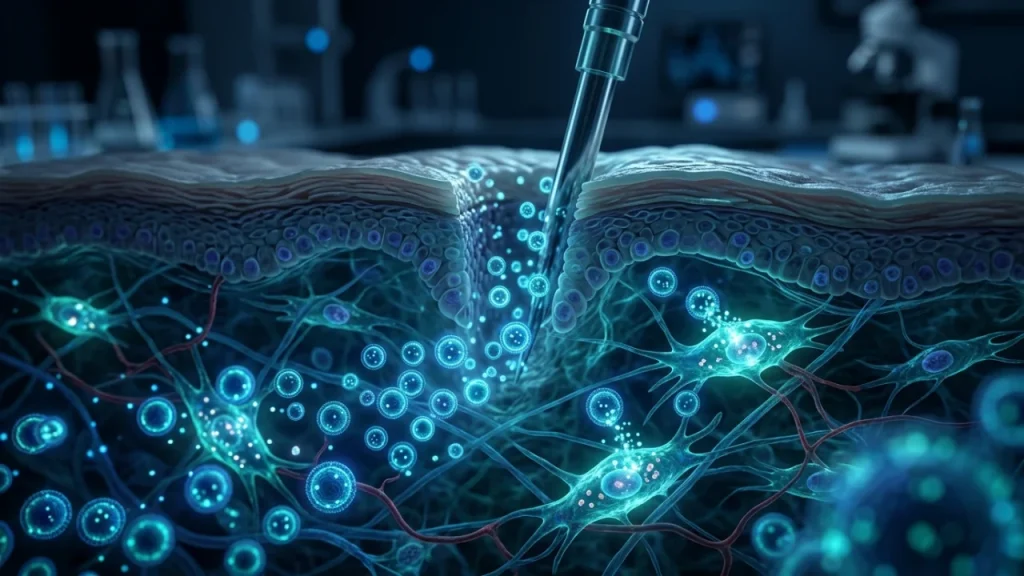
What Are Exosomes After Microneedling and Why Should You Care?
Understanding the Basics of Microneedling
Microneedling creates controlled micro-injuries in the skin. It uses very fine needles. These needles are incredibly small. They create tiny channels. These channels are not visible to the naked eye. This process is precise and deliberate.
The skin sees these micro-channels as a signal. It is a signal to begin healing. This triggers your body’s natural repair system. Collagen and elastin production increases. These are the skin’s support fibers. Think of them as the scaffolding underneath. New collagen makes skin firmer. It also improves texture.
The channels themselves are temporary. They close within a day or so. But their effect is powerful. They offer a unique delivery route. This route bypasses the skin’s top barrier. That barrier is called the stratum corneum. It is designed to keep things out.
This bypass is the key innovation. It allows active ingredients to reach deeper layers. They go where they are most effective. Without these channels, many compounds cannot penetrate well. They sit on the surface. Their potential is wasted.
Consider these core benefits of the process: – It stimulates natural collagen without harsh chemicals. – It improves skin texture and reduces shallow scars. – It enhances product absorption significantly. – It treats a wide range of concerns with one tool.
The depth of needle penetration can be adjusted. This adjustment targets specific skin issues. Shallow depths work on texture and absorption. Deeper settings address scars and firmness. A professional chooses the correct depth for your goals.
Healing after microneedling is swift. You might see slight redness for a short time. The skin feels refreshed soon after. The real magic happens underneath over the following weeks. New collagen forms gradually. Results build over time.
This sets the perfect stage for advanced treatments. The micro-channels are not just for healing stimulation alone. They become pathways. These pathways can carry sophisticated messengers directly to living skin cells. This leads us to a powerful combination: using exosomes after microneedling.
The logic is clear and sequential. First, create temporary access routes. Then, deliver a targeted payload through them. This two-step approach transforms the procedure from simple stimulation to intelligent communication with your skin’s cells. The foundation of channels makes the next step possible and highly effective for rejuvenation.
What Exosomes Are and How They Function
Exosomes are tiny packages released by your cells. Think of them as microscopic mail carriers. They travel between cells to deliver important messages. These messages are instructions for repair and renewal.
Your body makes exosomes all the time. It is a natural process. Healthy cells use them to talk to each other. For example, a damaged skin cell can send an exosome. This exosome tells a neighboring cell to start healing. It is a vital communication system.
Each exosome carries a specific cargo. This cargo includes proteins and genetic material. These are not random items. They are precise signals. The signals can tell a cell to make more collagen. They can instruct a cell to calm inflammation. They can even guide a young cell on how to mature.
The function is direct and powerful. Exosomes do not work like drugs that force one action. Instead, they deliver information. They provide the blueprint for healthy activity. The receiving cell reads the instructions. Then it performs its own natural function better.
This process is key for skin rejuvenation. As we age, cell communication slows down. Signals get weak or lost. Skin repair becomes less efficient. This leads to wrinkles and thin skin. Applying concentrated exosomes can restart the conversation.
The science behind this is robust. Researchers have studied exosomes for decades. They first linked them to immune responses and cancer. Now we know their role in healing is fundamental. Studies show they can shift cell behavior toward repair.
Why use exosomes after microneedling? The procedure creates a unique opportunity. Those micro-channels are perfect delivery routes. They allow these natural messengers to bypass the skin’s tough outer layer. The exosomes reach living cells directly.
Without these channels, most exosomes cannot penetrate deeply. They would sit on the surface with limited effect. Microneedling changes that completely. It ensures the payload gets to the right address.
The combination is logical and efficient. First, microneedling prepares the skin. It opens temporary pathways and triggers a minor healing signal. Then, exosomes arrive through those same pathways. They amplify and direct the healing with intelligent commands.
Consider what these messengers can specifically instruct skin cells to do: – Increase production of collagen and elastin fibers. – Accelerate the repair of damaged tissue. – Reduce persistent inflammatory signals. – Enhance the formation of new, healthy blood vessels.
This is not science fiction. It is your body’s own language used with precision. The goal is to support what your skin already tries to do. We are just giving it clearer instructions and better tools.
The result is a smarter approach to aesthetics. We move beyond simple physical irritation or filler addition. We engage the skin’s innate intelligence. Using exosomes after microneedling leverages two powerful ideas: access and communication.
This sets the stage for understanding the next critical point. Not all exosome sources are equal. Their quality and preparation matter immensely for safety and results.
The Synergy of Combining These Two Methods
Think of your skin as a fortified city. The outer wall is strong and designed to keep things out. Microneedling creates secure entry gates through that wall. Exosomes are the specialized couriers carrying vital blueprints. Using exosomes after microneedling ensures those couriers get inside the city to deliver their plans directly to the construction crews.
This is a true partnership. Each method solves a major problem for the other. Alone, their power is limited. Together, they create a perfect cycle of repair and renewal.
First, microneedling solves the delivery problem for exosomes. Exosomes are tiny. They are also fragile. The skin’s top layer, the stratum corneum, is a formidable barrier of dead, tightly packed cells. It blocks almost everything. Applying exosomes to unbroken skin means most never reach the living cells below. They cannot do their job from the surface.
Microneedling changes this physical reality. The fine needles create micro-channels. These are temporary pathways. They bypass the tough outer shield. The channels lead directly to the dermis. This is the skin’s living, active layer. Now, exosomes have a clear route to their target.
Second, exosomes solve the direction problem for microneedling. Microneedling works by causing controlled, minor injury. This triggers the skin’s natural wound-healing process. However, that process is generic. The skin knows to heal, but not necessarily to optimize collagen quality or calm inflammation perfectly.
Exosomes provide precise instructions. They guide the healing response. They tell fibroblast cells to build more structured collagen. They signal to reduce unnecessary inflammation. They encourage the growth of new capillaries for better skin nourishment. Microneedling starts the engine. Exosomes then steer the vehicle toward the desired destination.
The timing is also key. Applying exosomes immediately after needling is critical. The micro-channels are fresh and open. The skin is in a receptive state. It is primed to accept signals and begin repair. This window of opportunity maximizes absorption and cellular response.
Consider what this synergy means for results: – Deeper product absorption ensures no valuable exosome is wasted on the surface. – Targeted cellular communication leads to more efficient and effective skin remodeling. – The combined approach can reduce overall treatment downtime. Healing is smarter and more organized. – Effects tend to be more significant and longer-lasting than with either technique alone.
This combination moves past simple cosmetic improvement. It is a form of regenerative medicine. We are not just poking the skin and hoping for the best. We are not just applying a substance and hoping it penetrates. We are using a logical, two-step protocol. Step one creates access. Step two delivers intelligent commands.
The outcome is a fundamentally different approach to skin health. It leverages biology rather than fighting against it. Using exosomes after microneedling represents this modern principle in action. Understanding this synergy helps explain why protocol purity and source quality are non-negotiable for success and safety in the next steps of treatment planning.
Key Benefits You Can Expect from This Treatment
The protocol of using exosomes after microneedling delivers distinct, measurable improvements in skin health. You can expect benefits that go beyond surface-level changes. These benefits stem from precise cellular communication.
One major advantage is a significant boost in collagen and elastin production. Microneedling creates a controlled injury. This signals the need for repair. The delivered exosomes amplify this signal with great clarity. They instruct fibroblasts, which are your skin’s building cells, to become highly active. These cells then produce more structural proteins. The result is firmer, tighter skin with improved elasticity. This is not a temporary plumping effect. It is the foundation of truly younger-looking skin.
You will also notice a dramatic improvement in skin texture and tone. Exosomes help normalize cellular behavior. They can reduce irregular pigment production that causes sun spots. They encourage a more even skin tone. The deep renewal process also minimizes the appearance of large pores. It smoothes out rough patches and fine lines. Your skin’s surface becomes more refined and uniform.
The healing process itself becomes smarter and faster. This is a key benefit. Traditional microneedling involves downtime with redness and peeling. Exosomes after microneedling change this. They provide cells with the exact blueprints and resources needed for efficient repair. Inflammation is better managed. The skin barrier recovers more swiftly. This often means less social downtime after your treatment. Your skin heals in an organized, optimal way.
Another critical benefit is enhanced hydration and barrier strength. Exosomes carry instructions that help skin cells produce natural moisturizing factors. They also support the lipids that hold your skin cells together. Think of your skin barrier as a brick wall. Microneedling opens a door for workers. The exosomes are the foremen who tell those workers to repair and reinforce the entire wall structure. Your skin becomes more resilient against environmental stressors.
Long-term, this approach supports sustained skin health. The signals sent by exosomes can have lasting effects on cell behavior. This may lead to results that endure longer than those from microneedling alone. The goal is not just a single improvement. It is to shift your skin into a ongoing state of better function and vitality.
To summarize, the key benefits are clear: – Increased firmness from new collagen. – Smoother texture and more even tone. – A more efficient, comfortable healing phase. – A stronger, more hydrated skin barrier. – Potential for longer-lasting aesthetic results.
These outcomes show why this combination is transformative. It addresses multiple signs of aging and damage at their source. Understanding these benefits helps set realistic expectations for your treatment journey. Next, we must examine how to ensure these results are achieved safely and effectively.
How Exosomes Work with Skin After Microneedling
The Science Behind Exosome Delivery Through Micro-Channels
Microneedling creates controlled pathways in your skin. These are not large wounds. They are precise micro-channels. Think of them as tiny temporary tunnels. These tunnels bypass the skin’s toughest outer layer. That layer is called the stratum corneum. It is a strong barrier against most topical products.
The micro-channels are incredibly small. They are measured in microns. Their depth can be carefully controlled. This allows them to reach specific living layers of skin. The goal is to reach the dermis. This is where collagen and elastin live. The channels close quickly on their own, often within hours. But they stay open long enough for delivery.
This is where exosomes after microneedling become crucial. The treatment creates the perfect entry points. Exosomes provide the repair instructions. The micro-channels act like direct mail slots for these cellular messages. Topical creams mostly sit on the surface. They struggle to penetrate deeply. The micro-channels solve this delivery problem completely.
Exosomes are nano-sized vesicles. They are far smaller than skin cells. Their tiny size is key. They can easily travel down the micro-channels. They move directly into the deeper skin tissue. There is no mechanical barrier to stop them. This ensures a high concentration reaches the target area.
The process follows a logical sequence. First, microneedling creates clean micro-injuries. This also triggers a mild healing signal in the skin. Second, the exosome solution is applied topically. It flows into the micro-channels by simple diffusion. Third, the exosomes disperse in the dermis. They come into close contact with your skin cells.
The delivery is efficient and targeted. Almost all applied exosomes get used. Very little product is wasted on the surface. This makes the protocol highly effective. The exosomes do not just float around. They are actively taken up by your skin cells.
Cells absorb exosomes through several methods. They can fuse with the cell membrane. They can also be engulfed whole. Once inside, they release their cargo. This cargo includes growth factors and RNA instructions. These molecules then influence the cell’s behavior.
The timing of application is critical. Exosomes are applied immediately after needling. The micro-channels are freshest then. Skin is also most receptive. Blood flow is slightly increased. This creates an ideal environment for cellular communication.
The combined effect is synergistic. Microneedling opens the door and calls for help. Exosomes answer that call with precise blueprints. They tell fibroblasts to build more collagen. They instruct keratinocytes to strengthen the barrier. They guide cells to reduce inflammation and speed repair.
This direct delivery system has clear advantages over other methods. – It avoids degradation by surface enzymes. – It ensures a high local concentration where needed. – It uses the body’s own natural signaling particles. – It leverages the skin’s brief window of heightened activity.
In essence, microneedling provides the highway. Exosomes are the vital cargo traveling that highway. The destination is the heart of your skin cells. This direct route is what makes the combination so powerful. It transforms a simple physical treatment into a targeted cellular therapy.
Understanding this science highlights why protocol matters. The technique used for needling influences channel quality. The formulation and handling of exosomes affect their potency. Next, we must consider what happens after delivery—the specific biological changes that lead to visible results
Cellular Communication and Repair Signals
Exosomes deliver precise instructions to skin cells. They are not just simple nutrients. They are complex communication packets. Think of them as urgent bulletins sent directly to a cell’s command center.
These bulletins contain different types of molecules. Each molecule has a specific job. The main messengers are proteins and RNA. Proteins can act as immediate signals. RNA molecules can rewrite cellular instructions.
One primary signal tells cells to calm down. Microneedling creates controlled micro-injuries. This triggers a natural inflammatory response. Exosomes after microneedling help modulate this process. They carry anti-inflammatory proteins.
These proteins signal immune cells. The message is to reduce swelling and redness. This shifts the skin from a reactive state to a repair state. It is a crucial first step.
The next set of signals focuses on rebuilding. Fibroblasts are the skin’s construction cells. They produce collagen and elastin. Exosomes target these fibroblasts directly.
They deliver growth factors and RNA blueprints. These blueprints tell the fibroblast to activate. The cell then starts manufacturing new structural proteins. This is how skin gains firmness and elasticity.
Exosomes also carry instructions for barrier repair. Keratinocytes are the skin’s outer barrier cells. Exosomes tell them to produce more ceramides and healthy lipids. This strengthens the skin’s protective shield.
A stronger barrier means better hydration. It also means less sensitivity. The skin becomes more resilient to environmental stress.
The communication is highly efficient. Exosomes bind to receptor sites on target cells. Their cargo is then internalized. The cell reads the new instructions and acts on them.
This process leads to several clear outcomes. – Reduced visible inflammation and redness post-treatment. – Accelerated wound closure and healing of micro-channels. – Increased production of new, high-quality collagen fibers. – Enhanced formation of a robust, functional skin barrier.
The timing is key for these signals. Applied after needling, exosomes enter a primed environment. Cells are already listening for repair commands. The exosome signals get heard immediately. There is no delay.
This direct line of cellular communication explains the clinical results. Patients see faster recovery. They notice improved texture and tone. The skin appears healthier from within.
The science shows this is not passive absorption. It is active cellular dialogue. Exosomes provide the language for that dialogue. Skin cells understand and respond.
This targeted signaling surpasses traditional topical approaches. Serums mostly work on the surface. Exosomes after microneedling work at the source. They influence cell behavior from the inside.
Understanding this crosstalk highlights the protocol’s elegance. The physical channels enable delivery. The biological cargo directs the repair. The outcome is coordinated, multi-level skin rejuvenation.
The next logical question concerns results. How do these cellular conversations translate to visible improvements in skin quality?
Stimulating Collagen Production Naturally
Collagen is your skin’s main support protein. Think of it as a scaffolding. This framework gives skin its firmness and bounce. As we age, this scaffold weakens. It also gets damaged by sun and environment. The body makes less new collagen. The existing collagen breaks down. This leads to wrinkles and sagging.
Microneedling creates a controlled, minor injury. This tells the skin to start a repair cycle. Fibroblasts are the key cells here. They live in the dermis, the skin’s deeper layer. Their main job is to make collagen and elastin. The needling process activates them. It calls them to the site of the micro-channels.
This activation is just the first step. The fibroblasts are awake and ready. But they need clear instructions on what to build. They also need the raw materials for high-quality construction. This is where exosomes after microneedling become crucial.
Exosomes deliver a precise set of commands to these fibroblasts. Their cargo includes growth factors and special molecules called microRNAs. These are not simple nutrients. They are information packets. The microRNAs act like master switches. They turn on the genes inside the fibroblast that are responsible for collagen production.
The signals do several specific things. – They tell the fibroblast to increase its metabolic activity. The cell starts working harder. – They provide the blueprint for Type I collagen. This is the strongest, most abundant type in young skin. – They guide the proper alignment of new collagen fibers. Haphazard fibers lead to weak structure. Properly aligned fibers create a strong, resilient network.
This process mimics the body’s natural healing at its best. But it does so with enhanced precision and power. The exosome signals are concentrated and targeted. They cut through background cellular noise. The result is a amplified but natural building response.
The new collagen produced is not rushed or poorly made. The signaling encourages careful, high-fidelity production. Think of it as a master builder directing a crew with perfect blueprints. The outcome is durable, functional collagen that integrates into the skin’s existing framework.
This takes time to become visible. Collagen is built beneath the surface first. Fibroblasts synthesize precursor molecules called procollagen. These are secreted into the surrounding space. There, they are assembled into long, sturdy fibrils. These fibrils then cross-link into a stable matrix.
You do not see this process happening. The visual improvements come later. After several weeks, this new supportive layer begins to influence the surface skin. Firmness improves gradually. Fine lines start to soften because the foundation beneath them is being reinforced.
The protocol’s timing is everything again. Applying exosomes after needling means these precise blueprints arrive right when fibroblasts are most receptive. The cells are already mobilized at the construction site. The delivery of instructions happens at the perfect moment for maximum impact.
This method contrasts with approaches that just irritate the skin to trigger collagen. General irritation causes a disorganized repair response. Exosome signaling is organized and intelligent. It directs resources toward structured rebuilding, not just inflammation.
Stimulating collagen this way leads to lasting change. The goal is not a temporary plumping effect. It is to guide your skin to rebuild its own youthful architecture naturally. The results accumulate with each treatment session as new layers of support are added.
Understanding this mechanism shows why patience is key. True collagen remodeling is a biological project, not an instant fix. The visible lifting and smoothing are the final display of work that started deep within your dermis weeks earlier. This foundational strengthening prepares the skin for further improvements in texture and resilience
Reducing Inflammation for Faster Healing
Microneedling creates controlled, minor injuries. This is necessary to start the repair process. Your body reacts to these tiny channels. It sends immune cells and signals to the site. This is a normal inflammatory response. However, this response can sometimes be too strong or last too long. Excessive inflammation leads to longer redness and swelling. It can also disrupt the ideal environment for rebuilding skin.
Exosomes after microneedling change this equation. They carry specific instructions to immune cells. Think of them as diplomatic messengers. They arrive at the active construction site. Their job is to promote order and efficiency. They do not stop the needed repair signals. Instead, they help guide the inflammation toward a productive resolution.
The vesicles deliver molecules called cytokines. These are communication proteins. Some cytokines tell immune cells to calm down. Others encourage them to switch from an attacking mode to a cleaning and healing mode. This shift is crucial. It means your skin transitions faster from a reactive state to a regenerative one.
The benefits of this modulation are direct and practical. – Recovery time is often shorter. Patients may see redness fade more quickly. – Post-procedure discomfort like tightness or heat can be reduced. – The risk of post-inflammatory hyperpigmentation may be lower, especially in darker skin tones. This is because a calmer response means less stimulus for melanin production.
Healing is not just about speed. It is about quality. A prolonged inflammatory state can degrade collagen and elastin. It can create uneven healing. By helping to resolve inflammation efficiently, exosomes protect the new matrix being built. They help ensure the fresh collagen framework forms in an optimal setting.
This process showcases the intelligence of biological signaling. The skin does not need to be left alone to figure it out. It also does not benefit from being suppressed with strong anti-inflammatory drugs. The goal is balanced communication. Exosomes provide exactly that. They use the body’s own language to promote a smoother healing trajectory.
The application timing is key for this effect. Applying exosomes after needling delivers these calming signals right when inflammation begins. The messengers are present at the critical starting moment. They can influence the entire course of the healing event from the very first hours.
This leads to a more comfortable patient experience. It also sets a solid foundation for the long-term results discussed earlier. A calm, orderly healing phase supports structured collagen remodeling. The skin can focus its energy on rebuilding rather than reacting.
Ultimately, managing inflammation is a core part of modern aesthetic science. The aim is to achieve results with minimal downtime and disruption. Exosome therapy after microneedling addresses this need precisely at a cellular level. It turns a standard healing process into a refined, guided biological operation. This careful direction paves the way for the next improvements in skin texture and barrier function.
The Process of Using Exosomes After Microneedling
Step-by-Step Guide to the Treatment Session
The treatment session begins with a thorough cleansing of the skin. Any makeup, oil, or sunscreen is gently removed. This step prepares the canvas. It ensures no surface barriers interfere with the procedure.
Next, a topical numbing cream is applied. This cream sits on the skin for about twenty to thirty minutes. It makes the microneedling process much more comfortable. Patients typically feel only a slight vibration or pressure sensation. After the time passes, the clinician carefully wipes the numbing cream away. The skin is cleaned again.
The microneedling device is then used. It is a handheld tool with very fine, sterile needles. These needles create microscopic channels in the skin’s surface. The depth of these channels is carefully chosen. It depends on the area being treated and the specific skin concern. The process is quick. A full face treatment often takes only ten to fifteen minutes. You may notice mild redness during this stage. This is a normal and expected sign of the skin’s initial response.
Immediately after creating these micro-channels, the exosome solution is applied. This timing is critical. The solution contains billions of signaling vesicles. They are in a clear liquid carrier. The clinician gently spreads the solution over the treated area. A soft brush or dropper may be used for this.
The application of exosomes after microneedling is not passive. The clinician may use specific techniques to aid absorption. Gentle massage in circular motions is common. Some practitioners use a sterile roller to help guide the solution. The goal is to ensure the exosomes enter the fresh micro-channels. They must reach the ideal depth in the skin.
The skin remains slightly damp with the solution for a short period. This allows for maximum contact time. Patients relax during this phase. The exosomes begin their work at the cellular level immediately. No active heating or light devices are used at this point.
After application, any excess solution may be patted into the skin. No harsh rubbing occurs. A final soothing layer, like a hyaluronic acid serum or a calming moisturizer, is often applied next. This helps lock in moisture. It also supports the initial healing phase.
Post-treatment care instructions are simple but important. They are given verbally and often in written form. – Avoid sun exposure completely for the first 48 hours. – Use only gentle, non-active skincare products for about five to seven days. – Do not scrub or exfoliate the skin. – Apply a high-SPF mineral sunscreen every morning. – Keep the skin hydrated with a simple moisturizer.
Patients leave the clinic with a visible glow and mild redness. This redness usually fades within 24 to 48 hours. The skin may feel tight or warm, similar to a mild sunburn. This sensation is temporary. Most people return to their normal routines the very next day. Makeup can typically be applied after 24 hours if needed.
The entire session, from consultation to departure, usually takes about an hour. The active treatment time is a fraction of that. This efficient process sets a biological cascade in motion. The real work happens beneath the surface in the following weeks as cells communicate and rebuild. This guided procedure seamlessly transitions into the crucial aftercare period where results become visible.
What to Expect During and After the Procedure
The skin’s immediate response is a sign of the process starting. Microneedling creates controlled micro-injuries. These tiny channels trigger the body’s natural repair system. Blood flow increases to the area. This brings nutrients and immune cells to the site. The applied exosomes enter through these micro-channels. They merge with the local skin cells. This delivery is precise and direct.
You will see visible changes right after the treatment. Mild redness is very common. It looks like a mild sunburn. This erythema shows increased circulation. It is a normal inflammatory response. This redness typically fades within a day or two. Some pinpoint bleeding might occur. This is minimal and stops quickly. A slight swelling or warmth is also possible. These sensations are temporary. They often settle within hours.
The skin may feel tight or dry for a few days. This is expected. The micro-channels close rapidly. They seal within hours. But the healing process continues underneath. The exosomes after microneedling are now inside. They begin signaling to your skin cells. They instruct cells to repair and regenerate. This communication is not felt physically. Yet it is the core of the treatment.
Peeling or flaking can happen around day three or four. Do not be alarmed. This is not like a chemical peel. It is often very subtle. It means old, damaged skin cells are shedding. New, healthier cells are coming to the surface. Do not pick or pull at this skin. Let it shed naturally. Gentle cleansing and moisturizing are key here.
The initial glow you see post-treatment is from hydration and increased blood flow. The true results come later. Cellular renewal takes time. Collagen and elastin production ramps up in the weeks following. You may not see this building phase. But you will feel its effects. Skin often begins to feel smoother and more resilient first.
Side effects are generally minimal and short-lived. However, knowing what is abnormal is important. – Severe or spreading redness after 48 hours should be noted. – Signs of infection like pus, yellow crusting, or intense heat are rare but serious. – A sudden rash or itching could indicate a reaction. – Prolonged swelling is uncommon.
Contact your provider if you experience these issues. They are not part of the normal healing path. Proper aftercare prevents most complications. Sun protection is non-negotiable. UV exposure can disrupt healing and cause pigmentation.
Your skin’s journey in the first week is one of active recovery. The visible signs are superficial and fade quickly. The most important work is invisible. It occurs at the cellular level where exosomes guide repair. This sets the foundation for improved texture, tone, and firmness that emerges in the coming month. Understanding this timeline helps manage expectations and supports optimal outcomes from this synergistic procedure.
Timeline for Seeing Results and Skin Changes
The journey to renewed skin follows a clear, phased schedule. Cellular communication drives each phase. The exosomes after microneedling begin their work immediately. But you see the benefits in distinct stages.
Think of the first week as the foundation phase. Redness and minor swelling fade within days. Your skin may feel tight or dry. This is normal. The micro-channels have closed. Deep inside, exosomes are signaling to your cells. They instruct fibroblasts to start new collagen production. This process is not visible yet. Your skin’s surface may peel lightly. This reveals fresher skin underneath.
Weeks two through four mark the early transformation period. You will likely notice the first real changes here. Skin texture often improves first. It feels smoother to the touch. Fine lines may appear softer. A healthy glow becomes more constant. This is not just surface hydration. It is a sign of active cellular renewal. New proteins are being built within the skin’s structure. Results vary by individual. Age and skin condition play a role.
The one to three month timeline is crucial for firmness and elasticity. Collagen and elastin take weeks to mature. You will not see this building process. But you will feel its effects. Skin often feels more resilient and plump. Continued improvement in pore appearance and overall tone is common. Some patients see further softening of deeper lines. The skin’s barrier function strengthens. This leads to better hydration retention.
Maximum results typically solidify between three to six months post-treatment. The cellular activity triggered by the exosomes reaches its peak effect. You can assess the full outcome now. Look for these sustained changes: – Improved skin firmness and elasticity. – A more even skin tone and reduced dullness. – Minimized appearance of acne scars or large pores. – A sustained healthy radiance.
Several factors influence your personal timeline. Your natural aging process continues alongside treatment benefits. Sun exposure without protection can slow progress and cause damage. Your skincare routine supports or hinders results. A single treatment provides significant improvement. For cumulative effects, professionals often recommend a series. Maintenance sessions may be suggested later.
This timeline underscores the procedure’s nature. It is not a quick fix but a cellular reset. The microneedling creates an opportunity for change. The exosomes deliver precise instructions for repair. Your body then executes the plan over time. Patience is key. The most meaningful improvements are those that develop from within. This method offers results that evolve naturally with your skin’s own biological rhythm, setting a new baseline for health.
How Often You Might Need This Treatment
The ideal number of sessions is not one-size-fits-all. Your skin’s starting point is the main guide. A single treatment can produce excellent results. Many people choose a series for more dramatic change.
A common plan involves three initial sessions. These are spaced about four to six weeks apart. This timing is deliberate. It aligns with your skin’s natural renewal cycle. The micro-injuries from needling heal fully within that month. The exosomes after microneedling then guide a fresh round of repair. Each session builds upon the last. This cumulative approach trains your skin cells over several months.
Your provider will assess your progress after the first series. They will look at your specific goals. Significant improvement in texture and tone may be achieved. For concerns like deep scars or pronounced aging, more sessions might be suggested. Sometimes a plan includes up to six treatments. The focus is always on steady, biological progress.
After your initial series, the work shifts to maintenance. Think of this like a tune-up for your skin. The cellular instructions from exosomes are powerful but not permanent. Natural aging and environmental stress continue. A maintenance session helps reinforce the new baseline.
A typical maintenance schedule is once or twice a year. This could mean every six months or annually. The frequency depends on your skin’s response and your lifestyle. Someone with lots of sun exposure may need sessions more often. Another person might see sustained results for a full year.
This schedule works because it respects skin biology. The process does not overload or stress the skin. Instead, it offers periodic, precise guidance. The goal is long-term health, not a temporary fix.
Consider these factors that influence your personal frequency: – Your primary skin concerns and their severity. – Your age and natural collagen production rate. – Your commitment to sun protection and skincare at home. – Your body’s unique speed of healing and response.
Some clinics offer package plans for initial series. This can make the process more predictable and cost-effective. Always discuss the financial aspect upfront. Ask what is included in each session.
Remember that patience remains crucial even with multiple sessions. You are supporting a living system. Results compound over time with each thoughtful application of exosomes after microneedling. The skin’s memory improves with consistent, correct signaling.
Your final maintenance rhythm will become clear over time. You and your provider will find a pattern that keeps your skin looking its best. This adaptable approach ensures lasting benefits from the innovative pairing of microneedling and exosome therapy.
Benefits and Results of Exosomes After Microneedling
Improving Skin Texture and Smoothness
One of the most immediate changes people notice is a smoother feel to their skin. This isn’t just a surface effect. It stems from fundamental repair deep within.
Microneedling creates controlled micro-injuries. This triggers the skin’s natural wound healing process. Old, damaged collagen is broken down. New collagen is then produced to replace it. This new collagen forms in a more organized, lattice-like pattern. Think of it as rebuilding a brick wall with neat, straight layers instead of a haphazard pile.
Exosomes after microneedling accelerate this rebuilding phase. They deliver precise instructions to the skin cells called fibroblasts. Fibroblasts are the cells that make collagen and elastin. The exosomes tell these cells to work more efficiently. They promote the creation of high-quality structural proteins.
The result is a denser, stronger dermis. This is the skin’s supportive middle layer. A stronger dermis directly translates to a smoother surface. Fine lines from dryness or sun damage begin to soften. They become less visible because the skin beneath them is plumper.
Rough patches and bumpy textures also improve. These can come from clogged pores, minor scarring, or uneven cell turnover. The micro-channels help clear out debris from pores. The exosome signaling promotes healthier, more regulated cell renewal. Old, rough skin cells shed in a more orderly way. Newer, smoother cells rise to the surface.
You can expect changes in these specific textural concerns: – Sandpaper-like feel on cheeks or forehead. – Small bumps associated with minor acne scars. – Enlarged pores that contribute to an uneven landscape. – Fine criss-cross lines that are felt more than seen. – Dullness caused by a buildup of dead skin cells.
The process doesn’t just fill in irregularities. It actively remodels the skin’s foundation. Improvements continue for weeks after each session. This is because collagen production stays elevated. The new proteins integrate into the skin’s structure.
Smoothness is also a function of hydration and barrier health. Exosomes carry messages that support the skin’s lipid barrier. A stronger barrier keeps moisture in. Well-hydrated skin always feels softer and looks more radiant. It has a supple, seamless quality.
This textural refinement is a cumulative benefit. With each appropriate application of exosomes after microneedling, the skin’s architecture becomes more robust. The surface reflects this internal order. It gains a uniform, polished feel that is resilient. This sets the stage for addressing more pronounced concerns like deeper wrinkles or loss of firmness, which rely on the same strengthened foundation.
Enhancing Elasticity and Firmness
Skin’s firmness relies on a strong, springy network beneath the surface. This network is made of collagen and elastin. Think of collagen as sturdy support beams. Elastin acts like rubber bands woven between them. Over time, this network weakens. Beams break down. Rubber bands lose their snap. The skin begins to sag and fold.
Microneedling creates a controlled repair signal in this deeper layer. The body reacts to the tiny channels as micro-injuries. It starts a natural healing process. This process calls for new collagen. But the body’s natural response can be slow and disorganized. It often does not fully restore the elastic components.
This is where the application of exosomes after microneedling changes the game. Exosomes deliver precise instructions to the skin’s repair cells. These instructions do more than just trigger general healing. They guide a smarter, more complete reconstruction. The messages tell fibroblast cells to produce high-quality, well-organized collagen fibers. They also specifically boost the production of new elastin and other crucial support proteins.
The result is a denser, more resilient dermal structure. The new collagen forms in a neat, cross-linked pattern. This is stronger than scar-like collagen. Fresh elastin fibers integrate into this new matrix. Together, they restore the skin’s ability to bounce back. You can see and feel this improvement as enhanced firmness.
Several visible signs of aging are directly tied to lost elasticity. These signs improve as the underlying network is repaired. – Skin appears tighter and more lifted along the jawline. – Nasolabial folds (lines from nose to mouth) may soften. – Crepey texture on the neck and décolleté becomes smoother. – The skin resists deformation from gravity and movement better.
The enhancement is not just about adding bulk. It is about improving quality and organization. Exosome signaling promotes the creation of Type I collagen. This is the main structural type found in youthful skin. It also helps regulate enzymes that break down old, damaged proteins. This clears the way for new growth. The process is a balanced remodel, not just simple addition.
Improvements in elasticity develop over weeks. Collagen synthesis peaks weeks after treatment. New elastin takes time to integrate. Patients often notice their skin feels thicker and more substantial. It has a supportive “cushion” underneath. This plush feeling is a sign of a rebuilt matrix.
The benefits are cumulative with each appropriate session. Each application of exosomes after microneedling reinforces the foundational network. The skin’s architecture becomes more robust from the inside out. This internal strengthening is key for lasting results. A stronger foundation supports all overlying layers better.
Ultimately, this approach addresses the root cause of laxity. It does not just temporarily plump the skin. It guides the body to rebuild its own support system. This leads to natural, sustained firmness. The skin gains a youthful resilience that responds dynamically to movement and expression. This foundational strength also optimizes the skin for receiving further nourishing treatments, enhancing overall vitality and glow.
Long-Term Rejuvenation and Anti-Aging Effects
The true power of this approach unfolds over months. It changes how your skin cells behave and communicate. This leads to lasting rejuvenation. Think of it as resetting your skin’s internal clock.
The micro-channels do more than deliver a payload. They send a consistent signal for repair. This signal lasts for weeks. Your cells receive ongoing instructions to renew themselves. This process is called cellular turnover. It is your skin’s natural way of making new, healthy cells.
Exosomes after microneedling optimize this turnover. They provide the precise blueprints for healthy aging. Your skin sheds old cells more efficiently. It then replaces them with stronger, more vibrant ones. This cycle becomes more reliable and effective.
The benefits are not just surface-level. They occur deep within your skin’s environment. Key long-term effects include sustained collagen production. Your fibroblasts stay active and productive for a long period. They do not quickly return to a dormant state.
Another effect is improved cellular energy. Mitochondria are the power plants inside your cells. Exosome signaling can help rejuvenate these mitochondria. This gives your skin cells more energy to function properly. They can repair damage and maintain health more easily.
The treatment also supports your skin’s own antioxidant networks. This helps neutralize daily environmental damage from pollution and UV exposure. Your skin becomes more resilient to these daily stresses. It does not show wear and tear as quickly.
Here is how the long-term rejuvenation process works in a cycle: – The initial treatment establishes a robust collagen network. – This new foundation improves blood flow and nutrient delivery. – Better nourishment allows skin cells to receive exosome signals more effectively. – Cells then maintain a higher rate of repair and protein synthesis. – The skin matrix remains dense and supportive, preventing future sagging.
This creates a positive feedback loop for skin health. Each step supports the next one. The skin’s overall biological age can improve. This means its function becomes more like younger skin.
Texture and tone improve continuously. Fine lines may continue to soften long after the first session. This happens because new collagen slowly replaces old damaged layers. The skin surface becomes more uniform and reflective.
The effects also help prevent new signs of aging. A stronger skin barrier locks in moisture better. Hydrated skin resists the formation of wrinkles more effectively. A well-supported dermis does not easily develop deep folds.
Patients often report their skin looks “healthier” overall. It has a consistent glow and clarity. This is a direct sign of improved cellular function. Healthy cells create a healthy appearance.
The protocol influences gene expression related to aging. It can downregulate genes that cause inflammation and degradation. It can upregulate genes that support structure and longevity. This genetic guidance has lasting impact.
Think of it as a software update for your skin’s operating system. The update fixes bugs and improves performance. The system then runs better for a long time. It does not slow down or crash as easily.
Maintenance sessions can extend these benefits further. They reinforce the positive signaling pathways. The goal is to keep your skin in an active state of self-renewal. This is the core of modern anti-aging science.
Ultimately, this leads to a prolonged aesthetic lifespan for your skin. The results are dynamic and living, not static or frozen. Your skin maintains its ability to heal and adapt. This sets the stage for a lifetime of better skin health, where vitality is sustained from within.
Comparing Results to Microneedling Alone
Microneedling alone creates a controlled injury. This triggers the skin’s standard wound healing process. The body sends signals to repair the micro-channels. This process builds new collagen and elastin. It is effective but relies solely on your body’s current capacity to respond.
Adding exosomes changes this equation fundamentally. The procedure is often called exosomes after microneedling for a key reason. The micro-channels become delivery pathways for precise instructions. Think of microneedling as opening mail slots in your skin. Exosomes are the critical messages sent through them.
The difference starts with the initial inflammatory phase. Microneedling alone causes a normal inflammatory response. This is necessary but can involve redness and swelling. Exosomes actively modulate this early response. They send signals that calm overactive immune cells. This reduces excessive inflammation. The result is often a shorter and more comfortable recovery period.
Next, consider the quality of the repair signals. Your body’s natural signals are general. They say “heal this area.” Exosome signals are highly specific and potent. They carry orders for optimal regeneration. These orders direct cells to perform specific tasks with high efficiency.
The comparison becomes clear in three key areas:
- Speed of Visible Repair: Skin after microneedling alone may take weeks to show improvement. The addition of exosomes can accelerate this timeline. Early changes in texture and tone can appear more quickly because cellular activity is boosted immediately.
- Depth of Remodeling: Microneedling stimulates collagen in the treated zones. Exosomes influence deeper regenerative processes. They enhance the formation of strong, well-organized collagen networks. They also improve elastin quality and hyaluronic acid production. This leads to more substantial structural improvement.
- Scope of Benefits: Standard needling primarily addresses texture and scars. The combination protocol targets a wider range of concerns simultaneously. This includes pigmentation, barrier strength, and overall luminosity. Exosomes support multiple cell types at once for a global effect.
Healing is not just faster but smarter with exosomes. Fibroblasts receive clearer instructions. They produce better structural proteins. Keratinocytes in the epidermis get support for faster turnover. This coordinated effort leads to superior cosmetic outcomes.
The results are also more consistent. Your skin’s innate healing ability can vary with age, health, and environment. Exosomes provide a standardized, potent stimulus. This helps ensure a powerful response every time. It elevates the predictability of the treatment.
Long-term, the divergence grows. Microneedling alone offers a period of renewed production. The exosome-enhanced protocol aims to reset cellular behavior. The goal is a sustained state of improved function. This is the difference between a temporary boost and a potential long-term upgrade.
In summary, microneedling sets the stage for renewal. Exosomes after microneedling direct the entire performance. They transform a general repair process into targeted, intelligent regeneration. This partnership yields results that are greater than the sum of their parts, fundamentally advancing what is possible in aesthetic rejuvenation.
Practical Steps to Consider for This Treatment
Finding a Qualified Professional for Your Session
Choosing the right professional is the most critical step for your safety and results. This treatment combines a medical device with a biological agent. It requires significant expertise. Not every clinic that offers microneedling is prepared to add exosomes. Your first task is to verify credentials. Look for a licensed medical doctor, nurse practitioner, or physician’s assistant. These providers have deep training in skin anatomy and sterile procedure. They can also manage any rare complications.
You should schedule a consultation before any treatment. This meeting is for you to ask questions and assess the clinic. A qualified provider will spend time explaining the process. They will review your medical history thoroughly. Be wary of anyone who promises guaranteed results or offers the treatment without a consultation.
Ask specific questions about their protocol. Their answers will reveal their knowledge and standards. – What is your source for the exosomes? They should explain it comes from a regulated laboratory. They should not mention specific brand names. – How do you store and prepare the exosomes? Proper cold storage is vital for potency. – What needle depth do you use for my concerns? Depth varies for scars, texture, or overall rejuvenation. – How do you ensure sterility? They should describe using sterile, single-use needle cartridges and a clean environment. – What is your experience with this combined protocol? Ask how many sessions they have performed.
The clinic environment itself offers clues. It should be clean and professional. It should feel like a medical office, not a casual spa. The staff should be able to explain aftercare clearly. They should provide detailed written instructions for healing. Proper aftercare protects your skin and optimizes results.
Understand the realistic timeline for improvement. Your skin will be red initially. The real renewal happens in the weeks following as cells respond. A good provider will schedule a follow-up to assess your progress. They will not pressure you into unnecessary additional sessions immediately.
Cost is also a consideration. This is typically a premium treatment. If a price seems too low, it may indicate an inferior product or lack of expertise. Investing in a qualified professional safeguards your health. It also makes your investment in the treatment worthwhile. The goal is to ensure the exosomes after microneedling are delivered correctly for maximum effect.
Finally, trust your instincts. You should feel confident in the provider’s knowledge and approach. They should prioritize your safety over making a sale. This careful selection process ensures your journey toward rejuvenation is built on a foundation of trust and science. Your next logical step is to prepare for the consultation itself with the right questions in hand.
Preparing Your Skin Before the Procedure
Proper skin preparation begins weeks before your appointment. This is not just about cleanliness. It is about creating an ideal canvas for healing. Your goal is to have healthy, calm, and receptive skin. This optimizes the entire process. It helps the exosomes after microneedling work with maximum efficiency.
Start by consulting with your provider about your current skincare. You must disclose every product you use. This includes prescription creams and over-the-counter serums. Certain ingredients can interfere with treatment. They may increase sensitivity or slow healing. Your provider will give you a clear timeline for pausing these items.
Common agents to stop temporarily include retinoids and strong acids. These include retinol, tretinoin, and glycolic acid. They are typically paused five to seven days prior. This reduces potential irritation. It allows your skin’s barrier to be intact for the procedure. Do not resume them until your provider says it is safe.
Focus on barrier support in the days leading up to your session. Use gentle, hydrating products. Look for ingredients like ceramides and hyaluronic acid. These molecules help maintain skin moisture. They fortify the outer layer of your skin. A robust barrier means less discomfort during needling. It also supports a smoother recovery.
Protect your skin diligently from the sun. Sun exposure causes inflammation and damage. Inflamed skin is not an ideal starting point. Use a broad-spectrum mineral sunscreen daily. Wear hats and seek shade. Aim for consistent protection for at least two weeks prior. This minimizes background solar stress.
Hydration starts from within. Drink plenty of water in the days before treatment. Well-hydrated skin tends to heal more effectively. It also responds better to the micro-injuries created by the needles. Think of it as priming your cellular environment.
Avoid certain activities that can stress the skin. Do not get waxing, chemical peels, or laser treatments in the same area for at least two weeks prior. Also, stop any facial scrubs or harsh physical exfoliation one week out. You want your skin calm, not aggravated.
On the day of your procedure, arrive with a clean face. Do not apply makeup, moisturizer, or sunscreen. Your provider will cleanse your skin again in the clinic. This ensures a sterile field for the microneedling device.
Consider your overall health in this preparation phase. Get adequate sleep in the nights before your appointment. Manage stress where possible. Your body’s general condition influences its repair systems. Cells that are not overtaxed can dedicate energy to regeneration.
Do not take blood-thinning supplements unless approved by your doctor. This includes aspirin, ibuprofen, fish oil, and vitamin E. These can increase bruising or bleeding during the needling process. Your provider will give you a specific list of what to avoid.
If you have a history of cold sores, inform your provider. Microneedling can sometimes trigger an outbreak if you are prone to them. A preventive antiviral medication may be prescribed. This is a simple step to avoid complications.
This preparatory phase is an active partnership with your clinician. It sets the biological stage for success. Your skin becomes a ready, receptive field for the micro-channels and the subsequent exosome application. Following these steps diligently minimizes risks. It also paves the way for a more comfortable experience and optimal results from the advanced cellular communication initiated during treatment.
Aftercare Tips for Best Healing and Results
The first 24 to 48 hours after your treatment are the most important for healing. Your skin will be sensitive and red, like a mild sunburn. This is a normal and expected response. The micro-channels created by the needles are still open. This is a key period for the exosomes after microneedling to communicate with your skin cells undisturbed.
Your primary goal is to support your skin’s natural repair. Do not wash your face for at least four to six hours post-treatment. Let the exosomes and your skin’s own healing factors work. After this initial period, gently cleanse with a mild, non-foaming cleanser. Use only lukewarm water and your fingertips. Pat your skin dry with a clean towel. Do not rub or scrub.
Hydration is critical both inside and out. Drink plenty of water in the days following your procedure. This helps your body’s systems function optimally. For your skin, use only the simple moisturizer or healing ointment recommended by your provider. Avoid any products with active ingredients for at least five to seven days. This means no retinoids, alpha hydroxy acids, beta hydroxy acids, or vitamin C serums. These can irritate the newly treated skin.
Your skin barrier is temporarily compromised. You must protect it from the sun absolutely. Sun exposure can lead to hyperpigmentation and undo the benefits of your treatment. For the first week, avoid direct sun exposure completely. After that, apply a gentle, mineral-based sunscreen every single day. Reapply it often if you are outdoors.
You may experience some peeling or flaking around day three or four. This is part of the skin renewal process. Do not pick, pull, or exfoliate these flakes. Let them shed naturally. Picking can cause scarring or infection.
Adjust your exercise routine for a few days. Avoid strenuous workouts and activities that cause heavy sweating for about 48 hours. Sweat can sting and may introduce bacteria to the treated skin. Also avoid swimming pools, hot tubs, and saunas during this initial period.
Sleeping on your back can be helpful for the first night or two. This prevents friction from your pillowcase on your sensitive face. You might consider using a clean pillowcase.
Here is a simple timeline for your first week: – Days 1-2: Focus on gentle cleansing, hydration, and strict sun avoidance. Redness is normal. – Days 3-5: Skin may feel tight or begin to flake. Continue gentle care and moisturizing. – Days 6-7: Most visible healing is complete. You may slowly reintroduce your regular skincare products, but do so one at a time.
Listen to your skin’s signals. If something causes stinging or redness, stop using it. Your provider will give you specific contact information for any concerns.
The success of this advanced treatment hinges on this aftercare phase. Proper care protects the microscopic pathways that allowed for deep delivery. It gives the exosomes after microneedling a stable environment to direct cellular repair and collagen production. By following these steps, you actively partner in the process. You guide your skin toward a stronger, healthier, and more rejuvenated state. This disciplined approach ensures you gain the full value from this innovative science.
Realistic Expectations and Common Myths
Setting realistic goals starts with understanding what exosomes after microneedling actually do. They are not a magic potion. They are tiny messengers. Your skin cells naturally release them. The treatment delivers a concentrated dose of these messengers into your skin.
Think of microneedling as creating tiny temporary roads. The exosomes travel these roads. They then send signals to your skin cells. These signals tell your cells to work better. The goal is improved skin function and repair.
One common myth is that results are instant. This is false. You may see initial redness fade quickly. But the real work happens unseen. Cellular processes take time. The most noticeable improvements often begin in a few weeks. Full results develop over two to three months. This timeline matches your skin’s natural renewal cycle.
Another myth is that one treatment is always enough. For some goals, one session may help. For more significant change, a series is typical. Your provider might suggest two to four sessions. These are spaced several weeks apart. This allows for cumulative benefits.
What can you realistically expect? Your goals should be about improvement, not perfection. – Better hydration and a healthier glow. – A smoother skin texture with fewer fine lines. – Firmer skin and improved elasticity. – A more even skin tone over time.
The treatment will not stop aging completely. It will not remove deep scars in one session. It cannot replace surgical procedures for loose skin. It is a powerful tool for rejuvenation, not a total transformation.
Some people worry about safety with exosomes. The exosomes used are purified and screened. They carry signals, not live genetic material. They do not change your DNA. They simply encourage your own cells.
You might also hear this called a “vampire facial.” That is a misleading nickname. No blood products are used here. The process relies on scientific signaling.
How long do results last? This depends on your age and lifestyle. Results typically last for many months. Sun exposure and smoking can shorten these effects. Good skincare helps maintain the benefits. Think of it as resetting your skin’s health. You must then support that new baseline.
Setting a realistic expectation is key to satisfaction. This treatment offers a scientific boost to your skin’s natural processes. It works from within your cells. The partnership between careful delivery and proper aftercare makes it succeed. Your patience after the procedure allows the exosomes to direct repair effectively.
Understanding the facts helps you see the true value of this approach. It prepares you for a sensible conversation with your provider about your personal goals.
Taking Action for Your Skin Health Journey
How to Decide If This Treatment Is Right for You
Choosing to combine microneedling with exosome therapy is a significant step. It is an investment in your skin’s biological health. The decision should be based on your specific skin profile and goals. Start by looking closely at your skin’s current state. Ask yourself what you want to change.
Consider your primary concerns. Are they fine lines that appear with movement? Is it a general lack of radiance and dull texture? Perhaps you have uneven pigmentation from past sun exposure. Maybe your skin has lost its youthful firmness. This treatment addresses these issues well. It is not designed for severe sagging or deep, pitted acne scars.
Your age and skin’s natural repair capacity matter. Younger skin may respond faster. Older skin may need more signals to rejuvenate. The treatment works with your body’s own pace. Think about your lifestyle habits too. Do you smoke? Do you get frequent sun exposure without protection? These factors can slow healing. They can also shorten how long your results last. Being honest here is crucial for success.
Your overall health is another key factor. Tell your provider about any medical conditions. Share all medications and supplements you take. Active skin infections or inflammatory conditions like rosacea may require management first. A history of poor wound healing or keloid scars needs discussion. Your provider needs a full picture to ensure your safety.
Financial and time commitment are practical considerations. This is not a one-time miracle cure. Most people need a series of sessions for optimal results. You must also budget for quality skincare products afterward. The recovery period is short but real. Your skin will be red and sensitive for a day or two. You must avoid sun and strenuous exercise briefly. Plan for this downtime.
The best way to decide is to have a detailed consultation. Bring your list of concerns and questions. A qualified professional will examine your skin. They will discuss your history and goals openly. They should explain how exosomes after microneedling could help you specifically. They will also tell you if another approach might be better.
Ask clear questions during this talk. Inquire about the practitioner’s training with these techniques. Ask how they source and handle the exosome solution. Understand the exact protocol they recommend for you. Know the total expected cost for the full treatment plan.
Listen to what they say about expected outcomes for someone like you. Remember the realistic expectations from before. If a provider promises dramatic, permanent changes, be cautious. Science supports improvement, not perfection.
Finally, trust your own feelings after getting all the information. Does the scientific approach make sense to you? Are you comfortable with the process? Do you feel confident in the provider’s expertise? This treatment is a partnership. You must be an active participant in your care.
Making an informed choice empowers you. It sets the stage for a positive experience and satisfying results. Your next step is finding the right professional for your journey.
This careful assessment ensures the treatment aligns with your needs. It maximizes your chance for a great outcome. Your skin’s health journey deserves this thoughtful start.
Next Steps to Explore This Option Safely
Your interest is sparked. Now, you need a safe path to explore this option. The first step is independent research. Start with reputable sources. Look for medical journals or university websites. Search for terms like “exosomes after microneedling” in these spaces. This helps you understand the core science.
Avoid commercial clinics as your primary info source. Their goal is often treatment sales. Instead, seek educational content from dermatology associations. Read about how exosomes work. Learn they are natural signaling vesicles.
Your research has a clear goal. You want to grasp the basic mechanism. Microneedling creates temporary micro-channels. These channels allow direct delivery of exosomes to the dermis. Exosomes then communicate with your skin cells. They can encourage repair and rejuvenation.
Next, compile a list of potential providers. Use specific search criteria. Look for board-certified dermatologists or plastic surgeons. These professionals have deep skin structure knowledge. They also follow strict medical ethics.
Check each provider’s website carefully. Look for before-and-after photos. But also look for educational content. A true expert teaches about the procedure. They explain both benefits and limits openly.
Verify their credentials with your state medical board. This is a crucial safety step. It confirms their license is active and in good standing. It also shows any disciplinary history.
Now, prepare for consultation calls. You are interviewing them, not just listening. Have a written list of questions ready. This keeps you focused and ensures you get all answers.
Ask these key questions: – What is your specific training in exosome therapy? – How do you ensure the purity and safety of the exosome solution? – What is your exact protocol for combining it with microneedling? – Can you share peer-reviewed studies that guide your approach?
Listen carefully to their responses. Vague answers are a warning sign. A qualified provider will explain clearly. They will not promise miracle cures.
Discuss the treatment plan in detail. Ask about the number of sessions needed. Most protocols require a series for best effect. Understand the timing between each session.
Inquire about the total investment. Get a full cost breakdown in writing. This should include the procedure and any follow-up care. Know what you are paying for.
Finally, assess your comfort level after each talk. Did the provider speak with scientific clarity? Did they respect your questions? Your trust in their expertise is vital.
Taking these steps turns interest into informed action. You build knowledge and vet professionals thoroughly. This method protects your health and investment. It leads you to a qualified partner for your skin journey.
Your proactive approach sets the foundation for success. You become an empowered participant in your care. The next phase involves understanding the treatment day itself and what follows.
The Future of Skin Treatments with Exosomes
The science of skin repair is advancing quickly. Exosome therapy is at the forefront. Researchers are constantly learning more. Their work points to a future of more precise and powerful treatments.
Today, we know exosomes carry signals. These signals tell skin cells to regenerate. The common method is to apply them after microneedling. This creates pathways for delivery. The future aims to make this process even smarter.
Scientists are engineering exosomes in labs. They can load them with specific instructions. Think of it as programming a delivery drone. One exosome could carry a signal for collagen. Another could carry a command to calm inflammation. This is called targeted cargo loading.
Personalization is another key trend. Your own cells could provide the starting material. A small sample of your blood or fat tissue could be taken. Your cells would then produce exosomes for your treatment. This may improve compatibility and results.
The timing and method of delivery will also improve. Researchers are studying the best moment for application. Applying exosomes after microneedling is effective now. Future protocols may use smarter devices. These devices could control depth and timing with great precision.
Combination therapies will become more refined. Exosomes might be paired with other regenerative elements. This includes growth factors or specific proteins. The goal is a synergistic effect. Each component would enhance the others.
The scope of treatable conditions will likely expand. Research is looking beyond aesthetic rejuvenation. Scientists are studying exosomes for wound healing. They are also researching uses for scar revision and hair regrowth. Each area shows promising early data.
Diagnostics will play a bigger role. In the future, a skin analysis might guide exosome selection. Your provider could analyze your skin’s specific needs. The treatment would then be customized to address those exact issues.
Here are some key areas of ongoing research: – Bioengineering exosomes to target specific skin layers. – Developing stable formats for longer shelf-life without losing potency. – Understanding how exosome signals change with a donor’s age and health. – Mapping the long-term effects of repeated treatments on skin biology.
The regulatory landscape will evolve alongside the science. Clearer standards for safety and quality are coming. This will help protect patients. It will also guide ethical providers.
This progress relies on strong clinical evidence. More human studies are underway every year. These trials move beyond theory. They provide real-world data on outcomes and safety.
The ultimate goal is predictable, natural regeneration. The skin would be guided to heal itself optimally. Treatments would work with your body’s own logic. This is the promise of regenerative medicine.
For you, this means future consultations will be more detailed. Your treatment plan could be highly individualized. It will be based on solid science that continues to grow.
The journey from innovation to common practice takes time. What seems experimental today may become standard tomorrow. Your informed approach prepares you for these advances. You will be ready to evaluate new options as they emerge.
This forward momentum in science empowers patient choice. It leads to better, safer, and more effective skin health strategies. The next step is integrating this knowledge into a long-term vision for your care.
Empowering Your Choices for Better Skin
Your skin’s health is a daily choice. It is shaped by your actions and your knowledge. This journey is active, not passive. You hold significant power over your results.
Start with a solid foundation. Consistent daily care is non-negotiable. Think of it as essential maintenance. Your basic routine needs three key parts. – Gentle cleansing to remove impurities without damage. – Effective moisturizing to support the skin’s barrier. – Daily sunscreen use to prevent most future damage.
These steps create a stable canvas. They prepare your skin for any advanced treatment. Healthy skin responds better and heals faster.
Professional treatments are powerful tools. They are not magic fixes. Their success depends on your skin’s condition and your provider’s skill. Always seek a qualified medical professional. A good consultation should answer your questions clearly. You should understand the “why” behind every recommendation.
Ask specific questions during consultations. Do not be shy. Your provider should explain the process in simple terms. – What is the exact goal for my skin? – How does this procedure work on a cellular level? – What is the realistic recovery time? – What are the possible side effects? – How many sessions might I need?
Understanding exosome therapy is crucial. Remember, exosomes after microneedling work as a delivery system. The needles create tiny channels. The exosomes carry healing messages into those channels. This signals your skin cells to repair and renew. It is a collaborative process between the treatment and your body’s biology.
Your lifestyle fuels this process. What you eat, how you sleep, and how you manage stress matter deeply. They change your internal environment. Your skin cells reflect this environment. – Eat foods rich in antioxidants. Berries and leafy greens are excellent choices. – Prioritize sleep. This is when most cellular repair occurs. – Manage chronic stress. It can trigger inflammation that harms skin.
Think long-term. Do not chase quick trends. Build a sustainable plan with your provider. This plan should mix daily care, professional treatments, and healthy habits. It should adapt as your skin and goals change.
Your investment should be in knowledge first. Then invest in consistent care. Finally, consider targeted treatments like exosomes after microneedling for specific concerns. This order builds lasting resilience.
You are the manager of your skin health journey. Your provider is your expert consultant. Together, you make decisions based on evidence and your unique needs. This partnership leads to the best outcomes.
Confidence comes from understanding the process. It comes from knowing you are making choices supported by science and self-care. Your skin’s future is built on these informed, daily decisions. They add up to visible, lasting health.
This proactive approach turns science into tangible results. It bridges the gap between future promise and present-day reality for your skin.