
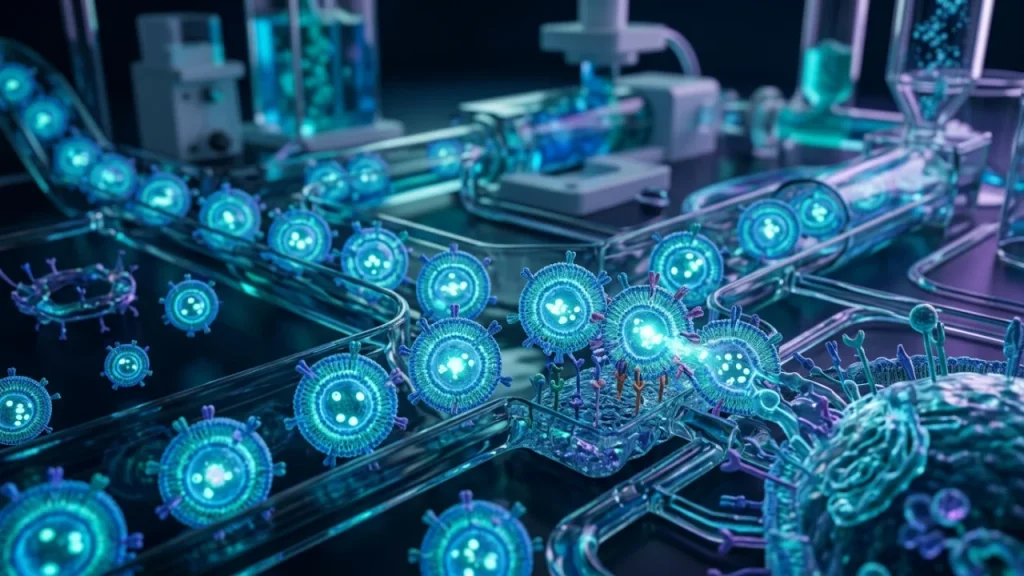
Why Your Choice of Exosomes Based Therapeutics Manufacturer Matters
What Are Exosomes and Why Do They Need Special Manufacturing?
Exosomes are tiny bubbles released by your cells. Think of them as microscopic mail trucks. They carry important cargo like proteins and genetic instructions. This cargo delivers messages between cells. This natural messaging system is key to new medicines.
Your body uses exosomes every day. Cells release them into fluids like blood. They travel to other cells. Then they deliver their instructions. This process can help repair tissue or regulate the immune system. Scientists aim to harness this power.
But not all exosomes are the same. A cancer cell’s exosomes differ from a stem cell’s. Their cargo changes based on the parent cell’s state. This variation is a core challenge for medicine. We need consistent, pure exosomes for reliable treatments.
Manufacturing these therapeutics is complex. It is not like making a standard chemical drug. You cannot simply synthesize exosomes in a vat. They must be produced by living cells under careful conditions. This biological process requires precise control.
First, scientists select the right cell type. Mesenchymal stem cells are a common choice. These cells naturally release healing signals. The cells are grown in special nutrient baths called bioreactors. The environment must be perfect.
Temperature, acidity, and food for the cells must stay constant. Even small changes stress the cells. Stressed cells send different messages in their exosomes. This could make a medicine ineffective or unsafe.
After cells release exosomes, they must be collected. This is like finding tiny needles in a huge haystack. The nutrient broth contains many other particles. Exosomes are only about 30 to 150 nanometers wide. That is one thousand times thinner than a human hair.
Separation uses advanced techniques like ultracentrifugation. Machines spin samples at extremely high speeds. Heavier particles sink first. Lighter exosomes gather later. Other methods use filters or special binding beads. Each step must protect the delicate exosome bubbles.
Purification is the next hurdle. The goal is to get only the desired exosomes. Any leftover cell debris or other vesicles are contaminants. They could cause unwanted immune reactions in a patient. Pure exosomes are non-negotiable for safety.
Finally, the exosomes must be stored without breaking. They are fragile lipid bubbles. Freezing can damage them if done incorrectly. Scientists use cryoprotectants. These are like antifreeze for biological particles. Proper storage keeps the medicine potent.
This entire process defines an exosomes based therapeutics manufacturer. Their expertise lies in mastering this chain. A single misstep can alter the product’s quality.
Why does this special manufacturing matter so much? The answer lies in function. An exosome’s job depends on its physical structure and cargo.
If an exosome is damaged during production, its cargo leaks out. It becomes an empty envelope with no message. The medicine would have no therapeutic effect.
If the manufacturing process is dirty, contaminants trigger side effects. A patient’s immune system might attack the foreign particles. This could cause inflammation or fever.
If batches are not consistent, doctors cannot trust the treatment. One vial might work well while another does nothing. Reliable medicine requires identical products every single time.
This is why choosing a partner is a pivotal decision. The right exosomes based therapeutics manufacturer controls every variable. They ensure cells are healthy and happy. They use gentle, precise harvesting methods. They test each batch for purity, quantity, and function.
The wrong partner might cut corners. They might grow cells in cheaper, unstable conditions. They might use harsh purification that destroys half the exosomes. Their final product could be weak or impure.
In short, the biology of exosomes creates the challenge. Their natural complexity demands an advanced, careful production process. You cannot have an effective exosome therapy without mastering its manufacturing from start to finish. This foundation determines whether a promising science becomes a reliable medicine for patients.
The next step is knowing what to look for in a manufacturing partner who meets this high bar
How a Good Manufacturer Impacts Your Drug Development Timeline
Time is the most critical resource in drug development. A single delay can cost millions of dollars. It can also mean patients wait longer for new treatments. Your choice of an exosomes based therapeutics manufacturer directly controls your timeline’s speed and reliability.
A good partner prevents delays before they start. Their work happens long before human trials. Consider the pre-clinical phase. Here, scientists test the therapy in labs and animals. They need consistent exosome batches for every experiment.
If the exosomes change from batch to batch, the data becomes unreliable. Scientists might see a strong effect in one test. The next week, with a new batch, they see a weak effect. They cannot tell if the change is due to the exosome therapy or due to manufacturing variance.
This forces the team to repeat experiments. Repeating work adds weeks or months to the schedule. A manufacturer with tight process control delivers identical material every time. This lets the science move forward in a straight line.
The chemistry and manufacturing controls package is a major regulatory step. Agencies like the FDA review this package deeply. They want proof that you can make your therapy the same way every single time.
A skilled manufacturer builds this package from day one. They document every single step with extreme care. They record how cells are grown, fed, and monitored. They document the exact conditions for harvesting exosomes.
They also validate every piece of equipment. They prove their purification system removes contaminants every time. This creates a mountain of high-quality data for regulators to review.
A weak manufacturer has poor documentation. Their processes might shift slightly. Regulators will notice gaps in the data. The agency will send a list of questions called information requests.
Answering these requests can take many months. It often requires new experiments and new data runs. Your entire program sits still during this wait. A strong manufacturer’s thorough work prevents most of these questions.
Clinical trials depend on a steady supply of medicine. Imagine a Phase 2 trial with one hundred patients. Each patient needs multiple doses over several months. The entire trial needs one large, consistent batch of exosomes.
If a manufacturer cannot scale up properly, the trial stalls. They might produce only enough for ten patients at first. The trial would pause while they make more medicine. Patients could miss doses, ruining the trial’s results.
Scaling is a specific engineering skill. Growing cells in a small flask is different from growing them in a large bioreactor. Nutrients and oxygen must reach all cells evenly. The harvesting process must work at a larger volume.
A proven manufacturer has mastered this scale-up path. They know how to move from lab scale to clinical scale smoothly. They ensure the exosomes at large scale are identical to the small-scale versions used in early tests. This guarantees an uninterrupted supply for trials.
The final goal is regulatory approval for market launch. The review process looks at all data from start to finish. Consistency is the golden thread that ties everything together.
Regulators need to trust your product. They look for a perfect chain of evidence. They check that the exosomes used in the first animal studies are the same as those used in the final human trials.
Any break in this chain raises red flags. A change in the manufacturing site can cause a break. A change in a critical raw material can cause a break. Even a change in a testing method can cause a break.
A top-tier manufacturer maintains this chain of identity. They use the same core methods from development through commercial production. They manage changes with rigorous testing and documentation. This provides regulators with confidence, smoothing the path to approval.
Think of development like building a house on a foundation. The science is the blueprint. The manufacturing partner pours the concrete foundation. A weak, uneven foundation causes problems at every later stage.
Walls will not be straight. Windows will not fit. Builders must stop to fix foundational errors. The project finishes late and over budget.
A strong, level foundation lets construction proceed on schedule. Each step builds cleanly on the previous one. The project meets its deadlines.
In drug development, a good manufacturer is that strong foundation. Their work ensures each phase transitions smoothly into the next. They turn complex biology into a reliable, scalable product.
This control over time is perhaps their greatest value. It reduces financial risk by avoiding costly delays. More importantly, it gets potential therapies to patients faster. The right partner does not just make exosomes. They build the reliable highway that carries your therapy from the lab to the clinic without unnecessary stops.
The next logical question is how to identify such a partner from the start, before any contracts are signed
Common Mistakes When Picking an Exosomes Based Therapeutics Manufacturer
Choosing a manufacturing partner is a complex decision. Many teams stumble by focusing on the wrong priorities first. This can set a project back by years. One common error is prioritizing cost above all else. The lowest bid often comes with hidden expenses. These expenses appear later as delays or failed tests.
A cheap process might use lower-grade materials. It might skip critical quality checks. These shortcuts risk the entire product’s consistency. A batch failure in late-stage trials is far more costly than a higher initial investment. Think of it like buying a cheap parachute. The savings are not worth the ultimate risk.
Another mistake is overvaluing scale-up speed alone. A partner might promise rapid production increases. But if their process is not controlled, speed creates problems. They might produce more exosomes faster. Yet those exosomes could be the wrong size or carry inconsistent cargo. Fast production of an unreliable product helps no one.
Teams sometimes focus only on the science of exosome creation. They forget the systems needed to prove what was made. This is a critical oversight. A strong exosomes based therapeutics manufacturer invests equally in analytics. They can not just make exosomes. They must measure them with extreme precision.
- They measure exosome count and size.
- They analyze the proteins on the exosome surface.
- They confirm the therapeutic cargo is inside.
Without this data, you cannot prove your therapy is consistent. Regulators will not accept it. Choosing a partner with weak analytics is like flying blind.
A related error is ignoring a partner’s change management process. All processes need adjustments over time. A raw material supplier might change. An instrument might be updated. How does the manufacturer handle this? A weak partner makes changes without deep testing. This can alter the exosomes without anyone knowing until a test fails.
A strong partner has a strict protocol for any change. They study the impact thoroughly before proceeding. They document everything. This protects your therapy’s identity over many years.
Many ventures seek a partner too late in development. They develop their entire process in an academic lab. Then they try to hand it to a manufacturer for large-scale work. This often fails. The lab method may rely on manual steps. It may use research-grade tools. These are not suitable for making medicine.
The right time to engage a manufacturer is early. An expert partner can help design a process that is scalable from the start. They build the strong foundation you need early on. This avoids painful and costly re-designs later.
Some are swayed by flashy, new technology alone. A novel purification device seems promising. But is it proven for consistent medical production? New tech can have unknown bugs. It might lack reliable supply chains for spare parts. A robust, well-understood method is often safer than an unproven one.
Finally, a major mistake is not checking a partner’s regulatory experience. Making exosomes for research is one thing. Making them for human trials is another. You need a partner who knows the regulatory pathway.
They should understand the required documents for clinical trials. They should have a history of audits from agencies like the FDA. A partner without this experience will learn on your project’s time and budget. This creates severe delays.
Each of these mistakes shares a root cause: short-term thinking. Focusing on initial cost or speed ignores the long journey of drug development. The goal is not to start quickly or cheaply. The goal is to finish with an approved, effective therapy.
Your choice in an exosomes based therapeutics manufacturer determines your path. A misstep here forces you to navigate obstacles at every stage. It consumes time, money, and scientific effort. The right choice creates a clear and controlled path forward.
The next step is knowing what to look for in a good partner to avoid these errors entirely
Essential Quality Standards for Exosomes Based Therapeutics Manufacturer
GMP Compliance: The Basic Rule Every Manufacturer Must Follow
Good Manufacturing Practice, or GMP, is not a suggestion. It is a strict legal rule. Every exosomes based therapeutics manufacturer aiming for human trials must follow it. Think of GMP as a detailed recipe and a clean kitchen rulebook combined. It ensures every batch of medicine is safe, pure, and works as intended.
Why is this so critical for exosomes? Exosomes are natural nanoparticles. Cells in your body make them all the time. But making them as a consistent medicine is incredibly complex. The process has many steps. Cells are grown. They release exosomes into fluid. The exosomes are collected and purified. They are tested, stored, and shipped. A tiny change at any step can alter the final product.
Without GMP, you cannot guarantee what is in the vial. One batch might be strong. The next batch might be weak or contaminated. This variability is dangerous in a drug. GMP removes this risk through controlled systems.
GMP covers every single part of production. It starts with the raw materials. The growth medium for the cells must be certified and tested. The bottles and filters used must be sterile. Even the air in the cleanrooms is controlled. Special filters remove dust and microbes. Workers wear gowns, gloves, and masks. This prevents human contamination.
Documentation is the backbone of GMP. Every action is written down and checked. If a technician uses a piece of equipment, they log it. If the temperature of an incubator changes, it is recorded. This creates a perfect paper trail. You can trace the history of any single batch from start to finish.
This traceability is vital for solving problems. Imagine a batch fails a quality test. The GMP records let scientists find the root cause quickly. They can check the cell culture logs. They can review the purification machine settings. They can verify the storage conditions. Without these records, finding the problem is just guesswork.
The rules also apply to the people doing the work. Staff must be thoroughly trained on GMP procedures. Their training records are kept up to date. This ensures everyone understands their role in making a safe product. Regular audits check that rules are followed every day.
Let’s look at key GMP areas for exosome production:
- Cell Banking: The original cells used are a master seed. Scientists create a Master Cell Bank from them. Then they make a Working Cell Bank for daily use. Each bank is rigorously tested for identity, purity, and safety. This guarantees every production run starts from the same, clean source.
- Process Controls: Each manufacturing step has defined limits. How long do you spin the centrifuge? What pressure is used for filtration? GMP requires these parameters to be set and strictly followed. Any deviation must be investigated.
- Cleaning and Sanitation: Equipment must be cleaned to a proven standard. A protocol shows how to clean a bioreactor. Another test proves no residue or microbes remain after cleaning. This prevents cross-contamination between batches.
- Quality Control Testing: This is separate from the production team. QC scientists test samples at many points. They check for sterility. They measure exosome count and size. They look for unwanted proteins or DNA. The product is only released if it passes all tests.
- Stability Studies: Manufacturers must prove exosomes stay stable in their final container. They store samples under different conditions for months or years. They test them over time. This defines the drug’s shelf life and storage rules.
A GMP facility is designed for control. Floors, walls, and ceilings use smooth, easy-to-clean materials. Air pressure gradients push air from cleanest areas to less clean ones. This keeps contaminants from floating into sterile zones.
For a biopharma company, partnering with a GMP-compliant manufacturer is essential. It is your first proof of serious capability. A partner without GMP cannot give you a product for clinical trials. Regulatory agencies will not accept data from a non-GMP process.
Choosing a GMP partner means choosing predictability. Their systems are built for consistency and evidence. Your development timeline becomes more reliable because production errors are rare and caught early.
GMP compliance is the basic price of entry. It transforms research-grade exosomes into a potential medicine. It provides the documented evidence regulators demand to protect patients. Without this foundation, scaling up and proving your therapy’s safety is nearly impossible.
Mastering these rules is just one part of quality. The next layer involves the specific tests used to define what an exosome medicine truly is and how it must perform to be effective
Beyond GMP: Why High Purity Exosomes Matter for Safety
High purity in exosome medicines is a direct safety requirement. Impure exosome preparations can cause serious side effects. These side effects are not caused by the exosomes themselves. They are caused by what travels with them.
Think of an exosome therapy as a targeted delivery truck. The truck itself is designed to go to a specific cell. Now imagine many other vehicles mixed in with these trucks. Some are empty. Some carry the wrong cargo. This chaotic mix causes problems. The body’s immune system may react to the extra material. The wrong cargo could send harmful signals to cells. The therapy becomes unpredictable and potentially dangerous.
The main impurities come from the manufacturing process. Cells grown in culture release exosomes. They also release many other things. A high-purity process must remove all these other components. Key impurities include: – Non-exosome vesicles. Cells shed other types of tiny bubbles. These look similar but function differently. – Free proteins and nucleic acids. These are fragments floating outside of vesicles. – Media components. Leftover growth serum or proteins from the cell culture soup. – Cell debris. Broken pieces of membranes or organelles from dead cells.
An exosomes based therapeutics manufacturer uses advanced tools to remove these. The goal is to isolate only the intact, correctly formed exosomes. Techniques like chromatography and precise filtration are common. Each step must be carefully designed. It must capture the wanted exosomes while washing away everything else.
Why does this matter so much for safety? Impurities trigger immune reactions. The human immune system is always on patrol. It looks for foreign invaders. Free DNA or proteins from animal serum are red flags. They can cause inflammation. For a patient, this might mean fever, pain, or organ swelling. It could make a patient sicker instead of better.
Impurities also cloud the mechanism of action. Scientists design exosome therapies to carry specific healing signals. If other vesicles are present, they send unknown signals. These mixed messages can confuse target cells. The cells might not respond as intended. The treatment effect becomes weak or inconsistent. Clinical trial results would be impossible to interpret correctly.
Purity is tightly linked to dose. A dose is measured by the number of exosome particles injected. An impure product makes dosing a guess. If half of an injection is useless debris, the effective dose is only half of what is stated. A patient might not get enough therapy to work. Alternatively, impurities could increase toxicity without adding benefit.
Regulators look at purity data very closely. They want to see a clear “purity profile.” This profile shows what percentage of the product is the desired exosome. It also lists and measures every significant impurity present. A manufacturer must prove these impurities are below safe limits. They must also show they are consistent from batch to batch.
Achieving high purity is a technical challenge. Exosomes are extremely small. They are measured in nanometers. Separating them from similar-sized impurities is difficult. It requires specialized equipment and deep expertise. A manufacturer invests heavily in this separation technology. This investment is a core part of their value.
For a biopharma company, purity data is critical evidence. It supports the safety argument for clinical trials. When you partner with a manufacturer, you must review their purity specifications. Ask for their typical purity profile. Ask how they validate that their process removes key impurities consistently.
The cost of low purity is high. It can lead to clinical trial failure. It can cause regulatory delays requiring new studies. Most importantly, it risks patient health. Selecting a partner who prioritizes purity protects your program and future patients.
Ultimately, GMP provides the clean room and controlled process. Purity defines the clean product that comes out of it. One enables the other. The next logical question is how we measure and confirm this purity before any vial is ever released for use.
Scalable Platforms for Growing Your Exosome Production
A single milliliter of therapeutic exosome product can require billions of purified particles. Making that first small, pure batch in a lab is one challenge. Making thousands of identical, pure liters for global patients is another. Scalability is the bridge between a scientific success and a real medicine.
Think of scalability as a blueprint for growth. A process that works in a small flask often fails in a large bioreactor. The goal is to increase output without changing the product’s critical qualities. Your exosomes must be the same every time, only more numerous.
The core challenge is the living factory: the cells. Cells produce exosomes. To scale up, you must grow more cells. You must also keep them healthy and productive at a large scale. Stressed or crowded cells change their exosome output. They might release different cargo. This alters the therapy.
A scalable platform manages this cell environment precisely. It controls key factors as volume increases: – Nutrient and oxygen levels for millions of cells. – Waste removal to keep cells healthy. – Consistent triggers for exosome release.
Without control, the product changes. This is why not all processes scale. A simple method like growing cells in stacked flasks hits a physical limit. Manual handling causes variability. It cannot supply a clinical trial.
True scalability needs integrated systems. Advanced bioreactors are the standard. These are large, computerized vessels. They constantly monitor the cell culture. They automatically adjust conditions. This mimics the ideal small-scale environment but at 100 or 1000 times the volume.
The choice of cell source ties directly to scalability. Some cell types are fragile. They do not grow well in large bioreactors. Others are robust and proliferate reliably. An experienced exosomes based therapeutics manufacturer selects or engineers cells for this trait. They build scalability into the process from the very start.
Harvesting and purification must also scale. The methods used for a small lab sample will not work for hundreds of liters of fluid. The platform must include large-scale separation technology. This technology must maintain the high purity standards discussed earlier. It is a full-system engineering problem.
Scalability directly impacts cost and timeline. A non-scalable process leads to “scale-up shock.” This occurs when moving from lab to pilot plant. The product profile shifts. Years of work are lost re-optimizing the process. A scalable platform avoids this shock. It de-risks the entire development path.
Consider these stages of clinical need: – Preclinical studies need small amounts. – Phase I trials need more. – Phase III trials and commercial supply need vast quantities.
A platform that scales linearly allows for predictable planning. You can forecast costs and material needs. You avoid switching manufacturers mid-stream. This continuity is vital for regulatory approval. Agencies want to see the final commercial process as early as possible.
Investment in scalability signals a partner’s long-term vision. It requires upfront capital in equipment and process development. A partner focused only on research services may lack this investment. A partner built for therapeutics will have scalability as a core design principle.
When evaluating a manufacturer, ask specific questions about scale: – What is the largest batch volume you have produced with consistent quality? – Show me data comparing key exosome attributes from small and large runs. – What is your roadmap to commercial-scale production?
Request this data. Look for overlapping graphs. The potency, size, and purity profiles should align almost perfectly across scales. This alignment proves control. It proves the platform is robust.
In summary, scalability is not an afterthought. It is a fundamental capability for any serious exosomes based therapeutics manufacturer. It ensures your therapy can journey from the lab bench to the patient’s bedside without changing its essential nature. The next consideration is how to prove that consistency at every single step, through rigorous analytical control.
Key Technical Skills of an Exosomes Based Therapeutics Manufacturer
Advanced Isolation Techniques for Clean Exosome Collection
Exosomes are tiny. They are one hundred times smaller than a typical cell. They also swim in a complex soup. This soup contains dead cell fragments, proteins, and other vesicles. Isolating just the exosomes is a major technical challenge. A clean harvest is the first critical step for any exosomes based therapeutics manufacturer. Impurities can cause side effects. They can also ruin experimental data.
Think of it like fishing with a very specific net. You only want to catch one type of fish. All other sea life must stay in the ocean. Advanced isolation techniques are that precise net. They separate exosomes based on their physical and chemical traits.
The oldest common method is ultracentrifugation. A machine spins samples at immense speeds. These speeds can exceed 100,000 times the force of gravity. Heavier particles slam to the bottom first. Lighter exosomes gather later. It is a powerful tool. But it is slow and can damage delicate exosomes through shear forces. It also may not fully remove similar-sized impurities.
Newer techniques offer better precision and gentler handling. They are key for scalable, pure production.
Size-based filtration is one approach. Solutions are pushed through filters with tiny pores. These pores act like a sieve. Large contaminants get stuck. Exosomes small enough to pass through are collected. This is faster than ultracentrifugation. It can be automated for larger volumes.
Polymer-based precipitation is another method. A special solution is added to the sample. This solution changes the solubility of exosomes. It makes them less soluble in the liquid. The exosomes clump together and fall out of solution. This is simple but can co-precipitate non-exosome material. It often requires a second cleaning step.
The gold standard for purity is often chromatography. This technique separates particles by their chemical attraction to a material. The sample flows through a column packed with beads. Different particles stick to the beads for different lengths of time. Exosomes exit the column at a specific time and are collected alone. This method yields very clean exosomes. It is excellent for research and sensitive therapies.
Immunoaffinity capture is the most specific tool. It uses antibodies like magnetic hooks. These antibodies are designed to latch onto one protein found only on the target exosome surface. When added to the mix, they pull the desired exosomes out magnetically. All other material is washed away. This gives ultra-pure exosomes from a specific cell type. But it is expensive and not ideal for large manufacturing scales yet.
Each method has pros and cons: – Ultracentrifugation is universal but harsh. – Filtration is scalable and gentle. – Precipitation is simple but less pure. – Chromatography is pure and reproducible. – Immunoaffinity is highly specific but costly.
A skilled manufacturer does not rely on just one method. They use a combination. This is called a orthogonal approach. For example, they might use filtration for an initial quick concentration. Then they would use chromatography for final polishing and purity.
The choice of technique directly impacts the final product. It affects the exosome’s activity, stability, and safety. A manufacturer must match the method to the therapy’s goals. A cancer vaccine might need ultra-pure exosomes from tumor cells. A large-scale regenerative therapy might prioritize gentle, high-volume filtration.
Consistency is paramount here too. The same isolation process must deliver identical results every single time at every scale. This requires deep process knowledge and control.
You should ask a potential partner about their isolation strategy. – What primary and polishing methods do you use? – How do you remove key contaminants like serum proteins? – Show me purity data from your standard isolation run.
Look for clear evidence of cleanliness. Electron microscope images should show cups-shaped vesicles of similar size with little debris. Protein analysis should show strong signals for exosome markers and weak signals for contaminants.
Advanced isolation is more than a lab step. It is the gatekeeper of quality for an exosomes based therapeutics manufacturer. It ensures that what goes into development is pure, active, and defined. Once you have a clean harvest, you must then be able to measure exactly what you have captured through detailed analysis
Rigorous Characterization to Verify Exosome Identity
Isolating exosomes is just the beginning. You must then prove what you have captured. This proof comes from rigorous characterization. Characterization is a set of tests. These tests confirm the identity, purity, and strength of your exosome sample. Think of it like checking a passport. The tests verify the exosome is real and ready for work.
Every exosomes based therapeutics manufacturer must master this. Characterization is non-negotiable for safety and science. You cannot develop a drug from something unknown. These tests provide the data that defines your product.
The process checks three main things. It checks physical traits, biochemical marks, and biological function. A strong partner uses multiple, complementary methods. Relying on just one test is not enough.
First, scientists measure size and number. They use a technique called nanoparticle tracking analysis, or NTA. This machine shoots a laser through the liquid sample. Exosomes scatter the laser light as they float. A camera records these tiny flashes.
The software then tracks each particle’s movement. It calculates size from how fast they move. It also counts them. This gives two key numbers. You get the average particle size in nanometers. You also get the particle concentration, like particles per milliliter.
Good results show a tight, single peak on a graph. Most particles should be between 60 and 150 nanometers. A broad peak suggests contamination or damaged vesicles. The count tells you your yield from isolation.
Second, they check for specific protein markers. Exosomes carry a signature set of proteins on their surface and inside. These are like identification badges.
Scientists use a method called western blotting. They break open the exosomes and separate the proteins by size. They then use special antibodies that stick to specific exosome proteins. Common targets include CD9, CD63, and CD81.
A positive signal for these markers is good news. It strongly suggests you have exosomes. But they also check for negative markers. These are proteins that should NOT be there.
A common contaminant is proteins from cell culture serum. A test for albumin or apolipoproteins should show a weak or absent signal. This confirms your isolation removed these impurities.
Third, they examine shape and structure. They use electron microscopy, or EM. For this, a sample is frozen very fast or stained with metal. It is then placed in a high-vacuum chamber.
An electron beam scans the sample. This creates an incredibly detailed image. You can see the classic cup-shaped morphology of exosomes under the microscope.
This visual check is powerful. It confirms the NTA size data with a picture. It also shows if vesicles are intact or broken. You can see if other debris is present.
These three methods form a core panel. – NTA gives size and count. – Western blot gives protein identity. – EM gives visual proof.
Together, they build a strong case for exosome identity.
But advanced characterization goes further. It looks inside the cargo. Exosomes are powerful because of what they carry. This includes RNA, proteins, and lipids.
Scientists can extract and analyze this cargo. They sequence the RNA to see what messages the exosome holds. They use mass spectrometry to list hundreds of carried proteins.
This deep analysis answers critical questions. What is the therapeutic mechanism? Does the cargo match the intended function? For instance, exosomes for nerve repair might carry specific growth factors.
This data is vital for an exosomes based therapeutics manufacturer. It links the physical product to a biological effect. It turns a vague “exosome soup” into a defined biologic agent.
Consistency testing is also key here. Characterization is not a one-time event. It happens with every batch produced at every scale.
The results must be nearly identical each time. The size distribution should match. The marker expression profile should be stable. The particle yield should be predictable.
This batch-to-batch consistency proves the manufacturing process is controlled. It shows the process is robust and reliable.
You should ask a potential partner for their standard characterization package. – What specific methods do you use for size, markers, and imaging? – Can you show me batch data for at least three production runs? – How do you characterize the functional cargo?
Look for comprehensive data sheets. They should show clear graphs and clean images. The numbers should be consistent across reports.
Rigorous characterization closes the quality loop started by isolation. It provides the evidence that your material is correct. This evidence supports further development steps.
It is essential for regulatory filings later on. Agencies will demand this proof of identity and consistency.
Without it, you are moving forward blindfolded. With it, you have a scientifically defined therapeutic candidate ready for the next stage: functional testing for potency and safety in models relevant to your disease target
Precise Cargo Loading: Putting Drugs Inside Exosomes
Exosomes are natural delivery vehicles. Their core job is to carry molecular messages between cells. For therapy, scientists replace these natural messages with precise therapeutic agents. This process is called cargo loading. It transforms a characterized exosome into a targeted drug delivery system.
Think of an empty shipping container. It has the right shape and labels. But its value comes from what you put inside. Cargo loading fills the exosome container. The goal is to get a high dose of active drug inside without damaging the vesicle.
The challenge is the exosome’s membrane. It protects the cargo but is a barrier to loading. Scientists have developed several key techniques to solve this. Each method has pros and cons. The choice depends on the cargo type and the final therapeutic goal.
One common approach is co-incubation. This is a simple passive method. Purified exosomes and the drug are mixed together. They are incubated under specific conditions. Some small molecules can drift across the membrane on their own.
This method is easy and does not harm exosomes. But it is often inefficient. Loading levels can be low and unpredictable. It works best for very small, lipid-soluble compounds.
A more active method uses electroporation. This technique applies a brief electrical pulse to the mixture. The pulse creates tiny temporary pores in the exosome’s membrane. The drug molecules can slip inside through these pores.
Electroporation can load larger molecules. It is often used for nucleic acids like siRNA or mRNA. The efficiency is higher than passive incubation. However, the electrical shock can sometimes damage exosomes. It can cause them to clump together.
Sonication is another physical method. It uses sound wave energy to disrupt the membrane. The vibrations make the membrane more fluid and permeable. Drug molecules are mixed in during this process.
This method can achieve good loading efficiency. Yet the mechanical force is harsh. It may alter the exosome’s structure or surface proteins. These proteins are important for targeting.
Some advanced methods are more biological in nature. One technique engineers the parent cells themselves. Scientists modify the cells to produce the drug internally. The cells then naturally package that drug into exosomes as they form.
This is called endogenous loading. The cell’s own machinery does the work. It can be very efficient for protein or genetic cargo. It often requires complex genetic engineering of the source cells.
Another strategy uses fusion agents. These are chemical compounds that merge two membranes together. A liposome carrying the drug can be fused with an exosome. Their membranes combine, mixing the contents.
The choice of method is a major technical decision for an exosomes based therapeutics manufacturer. It directly impacts product quality and therapeutic effect. The best method achieves several goals simultaneously.
First, it must provide high loading efficiency. A large percentage of the drug should end up inside the vesicles. Second, it must preserve exosome integrity. The vesicles must remain intact and functional after loading.
Third, the process must be scalable and consistent. What works in a tiny lab vial must work in a large production bioreactor. Finally, it must not introduce harmful contaminants or byproducts.
Different cargo types demand different approaches. – Small molecule drugs: Often use passive incubation or electroporation. – Nucleic acids (DNA, RNA): Typically require electroporation or sonication. – Proteins: May use endogenous loading or gentle fusion techniques. – CRISPR components: Often need advanced endogenous or hybrid methods.
After loading, scientists must verify their work. They must separate loaded exosomes from any leftover free drug. They then test to confirm the cargo is inside and active. This is another critical step in quality control.
The amount of drug inside each exosome is measured. This is called drug loading capacity or encapsulation efficiency. Teams also check that the drug still works after the loading process. A damaged drug is useless.
Successful cargo loading creates a potent therapeutic product. The exosome delivers its payload directly to target cells. This can increase drug efficacy and reduce side effects elsewhere in the body.
Mastering this skill separates basic exosome producers from true developers of therapeutics. It turns inert nanoparticles into targeted medicines. The next step is to test how well these loaded exosomes perform their intended function in biological models, moving closer to a real therapy for patients
How an Exosomes Based Therapeutics Manufacturer Supports Your Project
Analytical Services for Robust Quality Control Testing
Quality control testing is not just a final check. It is a continuous process. It confirms every batch of exosomes meets strict standards. An exosomes based therapeutics manufacturer relies on a suite of analytical services. These tests prove the vesicles are what you need them to be. They ensure safety and function for your project.
First, scientists must identify the exosomes. They need to confirm the particles are truly exosomes. Not other extracellular vesicles. Not cell debris or protein aggregates. This starts with measuring size and concentration. A technique called Nanoparticle Tracking Analysis (NTA) is common. It tracks particles moving in liquid under a laser. It gives two key numbers. The average size of the particles in nanometers. The exact number of particles per milliliter of solution.
Size alone is not enough proof. Exosomes have a specific set of marker proteins on their surface. Tests must confirm their presence. Flow cytometry can do this for larger vesicles. Newer, more sensitive methods are used for small exosomes. These tests look for proteins like CD63, CD81, and CD9. They also check for the absence of proteins from cell organelles. This confirms the vesicles are pure and not contaminated.
Purity is a major concern. The exosome preparation must be clean. It should have very little non-exosome material. Scientists measure the ratio of particle count to total protein amount. A high ratio is good. It means many particles with little stray protein. A low ratio suggests contamination. Too much free protein or other debris is present.
Another critical test checks for endotoxin. Endotoxins are harmful parts of bacterial cells. They can cause severe fever in patients. Even tiny amounts are dangerous. Every batch must be tested. The level must be far below the safety limit set by regulators.
After confirming identity and purity, the focus shifts to cargo. Did the loading process work? How much drug is inside? Analytical services answer these questions. For nucleic acid cargo, a lab can extract and quantify the RNA or DNA. They measure how many copies are inside the exosomes versus floating free in solution.
For protein cargo, different methods are used. Enzymatic activity assays can show if a loaded enzyme still works. Special stains can visualize proteins inside vesicles under advanced microscopes. The goal is to prove the cargo is there. It must also be protected and functional.
The most important tests are functional. They show if the exosomes do their job in a biological system. These are called potency assays. A simple potency test checks cellular uptake. Scientists label exosomes with a fluorescent dye. They then add them to target cells in a dish. After some time, they wash the cells. They use a microscope or plate reader to see if the cells glow. This confirms the exosomes can deliver their payload.
More complex assays test the biological effect. For example, exosomes might carry an anti-cancer RNA. The functional test would measure gene silencing in tumor cells. Do the target protein levels drop? Another example is regenerative exosomes carrying growth factors. Do they actually speed up wound healing in a cell model? These tests move beyond simple characterization. They prove therapeutic potential.
Stability testing is another key service. How long do the exosomes last? Scientists store samples under different conditions. They check them over days, weeks, or months. They look for changes in size, particle count, and cargo integrity. This data defines the shelf life. It also guides how to ship and store the product.
All this testing generates massive data. A strong analytical report does not just list numbers. It interprets them against project goals and regulatory guidelines. It shows if the batch passes all release criteria. This documentation is vital for future clinical trials.
Here is a summary of core analytical service categories: – Identity: Size, concentration, and marker confirmation. – Purity: Particle-to-protein ratio and contaminant screening. – Safety: Endotoxin and sterility testing. – Cargo: Quantification and activity of loaded drug. – Potency: Cellular uptake and biological effect assays. – Stability: Shelf-life and storage condition studies.
Without this analytical backbone, an exosome therapy is a black box. You cannot be sure what you have. Robust quality control turns unknown nanoparticles into a characterized product. It provides the evidence needed for the next step: preclinical testing in animal models to assess safety and efficacy before human trials.
This rigorous approach de-risks development. It ensures every step forward is built on solid, verified data from trusted analytical services
Regulatory Strategy Help for FDA and EMA Submissions
Navigating government rules is a major hurdle for new therapies. An experienced exosomes based therapeutics manufacturer does more than just make the product. They provide a roadmap for approval. This guidance is called regulatory strategy. It is a detailed plan for dealing with agencies like the FDA in the United States and the EMA in Europe.
These agencies require proof your therapy is safe and works. They also need proof it is made the same way every single time. Your manufacturer’s quality control data becomes this proof. But you must present it correctly. A good regulatory strategy organizes all this evidence. It answers the agency’s questions before they even ask them.
The first step is early dialogue. Your manufacturer can help prepare for meetings with regulators. These are called pre-submission meetings. The goal is to get feedback on your plans. You might discuss your manufacturing process. You could talk about your proposed tests for safety. Getting early input prevents costly mistakes later.
A key part of strategy is defining your product correctly. Exosome therapies are complex. Regulators will ask what exactly your product is. Is it a vesicle carrying a drug? Is it an unmodified signaling particle? The manufacturer helps craft the scientific description. This definition guides all later requirements.
They also help design your development plan. This plan outlines every study needed before human trials. It includes pharmacology and toxicology tests. The manufacturer ensures the exosomes used in these studies are identical to those planned for patients. Any change later could invalidate the earlier work.
Dossier preparation is another critical service. A dossier is a huge application document. It contains thousands of pages of data. There are specific formats for each agency. The Common Technical Document (CTD) format is standard. An expert manufacturer knows how to compile these sections.
- Module 2 contains summaries and overviews.
- Module 3 covers detailed quality data about the exosome product itself.
- Module 4 has non-clinical study reports from animal tests.
- Module 5 covers clinical trial protocols and results.
Module 3 is where the manufacturer’s expertise shines. This section details the chemistry, manufacturing, and controls (CMC). It describes the entire production process from start to finish. Every raw material is listed. Every step is defined. Every test method is validated.
Writing a strong CMC section requires precise language. It must show deep process understanding and control. For example, you cannot just say “exosomes are purified.” You must specify the exact method. You must list all equipment parameters. You must provide data showing the step removes specific impurities every time.
Regulatory strategy also involves risk management. What could go wrong with your product? The manufacturer helps identify potential risks. They then design controls to mitigate them. A risk could be viral contamination from the source cells. A control would be rigorous testing of all cell banks.
Stability data directly informs shelf-life claims in the dossier. The agency will approve a specific storage time and temperature based on this data. The manufacturer provides the studies to support your requested shelf life.
Another complex area is comparability. Imagine you need to scale up production for Phase 3 trials. You must prove the new, larger batch is equivalent to the old, smaller one used in earlier studies. The manufacturer runs a comparability study. They analyze both batches with many tests. They show all critical qualities remain the same.
Submitting the dossier is not the end. Agencies always have questions. They send official requests for information. These questions are often highly technical. Your manufacturer helps you craft accurate and complete responses quickly. Delays in answering can pause the entire review clock.
Finally, a good partner thinks ahead to inspections. If an application is successful, regulators will inspect the manufacturing site. The manufacturer prepares for this audit. They ensure all practices match what was described in the dossier. They train staff for interviews with inspectors.
Working with a skilled manufacturer transforms regulatory submission from a mystery into a managed project. They translate excellent science into a language regulators understand and trust. This strategic support turns your characterized exosome product into a viable candidate for clinical trials and, ultimately, for patients waiting for new treatments. This foundation allows teams to then focus on the next practical challenge: scaling production from lab to clinic reliably
Collaborative Approach: Working Together on Scientific Challenges
Developing a new therapy is full of unexpected puzzles. Your cells might not produce enough exosomes. The vesicles you collect might not carry the right therapeutic cargo. These are common scientific hurdles. You do not face them alone. A true partner in manufacturing works with you to solve them. This collaborative approach speeds up progress dramatically.
Think of it as a shared lab bench. Your team brings deep knowledge of your drug candidate and its target disease. The exosomes based therapeutics manufacturer brings vast experience with cell cultures and purification processes. They have seen many similar challenges before. Combining these perspectives creates powerful solutions.
One major challenge is low yield. Your chosen parent cells might be fragile. They may not release many exosomes in culture. A collaborative manufacturer does not just report the low numbers. Their scientists will propose and test changes to the growth environment. They might adjust nutrients or the surface the cells grow on. They will share data from each experiment with your team. Together, you decide the next step.
Another puzzle involves cargo loading. You need exosomes to carry a specific drug or signaling molecule. Loading can be tricky. The manufacturer can test different methods with you. – One method engineers the parent cell to make the drug itself. The cell then packs it into exosomes naturally. – Another method takes empty exosomes and loads them after purification. Each approach has pros and cons. A good partner will run small parallel studies. They compare loading efficiency and final product activity. You review the data together. This joint analysis leads to a smarter choice.
Process changes often create new questions. Scaling up a process can change the exosomes themselves. Perhaps a new filter introduces slight shear stress. This stress might damage some vesicles. Your manufacturing partner will detect this in their quality checks. They will immediately alert your team. Then, you brainstorm fixes together. Maybe a gentler filtration method is needed. Perhaps a different step in the sequence works better.
Communication is the fuel for this collaboration. Regular meetings are essential. These are not just status updates. They are working sessions focused on problems and data. Teams share raw results and graphs. They discuss what the data might mean. They plan the very next experiment. This tight loop prevents wasted time and resources.
A collaborative partner also thinks about your final goals early. They ask about your target patient dose. They ask about storage needs for clinics. These answers guide their process development. For instance, if a therapy needs frozen storage, the manufacturer will test freeze-thaw cycles during development. They will check if exosomes stay intact and potent after thawing. They solve stability problems long before final production.
This teamwork extends to analysis. Exosomes are complex nanoparticles. A single test cannot define them. The manufacturer uses many instruments to build a full profile. – They measure particle size and concentration. – They identify key protein markers on the surface. – They check for unwanted DNA or cell debris. Interpreting this data requires both sides. Your team knows which biomarkers are critical for function. The manufacturer knows if the readings are typical for their system. Together, you establish clear release criteria for batches.
Sometimes, the best path forward is not obvious. Experimental results can be confusing. A collaborative partner is honest about dead ends. They help you pivot without losing momentum. They might suggest a different cell line or a new loading technology from recent research. This openness turns setbacks into valuable learning.
The ultimate benefit of this partnership is risk reduction. Every scientific challenge solved together makes your program stronger. It builds a robust manufacturing process from the start. This process is documented in detail. All the decisions and data become part of your knowledge base. This makes future regulatory submissions smoother and more defensible.
In essence, the right manufacturer acts as an extension of your R&D team. They provide more than a service agreement. They provide a partnership built on shared scientific curiosity and a common goal. This collaborative engine turns difficult prototypes into reliable medicines ready for patients waiting for breakthrough care
Evaluating an Exosomes Based Therapeutics Manufacturer’s Track Record
Proven Success in Clinical Trial Support and Data
A manufacturer’s past performance is your best clue to future reliability. This is especially true for clinical trials. Trials demand proof. They require data that regulatory agencies will trust. An experienced exosomes based therapeutics manufacturer has already navigated this path. They have systems built for this high-stakes phase.
Think of clinical support as a specialized skill set. It goes beyond making consistent exosomes. It involves documenting every step with extreme care. Every measurement, every test, every storage record must be flawless. A single paperwork error can delay a trial for months. A partner with a proven track record understands this deeply. Their processes are designed for audit readiness from day one.
Look for evidence of successful regulatory interactions. Has the manufacturer’s data been part of an Investigational New Drug (IND) application? Was that application approved by agencies like the FDA? This approval is a major milestone. It means experts have reviewed the manufacturer’s methods and found them acceptable. This de-risks your own regulatory journey significantly.
The type of data needed evolves with each trial phase. – Phase I trials focus on safety. The manufacturer must provide clear data on product purity. They must show the absence of toxins or harmful contaminants. – Phase II trials assess dosing and early signs of effect. Here, data on exosome potency becomes critical. The manufacturer must prove batch-to-batch consistency in key biological activities. – Phase III trials confirm efficacy in large groups. Demands on data volume and statistical rigor peak. The manufacturing process must be locked and validated at commercial scale.
Ask specific questions about their history. How many INDs have they supported? For which disease areas? What was the largest batch size they produced for a clinical trial? Did those batches pass all quality checks? Answers to these questions move you from promises to proof.
Clinical data packages are complex. They are not just spreadsheets of numbers. They tell a story about your product’s identity and strength. A strong manufacturer helps author that story. They provide the analytical data that links your exosome’s physical traits to its medical function.
For example, they might show that a specific surface protein level correlates with patient response. This is called establishing a Critical Quality Attribute (CQA). Finding these links requires advanced analysis and long-term data tracking. A manufacturer without clinical experience may not even know to look for them.
Stability data is another crucial area. Clinical trials can last years. Your exosome therapy must remain potent and safe throughout. A proven manufacturer will have stability study protocols in place. They will show you data proving their exosomes last under various storage conditions. This data directly informs how you label and ship the product.
Audits are inevitable during clinical development. Regulatory inspectors will visit the manufacturing site. They will examine equipment logs, training records, and deviation reports. A seasoned manufacturer has been through this before. Their team stays calm under audit pressure. They know how to present information clearly and confidently. This experience protects your trial timeline.
The transition from clinical to commercial supply is a known hurdle. A manufacturer with a strong track record has planned for this scaling challenge. Their clinical-phase processes are designed to be expanded later. This prevents costly re-development work after your therapy is approved.
In summary, evaluating a track record is about seeking evidence, not assurances. Look for a history of generating compliant, audit-ready data that has successfully passed regulatory scrutiny. This proven success in clinical trial support translates directly into lower risk and higher confidence for your program’s most public and critical stage. The right partner turns manufacturing from a vendor task into a strategic pillar for your clinical success.
Technological Edge: Staying Ahead in Exosome Science
Exosome science is moving fast. New tools appear every year. A leading exosomes based therapeutics manufacturer does not just use today’s methods. They actively prepare for tomorrow’s. This technological edge is critical. It shapes the purity, power, and consistency of the final therapy.
Think about how exosomes are made. Cells in bioreactors produce them. Older methods collect everything the cells release. This mix contains exosomes, but also other particles and debris. Advanced purification is key. Technologies like tangential flow filtration and density gradient separation are now standard for good producers. The best go further.
They might use affinity chromatography. This method uses specific “hooks” to grab only the exosomes. It is like using a magnet to find a needle in a haystack. The result is a much cleaner product. Cleaner exosomes mean fewer side effects and more reliable dosing in patients.
Characterization technology is equally vital. You must know exactly what you have made. Simple size measurements are not enough. A top manufacturer will use nanoparticle tracking analysis for size and concentration. They will use flow cytometry to check for surface markers. These tools confirm the identity of the exosomes.
Cutting-edge labs add even deeper analysis. They might use proteomics to list every protein inside a vesicle. They could use lipidomics to study the fat membrane. This deep data proves the exosomes are not just empty bubbles. They carry the correct therapeutic cargo.
The source cells matter greatly. Some manufacturers use mesenchymal stem cells (MSCs). Others use immune cells or even engineered cell lines. The technology to grow these cells consistently is a core skill. It involves precise control of the cell environment.
- Bioreactors must keep temperature, oxygen, and nutrients perfectly stable.
- Sensors monitor cell health in real time.
- Feeding strategies are automated to avoid stress.
Stressed cells make bad exosomes. Advanced process control prevents this. It ensures every batch starts from healthy, happy cells.
Cargo loading is a major frontier. Natural exosomes carry specific molecules. For therapy, we often want to add more. We might want to pack in a drug, a RNA strand, or a signaling protein. Loading technology is complex.
Some methods electroporate the exosomes. A quick electric pulse opens tiny holes in their membrane. The therapeutic cargo slips inside. Other methods incubate exosomes with cargo at high pressure. A third approach engineers the parent cell itself. The cell is instructed to make the drug and pack it directly into the exosome during formation.
Each method has pros and cons. A manufacturer with a strong technological portfolio will master more than one. They can choose the best tool for your specific drug molecule.
Scale-up is where many good lab processes fail. Making a billion exosomes for research is one thing. Making trillions for clinical trials is another. This requires engineering skill, not just biology.
The transition needs scalable equipment. A manufacturer planning ahead will use bioreactors designed for growth. They will have closed, automated systems to prevent contamination. Their purification machines must handle large volumes without losing yield or quality.
Process analytical technology (PAT) is a sign of maturity. This means testing the product during manufacturing, not just at the end. Sensors check critical quality attributes in real time. If something drifts, the system can adjust automatically. This builds quality into every step.
Finally, consider innovation pipelines. The field is young. The best manufacturers partner with universities and tech startups. They run internal research projects to test new isolation methods or new characterization tools.
They might explore novel delivery targeting methods. This involves adding a homing signal to the exosome surface. The signal guides vesicles directly to diseased tissue, like a GPS for medicine.
This constant improvement is what you are really evaluating. You are not just hiring a production facility. You are aligning with an innovation engine. Their technological edge today becomes your product’s advantage tomorrow.
It protects your investment against obsolescence. A platform built on flexible, advanced science can adapt as your therapy evolves from Phase 1 to Phase 3 and beyond.
Therefore, when assessing a potential partner, dig into their tools and their research commitments. Ask about their next-generation platforms, not just their current ones. Their answer will show if they are merely a supplier or a true scientific collaborator for the long journey ahead
Case Studies: How Manufacturers Helped Other Biopharma Ventures
A biopharma company had a promising exosome candidate for a rare neurological condition. Their own lab process was slow. It produced low yields of exosomes. The vesicles were also inconsistent in size. This is a major problem for clinical trials. Doses must be identical for every patient.
They partnered with an experienced exosomes based therapeutics manufacturer. The manufacturer’s team first analyzed the process. They identified a bottleneck in the cell culture step. The client was using a static flask system. This system limited nutrient exchange for the producer cells.
The manufacturer moved the process to their single-use bioreactors. These provided constant, gentle stirring. Oxygen and nutrients reached the cells more efficiently. The cells remained healthier for a longer period. This simple change increased exosome yield by over 300%. The manufacturer’s advanced purification platform then handled the larger volume seamlessly.
The result was a scalable, robust process. The biopharma company entered Phase 1 trials on schedule. Their development timeline shortened by an estimated 18 months. This case shows how manufacturing expertise accelerates translation from lab to clinic.
Another venture focused on oncology. They engineered exosomes to carry a specific tumor-suppressing miRNA. Their challenge was loading the genetic material efficiently. Their lab method had a loading efficiency of only about 15%. Most of the expensive therapeutic cargo was wasted.
They needed a partner with specialized technical skills. The chosen manufacturer had a platform for active loading. This platform used electroporation. A brief electrical pulse creates temporary pores in the exosome membrane. The miRNA molecules can then enter the vesicle.
But the manufacturer did not just apply a standard protocol. They optimized pulse length and voltage for this specific exosome source and miRNA type. They ran dozens of small experiments to find the perfect balance. Too much force destroys exosomes. Too little force achieves nothing.
Their optimization work paid off. They achieved a stable loading efficiency of 68%. This was more than a four-fold improvement. The final product also passed stringent tests for potency and stability. The partnership turned a promising idea into a viable drug candidate.
Sometimes the challenge is not the science itself. It is navigating the regulatory pathway. A startup developed exosomes for wound healing. Their data was strong from animal studies. They were unsure how to prepare for talks with health authorities like the FDA.
They selected a manufacturer with a proven regulatory track record. This manufacturer had previously guided a different exosome product through an Investigational New Drug (IND) application. That application was successful.
The manufacturer’s regulatory team became an extension of the startup’s team. Together, they built a complete chemistry, manufacturing, and controls (CMC) package. This is a critical part of any IND submission.
- They defined critical quality attributes for the exosomes.
- They established strict release specifications for purity and potency.
- They validated analytical methods to measure those specifications.
- They designed stability studies to prove shelf life.
The manufacturer provided all the necessary documentation from their own facility. This included audit reports and equipment qualifications. The startup submitted their IND with confidence. It cleared regulatory review without major CMC questions. This allowed clinical trials to begin without delay.
These examples share common threads. Success came from more than just renting equipment.
First, deep problem-solving was key. Each manufacturer acted as a diagnostic partner. They looked at the core scientific and production hurdles.
Second, adaptation was crucial. They did not force every client into one rigid process. They tailored their platforms to fit the unique therapy.
Third, they provided strategic guidance beyond the lab bench. They helped with scale-up planning and regulatory strategy.
Evaluating an exosomes based therapeutics manufacturer requires looking at this history of partnership. Ask potential partners to describe past challenges they have solved for others. Request non-confidential summaries of technical problems and their solutions.
Look for evidence of shared risk and iterative development. The best manufacturers do not just execute a client’s exact instructions. They collaborate to improve the instructions themselves. They bring their experience from many projects to bear on your single project.
This track record is your best predictor of future performance. It shows a team capable of navigating the unexpected obstacles that always arise in complex biotech development. Your choice ultimately determines whether your therapy moves forward smoothly or gets stuck in development limbo.
The next logical step is understanding the cost and timeline implications of such a partnership, which directly ties investment to these demonstrated capabilities
The Future of Exosomes Based Therapeutics Manufacturing
Emerging Trends in Exosome Production and Delivery
The field of exosome manufacturing is not standing still. New methods are emerging that aim to solve two big problems: high cost and inconsistent results. These trends point toward a future where exosomes based therapeutics could become more powerful and more accessible.
One major trend is moving beyond traditional cell culture. Growing vast numbers of parent cells in flasks is slow and expensive. Scientists are now developing cell-free production systems. Think of it like brewing beer instead of farming wheat. These systems use purified cellular machinery in a controlled vat. They instruct this machinery to assemble exosomes from scratch. This method could slash production costs. It also allows for precise engineering of the exosome membrane and cargo.
Another key advance is in loading exosomes with therapeutic molecules. Loading drugs or RNA into exosomes has been a technical hurdle. Passive loading, where molecules diffuse inside, is often inefficient. New active loading techniques are changing the game.
- Electroporation uses short electrical pulses to temporarily open the exosome’s membrane. This lets therapeutic cargo slip inside before the membrane seals again.
- Sonication uses sound waves to achieve a similar effect, gently agitating the mixture to encourage uptake.
- Some of the most precise methods use engineered proteins. These proteins act like smart docks. They attach to both the exosome and the drug, guiding the cargo directly into the vesicle.
These methods ensure more of the expensive drug ends up inside the exosome where it belongs. This increases the final product’s potency. Higher potency means patients might need a lower dose, which further reduces costs.
Delivery to the right part of the body is equally critical. A major focus is on engineering “homing” capabilities into exosomes. Natural exosomes often get filtered by the liver or spleen before reaching their target. Researchers are now adding tiny protein tags or antibody fragments to the exosome surface. These tags act like GPS addresses. They can direct the exosome to a specific organ, like the brain, or even to diseased cells like tumors.
This targeting does two important things. First, it makes the therapy more effective by concentrating it at the site of disease. Second, it reduces side effects. When exosomes go only where they are needed, they are less likely to disturb healthy tissues.
Automation and advanced analytics are also reshaping the factory floor. Making exosomes consistently is hard. Tiny changes in temperature or nutrients can alter the final product. Closed, automated bioreactor systems are becoming essential. These systems constantly monitor and adjust conditions like pH and oxygen levels. Robots handle fluid transfers, minimizing human error and contamination risk.
At the same time, new tools check product quality in real time. A technique called nanoparticle tracking analysis counts and sizes exosomes as they flow through a laser beam. Advanced flow cytometry can check for specific markers on millions of individual vesicles quickly. This means a manufacturer can catch a bad batch early, saving time and money.
Looking further ahead, synthetic biology offers perhaps the most radical change. Scientists are designing completely artificial nanovesicles. These are not produced by cells at all. They are built from lipids and proteins in a lab to mimic natural exosomes. The big advantage is control. Every synthetic vesicle can be made identical, eliminating batch-to-batch variation. Their structure can be perfectly tuned for drug loading, targeting, and longevity in the bloodstream.
All these trends share a common goal: moving from artisanal craft to predictable engineering. For a company choosing a manufacturing partner, this landscape matters deeply. The right partner will not only have today’s tools but also a clear path to adopting tomorrow’s innovations. They should have active research in areas like cell-free synthesis or targeted delivery platforms.
These advances directly address the cost and timeline questions raised earlier. Cheaper, more efficient production shortens development timelines. More potent and targeted exosomes increase the chance of clinical success. This means your investment in a sophisticated exosomes based therapeutics manufacturer is an investment in a pipeline that is becoming smarter, faster, and more reliable every year.
The logical next question is how these scientific trends translate into tangible business and health outcomes for patients waiting for new therapies.
Why Investing in the Right Manufacturer Now Pays Off Later
Choosing the right exosomes based therapeutics manufacturer is not just about starting production. It is about securing your entire future. A good partner acts as a force multiplier for your science. A poor choice becomes an anchor that slows everything down. The early stages of development feel far from the clinic. Yet decisions made here echo for years. They can add millions in cost and years to your timeline.
Think of manufacturing like building a house. You must pour a strong foundation first. You cannot fix a weak foundation after the walls are up. For exosome therapies, the manufacturing process is that foundation. Changing it later is incredibly difficult and expensive. It often means repeating key studies from the beginning.
A capable manufacturer provides process robustness. This means the method for making exosomes is reliable and consistent. Every batch meets strict quality standards. This consistency is not a luxury. It is a requirement for clinical trials and for regulators. Inconsistent exosomes produce inconsistent clinical data. That data can fail to show your therapy works even if the science is sound.
Delays happen in many ways. A common delay comes from scaling up. A process that works in a small lab flask often fails in a large bioreactor. An experienced manufacturer anticipates these scale-up challenges. They design processes with growth in mind from day one. A less experienced partner might hit a wall at this stage. Your entire project then stalls while you find a new solution.
These stalls have a direct cost. They burn through cash reserves while producing no forward progress. They also have an opportunity cost. Your team could be advancing the science instead of fixing production problems. Competitors with better manufacturing move ahead while you are stuck.
Regulatory alignment is another critical factor. The FDA and other agencies have clear rules for making biologic drugs. Your manufacturer must understand these rules deeply. Their entire quality system must be built for compliance. If their system is weak, your regulatory submissions will be weak too. This can lead to clinical holds or rejection of your application.
Fixing regulatory problems late in development is a nightmare. It can require redoing years of work. Choosing a partner with a proven quality system prevents this.
Future-proofing is a major benefit of the right choice. The previous section discussed new technologies like cell-free synthesis and synthetic vesicles. A forward-looking manufacturer is already exploring these areas. They have active research programs. Partnering with them gives you a pathway to adopt these next-generation tools seamlessly.
You avoid being locked into an outdated method. Your therapy can evolve to become cheaper and more effective over time. This protects your long-term investment.
Consider these concrete risks of a poor manufacturing partnership:
- Batch failures: Contaminated or out-of-spec product must be thrown out. This wastes materials and time.
- Data gaps: Inconsistent exosomes create noisy or unreliable experimental results.
- Scaling failure: The process cannot produce enough exosomes for larger trials.
- Regulatory questions: Agencies ask for more data or halt trials due to production concerns.
- Tech obsolescence: The partner’s method becomes outdated, forcing a costly switch later.
Investing in the right partner mitigates every one of these risks. The higher initial cost of working with an expert saves money over the full project life cycle. It is like buying a quality tool that lasts for decades versus a cheap one that breaks quickly.
The payoff comes in faster timelines and higher success rates. Your therapy moves smoothly from lab to animal studies to human trials. Each step builds on a solid manufacturing base. You can trust your data because you trust your exosomes.
This reliability also makes your company more attractive to investors and partners. They see lower risk in your project. They see a team that has made smart foundational choices. This can lead to better funding terms and stronger collaboration deals.
Patient access is the ultimate goal. Every month saved in development is a month sooner patients might get a new treatment. Robust manufacturing ensures there is enough high-quality medicine for all who need it if the trial succeeds.
Choosing wisely now is an act of responsibility to future patients.
In summary, the right manufacturer is a strategic asset. They turn scientific promise into a reproducible medicine. Their expertise prevents costly errors and delays at every stage. This early investment compounds over time, paying off in faster development, stronger data, and a clearer path to market.
The next step is understanding how to evaluate potential partners against these critical criteria
Final Checklist for Selecting Your Exosomes Based Therapeutics Manufacturer
Selecting your exosomes based therapeutics manufacturer is a detailed process. You need to compare options systematically. A final checklist makes this task clear and thorough. It ensures you do not overlook key details. Use this list when you meet with potential partners. Ask direct questions. Take careful notes for later comparison.
First, examine their scientific foundation. The team must have deep cell biology knowledge. Ask about their source cells. They should explain why they use a specific cell type. This could be stem cells or adult cells. The choice impacts your exosome’s final function. They should detail how they grow these cells. The process must keep cells healthy and consistent. Unhealthy cells make poor exosomes.
Look closely at their production methods. The best systems are closed and automated. This reduces contamination risk. Human hands should not touch the product during key steps. Ask for their average exosome yield. A good yield means the process is efficient. Low yields can make therapy too expensive to produce. Inquire about purification. They must use multiple methods to get pure exosomes. Common techniques are ultracentrifugation and filtration.
Scalability is a critical point. A process that works in a small lab may fail at larger volumes. Ask them to show their scaling plan. They should have data from different production sizes. Can they make enough for your clinical trials? More importantly, can they make enough for thousands of patients later? The path to large-scale manufacturing must be clear and tested.
Quality control is non-negotiable. Every batch of exosomes must be identical. Ask for their testing checklist. It should include several key items.
- Particle count and size. They must prove all exosomes are the correct, tiny size.
- Surface markers. Tests must confirm the vesicles are truly exosomes.
- Purity tests. These show no leftover cell debris or proteins.
- Potency assays. These check if the exosomes perform their intended biological function.
- Sterility tests. These ensure no bacteria, viruses, or fungi are present.
They should provide a Certificate of Analysis for every batch. This document lists all test results.
Review their regulatory experience. Have they worked with agencies like the FDA or EMA? They should understand current good manufacturing practices (cGMP). Their facility design should support these standards. Ask if they have been through a formal audit. Their answers will show real-world regulatory knowledge.
Consider their project management style. Communication should be regular and transparent. You will want weekly updates at minimum. They should assign a dedicated lead to your project. This person coordinates all work. Ask about their typical timelines for each stage. Delays in making exosomes delay your entire research program.
Analyze their data package. A strong partner provides extensive documentation. They should share characterization data from past projects. This shows what their exosomes look like and do. Ask for stability data too. How long do their exosomes remain active when stored? This affects shelf life and logistics.
Finally, think about the partnership feel. Do they ask smart questions about your therapy’s goal? A true collaborator wants to understand your science. They should offer insights, not just follow orders. Trust your instincts during meetings. The right partner feels like a seamless extension of your own team.
This checklist covers the major areas. It moves you from general ideas to specific facts. Comparing partners side-by-side becomes straightforward with this framework.
The future of exosomes based therapeutics manufacturing depends on these strong partnerships. As science advances, manufacturing must keep pace. New technologies will emerge for creating and loading exosomes. Your chosen manufacturer must be ready to adapt and grow with these changes.
Your final choice will shape your therapy’s journey for years. Take your time with this decision. A careful selection now builds a foundation for lasting success. It turns the complex challenge of manufacturing into a reliable strength for your program.
The next phase involves integrating this partner into your development timeline seamlessly