
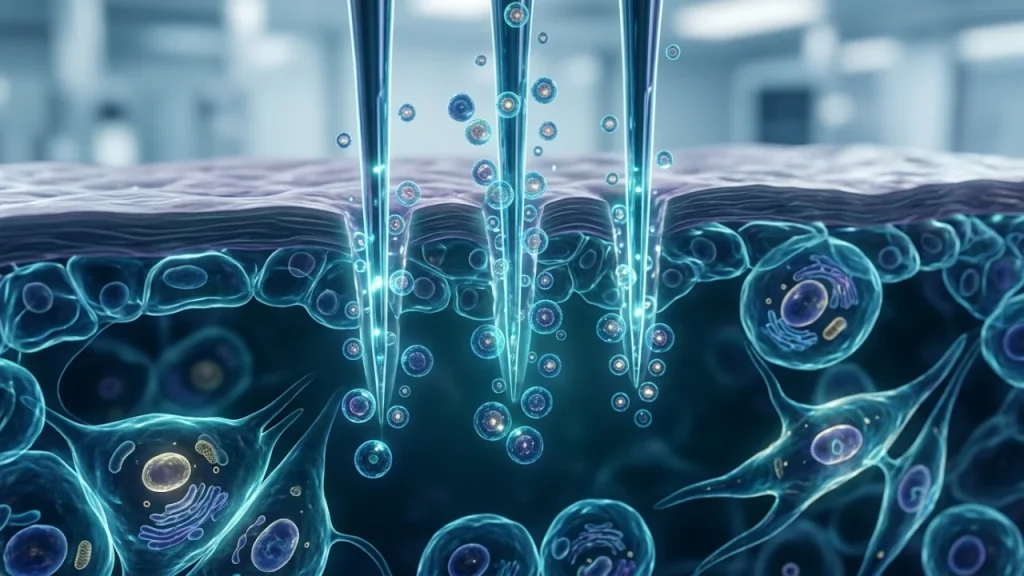
What Are Exosomes and Why Do They Matter for Your Skin?
Understanding Tiny Cellular Messengers
Your body’s cells are constantly talking to each other. They do not use words. They use tiny biological packages called exosomes. Think of them as microscopic mail trucks. Each exosome carries a precious cargo of instructions from one cell to another.
A cell creates an exosome inside itself. It packs the vesicle with proteins, lipids, and genetic material like RNA. This cargo is the message. The cell then releases the exosome into the space around it. The exosome travels until it finds another cell. It delivers its instructions directly to that cell.
This process is natural and happens all the time. Healthy cells use it to coordinate repair. They signal for new collagen or to calm inflammation. Damaged or stressed cells also send exosomes. Their messages can be different. The receiving cell changes its behavior based on the instructions it gets.
Exosomes are incredibly small. Thousands could fit across the width of a single human hair. Their power comes from their precision. They are not general signals. They are targeted deliveries with specific commands.
Why does this matter for your skin? Your skin is made of billions of cells. They need clear communication to stay healthy and young. As we age, this communication slows down. Cells send fewer helpful messages. The signals can become confused.
This is where the science of exosomes for microneedling becomes exciting. Researchers can collect beneficial exosomes from healthy cells. These exosomes carry youthful, regenerative instructions. The goal is to deliver these instructions directly to aging skin cells.
The core idea is to boost your skin’s natural language. It is about providing clearer commands for repair and renewal. This is a shift from just damaging skin to stimulate healing. It is about giving cells the exact information they need to heal themselves better.
In short, exosomes are your body’s own communication network. They are the fundamental system for cellular instructions. Harnessing this system offers a new path for skin therapy. The next step is understanding how microneedling opens the door for these messengers.
How Exosomes Differ from Stem Cells
Stem cells are the body’s master builders. They can divide and turn into different cell types. For example, a stem cell could become a skin cell or a collagen-producing fibroblast. Their job is to add new material and structure.
Exosomes are different. Think of them as messengers or instruction packages. They do not divide or turn into new skin cells. They carry signals that tell your existing cells how to behave.
This is a crucial difference for treatments. Stem cell therapies use living cells. These cells must stay alive and work correctly in your body. This can be complex and carries certain risks. The cells might react in unexpected ways.
Exosome therapies use the signals, not the cells. Scientists collect the exosomes that healthy cells release naturally. They remove the original cells. What remains is a concentrated dose of pure biological instructions.
This approach has clear benefits for skin care: – No risk of unwanted cell growth. The exosomes cannot multiply or form tumors. – Precise targeting. The messages go directly to mature skin cells. – Lower chance of immune reaction. Exosomes are natural carriers that your body recognizes.
The process for exosomes for microneedling uses this principle. We are not implanting foreign stem cells into your skin. Instead, we apply a solution filled with billions of these signal-carrying vesicles.
Your own cells then receive these precise commands. A fibroblast might get an order to make more collagen. An inflamed cell might get a signal to calm down. The cells follow these new instructions because they speak the same biological language.
Research shows this signal-based method is powerful. Studies on skin healing often measure collagen and elastin levels. Treatments using exosome signals show strong improvements in these key proteins. The skin repairs itself with better guidance.
Safety is a major reason for this shift. Regulators view non-living biological products differently than live cell therapies. The exosome approach focuses on communication. It aims to reboot your skin’s own repair systems without adding new cellular actors.
In essence, stem cells are like contractors who bring new bricks to rebuild a house. Exosomes are like the architect’s detailed plans delivered to the current crew. The plans tell the existing crew exactly what to do and how to do it better.
This makes exosome technology a next-step innovation. It captures the regenerative power of cell biology in a more controlled way. The focus moves from adding new workers to optimizing the ones you already have. Your skin’s cells become more efficient with the right information.
This precise signaling is why exosomes matter for your skin’s health and appearance. They offer a targeted strategy for renewal. The next logical question is how microneedling creates the perfect delivery route for these intelligent messengers.
The Body’s Built-In Repair System
Your skin is a dynamic organ that constantly repairs itself. Tiny cuts, sun exposure, and daily stress cause minor damage. Your body has a built-in system to fix this. Exosomes are central messengers in this system.
Cells create and release exosomes every day. Think of them as tiny biological text messages. They carry specific instructions from one cell to another. A damaged skin cell can send an exosome signal for help. A healthy neighboring cell receives the message and responds.
This communication directs key repair processes. It tells your skin to produce more structural proteins. Collagen gives skin its firmness. Elastin allows it to snap back. The signals also manage inflammation. They can calm an overactive immune response that slows healing.
The natural repair system slows with age and damage. Older cells send fewer clear messages. The communication network gets noisy. Skin loses its ability to fix itself efficiently. This leads to thin skin, wrinkles, and slow healing.
Exosome therapy aims to boost this native system. It adds a high volume of clear instructions. This is not introducing foreign material. It is amplifying your skin’s own language.
The logic for using exosomes for microneedling builds on this principle. Microneedling creates controlled micro-injuries. This triggers the skin’s natural repair mode. Cells are alert and ready for signals. Introducing exosomes at this moment provides optimal guidance. The skin follows these precise commands to rebuild better tissue.
Key signals within exosomes include: – Growth factors that stimulate cell growth. – Proteins that code for new collagen. – RNA molecules that reprogram cell behavior. – Anti-inflammatory messages to reduce redness.
This process is fundamentally different from simply adding filler or surface-level treatments. It works at a cellular command level. The goal is to restore the skin’s intrinsic ability to maintain itself. This leads to results that develop naturally over time.
The body recognizes and uses these exosomes efficiently. They are not seen as invaders. This makes the biological approach highly compatible. Your skin uses the delivered information to upgrade its own functions.
Ultimately, healthy skin depends on clear cellular communication. Exosomes are the vocabulary of this conversation. Supporting this system addresses the root cause of aging skin. It moves beyond temporary fixes toward genuine renewal.
The next step is understanding how modern science harnesses these natural messengers for clinical use.
Microneedling Basics: More Than Just Tiny Pokes
How Microneedling Creates Micro-Channels
Microneedling uses fine, sterile needles to create hundreds of tiny openings in the skin. These are not deep wounds. They are precisely controlled micro-injuries. Think of them as microscopic vertical channels. They penetrate the top layer of skin, the epidermis. Their main target is the dermis beneath.
The dermis is the skin’s living, functional layer. It houses collagen, elastin, and blood vessels. Most topical skincare products cannot reach this depth. Their molecules are too large. The skin’s outer barrier, the stratum corneum, blocks them. This barrier is excellent at keeping things out. Unfortunately, it also keeps beneficial ingredients from getting in deeply.
Microneedling temporarily bypasses this barrier. Each micro-channel is a direct pathway. It allows substances to enter the dermis effectively. This process is often called transdermal delivery. The channels are so small they close quickly. They typically seal within minutes. This minimizes any risk of infection.
The creation of these channels serves a dual purpose. First, it enables better product absorption. Second, the micro-injuries themselves trigger a natural wound-healing cascade. The body detects the tiny punctures. It sends repair signals to the area immediately. Blood flow increases. Cells become active and receptive.
This receptive state is critical for advanced treatments like exosomes for microneedling. The micro-channels do more than just physically allow passage. They create a biological opportunity. The skin is already signaling for repair instructions. Delivering targeted messengers at this exact moment is perfectly timed.
The procedure’s depth can be adjusted. Shallow depths focus on product delivery. Deeper settings emphasize collagen induction therapy. This is the process of stimulating new collagen production through injury. Most cosmetic treatments use depths between 0.2 and 1.5 millimeters. A practitioner selects the depth based on skin concern and area.
After microneedling, the micro-channels remain open for a short window. This is the optimal time to apply topical serums or solutions. The ingredients can travel down the channels directly into the dermis. Their effectiveness is multiplied compared to standard application. This principle transforms how skin receives active compounds.
Therefore, microneedling is fundamentally a delivery enhancement technology. Its value lies in creating temporary access points. These points allow for direct communication with the skin’s living layers. This sets the perfect stage for introducing sophisticated biological signals that guide healing and regeneration from within.
Traditional Microneedling Limits
Traditional microneedling works by creating controlled micro-injuries. This process triggers the body’s standard wound-healing response. The skin repairs itself by producing new collagen and elastin. This is a generalized repair program. It is not a targeted treatment for specific concerns like hyperpigmentation or inflammation.
The results depend almost entirely on this mechanical stimulus. The skin’s response can be inconsistent. Factors like age, genetics, and overall health affect the outcome. Two people may get different results from the same procedure. The regeneration signal is broad, not precise.
The approach has clear ceilings. The skin can only produce so much collagen from injury alone. Repeated treatments hit a point of diminishing returns. You might see less improvement after several sessions. The skin becomes accustomed to the stimulus.
Furthermore, traditional methods offer little direct instruction to the skin. They rely on the body’s innate, one-size-fits-all healing cascade. This cascade is not designed for cosmetic perfection. It is designed for basic wound closure. Key limitations include:
- Inefficiency: A large portion of the healing energy goes to general inflammation.
- Lack of Direction: The signal says “repair,” but not “repair with brighter, even-toned skin.”
- Missed Timing: The open micro-channels are often used only for simple serums with large molecules that cannot communicate complex commands.
This creates a gap between the tool’s potential and its traditional use. Microneedling creates a powerful delivery network. Yet, historically, we sent only basic cargo through it. Think of it like building a high-speed fiber-optic internet line but using it only to send text messages.
The core limitation is biological communication. The needles create an opportunity for dialogue with the skin’s deeper layers. Traditional practice ends the conversation after saying “hello.” It prompts the skin to act but does not tell it how to optimize the action for aesthetic goals.
This is where the field is evolving. The next step is to use that perfect delivery system for intelligent messengers. These messengers can provide specific instructions during the critical healing window. This moves therapy from simple stimulation to guided regeneration. The logical advance is to pair the channels with sophisticated biological signals, creating a true targeted treatment. This leads directly to exploring advanced agents like exosomes for microneedling.
Why Skin Needs More Than Collagen Induction
Collagen is a crucial building block for firm, youthful skin. Microneedling effectively tells your skin to make more of it. This process is called collagen induction. But collagen alone is not a complete solution. Think of it like rebuilding a house after a storm. Collagen provides the new bricks and lumber. Yet you also need skilled architects and precise blueprints. Your skin needs those too.
The wound response from needles is a general repair program. It focuses on fast structural repair. This often overlooks other vital aspects of skin health. For example, it may not adequately address pigment cells or elastin fibers. Elastin gives skin its snap-back quality. A basic repair job might not prioritize it. The result can be thicker skin that still shows lines or uneven tone.
Skin aging and damage involve multiple layers and cell types. Each has a different job. The epidermis provides the barrier. The dermis gives support and nourishment. Fibroblasts make collagen. Melanocytes control pigment. A blunt signal to “repair” does not coordinate all these players. It is like a conductor telling an orchestra to just play louder. Harmony is lost without specific instructions for each section.
Modern aesthetic goals require precision. People seek even tone, refined texture, and lasting resilience. Achieving this demands more than just adding structural protein. It requires guiding how that protein is organized. It needs signals to calm overactive pigment cells. It benefits from cues to improve local blood flow and nutrient delivery.
This is the core reason skin needs more than collagen induction. The mechanical micro-injuries create an opening. They set the stage. But the healing script that follows is too generic. To elevate results, we must provide smarter biological information during this critical window. The skin is listening and ready to act. We must give it a better, more detailed plan to follow.
This leads directly to the promise of using advanced biological agents like exosomes for microneedling. These agents can carry the precise instructions that generic wound healing lacks. They can communicate directly with different skin cells. This transforms the process from simple construction to intelligent redesign. The next step is understanding what these messengers are and how they work within the microneedling framework.
The Science Behind Exosomes for Microneedling
How Exosomes Enter Skin Through Micro-Channels
Microneedling creates temporary pathways into the skin. These are not just holes. They are precise micro-channels. Each channel is a direct route past the tough outer barrier. This barrier normally blocks large molecules and particles. The channels allow passage to the living layers beneath.
Exosomes are perfectly sized for this journey. They are tiny biological vesicles. Think of them as natural nanoparticles. Their size ranges from 30 to 150 nanometers. A nanometer is one-billionth of a meter. This is thousands of times smaller than the width of a human hair. Their small scale is key.
The micro-channels from needles are about as wide as a few human hairs. For exosomes, this is a wide highway. They can flow easily into these openings. They travel with the applied serum or solution. This delivery is direct and efficient.
The process has clear steps. – First, microneedles create vertical channels. – Next, a solution containing exosomes is applied to the skin’s surface. – Then, capillary action and diffusion pull the exosomes downward. – Finally, they reach the dermis within minutes.
This targeted delivery is vital. It places exosomes exactly where they are needed. They arrive in the dermal layer. Here, fibroblasts and other cells reside. These cells are responsible for making collagen and healing.
Exosomes do not force their way into cells. They use natural communication methods. Their outer membrane can fuse with a target cell’s membrane. This releases the exosome’s cargo inside the cell. Alternatively, the whole vesicle can be swallowed by the cell. This process is called endocytosis.
Once inside, the exosome’s payload goes to work. This payload includes signaling proteins, growth factors, and RNA instructions. These molecules talk to the cell’s nucleus. They provide new directions. The cell then changes its behavior based on these precise commands.
This method is far superior to topical creams alone. Most cream ingredients cannot penetrate deeply. They sit on the surface. The micro-channels solve this problem for exosomes. They ensure a high percentage of the applied messengers reach the active site.
Using exosomes for microneedling leverages this efficient delivery system. The needles open the door. The exosomes walk through it. They then begin their sophisticated work of cell instruction. This turns a simple physical procedure into a targeted biological therapy. The next question is what specific commands these exosomes carry for skin renewal.
Targeted Delivery to Skin Cells
Exosomes are not random messengers. They carry molecular addresses. These addresses guide them to specific cell types. This targeting is key for repair. Think of a skin cell needing help. It sends out signals or displays markers. Exosomes can recognize these signals.
The outer surface of an exosome holds proteins and receptors. These act like keys. They look for matching locks on target cells. A fibroblast making collagen has different locks than an immune cell. Exosomes for skin renewal often carry keys for fibroblast locks. This ensures they bind to the right place.
Targeting happens in two main steps. First, exosomes move through the fluid between cells. This is called the extracellular matrix. Second, they find and attach to their target cell. The binding is selective. It is not random contact.
Once bound, the exosome transfers its information. This process is efficient. It means little signal is wasted. The cargo goes directly into cells that can use it. This direct delivery is a major advantage of using exosomes for microneedling. The procedure places them in the right neighborhood. Their own intelligence does the rest.
Different skin concerns need different cell targets. For collagen loss, fibroblasts are the main target. For reducing inflammation, immune cells like macrophages are targeted. For healing wounds, keratinocytes and endothelial cells get the messages. Exosome populations can be rich in signals for one job over another.
This targeting explains the precision of regenerative results. The exosomes tell tired cells to become active again. They instruct inflamed cells to calm down. They guide repair cells to build new, healthy tissue. The commands are direct and specific.
The entire system relies on natural biological communication. We are not inventing a new language. We are amplifying the body’s own precise dialect. Microneedling simply delivers more of these skilled messengers to the scene. They then follow their innate programming.
The outcome is focused cellular change. This leads to clearer, stronger, and younger-looking skin. The next logical step is to explore what these powerful commands actually are and how they renew the skin’s structure from within.
Synergy Between Needles and Biological Signals
Microneedling creates temporary micro-channels in the skin. These are not just wounds. They are precise access routes. The channels bypass the skin’s tough outer barrier. This barrier normally blocks large molecules. Exosomes are tiny, but they still benefit from this direct path.
The synergy is physical first. The micro-channels act like express highways. They allow applied exosome solutions to reach deeper living layers. This is where target cells reside. Without these channels, most of the solution would sit on the surface. It would not reach the dermis effectively.
The biological synergy begins immediately. The mild injury from microneedling triggers a natural healing response. Cells release signaling chemicals. Blood flow increases slightly. This creates a busy, alert cellular environment. Introduced exosomes join this native activity. They do not work alone.
Think of microneedling as opening a city’s gates. The exosomes are skilled messengers entering at that moment. The city is already preparing for action. The messengers can start their work right away. They integrate into the existing process seamlessly.
The combination enhances signal efficiency in key ways. – The channels prevent exosome waste on the surface. – The healing environment makes target cells more receptive. – The direct placement reduces the distance signals must travel.
This teamwork is crucial for exosomes for microneedling. The procedure is no longer just about creating collagen pathways. It becomes a timed delivery system for intelligent commands. The needles create the opportunity. The exosomes execute the complex instructions.
Timing matters greatly. Exosomes are applied during a short window after needling. The micro-channels are still open. The skin’s repair signals are freshly activated. Applying exosomes at this peak moment maximizes their uptake. Cells eagerly absorb the new instructions.
The result is a coordinated two-phase action. Phase one is mechanical access. Phase two is biological communication. One enables the other. This turns a simple tool into a sophisticated regenerative platform. The skin receives a clear, unified directive to repair and renew.
This synergy explains improved clinical outcomes. Effects are often seen faster. Results can last longer. The skin’s response is more organized because the signals arrive at the right place and time. The next question explores the specific regenerative commands within the exosomes themselves.
Key Benefits of Combining Exosomes with Microneedling
Enhanced Collagen Production for Firm Skin
Collagen is the main structural protein that keeps skin firm and smooth. Our skin cells make less of it as we age. This leads to wrinkles and sagging. Microneedling alone prompts the skin to repair itself. This repair includes some new collagen. But it is a general injury response. The addition of exosomes for microneedling changes this process fundamentally. Exosomes carry precise orders to boost collagen production directly.
Think of a fibroblast. This is the skin cell that manufactures collagen. An exosome can fuse with this cell. It delivers its cargo of signaling molecules and genetic instructions. These molecules act like a targeted memo. They tell the fibroblast to become more active. The cell shifts into a higher production mode. It starts reading the genetic blueprints for building collagen more efficiently.
The commands inside exosomes are very specific. They do not just tell cells to “work harder.” They upregulate the exact pathways for making Type I and Type III collagen. These are the most important types for youthful skin structure. The signals can also downregulate enzymes that break collagen down. This dual action is key. It increases new building while slowing existing loss.
The process mirrors the body’s own natural signaling but amplifies it. Benefits from this targeted approach are clear. – Collagen synthesis becomes a prioritized cellular task. – New collagen fibers are organized in a healthy, lattice-like pattern. – Results appear more natural than with filler injections.
This is not about adding foreign material. It is about instructing your own biology to rebuild its own support network. The micro-channels from needling get the exosomes to the right cells. The exosomes then provide the detailed blueprint. The outcome is skin that regains its own intrinsic firmness. The improvement comes from within.
Clinical observations support this mechanism. Patients often see better skin texture and elasticity. These are direct signs of quality collagen remodeling. The effect builds over weeks as cells execute their new instructions. This sustained production differs from a one-time plumping effect. It leads to longer-lasting results because the skin’s own machinery is recalibrated.
The focus on collagen is just one example of exosome-directed healing. The same delivery system can carry other vital commands. These instructions can address pigmentation, inflammation, and overall cellular energy. The principle remains powerful. You give skin the tools and the exact plans to rebuild itself properly. This turns microneedling from a simple stimulus into a comprehensive regenerative treatment.
Reduced Inflammation and Calmer Skin
Microneedling creates tiny, controlled injuries. This is necessary to start the healing process. But it also triggers inflammation. Inflammation includes redness, swelling, and heat. This is the body’s normal first response. For some people, this reaction is strong or lasts too long. It can delay results and cause discomfort.
Exosomes change this equation. They carry specific instructions to immune cells. These instructions help calm the overactive response. Think of exosomes as diplomatic messengers. They tell the inflammatory cells their job is done. They encourage the next phase of clean, orderly repair.
The science behind this is precise. Exosomes deliver molecules called cytokines and microRNAs. These are natural signaling compounds. They do not block inflammation completely. That would be harmful. Instead, they guide it toward a balanced state. This process is called immunomodulation.
The benefits for your skin are direct and visible. – Post-procedure redness fades faster. Skin returns to its normal color more quickly. – Swelling and tenderness are reduced. This means less downtime after treatment. – The risk of post-inflammatory hyperpigmentation drops. This is when dark spots form after skin trauma.
Using exosomes for microneedling tackles inflammation at its source. The micro-channels deliver these messengers deep into the skin. They reach the fibroblasts and immune cells working at the site. The exosomes provide a blueprint for efficient healing. This shifts the process away from reactive swelling and toward smart regeneration.
Patients often notice their skin feels calmer sooner. It looks less irritated. This is not just about comfort. It is about biology. Excessive inflammation can break down collagen and elastin. By managing inflammation, exosomes protect the new matrix they are trying to build. The two benefits work together.
Reduced inflammation also supports better long-term outcomes. Skin that heals calmly is less likely to scar or develop uneven texture. The regenerative signals face less interference. Cells can focus on rebuilding rather than just reacting.
This controlled environment is ideal for addressing conditions like rosacea or general sensitivity. The treatment does not just add temporary masking agents. It teaches the skin’s own immune system to behave in a more balanced way. The result is a stronger, more resilient complexion.
The combination offers a dual advantage. Microneedling opens the delivery route. Exosomes provide the intelligent commands for repair and calm. This moves skin recovery from a blunt trauma response to a guided therapeutic process. The next logical step is seeing how this precise delivery enhances other vital functions, like brightening and evening skin tone.
Faster Healing and Less Downtime
Microneedling creates controlled micro-injuries. This triggers the skin’s natural repair cycle. That process normally takes time. Cells must communicate to coordinate healing. Exosomes for microneedling enhance this communication dramatically. They deliver pre-packaged instructions directly to skin cells.
Think of a construction site after a storm. Normally, workers must wait for blueprints and orders. This causes delays. Exosomes act like instant work orders delivered to every crew. They tell fibroblasts to produce collagen quickly. They signal keratinocytes to regenerate the outer layer. They guide blood vessels to reform. This organized effort cuts recovery time.
Patients typically see a difference in their downtime. Standard microneedling may involve several days of redness. Skin can feel sensitive and look flushed. Adding exosomes changes this timeline. Many people notice significant redness fading within 24 to 48 hours. The skin’s surface calms faster. The tight, warm feeling after treatment diminishes more rapidly.
The biological reason is direct signaling. Exosomes carry specific molecules like growth factors and microRNAs. These are not general stimulants. They are precise commands. – One command might be: “Start collagen production now.” – Another could be: “Reduce oxidative stress in this cell.” – A third may signal: “Begin the migration phase for wound closure.”
These commands arrive immediately through the micro-channels. The skin does not waste energy figuring out what to do first. The repair pathway is already mapped out. This efficiency translates to less visible trauma.
Faster healing also means the skin barrier repairs itself sooner. A strong barrier protects against moisture loss and environmental irritants. Patients can often resume their normal skincare routine earlier. They experience less peeling or dryness post-treatment. The goal is not just speed, but also quality of healing.
The result is a practical advantage for daily life. Less downtime means fewer days hiding redness. It means quicker return to social and professional activities. The treatment feels more convenient and less disruptive. This benefit makes advanced skin regeneration accessible for busy people.
Ultimately, exosomes turn microneedling into a smarter procedure. The device opens the door. The exosomes guide the repair crew inside to work swiftly and effectively. This synergy leads to a smoother recovery experience from start to finish. The next benefit builds on this efficient foundation, focusing on how this targeted delivery can remodel aging structural support in the skin.
How Exosomes Improve Specific Skin Concerns
Smoothing Fine Lines and Wrinkles
Fine lines often start with a slowdown in your skin’s own collagen factory. This is where exosomes for microneedling show their strategic value. They deliver direct instructions to the aged cells in the dermis. These instructions tell fibroblasts to become active again.
Fibroblasts are the skin cells that make structural proteins. They produce collagen and elastin. Think of collagen as sturdy support beams. Elastin acts like a spring. Together they create a firm and bouncy skin layer. As we age, fibroblast activity drops. The support network weakens and thins. This thinning allows the surface to crease.
Exosomes carry specific blueprints for protein creation. They do not just vaguely stimulate cells. They provide the exact code needed. Microneedling creates temporary channels. These channels allow exosomes to bypass the surface. They reach the deeper dermal layer where fibroblasts live.
The result is a targeted production boost. Fibroblasts get a clear signal to resume work. They start building new collagen and elastin fibers. This is not a surface plumping effect from a filler. It is a gradual reconstruction from within.
The process follows a logical sequence: – First, exosomes signal for new collagen production. – Next, fresh collagen strands integrate into the existing network. – Then, this reinforced structure provides better support for the skin above it. – Finally, the overlying skin smooths out as it gains a stronger foundation.
This internal remodeling takes time. Results are not instant. The skin needs weeks to build these new proteins. The improvement develops gradually. The final effect is more natural than a sudden surface change.
Increased hydration also plays a key role. Exosomes can instruct cells to produce more hyaluronic acid. This substance holds vast amounts of water. It acts like a natural sponge within the skin. Better hydration plumps up skin cells from the inside. This further helps to smooth fine lines.
The combined action is powerful. Structural support improves through new proteins. Cellular hydration increases simultaneously. This two-part approach addresses the root causes of aging skin. The focus shifts from temporary masking to genuine cellular renewal.
This foundational repair sets the stage for tackling more stubborn wrinkles. It also improves overall skin texture and resilience. The next concern involves loss of firmness and sagging contours.
Improving Skin Texture and Tone
Skin texture and tone depend on two main processes. One is the even production of pigment. The other is the smooth shedding of old skin cells. Exosomes help regulate both. They send specific instructions to different cell types. This creates a more uniform and radiant complexion.
Consider skin discoloration like sun spots. These spots form when melanocytes produce too much pigment. This pigment is called melanin. Exosomes can communicate with these pigment-making cells. They can signal them to normalize their activity. The goal is a more balanced melanin output. This reduces the intensity of dark spots over time.
The process is gradual. It does not bleach or remove skin. Instead, it encourages cells to function normally again. This leads to a natural evening of the skin tone. Results appear slowly over several weeks.
Rough or bumpy texture often has a different cause. It usually involves the outer skin layer, the epidermis. Skin cells here should shed evenly. Sometimes this process becomes uneven or slow. Dead cells can build up on the surface. This makes skin feel rough and look dull.
Exosomes for microneedling address this directly. The microneedles create temporary channels. Exosomes enter through these channels. They reach the living cells below the surface. Here, they can influence keratinocytes. These are the primary cells of the epidermis.
The signals promote healthy cell turnover. They encourage the proper maturation and shedding of skin cells. This results in a smoother surface texture. The skin’s natural reflective quality improves. It looks brighter and feels softer to the touch.
The combined effect on tone and texture is significant. – Pigment-producing cells receive signals to calm overactivity. – Surface skin cells get instructions for orderly renewal. – The underlying structure is already being strengthened from previous steps.
This multi-layer approach is key. Improving collagen helps with large pores and scars. Better cell turnover refines fine lines and flakes. Regulating pigment lightens dark areas. All these actions work together.
Think of it as a coordinated renovation project. First, you repair the foundation and walls. That was the collagen work. Next, you smooth and repaint the surface. That is the texture and tone improvement. Each step requires precise instructions.
The use of exosomes for microneedling provides these instructions. The treatment delivers the messages exactly where they are needed. This targeted approach minimizes irritation. It focuses on correcting the root causes of uneven skin.
Patients often notice the change in texture first. Skin begins to feel consistently smoother within a few weeks. The improvement in tone, like faded spots, follows later. This sequence makes biological sense. Regulating complex pigment production takes more time than speeding up cell renewal.
Ultimately, skin achieves a more harmonious appearance. Its color looks more even. Its surface reflects light uniformly. This sets the stage for addressing a final concern: loss of facial firmness and contour.
Boosting Overall Skin Vitality
Healthy skin requires constant communication. Cells must coordinate their activities every day. Exosomes act as the body’s natural messaging system for this task. Using exosomes for microneedling restores this vital dialogue. It goes beyond fixing single problems. This approach boosts the skin’s overall vitality.
Think of your skin cells as a busy community. Young cells work efficiently. They produce energy, repair damage, and follow clear instructions. As cells age or face stress, this efficiency drops. Communication breaks down. Cells become less responsive. The entire community slows its work.
Exosomes deliver a powerful set of instructions to reverse this slowdown. They carry specific codes and tools. These tools help cells perform their basic jobs better. The result is not just the repair of one issue. It is a widespread renewal of function.
One key action is boosting cellular energy. Mitochondria are tiny power plants inside cells. They can become sluggish. Exosome signals help recharge these mitochondria. Cells with more energy can perform their duties more effectively. They can synthesize proteins better. They can also clean up internal waste more efficiently.
This leads to a visible glow. Well-fueled cells function optimally. Skin looks more radiant from within. This luminosity is different from surface hydration or shine. It comes from improved underlying cell activity.
Another vital function is enhancing cell turnover. This is the natural process of shedding old cells. Fresh new cells rise to the surface. This cycle slows with age. Exosomes help reset its pace.
- Older surface cells shed in a more orderly way.
- Newer, healthier cells take their place faster.
- The skin’s natural renewal engine runs smoothly again.
Faster turnover means skin looks fresher. It also helps skin respond better to environmental challenges. A robust cell layer is more resilient.
Exosomes also support the skin’s own defense and repair systems. They can modulate inflammation. This helps create a calmer internal environment. Cells are not distracted by false alarms. They can focus on regeneration and daily maintenance.
The combined effect is comprehensive revitalization. Skin behaves like a younger version of itself. It maintains its balance with greater ease. Resilience against daily stress improves. The healthy glow becomes a consistent feature.
This foundational boost makes all other improvements more sustainable. It is the difference between a temporary fix and long-term change. Skin vitality is the bedrock of lasting beauty. The next logical step is understanding how this renewed vitality translates into a firmer, more lifted facial appearance over time.
The Treatment Process: What to Expect
Step-by-Step Microneedling with Exosomes
The procedure begins with a consultation and skin preparation. Your provider will cleanse your skin thoroughly. This removes surface oils and debris. A topical numbing cream is then applied. You will wait for about 20 to 30 minutes. This ensures your comfort during the microneedling itself.
Next comes the microneedling step. A sterile device with fine needles creates micro-channels. These channels are incredibly tiny. They are not deep wounds. Think of them as superhighways into the skin’s upper layers. They bypass the tough outer barrier. This allows for direct delivery of active ingredients. The process causes minimal discomfort. Most patients describe a mild vibrating sensation.
The exosome solution is then applied. This is the key moment. The liquid containing billions of exosomes is spread across the treated area. The micro-channels act as direct entry points. The exosomes for microneedling enter the skin efficiently. They do not need to struggle past the surface. They are delivered precisely where they are needed most.
The exosomes begin their work immediately upon entry. They communicate with your skin cells right away. This communication instructs cells to repair and regenerate. The micro-injuries from the needles also send a natural signal. This signal tells your body to heal. The exosomes amplify and guide this natural response.
After the application, there is a brief period of absorption. The provider may let the solution sit for a few minutes. Some clinics use a gentle massaging technique. This helps ensure even distribution. No bandages or dressings are typically required.
Post-treatment care is simple but important. Your skin will appear pink or flushed. This is normal and temporary. It resembles a mild sunburn. The redness usually fades within 24 to 48 hours. – Use only gentle, recommended cleansers. – Apply a provided moisturizer or healing ointment. – Strictly avoid sun exposure and wear sunscreen. – Do not use active skincare products for a few days.
You can resume most normal activities immediately. Makeup can often be applied the next day. The entire process, from numbing to finish, often takes under an hour. It is a focused and efficient treatment.
The real changes happen beneath the surface in the following weeks. Your newly instructed cells start their regenerative tasks. Collagen production increases steadily. Cellular turnover gets faster. This process builds over time. Visible results develop gradually and naturally.
This seamless procedure combines physical and biological methods. It turns a simple tool into a smart delivery system. Understanding this process shows why the treatment’s effects are so profound and lasting. The next consideration is how to ensure these results are safe and consistent for every patient.
Immediate Aftercare and Sensations
Your skin will feel warm and tight immediately after the procedure. This sensation is common and expected. It is a direct sign of the treatment’s initial effect. The micro-channels are still open. Your body’s inflammatory response is beginning. This is a controlled and necessary part of the process.
The feeling resembles a moderate sunburn. This warmth and tightness typically peak within the first few hours. It then gradually subsides. You may experience a slight tingling sensation. This is often described as a mild pins-and-needles feeling. It indicates increased blood flow and cellular activity in the treated area. These sensations confirm the process is working.
Mild swelling or puffiness is also normal. It is usually most noticeable around the cheeks and eyes. This edema is your skin’s reaction to the micro-injuries. It is also a response to the new signaling molecules now present. The swelling helps create a protected environment for early healing. It generally decreases significantly after the first night.
Some tenderness to the touch is common for about 24 to 48 hours. Your skin may feel more sensitive than usual. This sensitivity is temporary. It occurs because your skin’s barrier function is temporarily altered. The channels created by the needles allow deep absorption. This includes the critical delivery of exosomes for microneedling. The sensitivity is a side effect of this efficient delivery method.
You might notice a sandpaper-like texture on day two or three. This is not dryness in the traditional sense. It is actually the formation of tiny micro-crusts at each channel site. Do not pick or scrub at this texture. These microscopic scabs are part of the skin’s natural sealing process. They will flake away naturally within a few days.
Itching can occur as healing progresses. This usually starts around day three or four. Mild itching is a positive sign. It signals that new skin cells are forming and collagen is remodeling. Resist the urge to scratch. Scratching can disrupt the delicate new cells and lead to scarring. A recommended moisturizer will help soothe this itch.
All these sensations are confined to the treated skin layers. You should not feel systemic effects like fatigue or fever. The process remains local and focused. If you experience unusual pain, spreading redness, or signs of infection, contact your provider immediately. These are not standard reactions.
The intensity of these feelings can vary per person. Your individual skin sensitivity plays a role. The depth of needle penetration used also affects it. Generally, sensations are milder than with traditional aggressive microneedling. The exosomes help modulate the inflammatory response. They guide it toward regeneration rather than prolonged irritation.
Managing these sensations is straightforward. Use cool compresses for the first few hours if needed. Apply the provided healing ointment as directed. This ointment soothes and protects. Stay well-hydrated by drinking water. Avoid strenuous exercise and heat for 48 hours. Heat can increase swelling and discomfort.
This phase lasts only a short time. The initial warmth and tightness fade quickly. The subsequent textures and itching are transient. These temporary feelings mark the start of a longer renewal cycle. Your skin is now actively receiving and responding to new biological instructions beneath the surface.
Timeline for Visible Results
Visible changes after your session follow a clear, biological schedule. This timeline depends on your skin’s natural renewal cycle. Exosomes for microneedling work within this existing framework. They simply make the process more efficient and targeted.
The first week is primarily a preparatory phase. You may notice initial redness has faded. Your skin might feel smoother or look brighter. This is not the final result. It is often called “glowing” skin. This glow comes from increased hydration and surface cell turnover. The deeper regenerative work is just beginning.
True structural changes start beneath the surface. This happens in the dermis. The exosomes have delivered their instructions to your skin cells. These instructions tell fibroblasts to produce new collagen and elastin. Building this fresh support structure takes time. You cannot rush this biological construction.
Most people see the first tangible results around week three or four. Skin texture often improves first. You may notice fewer fine lines. Pores can appear smaller. Your skin’s firmness might increase. These are signs that new collagen is forming. The process is gaining momentum.
The most significant improvements typically appear between months two and three. Collagen production reaches a peak during this period. You will likely see improved skin tightness. Deeper wrinkles may soften. Scarring can look less noticeable. Skin tone often becomes more even. This is the core regenerative phase in action.
Full results are usually visible by month four to six. Your skin completes several renewal cycles in this time. The new collagen matures and organizes itself. This provides lasting support. The effects are not a temporary plumping. They represent genuine structural reinforcement.
Several factors influence your personal timeline. Your age and skin condition are important. Older skin may rebuild a bit slower. Your overall health and lifestyle also matter. Consistent sun protection is critical. Smoking can slow healing significantly. A nutrient-rich diet supports cellular repair.
This staged progress is intentional and logical. – Week 1-2: Surface recovery and early signaling. – Month 1: Initial textural and tonal improvements. – Months 2-3: Peak collagen production and visible structural change. – Months 4-6: Collagen maturation and final, stabilized results.
Patience is key. The goal is lasting rejuvenation, not instant swelling. The procedure plants a biological seed. The exosomes provide the precise growth instructions. Your body then does the work on its own natural schedule. This leads to results that look authentic and feel integral to your skin.
Understanding this timeline sets realistic expectations. It allows you to appreciate each phase of improvement. The next consideration is how to maintain and extend these results over the long term.
Safety and Considerations for Exosome Therapy
Natural Origin and Biocompatibility
Exosomes are not synthetic or manufactured chemicals. They are natural biological particles. Your own cells create and use them every day. Billions of these vesicles travel through your body right now. They carry messages between your cells. This is a fundamental form of cellular communication.
For therapy, exosomes are collected from a controlled source. This is often human stem cells grown in a lab. These stem cells are healthy and carefully screened. They release exosomes into their growth solution. Scientists then purify these exosomes. The goal is to capture these natural messengers.
The key to safety is biocompatibility. This means the substance works well with your body’s own systems. Because exosomes are a native particle, your body recognizes them. They do not trigger a strong immune attack like a foreign invader might. Think of it as receiving a letter in your native language. The instructions are clear and expected.
Their mechanism is also gentle and precise. Exosomes for microneedling do not force cells to act. They do not contain harsh commands. Instead, they deliver supportive signals and resources. These signals encourage your skin’s own repair processes. It is like giving a clear map and supplies to a construction crew already on site.
Consider the difference from some traditional approaches. Some treatments use strong acids or lasers to injure skin. This forces a healing response. Exosome therapy takes a different path. It uses microneedling to create tiny channels. Then it delivers intelligent biological instructions. The approach is more about guidance than force.
The natural origin leads to several practical safety advantages: – Low risk of allergic reaction. The core components are familiar to your immune system. – Reduced inflammation. The signals can actually help calm overactive immune responses in the skin. – No permanent foreign material is implanted. Exosomes are used up by cells or break down naturally.
This does not mean the therapy is without consideration. The source matters greatly. Reputable providers use rigorous testing protocols. They ensure the exosomes are free from contaminants. They verify the potency and purity of the final preparation. This careful handling preserves their natural benefits.
Understanding this biocompatibility helps explain the results timeline from before. Because the process works with your biology, it follows your body’s natural pace. There is no artificial “shock” to the system. The improvement comes from amplified natural regeneration. This foundational safety makes the regenerative promise of exosomes for microneedling a credible and elegant approach to skin renewal. The next logical step is to examine who is an ideal candidate for this synergistic treatment.
Minimal Side Effects and Risks
This section will detail the common, typically mild, side effects and contrast them with the low risk profile, moving from the foundational safety discussed earlier to practical patient experience. It logically follows the prior section’s focus on biocompatibility by showing the real-world manifestation of that safety. The tone will be factual and reassuring, using specific examples of transient reactions.
Most people experience only mild, temporary reactions after a treatment session. These effects are similar to a standard microneedling procedure. They show the initial biological activity is starting. The most common side effect is skin redness. This redness usually looks like a mild sunburn. It typically fades within 24 to 48 hours. Some slight swelling or tenderness in the treated area is also common. This is a normal local response. It resolves quickly on its own.
Minor pinpoint bleeding or bruising can sometimes occur. This happens because microneedles create micro-channels. These channels are essential for delivery. Any bleeding is minimal and stops rapidly. A sensation of warmth or tightness in the skin is also frequently reported. These sensations are temporary. They often subside within the first few hours post-treatment.
The use of exosomes for microneedling aims to minimize further risks. The exosomes themselves are not synthetic chemicals. They are natural signaling vehicles. This greatly lowers the chance of allergic rejection. Your body recognizes their basic structure. Serious adverse events are extremely rare when protocols are followed. Proper technique and sterile conditions prevent most complications.
Potential risks are often linked to the procedure itself, not the biological agent. The main considerations include: – Infection. This risk exists with any procedure that creates micro-openings. It is managed by strict antiseptic technique before and after. – Post-inflammatory hyperpigmentation. This is a temporary darkening of the skin. It is more possible in individuals with darker skin tones. Proper assessment and settings reduce this risk. – Uneven results or lack of effect. Biological responses can vary between individuals. Multiple sessions are often needed for a cumulative effect.
It is crucial to have treatments performed by a trained professional. They will evaluate your skin type and medical history. This screening helps identify any individual factors that need caution. Following aftercare instructions is vital for optimal healing. These instructions protect the treated skin and support the regenerative process.
The overall safety profile is favorable precisely because the therapy works with biology, not against it. Side effects are generally short-lived and manageable. This low-risk characteristic supports the consistent use of this combined approach for gradual, natural-looking renewal. Understanding these typical reactions prepares patients for a realistic recovery experience and sets the stage for discussing ideal candidates who stand to benefit most from this synergy.
Who Should Consider This Treatment
Exosome therapy with microneedling is not a one-size-fits-all solution. It serves specific skin concerns best. The ideal candidate seeks improvement in skin quality and repair, not just a single flaw. This person understands that results build over several sessions.
Who should consider exosomes for microneedling? The treatment excels for certain goals. These include improving skin texture and tone. It also helps reduce the appearance of fine lines. Another target is enhancing overall skin vitality and luminosity. The approach is also powerful for supporting scar remodeling. This includes acne scars or other textured scars.
Good candidates often share common traits. Their primary concern is often overall skin aging or damage. They may have tired-looking skin that lacks radiance. They are typically looking for a natural, refreshed outcome. They do not expect a single treatment to erase deep wrinkles completely. Patience for a gradual process is key.
This combination is particularly strategic for specific scenarios. It is excellent for preventative aging care in younger adults. The therapy can fortify skin before significant damage appears. It is also a powerful next step after procedures like laser treatments. Exosomes can help calm the skin and optimize healing afterward. Another scenario is overcoming a plateau with microneedling alone. Adding exosomes can restart a stalled regenerative response.
Certain skin conditions may benefit greatly. This includes skin dealing with environmental stress and pollution. Dull, dehydrated skin often responds well to the regenerative signals. The treatment can also help uneven pigmentation from sun damage. It works by encouraging healthier, more uniform cell behavior.
The best candidates are in generally good health. Their skin should not have an active infection or rash. They should have realistic expectations about the timeline. Multiple sessions, often three to four, are standard for a full course. Maintenance treatments are typically needed to sustain results over time.
This approach may not be the first choice for everyone. It is less suited for targeting isolated, deep wrinkles without broader texture concerns. Individuals with certain autoimmune conditions may need special evaluation first. A detailed consultation with a provider is essential. This discussion will match your specific goals with the treatment’s proven strengths.
Ultimately, this therapy fits those seeking a biological upgrade to their skin’s function. It is for people who view their skin as a living organ that can be guided toward better health. The synergy targets the root causes of aging, not just the surface signs. This makes it a compelling choice for informed individuals focused on long-term skin vitality and resilience.
Comparing Exosome Microneedling to Other Options
Versus Standard Microneedling Alone
Standard microneedling creates controlled micro-injuries in the skin. This process triggers the body’s natural wound healing response. Your cells get busy repairing the tiny channels. They produce new collagen and elastin over time. This approach relies entirely on your body’s innate ability to respond. The results are good. They improve skin texture and firmness. But the process is a general signal. It simply tells your skin to “repair this damage.”
Adding exosomes for microneedling changes this fundamental mechanism. The needles now do two jobs. First, they create micro-channels. Second, they deliver billions of exosomes directly into the skin’s deeper layers. These exosomes are not drugs or foreign substances. They are natural biological messengers. They carry precise instructions from healthy, young cells.
Think of standard microneedling as rebuilding a road. The process fixes potholes and patches cracks. Exosome-enhanced microneedling is like upgrading the entire construction crew. It gives them better tools and a smarter blueprint. The focus shifts from simple repair to intelligent regeneration.
The differences show in several key areas: – Signal Specificity: Standard needling sends a general “heal” signal. Exosomes deliver targeted commands like “make collagen,” “reduce inflammation,” or “form new blood vessels.” – Cellular Communication: The treatment uses exosomes to directly instruct your skin’s older or tired cells. It guides them to act younger and more efficiently. – Speed of Response: Results often appear faster with exosomes. The regenerative signals start working immediately, not just after the injury response begins. – Depth of Results: Standard microneedling mainly improves surface texture. Exosome therapy aims to improve overall skin health and function at a cellular level.
The recovery process may also differ. Some patients notice reduced redness and swelling after sessions with exosomes. This happens because some exosome signals help calm inflammation. The treatment is not just about creating an injury. It is about managing the healing process intelligently.
Standard microneedling remains a valuable tool. It is excellent for mechanical improvement. The exosome version represents an evolution. It merges physical technique with cellular science. This combination targets the root causes of aging skin more directly. It moves beyond simple collagen induction to true cellular communication.
Ultimately, the choice depends on your goals. Seeking modest texture refinement may only require the standard approach. Seeking comprehensive rejuvenation and healthier skin biology benefits from the enhanced protocol. This biological upgrade is the core added value of combining these advanced technologies. The next logical consideration is how this compares to other popular regenerative treatments available today.
Versus Topical Serums and Creams
Topical serums and creams work on the skin’s surface layers. They face a significant biological barrier. Your skin’s outermost layer, the stratum corneum, is designed to keep things out. This protective barrier blocks most large molecules. Many potent ingredients cannot pass through it to reach living cells. They remain on the surface where their effect is limited.
Exosome microneedling solves this delivery problem directly. The microneedles create temporary micro-channels. These tiny pathways bypass the surface barrier completely. They allow direct access to the dermis. This is the skin’s living, cellular layer. The exosomes are deposited precisely where they are needed most. This method ensures the biological messengers reach their target.
Consider the journey of a growth factor in a premium serum. It is applied to the skin’s surface. Only a tiny fraction may penetrate deeply enough. The majority may degrade or rinse away. Its signal becomes diluted and scattered. In contrast, exosomes for microneedling are placed accurately. They arrive intact and concentrated at the site of action. Their instructions can start immediately.
The difference is like sending a letter versus having a face-to-face meeting. A topical product sends signals that must shout through a closed door. The microneedling procedure opens the door and places the messenger inside the room. Communication is direct and clear.
Here are the core limitations of topical-only approaches: – Barrier Blockade: Molecular size limits deep absorption of key compounds. – Degradation Risk: Active ingredients can break down under light or air before penetrating. – Indirect Action: They often work by conditioning surface cells, not instructing deeper dermal cells. – Slow Progress: Changes rely on gradual diffusion, which is often incomplete.
Exosome therapy with microneedling operates on a different principle. It is not about gradual conditioning from the outside. It is about precise intervention from within. The exosomes deliver their regenerative cargo directly to fibroblasts and other cells. These cells are responsible for producing collagen and elastin. The instructions are specific and cellular.
This does not mean topical products lack value. They are excellent for daily maintenance and surface hydration. They support the skin’s barrier function. However, for driving true cellular renewal, direct delivery is superior. The exosomes for microneedling protocol achieves what creams cannot. It ensures the therapeutic message is not lost in transit.
The result is a more efficient and definitive treatment outcome. Why rely on uncertain absorption when you can guarantee delivery? This fundamental advantage explains why in-office procedures offer different results than home care. The next logical comparison is with other injectable or energy-based treatments that also reach deeper skin layers.
Versus Laser and Energy Treatments
Laser and energy treatments work through a controlled injury. They use heat or light to create microscopic wounds in the skin. This process is called photothermolysis. The body then reacts to repair this damage. This repair cycle stimulates collagen production over time.
The approach is effective but indirect. You are not giving cells new instructions. You are triggering a general wound-healing response. The skin’s reaction is somewhat predictable but not perfectly precise. The results depend heavily on your body’s innate healing capacity.
Exosome therapy with microneedling follows a different path. It does not rely on creating thermal injury. Instead, it uses the microneedles to create temporary channels. These channels allow for the direct placement of exosomes into the dermis. No heat damage is involved.
The exosomes then act as biological messengers. They deliver specific signals to the skin’s cells, like fibroblasts. These signals can instruct cells to increase collagen synthesis, reduce inflammation, or improve tissue repair. The method is about adding information, not just causing injury.
Consider the recovery and downtime involved. Many laser treatments require significant healing. Redness, swelling, and peeling are common. This is due to the intentional thermal damage that must heal. The process can take days or even weeks.
The exosomes for microneedling protocol typically has minimal downtime. Since the microneedling is often very fine and no heat is applied, the skin barrier recovers quickly. The primary action is biological, not traumatic. Patients may see only slight redness for a few hours.
The outcomes also differ in nature and timing. Laser results are often gradual. You wait for the wound-healing process to complete over several months. The effect is primarily structural, focusing on tightening and smoothing texture from collagen remodeling.
Exosome-enhanced results can be more multifaceted. Because exosomes carry diverse cargo, they can address structure, pigmentation, and inflammation simultaneously. Improvements may be seen more quickly as cells receive direct prompts to activate their functions.
Here is a simple comparison of core mechanisms: – Laser/Energy: Controlled heat injury -> General wound-healing signal -> Body’s natural repair -> Collagen production. – Exosome Microneedling: Micro-channels created -> Exosomes delivered -> Specific cellular instructions received -> Targeted collagen and elastin production.
Neither approach is universally superior. They serve different purposes. Lasers excel at treating specific issues like deep wrinkles, sun damage, or scar remodeling through powerful, focused energy.
Exosome microneedling excels at global rejuvenation and regenerative signaling. It aims to improve overall skin health and function at a cellular level. It is a complementary strategy, not just a substitute.
Choosing between them depends on your goals. Do you need to resurface damaged skin or treat a specific lesion? An energy-based treatment might be ideal. Are you seeking overall rejuvenation with minimal disruption? Then the biological precision of exosome therapy may be the better path. This leads us to consider how it compares to another category: traditional injectables like fillers and neurotoxins.
Future Directions in Regenerative Aesthetics
Ongoing Research and New Discoveries
Research is now moving beyond simply delivering exosomes. Scientists are learning to engineer these vesicles for even greater precision. Think of it as upgrading a general delivery truck into a targeted smart car. This engineering can happen in two key ways. First, researchers can load exosomes with specific therapeutic molecules. These molecules might be growth factors or even small RNAs designed to silence problematic genes in aging skin cells. Second, the surface of the exosome itself can be modified. This modification helps it find and bind to a particular type of cell in the skin. This ensures the cargo goes exactly where it is needed most.
Another major frontier is personalization. The goal is to move from a universal treatment to one designed for an individual. This could involve using a person’s own cells. For instance, a small sample of a patient’s blood or fat tissue could be taken. Their own stem cells would then be grown in a lab. These cells release exosomes that are uniquely matched to that person. These personalized vesicles may carry signals the body recognizes perfectly. This could potentially improve results and reduce any risk of reaction.
The diagnostic potential of exosomes is equally exciting. Exosomes are not just delivery vehicles. They are also tiny snapshots of the cells that released them. Scientists can collect exosomes from a simple blood draw or even from the surface of the skin. By analyzing their cargo, they might one day detect very early signs of skin aging or disease long before it is visible. This analysis could reveal imbalances in collagen production or inflammatory signals. A treatment plan, including targeted exosomes for microneedling, could then be designed to correct these specific imbalances before they become a problem.
Ongoing studies are also refining how we use these powerful tools. Key questions drive current laboratory work: – What is the optimal dose of exosomes for different skin concerns? – How often should treatments be repeated to sustain results? – Can specific exosome profiles be linked to treating conditions like melasma or stubborn scars?
These are not abstract questions. Teams are conducting rigorous clinical trials to find answers with data. The mechanism of action is also under deeper study. Researchers are mapping the exact signaling pathways that exosomes activate in skin cells like fibroblasts and keratinocytes. This knowledge will lead to more effective and reliable protocols.
The future of regenerative aesthetics lies in this blend of biology and engineering. It shifts the focus from general stimulation to intelligent, cellular communication. The next era will likely offer treatments that are both deeply personalized and precisely targeted, guided by ongoing discoveries in exosome science.
Potential for Personalized Skin Therapies
Personalized skin therapy starts with your unique biological data. Think of it as a blueprint for your skin’s current state. This data can come from several sources. A small skin sample might be analyzed. A blood test could reveal systemic factors. Even a detailed image of your face can provide useful information. This isn’t just about wrinkles or pores. It is about the cellular activity beneath the surface.
The goal is to identify your specific needs. Your skin may produce too little of a certain collagen type. It might have a slow wound-healing response. There could be a background of inflammation you cannot see. Two people with similar-looking fine lines may have completely different underlying causes. A generic treatment addresses only the surface symptom. A personalized plan targets the root cause.
Exosomes are the ideal tool for this targeted approach. Scientists can load exosomes with specific instructions. These instructions match the deficits found in your personal skin analysis. For example, your blueprint might show poor elastin production. Your treatment could use exosomes carrying messages to boost elastin genes. Another person’s blueprint may highlight pigment issues. Their exosomes would carry a different set of commands.
This leads to a new model for exosomes for microneedling. The procedure becomes a precise delivery system for your custom formula. The microneedles create temporary channels. Your personalized exosome solution enters through these channels. The exosomes go straight to the living skin layers. They then instruct your cells based on your plan. This is far more targeted than using a standard exosome mix.
The process for a personalized treatment would likely follow clear steps. First, a detailed assessment creates your skin profile. Next, a lab prepares an exosome formulation designed for your profile. Then, a clinician applies this formula using microneedling techniques. Finally, results are tracked and the plan is adjusted over time.
This approach transforms maintenance care. Future touch-ups would not be guesswork. A follow-up analysis would show what has changed in your skin. Your next treatment would then address the new priorities. Skin care becomes a dynamic and responsive process. It adapts as your skin and your goals evolve.
The potential extends to preventing visible aging before it starts. Early analysis could spot declining cellular function. Proactive, personalized treatments could then support optimal function longer. The focus shifts from repair to sustained vitality. This represents the ultimate promise of regenerative aesthetics. It combines detailed diagnostics with intelligent biological tools to create care that is truly yours.
The Shift to Biology-First Approaches
The future of skin rejuvenation is not about adding more foreign substances. It is about smarter communication. The central trend is a move toward biology-first approaches. This means treatments work primarily with your body’s own repair systems. They use natural biological signals to guide healing.
Think of traditional aesthetic procedures as loud, general commands. They tell a wide area of skin to do one thing, like inflame or plump. A biology-first approach uses a precise whisper. It delivers specific instructions that your cells already understand. The goal is to restore the natural conversation between cells that slows with age.
Exosomes for microneedling are a perfect example of this shift. They are not an active drug or a filler. They are carriers of biological information. Their job is to start a targeted conversation with your skin cells. This conversation tells cells to perform their normal, healthy functions more efficiently.
The mechanism relies on key biological codes. Exosomes contain proteins, lipids, and RNA. These are not exotic ingredients. They are the same fundamental molecules your cells use every day to talk to each other. By delivering them directly to needy cells, we skip the blunt trauma of older methods. We provide the exact signals for collagen production, inflammation reduction, or barrier repair that the skin is missing.
This represents a fundamental change in medical thinking. For decades, the model was intervention: cut, burn, or inject something to force a change. A biology-first model is about facilitation. It gives your body the tools it needs to repair itself correctly. The treatment outcome is not just a temporary effect. It is the restoration of a healthier, more functional cellular environment.
The advantages of this shift are clear: – Treatments align with the body’s innate processes, reducing risk of rejection or strange reactions. – Results can appear more natural because they come from the body’s own renewed activity. – The potential for long-term improvement grows because we are improving function, not just masking a problem.
This approach also changes how we view aging skin. Aging is partly a breakdown in cellular communication. Signals get lost or garbled. Biology-first therapies aim to fix the signal, not just patch over the poor reception. Future directions will likely map these communication networks in detail. Scientists will identify which specific signals are missing for different concerns. Treatments will then become even more precise.
The ultimate goal is elegant simplicity. The most effective regenerative therapy may be the one that does the least forceful intervention. It simply delivers the right message at the right time. This turns microneedling from a mechanical tool into a biological messenger system. The next frontier is learning the full language of these messages to write even better instructions for skin health.
Making an Informed Decision About Your Skin Health
Questions to Ask Your Provider
Choosing a provider for exosomes for microneedling is a key step. Your choice directly impacts your safety and results. You are not just buying a procedure. You are investing in a specific biological process. Prepare for your consultation with these focused questions.
First, ask about the exosome source. Where do the exosomes come from? Reputable providers use exosomes derived from human stem cells grown under strict conditions. They should explain their supplier’s standards without naming brands. A good answer will mention third-party testing for purity and potency. Avoid clinics that are vague or cannot explain the origin.
Next, inquire about storage and handling. Exosomes are fragile biological products. How are they shipped and stored? They typically require deep freezing at very low temperatures. Ask how the clinic ensures they remain active until your treatment. Proper handling is non-negotiable for the exosomes to work.
You must also discuss the microneedling device itself. The device creates temporary channels in your skin. How deep will the needles go? The depth should match your skin concern. Ask if the device is medical-grade and sterile. The combination of the right needle depth and properly applied exosomes is what makes the treatment effective.
Finally, talk about realistic expectations. What results can you reasonably expect? How many sessions might you need? Your provider should not promise miracle cures. They should explain that results come from your body’s natural response over weeks. Ask to see before-and-after photos from their own practice, if available.
These questions help you find a knowledgeable provider. You want someone who understands the science behind the treatment. This ensures your therapy is both safe and tailored to your goals. Your skin’s health deserves this level of care and attention.
The right provider will welcome your questions. They will give you clear, confident answers. This conversation builds trust and sets the stage for a successful treatment plan. It turns the science of cellular communication into a personal health strategy.
Setting Realistic Expectations
Exosomes are not a magic potion. They are biological instructions. Your skin must read and act on these instructions. This process takes time. You will not see dramatic changes overnight. The most common initial result is improved skin hydration and a subtle glow. This can happen within the first week. It occurs because exosomes help restore the skin’s barrier function.
The more significant changes happen beneath the surface. Exosomes for microneedling deliver signals to your skin cells. These signals tell your cells to do specific things. They tell cells to make more collagen and elastin. These are the support structures of your skin. Think of it like rebuilding the foundation of a house. You cannot see the new foundation right away. The rebuilding work is invisible at first.
This is why a typical treatment plan involves multiple sessions. Most people need a series of treatments. A common plan is three sessions spaced about a month apart. The first session starts the cellular conversation. The second and third sessions reinforce the message. They build on the progress already started. You may notice gradual improvements after each session.
Realistic expectations focus on progressive change over months, not days. – Fine lines may appear softer. – Skin texture can become more even. – Overall firmness might improve. – Redness from conditions like rosacea may diminish.
These changes are often subtle to others but feel significant to you. Your skin should look healthier and more resilient. Do not expect a single treatment to erase deep wrinkles completely. That is not how biological signaling works. Exosomes guide your natural repair processes. Your genetics, age, and lifestyle influence the final result.
Your provider should map out this timeline with you. They should explain that peak results often appear three to six months after your last session. This delay happens because collagen takes weeks to mature. True regeneration is a slow, steady process. It is the difference between painting over a wall and rebuilding it brick by brick.
Patience is part of the science. Setting realistic expectations means trusting cellular time, not clock time. This understanding turns hope into a practical, science-backed plan for your skin’s long-term health. It prepares you for a journey of improvement that is measured in seasons, not weekends.
Integrating Treatment into a Skin Care Plan
Exosome treatments do not replace your daily skincare. They work with it. Think of the procedure as a major cellular update. Your daily routine is the essential maintenance that follows. This integration protects your investment. It also helps your results last much longer.
Your skin is more receptive after microneedling. The micro-channels are open for a short time. This is a key period. Your provider will give you specific post-care instructions. Following them is critical. They are designed to support healing and avoid irritation.
For the first 24 to 48 hours, treat your skin gently. Use only the products your provider recommends. These are usually simple, soothing formulas. Their goal is to calm the skin. They let the exosomes do their work without interference. Avoid active ingredients like retinols or strong acids during this initial phase.
After this brief healing window, you can resume your normal products. Now, your enhanced cellular activity can be guided. Your daily care should focus on three pillars.
- Protection: Sunscreen is non-negotiable. UV rays create inflammation and break down collagen. This directly counteracts the regenerative signals from your exosomes for microneedling. Use a broad-spectrum SPF 30 or higher every single day.
- Support: Antioxidant serums (like vitamin C) are powerful partners. They neutralize free radicals in the skin. This protects the new, healthy cells that are being encouraged by the exosome signals.
- Nourishment: Quality moisturizers support a strong skin barrier. A healthy barrier keeps hydration in and irritants out. This creates the ideal environment for ongoing cell renewal.
Do not introduce multiple new products right after treatment. Add one at a time every few weeks. Watch how your skin responds. The goal is to build a stable, effective routine. This routine should not cause redness or peeling.
Your skin’s needs may change as you see results from the treatments. You might find you need less aggressive exfoliation. Your skin may become more balanced. Listen to these changes. Adapt your routine slowly.
The true power lies in the combination. The exosomes for microneedling provide a precise biological instruction set. Your consistent daily care creates the optimal conditions for those instructions to be carried out successfully, day after day. This integrated approach treats skin health as a continuous process, blending advanced treatment with intelligent daily habits for a lasting outcome.