
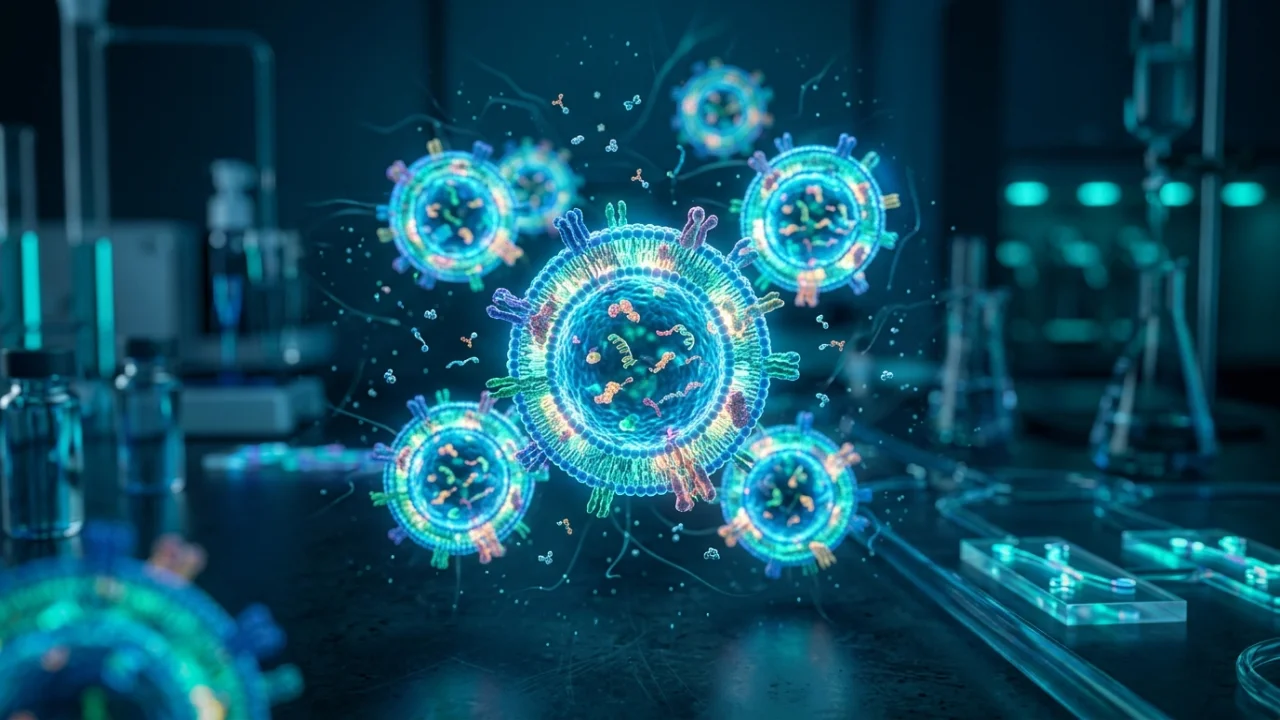
What Are Exosomes and Why Should You Care About Buying Them?
Understanding Exosomes: Tiny Messengers with Big Potential
Imagine your body’s cells are like a vast network of offices. They don’t send emails or letters. Instead, they send tiny, sealed packages. These packages are called exosomes. They are incredibly small. You could line up thousands of them across the width of a single human hair.
Cells create these vesicles inside themselves. They then release them into bodily fluids like blood or saliva. Each exosome carries a specific cargo from its parent cell. This cargo is a set of instructions and tools.
What’s inside? The load includes: – Proteins that can change how a cell works. – Lipids that help the exosome fuse with a target. – Most importantly, genetic material like RNA.
This RNA acts like a software update. When an exosome reaches another cell, it delivers its cargo. The receiving cell reads the new instructions. It may then change its behavior because of this message.
This process is a fundamental form of communication. It happens constantly in your body. Healthy cells use it to coordinate repairs. Stem cells send out exosomes to help heal damaged tissues. The potential here is enormous. Scientists believe we could harness these natural messengers.
The source of the exosome matters completely. An exosome from a young, healthy stem cell carries different information than one from a stressed or old cell. The “return address” defines the message. This is a critical point for anyone looking at exosomes for sale. You are essentially buying the biological output of a specific cell type.
Researchers are actively studying these vesicles for many applications. They look at skin health, muscle repair, and immune system modulation. The science moves quickly from labs to clinics. Understanding this basic biology is the first step in making a smart decision. Not all exosome products are equal. Their power comes directly from their origin and their precise cargo.
Now that you know what they are, the next question is about their creation. How are these complex messengers actually produced and collected for potential use?
The Growing Market for Exosomes for Sale
The scientific interest in exosomes has exploded. Published research papers on the topic have increased over tenfold in the last decade. This isn’t just academic curiosity. It translates directly into a growing commercial landscape. More clinics and suppliers now offer exosomes for sale. This growth comes from several key factors.
First, the promise of regenerative medicine is powerful. People seek new options for chronic issues. These include joint pain, stubborn wounds, and age-related tissue decline. Traditional drugs often manage symptoms. The idea of a cell-signaling therapy offers a different approach. It aims at supporting the body’s own repair systems.
Second, the technology to produce exosomes has improved. Scientists can now grow certain cell types in clean lab environments. These cells release exosomes into their nutrient solution. Better filtration methods then isolate the vesicles. This creates a more consistent product than early methods allowed. Increased production scale helps meet rising demand.
Third, patient awareness is higher. Stories about stem cells and regenerative therapies are common in media. Many people now ask their doctors about these advanced options. They are looking for the next generation of wellness and recovery tools. Exosomes are often presented as a refined version of earlier cell therapies.
This creates a complex market for buyers. You will find many sources offering exosomes for sale. The products differ greatly in their core details.
- Source Cell Type: Are they from mesenchymal stem cells, immune cells, or other origins?
- Production Method: How are the parent cells nurtured? What triggers exosome release?
- Purification Standard: How clean is the final liquid? What unwanted cell debris is removed?
- Cargo Profile: Is the RNA content tested and verified? This defines the biological message.
The market is not yet fully standardized. This means buyer knowledge is essential. Understanding why the market exists is your first layer of defense. It prepares you to ask the right questions next. You must look past the general promise and examine the specific product details. The following section will guide you through those critical evaluation steps.
Why You Need a Smart Buying Strategy
The biological activity of an exosome treatment depends entirely on its specific cargo. Think of cargo as the instruction manual inside the vesicle. Different source cells pack different instructions. Exosomes from young mesenchymal stem cells may carry signals for tissue repair. Exosomes from immune cells might carry signals to reduce inflammation. If you do not know the source, you cannot predict the effect.
This is why a smart buying strategy is non-negotiable. The field currently operates without universal production standards. Two vials both labeled exosomes for sale can be fundamentally different products. One might be a potent, purified concentrate. The other could be mostly cellular debris with few intact vesicles. Without careful evaluation, you cannot tell them apart.
A poor-quality product does more than just waste your money. It can pose real risks. First, it may simply do nothing. Your body clears the ineffective vesicles with no benefit. Second, impure preparations can trigger unwanted immune reactions. Contaminants from broken cells can cause inflammation. This is the opposite of the desired therapeutic goal.
Third, you miss a genuine opportunity. Using a weak product might lead you to conclude all exosome therapies are ineffective. You might abandon a promising pathway altogether. A strategic approach protects your investment and your health.
Your evaluation must focus on verifiable data, not just promises. Sellers should provide specific documentation. You need to ask for it. Key documents include a certificate of analysis from an independent lab. This report should list critical metrics.
- Particle Concentration: How many exosome-sized particles are in each milliliter?
- Protein Markers: Does testing confirm the presence of standard exosome surface proteins?
- Absence of Contaminants: Does the report show low levels of unwanted proteins from cell debris?
- Sterility Testing: Is the final product tested for bacteria, fungi, and endotoxins?
A reputable source will share this data willingly. If this information is hidden or unavailable, consider it a major warning sign. The price tag alone tells you very little. A high cost does not guarantee high quality. A surprisingly low cost often signals poor manufacturing or dilution.
Your strategy turns you from a passive buyer into an informed evaluator. You shift the question from “Are exosomes for sale?” to “Does this specific product meet rigorous quality benchmarks?” This mindset is your most important tool. It allows you to navigate the promising yet complex landscape with confidence. The next step is learning exactly which questions to ask and how to interpret the answers you receive.
How to Check the Source of Exosomes for Sale
Why Cellular Origin Matters for Quality
The cells that produce exosomes define their cargo and purpose. Think of exosomes as tiny cargo trucks. The factory that builds the truck decides what goes inside. A factory making delivery trucks will load different goods than one making ambulances. The same principle applies here. Different cell types create exosomes with different missions.
Mesenchymal stem cells (MSCs) are a common source for therapies. These cells are known for supporting repair. Their exosomes often carry signals that can calm inflammation. They may also encourage tissue regeneration. This makes them a target for many research applications. However, not all MSC sources are equal. Cells from umbilical cord tissue are not identical to those from adult fat tissue. Their age and tissue environment matter.
The health and state of the donor cells are critical. Stressed or aging cells release different exosomes. So do cells grown for many generations in a lab dish. Their biological messages can change. This is why the cultivation process is so important. Reputable producers use carefully controlled conditions. They monitor cell health closely to ensure consistency.
Some sources pose clear risks that buyers must understand. For example, exosomes derived from cancer cell lines are a major red flag for therapeutic use. Cancer cells communicate to promote their own survival and spread. Their exosomes can contain harmful signals. Using such a product could be dangerous. Always ask: “What is the exact original cell type?” A vague answer like “stem cells” is not sufficient.
When evaluating exosomes for sale, you must investigate the source. Here are key questions to ask any supplier.
- What is the specific donor cell type and tissue origin?
- How are the cells sourced and tested for purity?
- Are the cells used at a low passage number to ensure youthfulness?
- What quality controls verify the cells are not stressed or contaminated?
The answers form the foundation for everything else. A high-quality certificate of analysis means little if the starting material was flawed. The cellular origin dictates the possible benefits and rules out certain dangers. Your inquiry shifts from just checking a lab report to understanding the product’s biological blueprint. This knowledge lets you assess if a product’s proposed use matches its inherent design. Next, we will examine how manufacturing scale-up can alter quality, even from a good source.
Common Sources Used in Exosome Production
Several cell types are commonly used to create exosomes for sale. Each source has unique properties. These properties influence the exosomes’ potential effects. Understanding these differences is key for any buyer.
Mesenchymal stem cells, or MSCs, are a frequent choice. They come from tissues like bone marrow or fat. MSC exosomes often carry signals for repair and modulation. They can tell other cells to reduce inflammation. They can also encourage tissue healing. This makes them a focus for many therapeutic investigations. However, not all MSC sources are equal. Cells from umbilical cord tissue are generally younger than those from an adult donor.
Another major category is fibroblast exosomes. Fibroblasts are cells that build our skin’s support structure. Their exosomes are rich in proteins for collagen production and skin renewal. Many cosmetic or dermatological research products use this source. The messages inside often relate to skin structure and youthfulness.
Some producers use immune cells, like natural killer cells or macrophages. These exosomes can carry signals that alert the immune system. Their profile is very different from stem cell exosomes. They might be studied for approaches needing an immune response. The source cell’s function directly shapes the exosome cargo.
Even specific plant cells can be a source. For example, grape or aloe vera exosomes are explored in consumer wellness. Their biological messages are meant for plant cells. The effect on human cells is a distinct area of science. It is not the same as using human-derived exosomes.
The health of the donor matters greatly. Cells from a young, healthy donor are ideal. Cells should be screened for viruses and other contaminants. They should also be used at an early population doubling level. This means they have not divided too many times in the lab. Young cells tend to produce more consistent and potent exosomes.
The growth conditions change the final product. Stressed or crowded cells send different messages. Reputable producers keep cells in optimal nutrient media. They avoid conditions that trigger artificial stress responses. This ensures the exosomes carry the intended, natural signals.
You now know the common sources. You can better interpret a supplier’s information. A good supplier will clearly state the exact cell type. They will explain why that source fits the intended use. They will provide data on donor health and cell passage number.
This leads to the next critical point. Even with a perfect source, the collection method is vital. How exosomes are harvested and purified defines their purity and activity. The manufacturing process itself can preserve or destroy their delicate natural signals.
Red Flags in Source Documentation
A vague or missing cell source description is your first major warning sign. Suppliers should name the exact cell type. Avoid claims that only say “stem cell exosomes” or “plant exosomes.” This is too broad. Which stem cell? Mesenchymal? Adipose? What tissue did it come from? For plants, which species and which part? Specificity is non-negotiable. It shows the producer understands source dictates function.
Watch for missing donor health profiles. Reputable sources document donor age and screening. They test for viruses and other pathogens. Be wary if this data is absent or called “proprietary.” Ethical sourcing uses healthy, young donors. Cells from older donors or unhealthy conditions produce different exosomes. Their cargo may be less effective or even carry inflammatory signals.
A critical red flag is the use of immortalized cell lines. These are cells altered to divide forever in a lab. They are often derived from cancers. For example, HEK293 cells came from human embryonic kidney tissue. They were transformed with genetic material. These cells are useful for research. They are not ideal for therapeutic exosome production. Their endless growth can change exosome content unpredictably.
Be skeptical of extreme yield claims. A supplier might advertise incredibly high exosome numbers. Natural cells release exosomes in a biological range. A yield that seems too high may indicate artificial stimulation. Cells can be stressed chemically to release more vesicles. This process often damages the exosome quality. The messages inside become scrambled or harmful.
Check for clarity on cell passage number. This is how many times cells have divided in culture. Low passage numbers are best—typically under ten. High passage numbers mean aged, senescent cells. Their exosomes lose potency. They may promote aging signals instead of repair signals. Documentation should state this number clearly.
Here are key questions to ask when you see exosomes for sale:
- Can you provide the full characterization data for the parent cells?
- What tests confirm the absence of microbial contamination?
- Is there proof the cells were not stressed during growth?
- What is the exact protocol for triggering exosome release?
Unwillingness to share third-party assay results is a profound red flag. Internal data is not enough. Independent labs should verify purity, concentration, and surface markers. They should confirm the absence of contaminants like cell debris or proteins. Without this, you cannot trust what is in the vial.
Finally, avoid suppliers who make wild source comparisons. They might claim their plant exosomes act identically to human stem cell exosomes. The science does not support this. Different kingdoms of life communicate with fundamentally different molecular tools. Such claims reveal a disregard for basic biology and focus on marketing over substance.
Spotting these red flags protects your investment and safety. It moves you from a passive buyer to an informed evaluator. The next logical step examines what happens after collection. Even pristine exosomes from a perfect source can be ruined by poor handling and storage before they reach you.
Evaluating Manufacturing Methods for Exosomes
Key Steps in Exosome Isolation
Once cells release their exosomes into the nutrient broth, the real technical work begins. This fluid is a complex mixture. It contains leftover growth factors, free proteins, and cellular debris. The goal of isolation is to separate the tiny exosomes from everything else. This step is crucial. Poor isolation yields a dirty product. It can even damage the exosomes you want to keep.
The most common method is ultracentrifugation. This technique uses extremely high spinning speeds. A machine called an ultracentrifuge creates massive gravitational forces. These forces pull heavier particles to the bottom of a tube over many hours. Lighter exosomes gather in a pellet. The problem is sheer physical stress. The intense g-forces can crush exosome membranes. It can also co-pellet non-exosome contaminants that are a similar size. This method is traditional but harsh.
Many newer, gentler techniques now exist. They often use size or chemical properties for separation.
- Size-exclusion chromatography pushes the fluid through a column packed with porous beads. Smaller molecules get trapped in the bead pores and move slowly. Larger exosomes flow around the beads and exit the column first. This method is gentle and preserves exosome structure.
- Precipitation kits add a polymer to the fluid. This polymer changes the solubility of the exosomes. It makes them clump together and fall out of solution with low-speed spinning. While simple, this method often brings down extra proteins too.
- Immunoaffinity capture uses antibody-coated beads. The antibodies stick to specific proteins on the exosome surface. This pulls only targeted exosomes from the soup. It is highly specific but very expensive. It may also miss exosomes that lack that exact marker.
Each method has a trade-off between purity, yield, and cost. Ultracentrifugation gives high yield but lower purity. Chromatography offers high purity but can have lower yield. Precipitation is fast and easy but results in impurity. The best labs often combine two methods. They might use precipitation for a quick first step. Then they use size-exclusion for a final polish.
The isolation process directly impacts what you get when you see exosomes for sale. A supplier’s choice of method tells you about their priorities. A vendor using only basic precipitation may offer a cheaper product. That product likely contains many impurities. These impurities can cause immune reactions or cloud results. A supplier using tandem techniques invests in quality. They ensure you receive concentrated exosomes, not just cellular soup.
The final output is measured in two key ways. Concentration counts the number of exosome particles per milliliter. Purity checks how much of that volume is actually exosomes versus protein contaminants. A good report shows both numbers from an independent lab. After isolation, these fragile particles face one last hurdle. They must be stored correctly to remain active until use.
Why Purification Protocols Affect Purity
The isolation method collects exosomes from the growth medium. But the raw harvest is not ready for use. It contains leftover serum proteins, cell debris, and other non-exosome particles. Purification protocols clean this mixture. They separate true exosomes from this biological noise. This cleaning stage is critical for product quality.
Think of it like refining gold. Miners first extract ore from the earth. This is like isolating exosomes. The ore contains gold mixed with rock and dirt. Refiners then use processes to remove all impurities. They are left with pure gold. For exosomes, purification is this refining step. Without it, you have a crude mixture. This mixture can be ineffective or even unsafe.
Specific protocol choices create different purity levels. A common step is washing. The exosome pellet gets resuspended in a clean buffer. Then it undergoes ultracentrifugation again. This washes away soluble contaminants. Each wash cycle increases purity. It also reduces the final yield. Some particles are lost during handling.
Another key choice is filtration. Using filters with precise pore sizes removes particles larger than exosomes. It also removes smaller protein aggregates. Serial filtration through different sized pores can significantly clean a sample. But filters can clog. They can also shear and damage delicate exosome membranes if done too harshly.
The most advanced protocols use a polishing step. Size-exclusion chromatography is a prime example. The sample flows through a column packed with porous beads. Smaller proteins get trapped in the bead pores. They travel slowly. Larger exosomes flow around the beads faster. They elute first in a pure fraction. This step is gentle and effective. It is also time-consuming and adds cost.
Why does this matter for someone looking at exosomes for sale? The purification protocol dictates what is in the vial.
- A poorly purified product has high particle counts. Many of those particles are irrelevant proteins or debris. These contaminants provide no therapeutic benefit. They can trigger immune reactions.
- A highly purified product has a particle count that truly represents exosomes. The signal is clear. Research experiments yield reliable data. Clinical applications have predictable effects.
Suppliers often detail their full protocol from isolation through purification. Look for these steps. A product description mentioning only “ultracentrifugation” or “precipitation” likely skipped rigorous purification. A description listing “ultracentrifugation followed by size-exclusion chromatography” indicates a refined product. The difference is not minor. It defines the product’s fundamental utility.
In essence, purification transforms a crude extract into a defined biological tool. The protocol’s rigor directly correlates with the reliability of any results you will get. It is a core factor in evaluating any offer for exosomes for sale. After ensuring purity, the next vital consideration is how these clean particles are stored and tested before they reach you.
Storage and Handling Best Practices
Exosomes are fragile biological nanoparticles. They are not stable at room temperature. Their therapeutic potential depends on proper storage from the moment they are purified. This is a key factor often overlooked when evaluating offers for exosomes for sale. Think of them like fresh milk. Leave them out, and they spoil. The spoilage here is a loss of function.
The primary enemy is enzymatic degradation. Exosomes carry active proteins and RNA inside them. Without proper storage, these molecules break down. The lipid membrane itself can also fuse or rupture. This renders the exosomes useless for research or therapy. The goal is to pause all biological activity until the moment of use.
The universal standard for long-term storage is ultra-low temperature freezing. Liquid nitrogen vapor phase storage, at around -150°C, is the gold standard. It effectively stops all molecular motion and degradation. A standard -80°C freezer is also acceptable for many applications. Storage at -20°C is not sufficient for long-term preservation. It leads to gradual but significant loss of quality.
The freezing process itself requires care. Exosomes must be suspended in a suitable buffer solution. This buffer often includes cryoprotectants. These are substances like trehalose or human serum albumin. They prevent ice crystal formation during freezing. Ice crystals can physically pierce and destroy the exosome membranes. A slow, controlled freezing rate is also best practice.
Thawing is just as critical as freezing. The worst method is to leave a vial at room temperature. The best practice is rapid thawing in a 37°C water bath. This minimizes the time the exosomes spend in a partially thawed, unstable state. Once thawed, the exosomes should be used immediately. Avoid repeated freeze-thaw cycles at all costs. Each cycle degrades a portion of the particles.
Suppliers should provide clear handling documentation. Look for specific details on their labels and data sheets. – Storage temperature: It should be clearly stated (e.g., -80°C). – Buffer composition: Knowing the cryoprotectant used is a sign of expertise. – Shelf-life data: Reputable suppliers test their own products over time. – Thawing instructions: Specific guidance should be included.
If this information is absent, ask for it. A vague “store frozen” statement is inadequate. Proper handling continues during shipping. Exosomes shipped for use should travel on dry ice or in specialized cold-chain packaging. The temperature should be tracked and logged. Receiving a warm package means the product may already be compromised.
For the buyer, this means planning your workflow. Only order exosomes for sale when you are ready to use them. Have your -80°C freezer space prepared in advance. Understand your own thawing protocol before the vial arrives. The integrity of the product is a shared responsibility between supplier and end user.
In summary, rigorous purification can be undone by poor storage. The most defined exosome preparation loses its value if mishandled. Evaluating storage protocols is a non-negotiable part of the assessment process. It protects your investment and ensures your experimental or therapeutic outcomes are valid. After confirming stable storage, the final step is verifying what you actually received through rigorous quality control testing.
Reading Certificates of Analysis for Exosomes
What a Certificate of Analysis Should Include
A Certificate of Analysis is your proof of purchase. It is a document that proves what is inside the vial. It should come with every order of exosomes for sale. Without a detailed CoA, you are buying an unknown substance. The document bridges the supplier’s claims with your own quality check.
A proper CoA starts with clear identification. This seems basic but is often incomplete. You must see a unique batch or lot number. This number links the vial to specific production data. You also need the exact date of manufacture. Concentration is another critical line item. It should state the particle count per milliliter. Common units are particles/mL or micrograms of total protein per mL.
The heart of the CoA is the purity data. This shows how clean the preparation is. Look for a nanoparticle tracking analysis plot. This graph shows particle size distribution. A pure exosome sample will have a single, sharp peak. This peak should center around 80 to 150 nanometers. A broad or multiple peaks suggests contamination. The report should state the mean and mode particle size.
Another key metric is the ratio of particles to protein. This is a crucial purity test. It is often called the particle-to-protein ratio. Exosomes have a high ratio because they are vesicles, not just protein clumps. A low ratio signals leftover protein contaminants from the cell culture fluid. Reputable suppliers will publish this number openly.
The CoA must also confirm the presence of exosome markers. These are specific proteins on the exosome surface. Tests like flow cytometry or western blot can detect them. The document should list which markers were tested. Common positive markers include CD63, CD81, and TSG101. The CoA should also list negative markers. These are proteins that should *not* be there, like GM130. Their absence proves the exosomes are not from broken cell parts.
Safety testing is a non-negotiable section. It proves the product is safe for your use. You need to see results for endotoxin levels. Endotoxins are fever-causing contaminants from bacteria. The level must be very low, typically under 1 EU/mL. Sterility testing results are equally vital. This confirms no live bacteria or fungi are in the vial.
Finally, a robust CoA includes quality control images. These are visual proofs from electron microscopy. A Transmission Electron Microscope image shows the classic cup-shaped vesicles. This image confirms the size and structure seen in the size plot. It is a direct visual validation of the other data.
Always compare the CoA to the supplier’s product description. The data must match exactly. Discrepancies are a major red flag. A missing CoA is an immediate reason to avoid a supplier. This document is your primary tool for verification. It turns a claim into measurable evidence. Your next step is to consider independent testing to confirm these results for yourself.
How to Verify Purity Measurements
Purity is the most important number on a certificate of analysis. It tells you what you are actually buying. A high purity means you get mostly exosomes. Low purity means you get exosomes mixed with other junk. This junk includes proteins and fragments that do nothing. They can even cause side effects.
The standard measurement for purity is the particle-to-protein ratio. Think of it like this. Particles are the actual exosomes. Proteins are the contaminating debris. A high ratio is good. It means many particles for a small amount of protein trash. A low ratio is bad. It signals a dirty preparation.
You will see this ratio written as particles per microgram of protein. For example, it may look like 2.0 x 10^9 particles/µg. This is a scientific notation. It simply means two billion particles per microgram of protein. You do not need to calculate this yourself. The supplier must provide the final number.
What is a good ratio? There is no single universal standard yet. However, research-grade exosomes should typically exceed 1 x 10^9 particles/µg. Clinical-grade products aim much higher. They often target ratios above 3 x 10^9 particles/µg. Any ratio below 1 x 10^8 (one hundred million) suggests a major purity problem. Be very cautious.
Always check how the ratio was measured. The method matters. – Particle count usually comes from NTA (Nanoparticle Tracking Analysis). This method uses a laser to see and count particles in fluid. – Protein quantification often uses a colorimetric assay like BCA. This test turns a liquid blue based on protein amount.
These two different tests generate the final ratio. The CoA should state both methods used. If it does not, ask the supplier for this detail.
Why does purity matter so much? Impure exosome products are less effective. Contaminating proteins can trigger immune reactions. They can also block the exosomes from doing their job. Your target cells might ignore the therapeutic signal.
You must compare purity data between different lots from the same supplier. The numbers should be consistent. Large variations between batches are a warning sign. It shows poor manufacturing control.
Also compare purity between different suppliers offering exosomes for sale. This comparison is powerful. It shows you which companies have superior isolation technology. Do not just look at the total particle count alone. A huge particle number is meaningless if the protein contamination is also huge. The ratio reveals the truth.
Finally, understand what purity cannot tell you. A good ratio confirms a clean product. It does not confirm the exosomes are active or functional. That is a separate question about potency. Purity is about quality control first.
Verifying these measurements protects your investment. It ensures you receive a concentrated therapeutic agent, not diluted cellular soup. Your next logical step is to examine what those pure exosomes can actually do—their biological function and potency claims.
Understanding Concentration and Particle Count
The number of exosomes in a vial is called the particle count. This is a crucial number. You need to know how many therapeutic particles you are actually buying. Suppliers measure this in particles per milliliter (particles/mL). The count is often very large. It can range from billions to trillions of particles in a single batch.
Do not confuse particle count with protein concentration. They are different measurements. Purity is their ratio. The count tells you the quantity of vesicles. The protein amount tells you about contaminants. A trustworthy Certificate of Analysis will list both numbers clearly.
How do scientists count something so tiny? They use a machine called a nanoparticle tracking analyzer, or NTA. This instrument shines a laser into the liquid. Exosomes scatter the laser light as they move. The machine films this movement and counts the flashes of light. Software then calculates the concentration.
Another common method is tunable resistive pulse sensing, or TRPS. It measures particles one by one as they pass through a tiny pore. Each method has strengths and weaknesses. The CoA should state which technique was used. Reputable suppliers use NTA or TRPS, not just protein estimates.
When you see exosomes for sale, the particle count is a major factor in the price. Higher counts often cost more. But a high number alone does not mean a good product. You must check it against the purity ratio first. A high count with poor purity is a contaminated product.
You should also look at the size distribution graph. This graph usually comes with an NTA report. It shows the range of exosome sizes in your sample. Most exosomes are between 30 and 150 nanometers in diameter. That is about one thousand times smaller than a human hair.
The graph should show a single, clean peak. A messy graph with multiple peaks can signal problems. It might mean there are many protein aggregates or broken cell fragments present. These impurities are similar in size to exosomes but are not therapeutic.
Here is how to evaluate the particle count data on a CoA:
- Look for the measurement method (NTA, TRPS).
- Check that the number is clearly stated in particles/mL.
- Find the size distribution data and its average.
- Compare the count to the purity ratio you already calculated.
- See if the count matches the claimed volume of the vial.
For example, a vial listed as 1 mL with a count of 5e10 particles/mL contains 50 billion particles. The “e10” means “times ten to the tenth power.” This is scientific notation for large numbers.
Batch-to-batch consistency is vital here too. Particle counts should not vary wildly between lots from the same supplier. A stable count shows their manufacturing process is under control. It means you can rely on getting the same dose every time.
Finally, understand what particle count does not tell you. It confirms quantity, not quality or function. A vial can have trillions of perfectly counted, pure exosomes that are biologically inactive. The count ensures you have enough vehicles. The next step is verifying those vehicles carry the right cargo and can deliver their message to your cells effectively.
The Critical Role of Third-Party Lab Testing
Why Independent Testing Is Non-Negotiable
A supplier’s own lab report is not enough. You need proof from an outside lab. This independent testing is your final safety check. It confirms the product matches its description. Think of it like a home inspection before you buy a house. The seller says everything is fine. The inspector finds hidden problems.
Why is this step non-negotiable? The company selling the exosomes has a clear interest in positive results. Their internal quality control is important. But it is not impartial. Only a separate laboratory with no financial stake provides unbiased data. This lab acts as a neutral referee. Its sole job is to report facts.
For exosomes for sale, these facts cover three critical areas. First is safety. The test must confirm the product is sterile. It must show no harmful bacteria or fungi are present. It must also prove there are no dangerous endotoxins. These are toxic substances sometimes found in bacterial cells. Even tiny amounts can cause severe reactions.
Second is identity. The test verifies the particles are truly exosomes. It checks for specific protein markers on their surface. These markers are like a fingerprint. They distinguish exosomes from other similar-looking vesicles or plain debris. A good test also confirms the absence of markers from cell fragments or other contaminants.
Third is potency. This is more complex but vital. Potency testing asks if the exosomes can do their job. Do they carry the correct signaling molecules? Can they influence target cells as intended? A basic potency test might measure the activity of key enzymes inside the vesicles.
What should an independent test report include? Look for these items from the lab.
- The full name and accreditation of the testing laboratory.
- A clear sample identification number matching your vial.
- Methods used for each test, like LAL for endotoxins and flow cytometry for markers.
- Exact numerical results with pass/fail limits stated.
- The date of testing and a signature from the lab director.
Without this report, you are taking the supplier at their word. The risks are real. A product might have correct particle counts and good purity ratios on the company’s CoA. Yet an outside lab could find it fails sterility. It might be contaminated during final packaging. Or, the exosome markers could be weak. This suggests the vesicles are damaged or not what they claim to be.
Getting this data may require direct action. Ask the supplier for a recent Certificate of Analysis from an independent lab. Reputable sources will provide this willingly. They may even post these reports on their website for transparency. If a company hesitates or refuses, see it as a major warning sign. It calls all their other data into question.
This independent verification protects your investment and your safety. It moves you from hoping a product is good to knowing it has passed strict checks. It turns claims into evidence. Your final step is to look at this evidence and see how it aligns with the intended use for these exosomes. Function follows form and safety.
Essential Safety Tests for Exosomes
Independent lab testing must check for specific dangers. These tests confirm a product is safe for use. They look for harmful contaminants you cannot see. Think of these checks as a final security scan.
One critical test is for endotoxins. Endotoxins come from certain bacteria. Even if the bacteria are dead, these toxins remain. They can cause strong immune reactions. In a person, this might mean fever or inflammation. The standard test is called the LAL assay. It uses blood from horseshoe crabs. This test is very sensitive. It measures endotoxin levels in units called EU per milliliter. A safe limit is typically under a certain threshold for clinical use.
Another vital check is for sterility. This test looks for live bacteria or fungi. These microbes could grow during the manufacturing process. They might also enter during final vial filling. A sterile product shows no growth after days in a special culture medium. This is a pass-or-fail test. Failure here is a serious red flag.
Mycoplasma testing is equally important. Mycoplasmas are tiny bacteria. They lack a cell wall and can slip through some filters. They can contaminate cell cultures used to produce exosomes. Mycoplasma infection can alter cell behavior. This changes the exosomes they release. Testing often uses PCR methods to detect mycoplasma DNA.
The product must also be free from adventitious viruses. These are unwanted viruses that could infect the original cells. Tests screen for a panel of known viruses. Some labs use broad methods to detect unknown viral material. This ensures the exosome source was healthy.
Finally, a test checks for residual process reagents. These are chemicals used during production. Examples include purification polymers or cell culture additives. They should be removed in the final steps. Testing verifies their levels are safe and minimal.
These safety tests are non-negotiable for any exosomes intended for research or potential use. They protect you from invisible biological hazards. A trustworthy supplier will have this data from a third-party lab.
Always review the numerical results. Do not just look for a “pass” mark. See how far the results are from the failure limit. This shows the safety margin. Wide margins indicate robust manufacturing control.
Your safety depends on this evidence. Never assume purity based on appearance alone. A clear liquid can still harbor dangerous contaminants. Independent verification turns assumption into certainty.
The next logical step is to consider what’s inside the vesicles themselves. Safety confirms the package is clean. Then you must validate the cargo and the vessel’s integrity. Function depends on both form and purity.
How to Request and Review Lab Reports
You have the right to see proof before you consider any exosomes for sale. A supplier’s claims are not enough. Independent evidence is everything. Always ask for the Certificate of Analysis, or COA. This document holds the test results from a third-party lab.
Do not accept an in-house report. A separate lab conducted the testing. This removes bias. It confirms the data is real. The lab’s name and accreditation should be clear on the document.
Make your request specific and direct. A vague question may get a vague reply. Ask for the full COA for the exact product lot number you are reviewing. Here is a simple way to phrase your request.
- Please provide the third-party Certificate of Analysis for product lot [Lot Number].
- I need to see mycoplasma testing via PCR method.
- I need to see sterility testing results.
- I need to see endotoxin levels in EU/mL.
- I need to see viral safety testing data.
A reputable supplier will provide this quickly. Hesitation or refusal is a major warning sign. It suggests they have something to hide.
Now you must review the report. Do not just check for a “pass” mark. Look at the actual numbers. Compare them to the acceptance limits listed on the COA.
For example, an endotoxin limit might be less than 0.25 EU/mL. A result of 0.05 EU/mL is strong. It shows a wide safety margin. A result of 0.24 EU/mL is a technical pass. But it is very close to failure. This can indicate poor process control.
Check the dates. The testing date should be recent. It should also be after the manufacturing date of the product lot. This proves the tests were done on that specific batch.
Verify the lab’s information. Is it a known independent testing facility? You can often search the lab’s name online. Their reputation supports your confidence in the data.
Look for test method names. You might see “LAL” for endotoxin or “PCR” for mycoplasma. This tells you how the test was done. Standard methods are more reliable.
Understand what “ND” means. It stands for Not Detected. This is a good result for contaminants like mycoplasma. The report should state the test’s detection limit too. A lower limit is better.
Do not ignore small print or footnotes. They may contain important details about the testing conditions or limitations.
If a value seems high, ask about it. A good supplier can explain any anomaly. They might discuss natural batch variation or their validation process.
This review turns a document into a decision tool. The numbers tell a story about quality and care. They show whether the producer values safety as much as you do.
Your goal is to connect three things: the product vial, its lot number, and a valid COA from an external lab. These three items must align perfectly. This alignment is your primary shield against risk.
Without this step, you are trusting marketing over science. With it, you move from being a buyer to being a verifier. This critical habit protects your research and your resources.
The final proof lies not just in having data, but in understanding what it reveals about manufacturing consistency and purity standards for every batch offered for sale.
Navigating Regulations for Exosomes for Sale
Current Regulatory Frameworks Worldwide
The rules for selling exosome products are not the same everywhere. This is a crucial fact for any buyer. Different countries and regions classify these therapies in different ways. Your location determines what you can legally purchase and use.
In the United States, the Food and Drug Administration (FDA) holds clear authority. The FDA regulates exosomes as biological products or drugs. They are not approved as simple supplements. Any company claiming otherwise is misleading you. To be sold legally, an exosome therapy must have an approved Investigational New Drug application or market approval. Very few have this.
This means most offers for exosomes for sale directly to consumers are not compliant with FDA rules. The agency has issued warnings to many companies. They state that unapproved exosome products pose significant risks. The FDA actively monitors this space for violations.
The European Union follows a similar medicinal product pathway. Exosomes intended to treat or prevent disease are classified as advanced therapy medicinal products. This requires a centralized marketing authorization. The process is rigorous and lengthy. It demands extensive clinical data on safety and efficacy.
Other regions have evolving or less defined frameworks. For example: – In some countries, exosomes may fall under regulations for cell-based therapies. – Other nations might treat them as biological agents under general safety laws. – A few locations currently have minimal specific oversight, creating a buyer-beware environment.
This patchwork of rules creates complexity. A product marketed legally in one country may be illegal to import into another. You must understand the regulations in your own jurisdiction. Ignorance of the law is not a valid defense for purchasing unapproved biologics.
The core principle is that classification drives the requirements. If a product claim mentions treating a specific disease, regulators almost always view it as a drug. Drug approval requires proven clinical trials. This process takes years and major investment.
Therefore, when you see exosomes for sale, immediately question their regulatory status. Ask the supplier about their legal pathway to market in your region. A legitimate entity will provide a transparent, factual answer. A dubious one will evade or give vague claims about “research use only.”
Your prior step was verifying scientific quality with a COA. This step verifies legal legitimacy. One without the other represents incomplete due diligence. A high-quality product that is illegally sold still carries substantial legal and safety risks for you as the end user. Navigating this landscape carefully is non-negotiable for responsible sourcing.
Research-Grade vs. Clinical-Grade Exosomes
A critical label you will encounter is “research-grade.” This term has a specific meaning. It describes exosomes made for laboratory studies. They are tools for basic science. These products are not meant for human use. Their manufacturing follows different standards. The focus is on experimental consistency, not clinical safety.
In contrast, “clinical-grade” exosomes target therapeutic application. This classification demands rigorous protocols. Every step must ensure patient safety and product purity. The entire process occurs in specialized cleanrooms. These facilities control for airborne particles and microbes. Staff wear full protective suits. This environment prevents contamination.
The difference extends far beyond the lab environment. It covers the entire production chain.
- Source Material: Clinical-grade exosomes start from carefully screened donor cells. These cells undergo extensive testing for viruses and other pathogens. Research-grade materials may use standard, less-vetted cell lines.
- Production Process: Clinical manufacturing tracks every input. All growth media and reagents are certified for human use. Research processes often use standard lab-grade chemicals.
- Testing and Documentation: Clinical batches undergo strict purity and safety tests. Each batch links to a detailed record, a “batch record.” Research products typically come with a basic analysis certificate only.
- Regulatory Pathway: As noted earlier, clinical-grade products align with a drug development path. They aim for regulatory approval. Research-grade exosomes exist outside this medical framework.
Seeing exosomes for sale labeled “for research use only” is a major red flag for patients. This is not a loophole. It is a clear statement of intent from the supplier. They are legally stating the product is unsuitable for human therapy. Using it otherwise is unsafe and likely illegal.
The cost difference between these grades is significant. Clinical-grade production is vastly more expensive. This cost reflects the stringent controls involved. If a price seems surprisingly low for a “treatment,” question the grade. High-quality clinical production cannot be cheap.
Understanding this split helps you interpret supplier claims accurately. A company selling research exosomes cannot ethically suggest human benefits. A company developing clinical exosomes should openly discuss their regulatory status and trial phases. This distinction separates experimental tools from potential future medicines. Your next step is to examine what proof lies behind any therapeutic promise.
Legal Considerations for Buyers
Purchasing exosomes places you within a specific legal framework. This framework depends entirely on how you plan to use them. The law draws a bright line between research and human application. Crossing this line has serious consequences.
You are responsible for the final use of any product you buy. This is a key legal principle. Suppliers of research-grade materials state their intended use clearly. They do this to limit their own liability. If you use a research product on a person, you assume all legal risk. The supplier’s documentation protects them, not you.
Consider these common legal pitfalls:
- Practicing Medicine Without a License: Administering any biologic substance as a therapy typically requires a medical license. A patient cannot legally treat themselves with an unapproved biologic either. This is a criminal offense in many regions.
- Violating Drug Laws: Regulatory agencies like the FDA classify substances intended for disease treatment as drugs. An unapproved exosome product marketed or used as therapy is an unapproved new drug. Its distribution and use violate federal law.
- Product Liability: If harm occurs from an improperly used product, you could face a lawsuit. This is true even if you administered it to yourself. You might sue the supplier, but their “for research only” label is a strong defense. The legal blame would likely fall on you.
- Fraud and Misrepresentation: Clinics or individuals selling unproven exosome “treatments” may commit fraud. They make deceptive claims about safety and effects. Patients harmed in these schemes can pursue legal action.
When you see exosomes for sale, the listing itself offers legal clues. Advertisements using patient testimonials or disease claims suggest intended therapeutic use. This means the seller should hold an Investigational New Drug (IND) approval or similar authorization. If they lack this, their marketing is likely illegal. Simply relabeling a research vial does not change its legal status.
For legitimate researchers, the process is straightforward. You order exosomes characterized for your experiment. Your institutional review board approves your study protocol. Your use aligns with the supplier’s terms. Your liability is managed through standard lab insurance and ethical guidelines.
The legal landscape favors informed, cautious buyers. Your due diligence is a legal shield. Always verify a supplier’s regulatory standing. Ask for their IND number or equivalent if human use is implied. A legitimate clinical developer will provide this information transparently. If they hesitate or refuse, consider it a major warning sign.
Understanding these rules protects you from significant financial and legal harm. It also supports the legitimate development of exosome science. Responsible purchasing channels funding toward ethical research and proper clinical trials. Your next evaluation step is to scrutinize the scientific evidence behind any claims, which further informs your legal safety.
Identifying Reputable Suppliers of Exosomes
Traits of Trustworthy Exosome Providers
A trustworthy exosome provider operates with complete transparency. They do not hide their processes or their limitations. You should be able to easily find detailed information about their operations. This is your first and most important filter.
Start with their source material. A reliable supplier will clearly state what type of cells produce their exosomes. They will specify if the cells are mesenchymal stem cells, fibroblasts, or another type. They should also disclose the donor species, such as human or bovine. The cell culture conditions are equally vital. Providers should explain how they grow and maintain these cells. This includes the nutrients used and how they prevent contamination.
The methods for harvesting and purifying exosomes are critical. Reputable companies use and name established techniques. These often include ultracentrifugation, size-exclusion chromatography, or tangential flow filtration. They will explain why they chose their specific method. They also share data on the final product’s characteristics. This is known as characterization data.
You should expect to see a detailed analysis report for any batch of exosomes for sale. This report is like a fingerprint for the product. A credible provider will share this before a purchase. Key data points include: – Particle concentration, measured in particles per milliliter. – Particle size distribution, showing most vesicles are within the 30–150 nanometer range. – The presence of specific marker proteins like CD63, CD81, or TSG101. – Tests showing the absence of contaminants, such as endotoxin or foreign proteins.
Look for evidence of functional testing. Some providers go beyond simple characterization. They may conduct in vitro assays to show biological activity. An example is testing if the exosomes can reduce inflammation in a cell model. This data suggests a deeper investment in product quality.
Customer support for researchers is another strong signal. Trustworthy suppliers have knowledgeable scientific staff. They can answer technical questions about storage, handling, and experimental use. They provide clear protocols for reconstitution and application in experiments. They understand that your research success depends on their product’s consistency.
Finally, examine their stated intended use. Ethical providers are unequivocal about this. Their labels and documentation will state “For Research Use Only” or a similar phrase. They do not imply or suggest human therapeutic applications without proper regulatory approvals. Their marketing focuses on the science, not on patient outcomes.
These traits form a coherent picture of integrity. A supplier exhibiting these qualities invests in robust science, not just sales. Their transparency allows you to make a truly informed decision. This due diligence directly supports the reliability of your own experimental results. Your next step is to learn how to critically evaluate the scientific publications a supplier might use to support their claims.
Questions to Ask Before Buying Exosomes
Purchasing exosomes for your research is a significant investment. Your questions should be as precise as your experiments. Direct dialogue with a supplier reveals their transparency and expertise. Prepare these inquiries before you contact any company.
First, clarify the source and production method. The answer should be specific and scientific. – What is the exact cellular origin of the exosomes? Are they from mesenchymal stem cells, another cell type, or a conditioned medium? – How are the cells cultured? Ask about the passage number and media used. High-passage cells or serum-containing media can alter exosome quality. – What isolation method is used? Is it ultracentrifugation, size-exclusion chromatography, or a commercial kit? Each method has different purity trade-offs.
Next, demand detailed characterization data. A reputable supplier will have this ready. Do not accept vague promises. – Can you provide the full nanoparticle tracking analysis report? You need to see the particle size distribution and concentration graph yourself. – What specific surface markers are confirmed via western blot or flow cytometry? They should list proteins like CD63, CD81, or TSG101. – What tests prove the absence of contaminants? Request documentation for endotoxin levels and sterility testing.
Then, probe into batch consistency and stability. This is critical for repeating experiments. – What is the typical particle concentration variance between batches? A low variance percentage indicates tight control. – What is the recommended storage protocol? Ask about shelf life at -80°C and stability after thawing. – Do you provide a certificate of analysis with every vial? This document should list all key parameters for your specific batch.
Finally, address practical support and ethics. Their answers show their commitment to research integrity. – What technical support do you offer after the sale? Can you speak directly with a scientist about application protocols? – What is your stated intended use? The only acceptable answer for research-grade products is “For Research Use Only.” – Can you share any relevant in vitro functional data? Some suppliers test exosome effects on cell migration or inflammation.
Asking these questions separates serious suppliers from mere marketers. It shifts the dynamic from passive review to active partnership. A confident supplier will welcome this dialogue. Their detailed responses become part of your project’s foundational data. This proactive approach ensures your search for exosomes for sale leads to a reliable, high-quality research reagent. Your final step is to understand how to interpret the scientific studies often cited in this field.
Evaluating Supplier Transparency and Documentation
A supplier’s willingness to share detailed documents is a key sign of reliability. This transparency is your primary tool for verification. Do not accept vague promises or marketing claims. Insist on seeing the actual data. This process is essential when searching for exosomes for sale. You must examine the provided paperwork with a critical eye.
Start with the certificate of analysis, or CoA. This document is the fingerprint of your specific batch. A thorough CoA should list concrete measurements, not just pass/fail statements. Look for these exact numbers. – The exosome particle concentration, measured by a method like NTA. – The protein content of the preparation. – Specific levels of markers that confirm exosome identity, like CD63, CD81, or TSG101. – Measured endotoxin levels, which must be very low. – Results from sterility testing.
If any of these data points are missing, ask why. A generic CoA used for multiple batches is a red flag. Each batch should have its own unique certificate.
Next, review any available characterization data. Reputable suppliers invest in this science. They should provide electron microscopy images. These pictures show the classic cup-shaped vesicles. Ask for graphs from nanoparticle tracking analysis. These graphs show the size distribution of the particles. The peak should be in the proper exosome range, typically between 30 and 150 nanometers. A wide or irregular peak suggests impurities or poor isolation.
Also request proof of functionality if possible. Some suppliers conduct basic bioassays. They might test if their exosomes can reduce inflammation in cells. They might check if the vesicles improve cell migration in a scratch test. This data links physical purity to biological activity. It is a strong indicator of a quality-focused supplier.
Pay close attention to the stated intended use. The documentation must clearly say “For Research Use Only.” Any suggestion of clinical or therapeutic use for a research-grade product is a major warning sign. It shows a misunderstanding of regulations. It could even pose a legal risk to your work.
Finally, assess the clarity of the storage and handling instructions. These should be precise and easy to follow. They must include the validated shelf life. They should state how many freeze-thaw cycles are allowed. Good documentation often includes a detailed protocol for use.
Transparent documentation builds trust. It allows you to verify claims independently. It provides a baseline for your experiments. If your results are unexpected, you can check back against the supplier’s data. This records trail turns a simple purchase into a traceable scientific step. Your next task is to learn how to compare different suppliers based on this collected evidence.
Interpreting Technical Specs for Exosomes for Sale
Key Metrics in Exosome Specifications
This section will explain the specific numerical data points found in product specifications for exosomes for sale. It logically follows the prior discussion on documentation by diving into the actual metrics one must interpret within that documentation. The tone will be instructional and precise, translating technical jargon into plain, actionable insights.
A product specification sheet is your primary tool for comparison. It lists the key measurements of the exosome preparation. Think of it like a nutrition label for cells. It tells you what you are getting. You must understand each metric to make a smart choice.
First, look at the particle concentration. This number is often given as particles per milliliter. It might look like this: 2.0 x 10^10 particles/mL. This tells you how many extracellular vesicles are in the vial. A higher number means more vesicles per dose. But concentration alone is not enough. You need to know what those particles are.
Next, check the protein concentration. This is usually in micrograms per milliliter. This metric matters because exosomes carry proteins. However, free proteins and other contaminants also add to this number. A very high protein count relative to particle count can signal impurity. The ratio between these two numbers is critical.
The particle-to-protein ratio is a vital quality marker. Pure exosome preps have a high number of particles for each microgram of protein. A good research-grade sample often exceeds 1.0 x 10^9 particles per µg of protein. A low ratio suggests non-exosome material is present. This material could be protein aggregates or debris from broken cells.
You will also see details about size. The average diameter is given in nanometers. Remember, exosomes are typically between 30 and 150 nm. The sheet should also show the size distribution range. A narrow range centered around 90-120 nm is often a good sign. A very wide range might include larger vesicles or other particles.
Many suppliers now include data on surface markers. These are specific proteins on the exosome’s outer shell. The specs may list markers like CD63, CD81, or CD9. These are common tetraspanin proteins found on many exosomes. The presence of these markers helps confirm the vesicles are exosomes. The absence of certain markers is also important.
The sheet should note the absence of negative markers. These are proteins from cell structures you do not want. Calnexin is a common negative marker. It comes from the endoplasmic reticulum inside cells. Its presence suggests contamination with cellular debris, not clean exosomes.
Finally, review the storage buffer details. The exosomes are suspended in a specific solution. This information is crucial for your experiments. You need to know if the buffer contains bovine serum albumin or animal-derived products. This could interfere with certain assays or cell cultures.
Always cross-reference these specs with the characterization data you requested earlier. The numbers on the sheet should match the graphs from nanoparticle tracking analysis. They should align with the western blot images for markers. Consistent data across documents builds confidence in the product’s reliability.
Understanding these metrics lets you compare different offers for exosomes for sale on a factual basis. You move beyond marketing claims to hard numbers. This quantitative approach forms the foundation for a valid experimental result. Next, we will discuss how to evaluate the source of the exosomes and why it fundamentally shapes their potential activity.
How to Read Potency Assay Results
Potency assays measure what exosomes can actually do. They go beyond counting particles or checking protein markers. These tests show if the vesicles are biologically active. You need this data when evaluating offers for exosomes for sale. Without it, you might buy inert particles.
Think of it like testing a battery. You can measure its size and weight. But you must also check if it holds a charge. A potency assay checks the exosome’s “charge.”
Common tests measure a specific cellular response. The exosomes are added to target cells in culture. Scientists then look for clear changes. These changes should happen in a dose-dependent manner. This means a higher exosome dose creates a stronger response.
One standard test is the migration or scratch assay. It checks if exosomes help cells move to close a wound. Here is a simple process. – Researchers grow a monolayer of cells. – They create a scratch in this cell layer. – They add the exosome sample to the culture. – They monitor how quickly cells move to fill the gap over 24 or 48 hours. Active exosomes often speed up this healing.
Another key test measures cell proliferation. It answers a basic question. Do the exosomes make target cells multiply faster? Scientists often use dyes or biochemical markers. These tools quantify new DNA in growing cells. A positive result shows increased growth.
Angiogenesis assays are also important. They see if exosomes can stimulate new blood vessel formation. This is a critical function for wound healing therapies. Researchers may use tube formation models with endothelial cells. Potent exosomes will cause these cells to organize into network structures.
Always check the assay details provided by the supplier. The report should name the exact cell type used. It should state the measurement method. Reliable data includes clear control results. You need to see how untreated cells behaved in the same test.
Look for a dose-response curve graph. This plot is vital. It shows the response increasing with higher exosome amounts. It proves the activity is directly linked to the vesicles. A flat line suggests no real potency.
Be cautious of vague claims like “promotes regeneration.” Demand the specific assay data that supports such statements. For instance, “promotes regeneration” could be shown by a collagen production assay in fibroblasts.
Interpreting this data requires context. An exosome sample might score well in one assay but poorly in another. This is normal. Different exosome sources have diverse functions. Your choice depends on your own research goals. Match the proven potency to your intended application.
Finally, compare potency data between different product lots. Reputable suppliers show consistent activity from batch to batch. This consistency is a sign of a robust manufacturing process. It ensures your experiments are reproducible over time.
Understanding potency turns a product sheet into a promise of biological action. It completes the picture started by physical characterization. Next, we must consider how production scale and methods impact both these qualities.
Comparing Different Product Listings
When you look at multiple listings for exosomes for sale, the details can seem overwhelming. Direct comparison is your most powerful tool. Start by creating a simple table or checklist. Use the key parameters you now understand from previous sections.
Your comparison sheet should have clear columns. List the product name or catalog number. Include the source cell type. Note the stated concentration. Record the particle count method. Add the potency assay data provided. Finally, list the price per billion particles or per microgram of protein.
This structured approach reveals differences instantly. One supplier might offer a high particle count at a low price. Another may have a lower count but extensive potency data. Your goal is not to find the cheapest option. Your goal is to find the best value for your specific need.
Concentration units are a common point of confusion. Some products list particles per milliliter (particles/mL). Others use micrograms of total protein per milliliter (µg/mL). These are different measurements. You cannot compare them directly.
You must normalize the data to a common unit. Calculate the cost per billion particles. Or calculate the cost per microgram of protein. This step is crucial. It lets you see the real price difference between products.
For example, Product A costs $500 for 1e10 particles/mL. Product B costs $750 for 5e10 particles/mL. At first glance, Product A seems cheaper. But when you calculate, Product A costs $50 per billion particles. Product B costs $15 per billion particles. Product B offers more value.
Next, scrutinize the source information. A listing might just say “mesenchymal stem cells.” This is too vague. A better listing will specify “human umbilical cord-derived mesenchymal stem cells, passage 4.” This level of detail matters. It affects consistency and function.
Look for missing data. If a supplier omits the particle size distribution graph, ask why. If no potency data is listed, that is a major red flag. A complete technical sheet answers questions before you ask them.
Pay close attention to the formulation buffer. Exosomes are stored in a specific solution. Some use a simple phosphate-buffered saline. Others use a proprietary cocktail with stabilizers. The buffer can affect how you use the product in your experiments.
- Check for documentation on endotoxin levels.
- Look for sterility testing results.
- Verify the recommended storage temperature.
- Note the shelf-life or expiration date.
These quality controls are not optional. They are signs of professional manufacturing.
Finally, assess the supporting documentation beyond the spec sheet. Does the supplier provide a detailed certificate of analysis for each batch? Is there a full methods section available? Are there references to published studies using their exact product? This supporting evidence separates premium suppliers from the rest.
Do not make a decision based on one parameter alone. A high concentration is meaningless without proven activity. Strong potency data loses value if the particle count is inconsistent between batches. The best choice balances physical characterization, biological potency, and transparent quality controls.
Your comparison will highlight trade-offs. You may need to prioritize what matters most for your work. This disciplined evaluation turns a crowded market into a clear shortlist of viable candidates. The final step is understanding what happens after you place an order, from shipping logistics to post-purchase support.
Making Evidence-Based Decisions on Exosomes
Building a Checklist for Your Purchase
A clear checklist turns complex data into a clear choice. Your goal is to compare different offers of exosomes for sale on equal terms. Do not rely on memory or scattered notes. A standardized list ensures you assess every critical factor.
Start with the source and characterization data. Write down these key points.
- Cell type: What specific cells produced the exosomes?
- Passage number: Is it a low passage for consistency?
- Particle concentration: The number of exosomes per milliliter.
- Size distribution: The average and range of particle sizes.
- Purity markers: Which proteins confirm they are exosomes?
Record this data for each supplier you review. Place the numbers side by side. Gaps in this data are a major red flag.
Next, document the biological proof. This evidence shows the exosomes are functional. Your checklist must include potency assays.
Look for specific activity tests. For example, a supplier might show their exosomes increase collagen production in skin cells by 40%. Another may prove their product helps neurons grow new connections. This is not general science. It is proof for their exact product.
Note the exact assay and the reported result. If no biological data exists, the product is just particles in a bottle. Its effect is unknown.
Now move to quality and handling. This practical area protects your investment.
- Buffer composition: What is the liquid they are stored in?
- Endotoxin level: It should be very low, often under 1 EU/mL.
- Sterility testing: Was the batch tested for microbes?
- Storage temperature: Is it -80°C, -20°C, or 4°C?
- Shelf life: How long are they guaranteed to remain stable?
Logistics are part of your purchase. Add a section for delivery and support.
Check the shipping method. Exosomes usually require dry ice or special cold packs. Confirm the cost is included or separate. Ask about the typical delivery time. Find out their policy if a shipment arrives compromised.
Also note the documentation offered. A detailed Certificate of Analysis is essential. Some suppliers provide experimental protocols designed for their product. This support can save you weeks of optimization.
Finally, create a summary column on your checklist. Label it “Decision Factors.” Here, you will note your top priorities.
Maybe purity is your absolute requirement. Perhaps you need a specific potency assay proven in your field. Cost per billion particles might be your main limit. Write these priorities down before you compare.
Seeing all the data together reveals the best value. One option may have moderate potency but excellent characterization and support. Another might have strong data but very high endotoxin levels. Your checklist makes these trade-offs obvious.
This tool removes emotion from the process. You make a fact-based choice aligned with your research needs. The final step is initiating contact with the supplier to clarify any remaining questions before you commit.
Avoiding Common Pitfalls in Exosome Buying
Buying exosomes without a clear plan is a frequent and costly mistake. You must define your biological question first. Ask what you want the exosomes to do. Do you need them to reduce inflammation? Should they promote skin cell growth? Your goal dictates the required exosome source and quality. Purchasing based only on a low price or general description often leads to failed experiments.
A major pitfall is ignoring the cellular source. Exosomes from different cells carry distinct cargo. Mesenchymal stem cell exosomes may support tissue repair. Immune cell exosomes can regulate inflammation. Using the wrong source for your application wastes time and money. Always match the source to your desired biological effect. Do not assume all exosomes are the same.
Another error is focusing solely on particle count. A high number of particles seems good. But that count includes all vesicles, not just functional exosomes. A sample with many non-exosomal particles or debris has low purity. Its biological activity will be weak. Prioritize vendors that provide purity data alongside the count. Look for protein markers or electron microscopy images.
Many buyers overlook delivery logistics until it is too late. Exosomes are fragile. They require consistent ultra-cold temperatures. A supplier with poor packaging can ruin your product during shipping. Confirm their shipping protocol uses sufficient dry ice. Ensure they offer a guarantee for shipments that arrive thawed. Do not let logistics be an afterthought.
Beware of vague marketing claims. Phrases like “high potency” or “premium quality” are meaningless without data. Reputable suppliers will show specific assay results. They provide a detailed Certificate of Analysis for each batch. If this document is not available before purchase, consider it a red flag.
Avoid these common traps by sticking to your prepared checklist. Let evidence guide you, not promises. This careful approach protects your research investment and leads to reliable results. Your next step is knowing what questions to ask a supplier directly.
When to Walk Away from a Deal
A supplier’s unwillingness to share a detailed Certificate of Analysis before purchase is a major warning sign. This document is your proof of what you are buying. It should list specific test results. These include particle concentration, purity ratios, and key protein markers. If a seller hesitates or refuses to provide this, walk away. You are not buying a mystery solution. You are investing in a characterized biological tool.
Be very cautious of claims that sound too good to be true. They usually are. For instance, a vendor claiming their exosomes work for every single application is ignoring basic science. Exosomes from different sources have different functions. A product marketed for both brain repair and skin rejuvenation likely lacks focused evidence. Specificity is a hallmark of credible science. Vague universality is a hallmark of marketing hype.
Pay close attention to how they handle questions about source and manufacturing. Deflection is a red flag. – They cannot clearly explain the cell source. – They avoid details about how they culture the cells. – They are unclear about the purification method. These are foundational elements. A reputable scientist can explain their process in simple terms. Evasion suggests there is no rigorous process to explain.
A critical red flag is the lack of sterility or safety testing data. Exosomes for sale must be tested for endotoxins and mycoplasma. These are harmful contaminants. Their presence can ruin an experiment or pose a risk. The Certificate of Analysis must show these tests were done. It must confirm the product passed. If this data is absent, the product is not suitable for research. Using it could compromise your entire study.
Notice the pricing structure. Extremely low prices can indicate a serious compromise. High-quality production and testing are expensive processes. A price far below the market average often means corners were cut. Perhaps they skipped critical quality controls. Maybe they have low purity. Your research time and materials are valuable. A cheap product that fails is the most expensive option of all.
Finally, assess their post-sale support. A supplier who is only interested in the transaction is a poor partner. They should be willing to discuss your application. They should provide basic handling protocols. If they disappear after payment, you have no recourse if problems arise. Your due diligence includes evaluating the company behind the product. A legitimate partner in science supports their products. Recognizing these warning signs protects your project from costly failures. It directs your resources toward credible sources that value evidence as much as you do. This careful filtering is the final, critical step before making a contact and initiating a formal inquiry with a potential supplier.
Future Trends in the Exosome Market
Emerging Standards for Exosome Quality
The exosome field is moving fast. New standards are forming. These standards will change what you see when you look for exosomes for sale. They aim to make quality clear and comparable. This shift benefits everyone. It helps researchers trust their materials. It pushes the entire industry toward better science.
One major trend is the push for precise counting. Right now, methods vary widely. A supplier might measure total protein. Another might count particles. These different methods make comparisons hard. The future standard will likely require a dual measurement. Suppliers will need to report both the particle number and the protein amount. This gives a purity ratio. A high particle count with low protein suggests cleaner exosomes. This simple ratio will become a key quality marker.
Characterization is also getting deeper. A simple surface marker test may not be enough. Future reports may need to show a full molecular profile. This profile would list specific proteins and RNAs inside the vesicles. It proves the exosomes come from the claimed cell type. It also shows they have the expected biological activity. Think of it as a detailed ingredient list and potency assay combined.
Manufacturing consistency is another focus area. Early processes often had high batch-to-batch variation. Emerging standards demand process validation. This means a supplier must prove their method produces the same exosome profile every time. They must document every step. This includes cell culture conditions, collection timing, and purification steps. Consistent processes lead to reliable, reproducible research results.
Safety testing will expand beyond basic checks. Testing for endotoxins and mycoplasma is just the start. Future standards may require tests for replication-competent viruses. This is especially important for exosomes made from immortalized cell lines. Tests for specific contaminants of concern will become routine.
Finally, storage and handling guidelines will become standardized. Today, protocols differ. Some products ship frozen on dry ice. Others may be lyophilized. Future standards will define optimal storage conditions. They will set clear expiration dates based on stability data. This ensures the exosomes you receive still work as intended.
These emerging norms create a framework for trust. They move the market from a wild west to a more orderly landscape. For buyers, this means easier comparisons and fewer hidden risks. For serious suppliers, it is a roadmap for improvement. The entire field matures as these standards take hold. Your future purchasing decisions will be guided by clearer, stricter data. This progress turns a complex evaluation into a more straightforward verification of published facts. The next wave of innovation will build upon this reliable foundation.
How Technology Is Improving Exosome Analysis
New tools are making exosomes far easier to see and measure. This is a major shift. Just a few years ago, studying these tiny vesicles was incredibly difficult. Now, advanced instruments are becoming more common. They provide clear, digital data about any sample. This move from vague descriptions to precise numbers changes everything for buyers.
One key area is nanoparticle tracking. This technology lets scientists count individual exosomes. It also measures their size. You get a precise profile of the particles in a vial. This is crucial for comparing different products. A supplier can now show you a graph of their exosome size distribution. You can see if it matches what they claim. This data replaces vague promises with hard facts.
The analysis of exosome contents is also leaping forward. Techniques like proteomics and RNA sequencing are becoming faster and cheaper. They can list thousands of molecules inside exosomes. This creates a detailed molecular fingerprint. For researchers, this means you can verify an exosome’s source and potential function. You are not just buying a vague “stem cell exosome” product. You can check if it contains the specific growth factors or signaling molecules you need for your work.
These tools directly address a core challenge in finding exosomes for sale. How do you know what you are actually getting? Technology now provides answers.
- Advanced imaging can confirm exosome structure and purity.
- Digital PCR can quantify specific genetic materials with high accuracy.
- New flow cytometers are being designed to detect single exosomes.
This technological progress creates a new expectation. Reputable suppliers will increasingly provide this analytical data upfront. They will include certificates of analysis with specific numbers. You should look for details like particle concentration, a size range graph, and tests for key markers. This information turns a purchase from a gamble into an informed choice.
The overall effect is powerful. Better analysis tools raise the bar for quality. They make it harder for poor products to hide. They give buyers clear points for comparison. This pushes the entire market toward greater transparency and reliability. Your evaluation process becomes less about trusting claims and more about reviewing standardized data sheets.
Ultimately, these technologies are building the language for a smarter marketplace. They provide the common facts that everyone can use. The next logical step is understanding how this clearer picture influences real-world applications and therapeutic potential.
Staying Informed as the Field Evolves
The science behind exosomes is advancing rapidly. New discoveries happen every month. This means today’s understanding may be updated tomorrow. For anyone considering exosomes for sale, staying informed is not optional. It is a critical part of being a smart buyer.
Think of it like buying a computer. You would want to know about the latest processor. The same is true for exosome therapies. The “processor” here is the science of what exosomes carry and do.
Your goal is to follow the research, not just the products. This helps you ask better questions. It also helps you spot outdated claims from suppliers.
Start with trusted public sources. Major research universities often publish plain-language summaries of their work. Government health agencies release reports on new regulatory guidelines. These sources have no product to sell you. Their information is based on evidence.
Scientific journals are the primary source, but they can be complex. You do not need to read every paper. Instead, look for review articles. These papers summarize a whole year of discoveries in one place. They connect the dots between different studies.
You can set up simple alerts online. Use a search engine to track key terms. For example, set an alert for “exosome clinical trial” or “extracellular vesicle biomarkers.” You will get emails when new information is published. This takes just minutes to set up.
Attending conferences can be very useful. Many now offer virtual attendance options. Look for events focused on regenerative medicine or cell biology. The presentations highlight the most current trends. You hear directly from the leading scientists.
Be cautious about information from only one source. Especially if that source is also trying to sell you something. Cross-check any big claims against neutral science news outlets or public agency updates.
The field is moving toward more specific exosome types. Researchers are learning how to load exosomes with particular drugs. They are also learning how to target them to specific organs, like the liver or brain. Future options for exosomes for sale will reflect this precision.
Your own evaluation checklist should evolve too. As new quality tests become standard, expect them on data sheets. What was optional last year may be required next year.
Building this habit has a clear benefit. It turns you from a passive buyer into an engaged participant. You gain the context needed to judge real innovation against mere marketing. This knowledge directly protects your investment and informs your choices.
Ultimately, the market will mature through this informed demand. Your commitment to learning shapes the quality of products offered to everyone.
Your Action Plan for Buying Exosomes with Confidence
Summarizing Key Steps to Take Now
Your journey to find reliable exosomes for sale starts with a plan. A clear plan prevents confusion. It turns a complex process into manageable steps. Follow these key actions in order.
First, define your goal with absolute clarity. Are you seeking exosomes for a research project? Is the goal skin rejuvenation or joint support? Your specific aim dictates everything else. It determines the exosome source and the required purity. Write this goal down. Refer to it often.
Next, become a document detective. Any reputable provider will offer a detailed analysis sheet. Do not proceed without it. This sheet is your primary evidence. It should list three critical things. First, the particle concentration. This tells you how many exosomes are in each vial. Second, the protein markers that confirm they are exosomes. Look for CD63, CD81, or CD9. Third, tests showing what the exosomes do not contain. They must be free from harmful bacteria and viruses.
Then, investigate the source. Where do the exosomes come from? They are always released by living cells. The cell type matters greatly. Mesenchymal stem cells are a common source. Some companies use other cell lines. You must ask how the cells were grown. The cells should come from a certified lab. They must be free from animal products. This ensures safety and consistency.
Now, examine the collection and storage process. Exosomes are fragile. Their quality can degrade quickly. The provider must use gentle methods to collect them. They should also use ultra-cold freezing for storage. Ask about the shelf life. Reliable companies will give you a clear expiration date. The shipping method must keep them frozen solid.
Finally, prepare your questions for the seller. Do not be shy. You are making a serious investment. Ask for proof of their claims. Request data from independent labs. Inquire about their quality control for every batch. A trustworthy source will answer these questions readily. They will provide the data you need.
Here is your condensed checklist: – Define your specific biological target or research aim. – Obtain and review the Certificate of Analysis for every batch. – Verify the origin and cultivation of the parent cells. – Confirm the integrity of the purification and storage process. – Dialogue with the provider using informed, technical questions.
This structured approach removes guesswork. It shifts your role from a hopeful buyer to a qualified evaluator. You systematically assess the science behind the product. This method protects you from poor quality or exaggerated claims.
Confidence comes from preparation, not promises. By executing this plan, you build that confidence step by step. You ensure that your decision rests on solid evidence, not just marketing language. This leads you to products that are worth their cost and have real potential for your intended use.
The final step is to act on your gathered information. Compare your findings from different sources side by side. Make your choice based on the strongest objective data, not the most persuasive sales pitch. This disciplined process is your greatest tool in a promising but complex market.
Resources for Further Learning
Your evaluation plan is ready. Now you need a strong knowledge base. Informed questions come from independent learning. You are not limited to a seller’s website for information. Many excellent resources exist. These resources are free and open to the public. They let you verify facts for yourself.
Start with major public databases. Scientists upload data here daily. The Vesiclepedia database is one key example. It catalogs thousands of molecules found in vesicles. Another is ExoCarta. These sites show the complex cargo of exosomes. You can see proteins, lipids, and RNA lists. This helps you understand what a quality analysis should include.
Peer-reviewed journals are the gold standard. Look for “review articles” on exosome biology. Review articles summarize years of research. They explain core concepts clearly. Many journals offer plain-language summaries too. Trusted journal names include *Nature*, *Science*, and *Cell*. Their websites have search functions. Use search terms like “extracellular vesicle characterization” or “exosome isolation methods”. This research will clarify the technical standards you should look for when considering exosomes for sale.
Scientific societies are neutral guides. The International Society for Extracellular Vesicles (ISEV) is central. ISEV creates guidelines for the field. They publish position papers on best practices. These papers define terms like “minimal information for studies of extracellular vesicles”. This knowledge helps you judge a provider’s methods. You can ask if they follow ISEV guidelines.
Educational platforms from universities are also valuable. Many institutions host free seminar videos online. Experts explain their research in these talks. You can find them on university YouTube channels or course websites. Look for lectures from departments of cell biology or biomedical engineering. These presentations often use helpful graphics. They make complex processes easier to visualize.
Consider these types of reliable sources: – Public data repositories (e.g., Vesiclepedia). – Review articles in major scientific journals. – Guidelines from professional societies like ISEV. – Recorded academic lectures and seminars.
Avoid sources that only want to sell you something. Be cautious of websites with excessive marketing language. Reliable science focuses on methods and data, not just promises. Cross-check any surprising claim across multiple neutral sources. If only one company talks about a miracle cure, it is likely not real.
Your learning should focus on two main areas. First, learn the basic science of exosome biogenesis. Know how cells make and release these vesicles. Second, study the key methods for analysis. Understand techniques like nanoparticle tracking analysis and electron microscopy. Knowing these methods lets you review a Certificate of Analysis with confidence.
This independent study builds your expertise quietly. It turns complex science into clear understanding. You will begin to recognize strong data from weak data. You will identify the important details in a product sheet. This self-education supports every step of your action plan. It transforms you from a casual reader into a discerning client. The market becomes less confusing when you have your own reference library.
Now you have both a plan and the resources to fuel it. You can approach any product listing with a critical eye. Your next conversation with a provider will be grounded in facts, not just hope. This foundation is what separates a thoughtful investment from a simple purchase.
Final Thoughts on Smart Exosome Purchases
Making a smart purchase is the final step of your preparation. You have built your knowledge base carefully. Now you must apply it with decisive action. The market for exosomes for sale is dynamic and often confusing. Your personal framework cuts through that noise. It lets you focus on evidence, not excitement.
Think of your buying process as a scientific review. You are the principal investigator. The product data is your experimental result. Your job is to validate its quality. Start by requesting the essential documents from any provider. A serious supplier will provide them readily. If they hesitate, consider it a major warning sign.
The key documents you need are clear and standard. – A detailed Certificate of Analysis from an independent lab. – A thorough methods sheet explaining how the exosomes were made and tested. – Proof of purity, showing what is not in the vial. – Data on vesicle concentration and size distribution.
Cross-reference these documents with your own research. Do the methods match established scientific protocols? Does the concentration seem realistic for the source material? Are there tests for common contaminants like proteins or other particles? Your earlier study of techniques like nanoparticle tracking now pays direct dividends. You can read these reports with a critical eye.
Remember the source matters immensely. Different cell types create exosomes with different natural functions. Mesenchymal stem cell exosomes may support tissue repair. Immune cell exosomes might regulate inflammation. The source should match your intended goal. A provider should explain why their chosen source is scientifically logical for your application. Be wary of vague claims that one source works for everything.
Cost analysis requires a deeper look. The cheapest option often carries hidden expenses. It might mean lower purity, inconsistent batches, or a complete lack of support. The most expensive option is not automatically the best either. Evaluate cost per billion particles with verified purity. Consider the value of rigorous testing and reliable customer service. A transparent company will explain its pricing structure based on its complex production costs.
Ultimately, confidence comes from alignment. The right product aligns with your specific goals, your budget, and the current scientific understanding. It is supported by transparent data from a reputable source. Do not rush under pressure. A legitimate scientific provider will respect your due diligence process. They will answer your technical questions patiently.
Your journey transforms you from a passive buyer into an active participant in this field. You are not just purchasing a vial. You are making an informed choice based on evidence. This approach protects your investment and your expectations. It directs resources toward serious companies that advance real science. Move forward with the assurance that your careful work has built a solid foundation for success. The right choice is now clear.